


Arriving in Mexico City can feel intense, especially after a long international flight. Before you even clear customs, touts may whisper “taxi, taxi” and rideshare apps might not clearly show where your driver can pick you up. This guide walks you through exactly how to use authorized airport taxis at Mexico City International Airport safely and confidently, what you can expect to pay, how late-night arrivals work, and the most common scams to avoid.
Get the latest updates straight to your inbox!
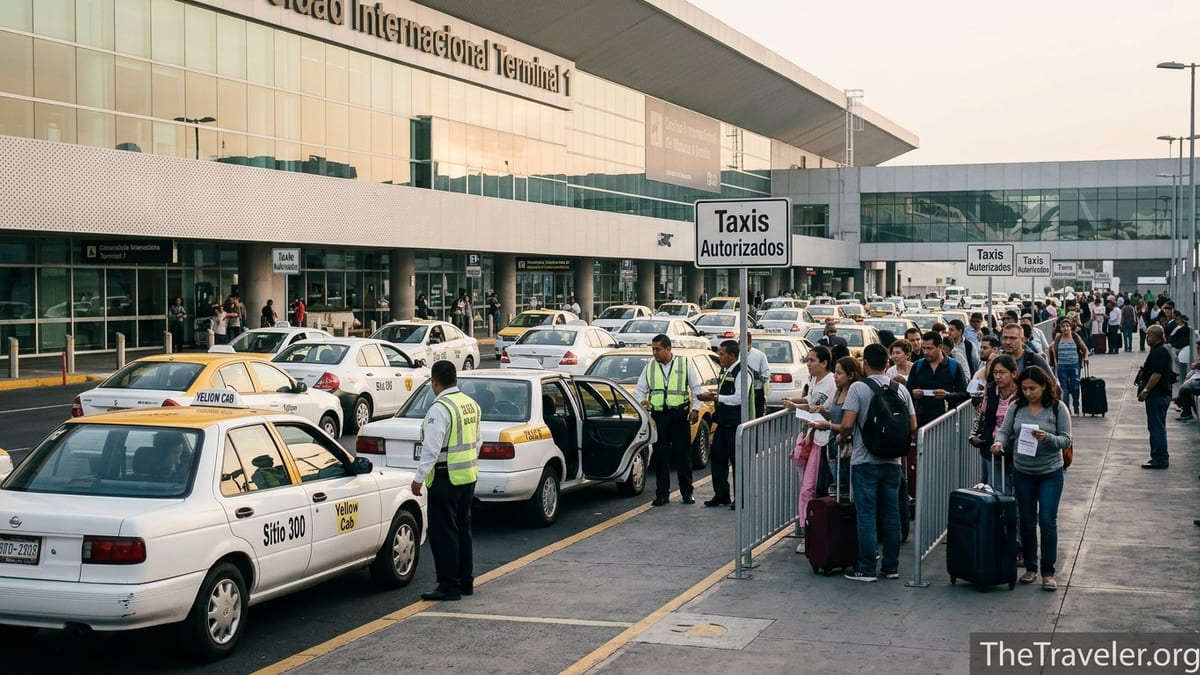
How Airport Taxis Work at Mexico City International Airport
Mexico City International Airport, often called AICM or Benito Juárez Airport, has two terminals: Terminal 1 (mainly legacy airlines and many domestic flights) and Terminal 2 (used largely by Aeroméxico and SkyTeam partners. In both terminals, the system for getting an official taxi is the same: you buy a prepaid ticket at an authorized taxi booth inside the terminal, then walk to the signed taxi ranks just outside the doors where the taxi companies line up to pick passengers up.
The airport’s “taxis autorizados” are strictly regulated and operate on fixed prices by zone, not by meter. You do not negotiate with the driver. Instead, you tell the booth agent your destination neighborhood or hotel, they check the zone, you pay at the counter, and you receive a printed ticket. Only after that do you head outside and hand the ticket to the dispatcher, who assigns you the next available cab.
These official airport taxis are sometimes called taxi de sitio or sitio taxis, and they are different from the pink-and-white city street taxis you might see elsewhere in Mexico City. Companies operating at the airport include well known brands such as Sitio 300, Nueva Imagen, Yellow Cab, Porto Taxi, Casadey, Prho Taxi and others, with boarding points around Doors 1, 9 and 10 in Terminal 1 and Doors 3 and 4 in Terminal 2. Their cars are usually white, yellow or a branded combination with clear company logos and airport authorization stickers on the windshield.
Because their fares are fixed, these taxis are more expensive than many city rideshare options, but they are widely regarded as one of the safest and simplest ways to leave the airport, especially if you are arriving for the first time, at night, or with heavy luggage.
Authorized Taxi Booths and Fixed-Zone Fares
The key to avoiding problems is to buy your ride only at an authorized taxi booth inside the terminal. After customs and baggage claim, as you walk toward the public arrivals hall you will see multiple counters with large signs for companies like “Sitio 300,” “Nueva Imagen,” “Yellow Cab” or generic wording such as “Transportación Terrestre” or “Taxis Autorizados.” Staff will usually wear branded shirts and work behind proper counters, not in the middle of the corridor.
Fares are based on zones that radiate out from the airport rather than on distance traveled on a meter. For example, in mid‑2026 a typical one-way sedan fare from the airport to central neighborhoods such as Centro Histórico, Roma Norte or Condesa often falls in a band roughly between 250 and 400 Mexican pesos depending on company, terminal and vehicle type. Trips to Polanco or Reforma business hotels may cost slightly more, and longer rides to southern districts such as Coyoacán, San Ángel or Pedregal can climb higher. Exact prices change periodically, but the zone chart is displayed at the booth so you can see the approximate cost before you pay.
You can usually choose between different categories of vehicles: a standard sedan, a larger minivan or SUV for families or large luggage, and sometimes executive cars. Expect to pay a premium of roughly 30 to 60 percent for a van compared with a regular sedan. For example, a couple heading to Condesa with carry-on bags might pay around 300 pesos with a standard taxi, while a family of five with checked luggage might be quoted closer to 450 to 550 pesos for a van to the same destination.
Most booths accept both cash and major credit or debit cards, although card terminals occasionally go offline. It is wise to have at least some pesos available so you are not forced to use a random ATM before you even leave the terminal. After payment, check that your ticket shows the company name, origin (Terminal 1 or Terminal 2), and your destination zone. Keep the receipt until you are safely at your hotel in case you need to contact the company about lost items.
Where to Find the Taxi Ranks in Terminals 1 and 2
Once you have your prepaid ticket, follow the signs for “Taxis Autorizados” or “Transportación Terrestre.” In Terminal 1, the main pick‑up points for authorized taxis are near Doors 1, 9 and 10 on the arrivals level. In Terminal 2, authorized taxis usually depart from the curb near Doors 3 and 4. There are clearly marked kiosks or small island stands outside where a dispatcher takes your ticket and directs you to a specific car.
As you exit the sliding doors, you may be approached by people asking where you are going or offering “taxi service” while walking alongside you. Some may say they can give you a “better price” than the booths. Ignore these offers politely and keep walking until you see uniformed dispatchers working at the official curbside taxi stations. Remember that if you have not yet paid at an indoor booth, you are not dealing with the airport’s regulated system.
The difference is easy to spot when you know what to look for. The official lines tend to be orderly, with several clearly branded vehicles waiting in a dedicated lane and staff with clipboards or handheld devices organizing passengers. Unofficial operators tend to linger just outside the doors or along the sidewalk, sometimes holding generic signs. If someone claims to be “from the booth” but asks you to pay in cash out at the curb, you can simply say you already have a ticket and proceed directly to the dispatcher.
If you are connecting between Terminal 1 and Terminal 2, you do not need a taxi at all. The airport runs a free airside train or shuttle bus depending on your airline and situation, and there is also a paid landside bus that runs between the terminals. Save your taxi ticket for your final exit from the airport toward your accommodation.
Safety: Why Authorized Taxis Are Recommended
Travel advisories from several governments and many seasoned travelers consistently recommend using only regulated airport taxis or reliable app-based services in Mexico City, and strongly discourage hailing random street cabs on the road outside the airport. The main concern is the higher risk of overcharging, robbery or express kidnapping when using unregistered vehicles that are not tied into any dispatch system.
Authorized airport taxis must be registered to operate in the federal zone of the airport and follow strict operating rules. Their plates, permits and drivers are recorded, and they are subject to periodic checks. That regulation does not make them perfect, but it significantly lowers the likelihood of serious problems compared with taking an unmarked car or a random city taxi waiting out on the main boulevard.
Real-world experience reflects this. Travelers who stick to booth taxis at AICM overwhelmingly report straightforward, if sometimes pricey, trips into town. Problems more often arise when passengers accept an unsolicited offer from someone in the arrivals hall or step into a cab that is loitering on a nearby side street rather than at the official ranks. In those cases, riders have reported tactics such as drivers “forgetting” to start the meter, claiming that traffic or tolls justify a much higher price than usual, or in rare but serious situations, diverting to unsafe ATMs to force cash withdrawals.
Inside Mexico City itself, taxi safety varies by type. Many residents and expatriates rely mainly on Uber, Didi or Cabify within town and avoid flagging street taxis unless they belong to a reputable sitio stand or are called by phone from a known base. But at the airport specifically, the formal prepaid taxi system is considered one of the safest options for travelers walking out of customs with luggage and jet lag.
Rideshare Apps, Late-Night Arrivals and Hotel Transfers
Mexico City has a strong rideshare culture, and apps like Uber, Didi and Cabify operate widely. However, as of mid‑2026, regulations and pressure from taxi unions still restrict app-based pickups directly at the airport’s arrival curbs. Officially, rideshare cars are not allowed to use the same pickup lanes as authorized taxis at AICM. In practice, many travelers use them by walking to a designated meeting point just outside the strict airport perimeter, such as a nearby pedestrian bridge, a gas station on the main boulevard, or the adjacent metro station area.
This workaround can be cheaper: in normal daytime traffic, an Uber from near the airport to Roma Norte or Condesa might cost around 120 to 200 pesos, sometimes less during off‑peak times, versus 250 to 400 pesos or more for an authorized airport taxi. However, the trade‑off is that you have to navigate outside with your bags, find the correct pickup spot, possibly cross large roads or busy sidewalks, and wait in an area that may feel chaotic, especially if you are unfamiliar with the city.
For late‑night arrivals after 22:00, early‑morning landings, or if you are traveling solo and tired, an authorized taxi or a pre‑arranged hotel or private transfer is usually the better option. Many larger hotels in Polanco, Reforma, Santa Fe and the historic center offer their own airport pick‑up services using vetted drivers. These services may cost similar to or slightly more than booth taxis but provide extra reassurance: the driver will be waiting with your name, you will know the vehicle details in advance, and communication can be handled through the hotel front desk.
If you do choose rideshare late at night, stay inside the terminal while arranging the ride on your app, confirm the driver’s name, license plate and car model, and walk straight to the meeting point without lingering. Avoid any driver who asks you to cancel your ride and pay in cash instead, or who suggests making large detours to “avoid traffic” when the streets are obviously quiet.
Common Taxi and Rideshare Scams to Avoid
Most trips from Mexico City airport end uneventfully, but a handful of recurring scams are worth knowing about so you can spot and avoid them. One common pattern involves fake taxi representatives standing just beyond customs, wearing generic badges or carrying clipboards. They may claim to represent the official taxi booths and offer to “help” you buy a ticket, only to walk you past the real counters to an unregulated operator. The price may be double the usual rate, or the driver may later claim that tolls or luggage were not included.
Another issue involves card payments. A minority of dishonest drivers or booth agents might pretend that the card terminal failed after you attempted to pay, ask you to try again, or suggest going to a nearby ATM once you are in the car. Later you discover multiple charges or an inflated amount on your card statement. You can reduce this risk by paying at the official booths inside the terminal, checking the amount carefully before tapping your card, and asking for a printed receipt. If a driver ever asks to “take” your card out of sight, refuse and insist on paying at a secure terminal or in cash.
There are also reported scams involving rideshare apps, such as drivers starting the trip before they reach you, then claiming you were a “no show” and charging a fee, or convincing passengers to cancel in‑app to avoid supposed airport controls and then demanding a much higher cash fare. In Mexico City, seasoned app users often cancel and rebook immediately if a driver makes unreasonable demands by message before pickup, and always keep communication inside the app so there is a record.
Overcharging through confusion is perhaps the most mundane but widespread issue. A tired traveler might be quoted “three hundred” at the curb without realizing the driver meant US dollars, or might accept a price that sounds normal in their home currency but is outrageous in pesos. To protect yourself, always confirm the currency clearly, know the approximate peso range for your route beforehand, and when using authorized taxis, rely on the booth’s printed tariff rather than any verbal quote from someone on the sidewalk.
Luggage, Tipping and Traveling with Families
One advantage of the booth taxi system is that it is designed for travelers with luggage. Sedans typically have room for two large checked bags plus carry‑ons, while vans can easily handle four or more suitcases, strollers and sports equipment. If you are a group of three or four adults each with full‑size checked luggage, it is often more comfortable and only modestly more expensive to book a van at the booth instead of trying to cram into a sedan.
Drivers generally load and unload bags from the trunk, though they may not always hop out to help as quickly as you might expect in some other countries. Tipping is not mandatory, but many visitors choose to round up or add around 10 percent for a smooth, helpful ride, especially if the driver assists with heavy luggage or navigates difficult traffic. For a 300‑peso fare, leaving 30 to 40 pesos in cash is considered polite but not excessive.
If you are traveling with young children, note that child car seats are not typically provided by airport taxis or rideshare drivers by default. Some private transfer companies can supply them if you arrange in advance, but you will usually pay extra. Many visiting families therefore bring their own lightweight travel car seat or rely on older children using the vehicle’s regular seat belts. Traffic can be heavy and driving styles assertive, so consider your comfort level and prepare accordingly.
For passengers with mobility challenges or large items like bikes, surfboards or musical instruments, it is worth showing a photo or explaining the size at the booth before paying so staff can recommend the most suitable vehicle type. If your item cannot fit safely inside even a van, arranging a specialized shuttle or cargo service ahead of time is a better solution than trying to improvise at the curb.
Staying Oriented: From the Airport to Popular Neighborhoods
Knowing roughly where you are headed makes it easier to judge whether your driver is taking a reasonable route. From the airport, many visitors go to well known areas such as the historic center (Centro Histórico), Roma and Condesa, Polanco, Juárez, Reforma, or Coyoacán. In normal traffic, a taxi ride to Centro Histórico can take around 20 to 40 minutes, while Roma and Condesa might be 30 to 45 minutes. Polanco is often 30 to 50 minutes, and Coyoacán may be 45 minutes or longer depending on congestion.
Traffic in Mexico City is unpredictable. At rush hour on weekday evenings, trips can easily take twice as long as they would late at night. Authorized taxis do not charge by time stuck in traffic, which is one advantage of the fixed‑zone system. Still, if your ride seems to be making large detours or circling aimlessly without clear reason, you can ask the driver how much longer they expect or show them a map on your phone with a suggested route.
Some visitors find it reassuring to share their live location with a friend or family member through a messaging app during the first taxi ride into the city. This is especially common for solo travelers arriving after dark. You can also note the taxi company name and vehicle number displayed inside the car or on the receipt and send that information to someone you trust.
Hotels in central neighborhoods are used to guests arriving by airport taxi at all hours. Front desk staff can confirm if the fare you paid sounds normal, and if you realize immediately that you have been overcharged or charged twice on your card, they can often help you contact the taxi company or your bank while you are still on site.
The Takeaway
Using taxis at Mexico City International Airport does not have to be stressful. The key decisions are straightforward: stick to the official booths inside the terminal, pay a fixed price by zone before you get into any car, and avoid accepting rides from people who approach you in the arrivals hall or on the sidewalk. Authorized taxis cost more than many rideshare options, but they offer a regulated, predictable way to reach your hotel, especially if it is late, you are traveling alone, or you are carrying a lot of luggage.
If you are comfortable using apps and willing to walk a bit outside the immediate airport perimeter, Uber, Didi and Cabify can be cheaper alternatives for daytime arrivals, provided you stay alert for drivers who suggest canceling in‑app or paying in cash. For maximum peace of mind, especially on a very late flight or a tight business schedule, arranging a private hotel transfer in advance can be a worthwhile extra expense.
Whichever option you choose, a bit of preparation goes a long way. Know the approximate peso cost to your neighborhood, keep your valuables in a small bag you can hold on your lap, and watch your payment receipts. Mexico City remains a complex but rewarding destination, and starting your visit with a safe, straightforward ride from the airport sets the tone for a much more relaxed stay.
FAQ
Q1. Are authorized airport taxis in Mexico City safe?
Authorized airport taxis are generally considered one of the safest options because they are registered, regulated and prepaid at official booths, which reduces the risks associated with random street cabs or unlicensed drivers.
Q2. How much should I expect to pay from the airport to Roma, Condesa or Centro Histórico?
Fares change over time, but many travelers currently pay roughly between 250 and 400 pesos for a standard sedan from the airport to central neighborhoods such as Roma, Condesa or the historic center, depending on the company, terminal and time of day.
Q3. Can I pay for my airport taxi by credit card?
Most official taxi booths inside the terminals accept major credit and debit cards as well as cash, although card terminals occasionally have technical issues, so it is wise to carry some pesos as a backup.
Q4. Where exactly do I find the authorized taxi booths?
After exiting customs and baggage claim in either terminal, walk into the public arrivals hall and look for counters clearly marked with names like Sitio 300, Nueva Imagen or Yellow Cab, or labeled as official “Transportación Terrestre” or “Taxis Autorizados,” then buy your ticket there before going outside.
Q5. Is Uber allowed to pick up passengers at Mexico City airport?
Rideshare apps such as Uber, Didi and Cabify operate in Mexico City, but due to airport and union rules they usually cannot pick up directly at the main arrival curbs, so many passengers walk to nearby meeting points just outside the strict airport zone to use them.
Q6. What should I do if someone in the terminal offers me a cheaper taxi than the booth?
Politely decline and continue to the official booths, as unsolicited offers inside or just outside the terminal are a common starting point for overcharging and other scams; only taxis paid and ticketed at the booths are part of the regulated airport system.
Q7. Do I need to tip taxi drivers from the airport?
Tipping is not obligatory, but rounding up or leaving around 10 percent is appreciated if the driver is courteous, helps with luggage or navigates heavy traffic calmly, so for a 300‑peso ride many travelers leave 30 to 40 pesos.
Q8. What if my flight arrives very late at night?
Authorized taxi counters and ranks operate around the clock, and they are usually the safest and simplest choice for late‑night arrivals; alternatively, some hotels and private transfer companies can arrange a driver to meet you in the arrivals hall if booked in advance.
Q9. How can I avoid taxi and rideshare scams at the airport?
Use only official booths inside the terminals, confirm the price and currency before paying, keep your receipt, avoid drivers who ask you to cancel app rides or pay in cash instead, and never hand your bank card to anyone who takes it out of your sight.
Q10. Is it better to prebook a private transfer instead of using airport taxis?
For many travelers, especially families, business travelers on tight schedules or those arriving alone at odd hours, a prebooked hotel or private transfer offers extra comfort and predictability, while solo travelers arriving in daytime often find authorized taxis or rideshare apps perfectly adequate.