


More news on this day
Continuing airspace instability in the wider Middle East is reshaping travel between the United Arab Emirates and Riyadh, as airlines adjust schedules, reroute services and rebalance capacity across key Gulf corridors.
Get the latest news straight to your inbox!
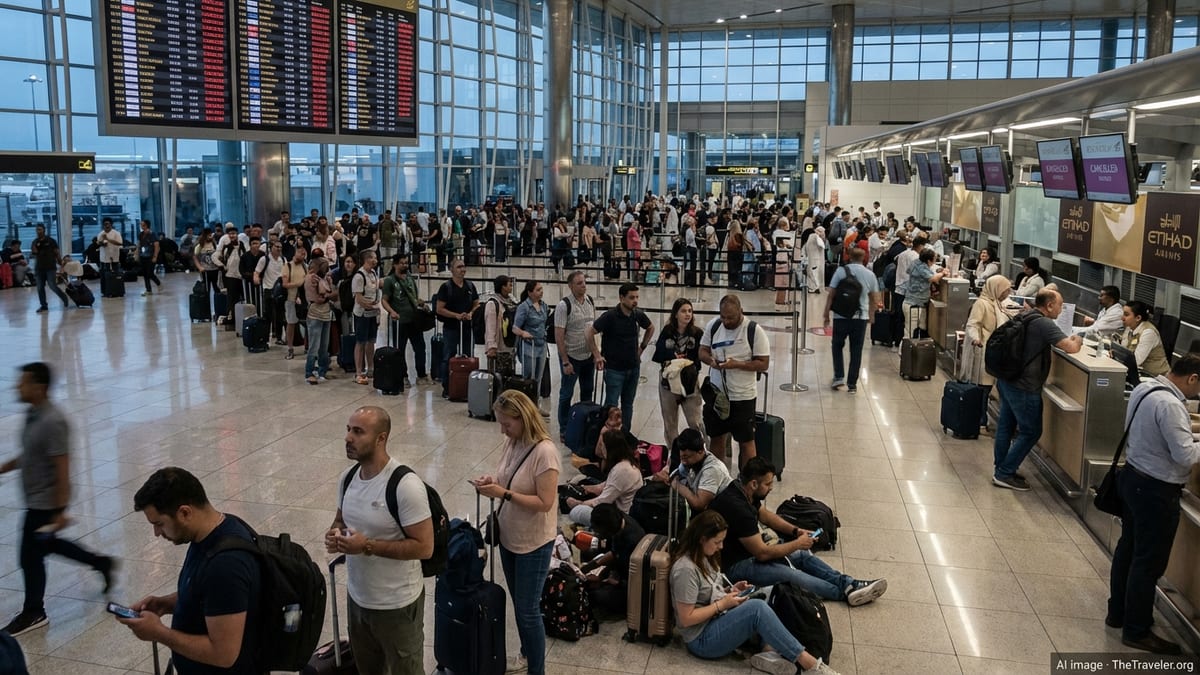
Regional conflict pushes structural schedule changes
Conflict-related airspace restrictions across parts of the Middle East since early 2026 have led to widespread cancellations and rerouting of flights, particularly on routes that traditionally relied on Gulf hubs. Industry analysis from the International Air Transport Association indicates that nearly four in five services between the region and Europe via Middle East hubs were cancelled at the height of the disruption, a level of impact previously seen only during the pandemic period.
Although major airports in the UAE and Saudi Arabia remain open and operational, published airline bulletins and operational updates show that many global carriers continue to impose selective suspensions or booking controls on Middle East routes, preferring to keep aircraft deployed on alternative long haul markets where networks have already been restructured. This has reduced some of the redundancy that previously helped absorb shocks on dense regional sectors such as those linking Dubai and Abu Dhabi with Riyadh.
According to recent operational briefings from global freight and travel management providers, airlines are still making frequent timetable adjustments on lanes touching Saudi Arabia and the UAE, with particular scrutiny on services to Riyadh and other Saudi gateways. While these changes are often announced at short notice, data published by network planners suggests that many carriers are now baking longer routings and extended block times into their schedules rather than relying on temporary workarounds.
UAE and Riyadh remain open but face knock on effects
Dubai International, Abu Dhabi’s Zayed International and Riyadh’s King Khalid International all remain open, and regional carriers based in the UAE and Saudi Arabia have largely maintained their scheduled operations to each other’s hubs. Publicly available airport and airline information shows that flights on core UAE–Riyadh city pairs continue to operate, even as wider Middle East networks remain constrained.
However, the knock on effects from broader Gulf disruptions are influencing how these routes function. Reports from logistics and travel tracking platforms describe selective cancellations to and from Riyadh and other Saudi cities by some foreign airlines, especially cargo operators, citing route specific restrictions and capacity bottlenecks. At the same time, advisories for the region highlight that operators must maintain detailed contingency planning when flying within the Emirates and Jeddah flight information regions, underlining the medium level security risk that still persists in parts of the Middle East airspace.
These dynamics have shifted more of the day to day burden of UAE–Riyadh connectivity onto Gulf based carriers and a smaller pool of international airlines that are still active on the corridor. Travelers who previously relied on a wide choice of one stop connections via European or Asian hubs to bridge UAE and Saudi cities are increasingly booking nonstop services, both for predictability and to reduce exposure to multi point itineraries that could be vulnerable to last minute changes.
Longer routings and higher costs ripple into UAE–Riyadh fares
Even when flights between the UAE and Riyadh operate as scheduled, altered routings around sensitive airspace and congestion in nearby flight information regions are feeding into travel times and pricing. Coverage from UAE based outlets earlier in 2026 documented how westbound flights from the Emirates to Europe and North America have been forced into longer southern or northern tracks to avoid higher risk areas, pushing up fuel burn and complicating crew scheduling.
More recent guidance for airlines from European and international regulators shows that while the broad conflict zone bulletins covering much of the Gulf have been scaled back, separate warnings remain in place for Iran, Iraq and Lebanon, with operators urged to exercise caution across Bahrain, the UAE and Saudi Arabia. In practice, that has kept many carriers on conservative routings that skirt these areas, adding minutes or even hours to some multi segment journeys that include UAE–Riyadh legs as part of a wider itinerary.
Travel management firms and cargo specialists report that these extended routings, combined with higher insurance and operating costs, are contributing to fare pressure across the Gulf. Passengers on UAE–Riyadh routes often compete for limited seats with long haul travelers repositioning through Dubai or Abu Dhabi, while freight operators juggling constrained bellyhold capacity can further tighten supply. The result is that even relatively short hops between the UAE and Riyadh may price higher than travelers were accustomed to before the 2026 disruptions.
Capacity rebalancing reshapes connection options
As the crisis has unfolded, a number of European and Asian airlines have redeployed aircraft from suspended Middle East routes to other markets, particularly transcontinental links that bypass the Gulf entirely. Travel industry coverage notes that once airlines commit additional capacity to these alternative routes, they are often reluctant to reverse the changes quickly, given the cost and complexity of another round of schedule upheaval.
This rebalancing has a direct effect on UAE–Riyadh travel. With fewer third country carriers operating into both the UAE and Saudi Arabia, there are reduced options for travelers who previously connected through neutral hubs such as Istanbul or key European gateways to move between Dubai, Abu Dhabi and Riyadh. Some airlines that once offered competitive one stop itineraries between UAE cities and Riyadh through European hubs have instead concentrated on point to point routes elsewhere, limiting indirect choices on the Gulf corridor.
Operational updates from major logistics providers illustrate how this tightening is playing out on the ground. They describe selective suspensions to Riyadh and restricted services to the UAE by some cargo carriers, as well as the introduction of temporary surcharges on airfreight lanes touching both countries. These measures signal that capacity constraints are likely to persist in the short term, even as overall airport operations in Dubai, Abu Dhabi and Riyadh remain stable.
What travelers between UAE and Riyadh should expect next
With conflict zone advisories evolving but not disappearing entirely, aviation risk assessment groups describe the current situation as one of residual but manageable risk across much of the Middle East and Persian Gulf. Saudi airspace is open and the Jeddah flight information region remains a key artery for rerouted Europe–Asia services, yet specialist airspace briefings underline that operators must closely monitor renewed tensions and periodic security incidents in southern parts of the country.
For travelers moving between the UAE and Riyadh, this means a market that is operational but less flexible than before. There is a greater reliance on nonstop services from Gulf carriers, fewer alternative connection options via third countries, and a heightened need to track schedule changes in the days leading up to departure. Travel advisories and airline notices consistently recommend that passengers verify flight status directly with their carrier and consider longer connection times if their UAE–Riyadh segment is embedded within a wider multi leg trip.
As airlines and regulators gradually refine routings and risk assessments, additional capacity could return to the corridor, particularly if tensions ease and conflict zone boundaries are narrowed further. For now, however, the UAE–Riyadh market reflects a broader regional pattern: routes are open, but they operate within tighter margins, with schedules, fares and network choices all shaped by a Middle East airspace map that remains in flux.
IATA: Global air traffic disruptions in strategic Middle East hub
EASA: Revised conflict zone advisories for Middle East and Persian Gulf
The National: Why flights from the UAE are taking longer and costing more