


More news on this day
Value Group will use the 27th Annual GHI Conference at Olympia London from 1 to 3 December 2026 to showcase its “Global Oversight, Local Action” model for managing airline disruption, highlighting how its RUBIK technology ecosystem, 24/7 Operations Control Center and global supplier network can link airlines and ground handlers in a more coordinated passenger recovery process.
Get the latest news straight to your inbox!
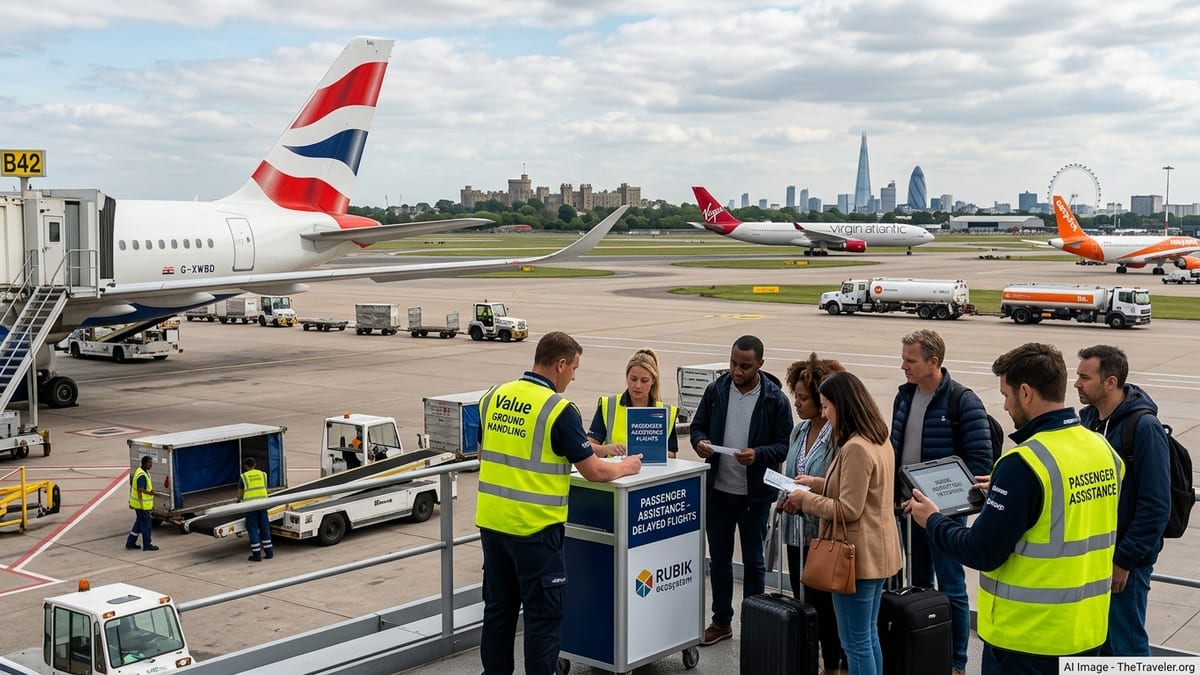
GHI London 2026 as a Platform for Disruption Management
The 27th Annual GHI Conference is scheduled to take place at Olympia London from 1 to 3 December 2026, bringing together airlines, ground handlers, airports, IT suppliers and equipment providers for what organisers describe as their flagship global gathering for the ground handling community. The London edition follows previous conferences that have drawn more than a thousand delegates and over a hundred airline representatives, and the 2026 programme again combines keynote panels, case studies and technical briefings on topics such as digitisation, ramp safety and changing passenger expectations.
For providers focused on irregular operations management, GHI London 2026 is positioned as a venue where operational decision makers and on-the-ground implementers meet in the same space. Ground Handling International promotes the event as a forum for benchmarking performance, reviewing regulatory developments and arranging structured one-to-one meetings between airlines, handlers and technology partners, alongside informal networking and side events that extend beyond the core conference hours. That mix of senior airline attendees and operational specialists from handling companies gives disruption management providers an opportunity to demonstrate concrete tools and processes rather than purely conceptual strategies.
Value Group is returning to the GHI Annual for the second consecutive year and plans to use its presence to outline how its model for disruption recovery fits into wider conversations about network reliability and cost control. The company is exhibiting and participating in discussions that focus on how airlines and their ground handling partners can reduce the operational and financial impact of disruption while maintaining passenger care standards across increasingly complex route networks.
Inside Value Group’s “Global Oversight, Local Action” Model
According to a Business Wire announcement published on 24 November 2026, Value Group describes itself as a provider of integrated aviation disruption management solutions and has framed its approach around the principle of “Global Oversight, Local Action.” At GHI London, the company intends to show how combining central governance with local execution can support a more consistent response when flights are delayed, cancelled or otherwise disrupted. The model is presented as a structured way to coordinate airlines, ground handlers and local service providers, rather than leaving each airport station to improvise in isolation.
The backbone of this approach is the integration of three core components: the RUBIK digital ecosystem, a global network of approved suppliers, and a 24/7 Operations Control Center staffed to monitor events and support local stations. RUBIK is positioned as a platform that automates key steps in the passenger recovery chain, including allocation of hotels and ground transport, coordination with accommodation and transport partners, and messaging to affected passengers. By centralising data and workflows, Value Group argues that airlines can gain clearer visibility of what is happening across their network during an irregular operations event, while handlers gain standardised, pre-agreed processes for serving disrupted travellers.
Value Group’s control center is intended to operate continuously, supporting stations in real time when disruption occurs overnight, across weekends or in locations where the airline has limited local staff. The company states that it uses this central hub to monitor foreseeable disruption risks, such as adverse weather or air traffic control restrictions, and to pre-alert suppliers and prepare operational resources when such events are likely to occur. Its supplier network, which covers accommodation, transport and other passenger services in multiple markets, is presented as a means to avoid ad hoc sourcing at the moment of disruption, when local capacities can be tight and prices volatile.
The Role of Ground Handlers in an Integrated IROPS Framework
In its pre-conference communications, including an interview with an aviation trade publication on 24 November 2026, Value Group has emphasised that ground handlers are central to making an integrated disruption management approach work, because they are the parties that face passengers at the airport when irregular operations unfold. While airlines typically retain responsibility for setting policy and covering the cost of passenger care, handlers are often the ones who must arrange hotels, transport, meal vouchers and communication at short notice. This is particularly the case when the operating carrier has limited or no own staff at a given station and relies on contracted handlers for passenger services.
By positioning handlers as strategic partners rather than purely as service providers, Value Group argues that recovery processes can become more predictable and scalable. Within the “Global Oversight, Local Action” framework, handlers use RUBIK and associated tools to execute predefined policies, connecting into the same disruption management environment that the airline’s network operations and customer care teams see centrally. The intent is that information about available hotel rooms, ground transport capacity and special assistance requirements is shared across all involved parties, reducing the need for repeated manual updates via email or phone.
The company has also underlined that ground handlers may be able to expand the value they offer airline customers by participating in such integrated models. Where handlers can demonstrate the ability to manage passenger recovery within a coordinated framework, they may differentiate themselves in contract negotiations and service-level discussions. However, the effectiveness of this approach depends on clear commercial agreements, shared performance metrics and reliable integration between handler systems and the RUBIK ecosystem, aspects that Value Group will be discussing with partners and prospects during the London conference.
Technology, Human Support and Passenger Experience
Value Group’s strategy places significant emphasis on the combination of technology with human assistance. The company’s materials describe RUBIK as enabling digital self-handling for passengers who are able to manage their own recovery, for example by accepting a rebooking, choosing from available hotel options or arranging ground transport through automated interfaces. In parallel, the company’s own operational staff, ground handler teams and a service referred to as RUBIK GO are tasked with supporting more complex cases and passengers requiring in-person or personalised assistance.
This layering of self-service and supported channels mirrors wider developments in travel disruption management, where providers are trying to free up human agents to focus on the highest impact and most vulnerable cases. During major events such as severe weather systems, business travel platforms and airlines have reported large spikes in customer contacts as travellers seek to understand their options and secure overnight arrangements. In that context, Value Group’s proposition is that automating routine disruption responses can reduce manual workloads and leave more resources to deal with families, unaccompanied minors, passengers with reduced mobility and others whose needs cannot be met solely through digital tools.
The company’s recent coverage in industry media highlights how disruption management is no longer seen only as a cost or regulatory obligation, but also as a factor influencing customer satisfaction and loyalty. Some profiles of Value Group note that its in-person assistance teams operate at major European hubs, supporting airlines in converting difficult disruption scenarios into opportunities to maintain or restore trust. However, the scale and geographical reach of such teams, and how quickly they can be deployed in new locations, remain important practical questions for airlines assessing the service. These operational details are expected to be a focus of discussions between Value Group and potential clients on the sidelines of GHI London 2026.
What Airlines and Handlers Should Watch for After GHI London
GHI London 2026 takes place from 1 to 3 December, and Value Group’s participation at this point is focused on presenting its model, holding meetings and demonstrating its technology ecosystem rather than announcing a specific new product launch or partnership. The company has signalled that it will continue to invest in greater automation and more personalised disruption responses through 2027, as well as expanding its international presence, but has not publicly specified particular markets or airline customers associated with that growth. Any concrete new contracts, deployments or technical integrations emerging from the conference are likely to be announced separately by Value Group or its partners after commercial agreements are finalised.
For airline and ground handling stakeholders attending GHI, the immediate next step is to evaluate how an integrated disruption management framework such as the one presented by Value Group fits with their current operational and commercial structures. Key considerations include whether existing passenger care processes are fragmented between departments or suppliers, the level of visibility that network operations teams have into station-level disruption responses, and how easily new digital tools can be integrated into legacy systems and contractual arrangements. Carriers and handlers will also need to examine how roles and responsibilities are divided during irregular operations, particularly in outstations where multiple airlines share a single handling company.
From a traveller’s perspective, any operational changes prompted by conversations at GHI London will take time to implement and will not be immediately visible during the conference itself. Passengers affected by disruption in late 2026 and early 2027 should continue to check the latest information directly with their airline, including rebooking options, compensation policies where applicable and the channels available for arranging accommodation and onward transport. As airlines and ground handlers adopt more integrated disruption management solutions over the coming years, travellers may see more consistent communication and a wider use of digital self-service tools, but the timing and extent of those changes will vary from carrier to carrier and station to station.