


More news on this day
Delta Air Lines passengers across the United States faced significant disruptions on November 22 after a malfunction in the carrier’s weight and balance automation system caused long delays and some cancellations at its largest hub, Hartsfield-Jackson Atlanta International Airport, and on flights nationwide, complicating travel at the start of the busy Thanksgiving week.
Get the latest news straight to your inbox!
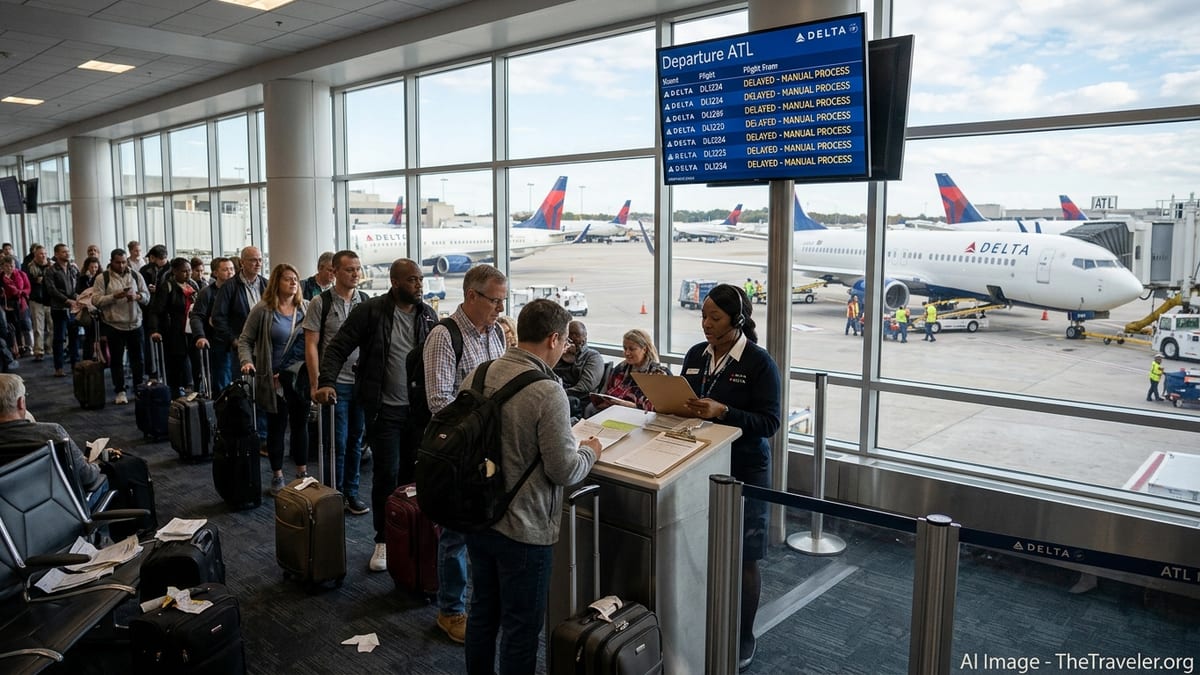
What happened to Delta’s automation system in Atlanta
On Sunday 22 November 2026, Delta reported a problem with the automated system it uses to calculate aircraft weight and balance data before departure. The outage affected flights at Hartsfield-Jackson Atlanta International Airport, the airline’s primary hub, and services across the network that rely on the same platform. The carrier confirmed that departures were delayed while teams reverted to manual workarounds to generate legally required performance numbers for each flight.
Weight and balance calculations determine how cargo, baggage, fuel and passengers are distributed on an aircraft and what thrust and flap settings crews must use for safe takeoff. Although airlines can perform these checks manually, the process is slower and more labor-intensive than automated dispatch tools. Delta emphasized that flights would not depart without accurate data, which contributed to longer ground times for many departures as staff completed the checks by hand and relayed information between dispatchers and flight crews.
According to multiple airline statements and flight-tracking data, the initial disruption was concentrated on Sunday morning and midday in Atlanta, where large numbers of Delta departures were held at gates or on the tarmac waiting for paperwork. The Federal Aviation Administration briefly ordered a ground stop for Delta flights bound for Atlanta, later easing this to a ground delay program once the airline began moving aircraft again using manual procedures.
Scale of delays and impact on travelers
By Sunday evening, flight-tracking service FlightAware reported that about 58 percent of Delta’s schedule had been delayed, equivalent to roughly 2,000 flights worldwide that day. The airline said approximately 70 percent of those delays and cancellations were attributable to the automation problem, with the remainder linked to weather and other operational factors. While the disruption was most visible in Atlanta, delays and some cancellations were recorded throughout Delta’s domestic network as aircraft and crews fell out of position.
At Hartsfield-Jackson, one of the world’s busiest airports, the effect was particularly noticeable. Local news outlets reported more than 700 Delta flights delayed out of Atlanta over the course of Sunday, with knock-on effects for connecting passengers. Some travelers reported spending several hours on board aircraft waiting for clearance to depart, while others described long lines at customer service desks as they sought rebooking options or overnight accommodation when flights were canceled or misconnected.
The outage followed closely on the heels of a nationwide Federal Aviation Administration communications problem and a separate United Airlines system failure earlier in the month, meaning some passengers had already experienced recent disruptions. For travelers who had chosen Atlanta as a connecting hub at the start of the Thanksgiving travel period, the timing meant fuller flights and fewer available seats for same-day rebooking, particularly on popular leisure routes.
Operational recovery and current status
Delta said on Sunday evening that the programming for its weight and balance calculations had been restored and that the automation system was back online. The carrier apologized to customers impacted by the disruption and stated that its teams had used manual processes during the day to keep flights operating where possible until the system could be fully reinstated. By Monday 23 November, local reports from Atlanta indicated that operations were largely stable, with only minimal delays attributed directly to the earlier outage.
Even after the technical issue was resolved, the airline continued to work through residual disruption as aircraft and crews returned to their scheduled positions. Delta’s Monday performance showed a significantly lower level of delays than on Sunday, although some passengers still encountered late departures that the airline linked to the need to clear backlogs and reposition resources following the outage.
Regulators have not indicated that the failure involved broader air traffic control systems, and there is no evidence that the issue compromised flight safety beyond requiring more time to complete pre-departure checks. The FAA’s brief ground stop and subsequent ground delay program were targeted measures to manage congestion at Atlanta during the height of the disruption. As of Tuesday 24 November, flights into and out of Hartsfield-Jackson on Delta were operating close to normal, with the weight-and-balance automation system reported as fully restored.
How this fits into a month of tech-related air travel disruptions
The Delta incident is the latest in a series of technology-related problems affecting U.S. air travel in November 2026. In the days before the Atlanta outage, a nationwide FAA communications issue prompted a rare ground stop for all U.S. flights, while United Airlines experienced its own system outage that forced a temporary halt to departures. Those events, combined with a widely reported global technology provider outage, have focused attention on the resilience of aviation IT infrastructure as passenger volumes climb.
Delta’s weight and balance glitch differed from the earlier FAA ground stop in that it was confined to a single carrier’s systems rather than the national air traffic network. However, Atlanta’s central role in Delta’s route map meant the ripple effects were felt across the airline’s domestic operation. The incident highlighted how closely airline schedules, crew rotations and aircraft utilization depend on the smooth functioning of behind-the-scenes automation tools, even when pilots retain the ability to operate with manual procedures.
The timing has also sharpened traveler sensitivity to technology failures. The Transportation Security Administration and major airlines, including Delta, have projected that Thanksgiving 2026 will see some of the heaviest holiday air travel since before the pandemic. Against that backdrop, another high-profile system problem, even one resolved within a day, can quickly translate into crowded terminals, limited rebooking options and uncertainty for passengers trying to reach family gatherings or vacation destinations on fixed dates.
What Delta passengers should check if they are traveling this week
For travelers booked on Delta in the days following the November 22 outage, the airline’s schedules are currently operating close to normal levels, but some residual disruptions may still appear on specific routes as aircraft and crews fully return to their regular rotations. Passengers with upcoming trips, especially those connecting through Atlanta, should monitor their flight status directly through Delta’s app or website on the day of travel, as this will reflect any timing adjustments or gate changes more quickly than airport departure boards alone.
Customers whose journeys were disrupted on Sunday or Monday may be eligible for fee-free changes or other forms of assistance, depending on Delta’s policies and the specifics of their itineraries. The airline has not publicly announced a broad compensation program but has indicated that it is working with affected passengers on a case-by-case basis. Travelers who experienced lengthy delays or cancellations should retain boarding passes, receipts and records of schedule changes in case they need to request relief such as travel credits or reimbursement for reasonable overnight expenses.
Looking ahead to the rest of Thanksgiving week, the key uncertainty for Delta passengers will be overall system congestion rather than the specific automation glitch, which the airline and local authorities say has been fixed. With high load factors expected across many routes, options for same-day rebooking may be limited if new weather or operational issues arise. Travelers may wish to allow additional time for connections, particularly at major hubs like Atlanta, and to confirm any tight onward plans, such as rail or hotel reservations, in case of knock-on delays. While Sunday’s outage appears to have been contained to a single day from a technical standpoint, its timing at the start of one of the year’s busiest travel periods means passengers should remain prepared for fuller flights and busy terminals across the network.