


More news on this day
Delta Air Lines says its automated system for calculating aircraft weight and balance is back online after a technical failure on Sunday, November 22, 2026, triggered widespread delays centered on Hartsfield-Jackson Atlanta International Airport just as the busy U.S. Thanksgiving travel period began.
Get the latest news straight to your inbox!
What happened to Delta’s system on Sunday
According to the airline and airport officials, the disruption began on Sunday morning, November 22, when Delta’s Automated Load Instruction System, which calculates weight-and-balance data for departing flights, experienced a technical fault. The outage meant load planners could not automatically generate instructions for how baggage and cargo should be distributed on each aircraft, a safety-critical step that must be completed before departure.
Because the automation was unavailable, Delta slowed or halted some departures while it shifted to manual processes. The airline requested a ground stop for its flights into Hartsfield-Jackson Atlanta International Airport, its largest hub, while it worked to diagnose and contain the issue. The Federal Aviation Administration confirmed that the stop applied to Delta traffic headed for Atlanta rather than to all airlines at the airport.
As the morning progressed, the FAA replaced the full ground stop with a ground delay program for Delta flights to Atlanta, effectively spacing arrivals to match the airline’s reduced ability to turn aircraft on the ground. Flight-tracking service data cited by local and national outlets showed that by early evening, nearly 1,250 flights in and out of Atlanta had been delayed, with more than 1,000 affected Delta-operated services across the United States.
Scale of disruption at Atlanta and across the network
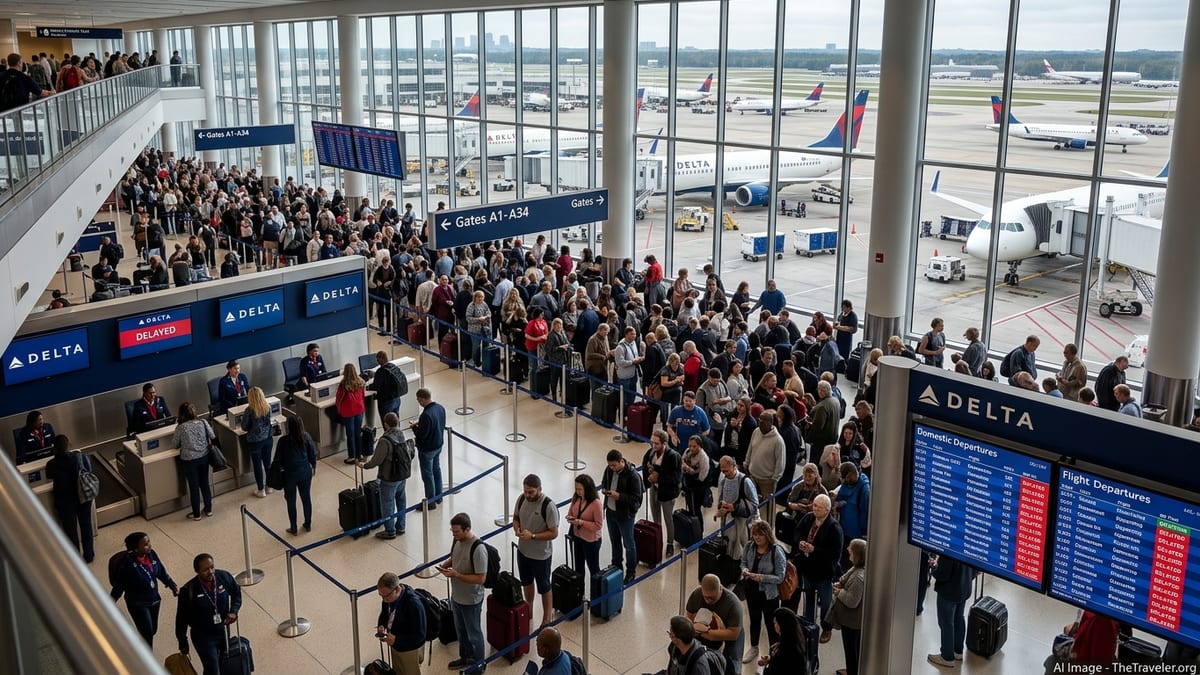
The most visible effects were at Atlanta, which is both Delta’s primary hub and consistently among the world’s busiest airports by passenger numbers. Travelers reported long lines at departure gates and customer service desks through the afternoon and evening, as the airline reworked departure times and sought alternative routings for passengers facing missed connections.
Although the automation problem was centered on the weight-and-balance system, its impact extended throughout Delta’s network. Flights into Atlanta from other hubs and spoke cities were subject to rolling delays because of the inbound ground restrictions, and knock-on effects were reported at major Delta stations including New York, Detroit and Minneapolis. Some aircraft operating outside Atlanta also faced slower turnarounds when weight-and-balance data needed to be checked or issued manually.
By Sunday evening, several sources, including airport representatives, characterized the disruption as widespread but temporary. While most of the delays were measured in hours rather than leading to mass cancellations, the timing meant that even relatively short disruptions complicated travel plans at the start of a peak holiday week, with high load factors leaving fewer options for same-day rebooking.
System restoration and Monday’s recovery
Delta said on Sunday afternoon that the automated weight-and-balance system had been restored and that it was resuming normal electronic processing of load instructions. The airline described its operations as stabilizing later that day, even as it continued to manage residual delays from the earlier stoppage. Hartsfield-Jackson officials confirmed that departures and arrivals were moving again, though many flights remained outside their scheduled times as airlines and air traffic control worked through the backlog.
By Monday, November 23, Delta said the system was fully operational and that its Atlanta schedule was largely back on track. Local reports from the airport indicated that check-in, security screening and gate areas were busy but functioning normally, with delays tapering off compared with Sunday’s peak disruption. Flight-tracking data showed the number of delayed Delta flights decreasing as the day progressed, consistent with a network recovering from a one-day technical interruption rather than a prolonged outage.
The airline has not publicly detailed the precise root cause beyond describing it as a technical issue affecting the automation used to calculate weight-and-balance data. Authorities and the airline have not indicated any link to cybersecurity problems or to the Federal Aviation Administration’s own systems. At this stage, there is no evidence that the failure extended beyond Delta’s internal infrastructure or that other U.S. carriers using Atlanta as a destination or connection point experienced similar automation issues over the weekend.
Why weight-and-balance systems matter for flight safety and timing
The incident has drawn attention to how critical weight-and-balance systems are for modern airline operations. For each flight, dispatchers must know the total weight of passengers, baggage, cargo and fuel, and how that weight is distributed across the aircraft. These calculations determine takeoff performance, center of gravity limits and safe loading. Major airlines rely on automated tools, like Delta’s system based at its Atlanta operations center, to generate load sheets and instructions quickly and consistently for hundreds of daily departures.
When such a system fails, airlines must either pause departures or revert to alternative procedures, which can include manual data entry, backup software or local station-level calculations. Even when these fallbacks are available, they are slower and more labor-intensive, particularly at high-volume hubs. That slowdown translates into longer turnaround times at gates, aircraft waiting for final paperwork, and a cascading series of delays as aircraft and crews fall out of their planned rotations.
The Atlanta disruption follows a broader pattern in which aviation operations increasingly depend on complex, interconnected information technology. Previous events, including a July 2024 global IT outage that impacted several airlines and a separate air traffic control network issue earlier in November 2026, illustrated how a single software or network fault can ripple through tightly scheduled systems. In the current case, the outage appears to have been contained to one operational domain, but its impact on holiday-period travel underlines the limited margin airlines have when demand is high and spare capacity is constrained.
What affected travelers can do and what to watch this week
With Delta’s system now restored and operations in Atlanta described as normal on Monday, travelers booked in the days after the outage are unlikely to see direct effects from Sunday’s technical fault. However, those whose journeys were disrupted at the time may still be working through rebooked itineraries or missed connections. As with other airline disruptions, passengers are advised to monitor their booking via the airline’s app or website, which typically reflects updated departure times and new seat assignments more quickly than airport display boards.
Delta has not announced a dedicated waiver specific to this incident, and there were no broad statements from regulators as of Tuesday, November 24, indicating additional consumer relief beyond standard obligations. In practice, the airline’s standard policies during irregular operations usually include options to rebook on the next available flight and, where delays extend overnight and are within the carrier’s control, meal and hotel support. Travelers whose plans were significantly affected can also review their eligibility for refunds rather than rebooking if their flight was cancelled or subject to substantial schedule changes.
Looking ahead, the key factor for passengers traveling through Atlanta and on Delta this week will be broader holiday congestion and weather, rather than continuing effects from Sunday’s automation problem. Delta and airport officials say systems are functioning normally, but travelers should build in extra time for check-in and security during the peak Thanksgiving period, reconfirm departure times before leaving for the airport, and keep contact details updated in their bookings so that any last-minute changes resulting from operational issues or storms are communicated promptly.