


More news on this day
Recent federal and independent data confirm that flights at Austin–Bergstrom International Airport struggled with punctuality over the last several holiday seasons, particularly during the disrupted winter of 2022, though performance improved markedly in late 2023 and remains mixed heading into the 2026 Thanksgiving and Christmas travel period.
Get the latest news straight to your inbox!
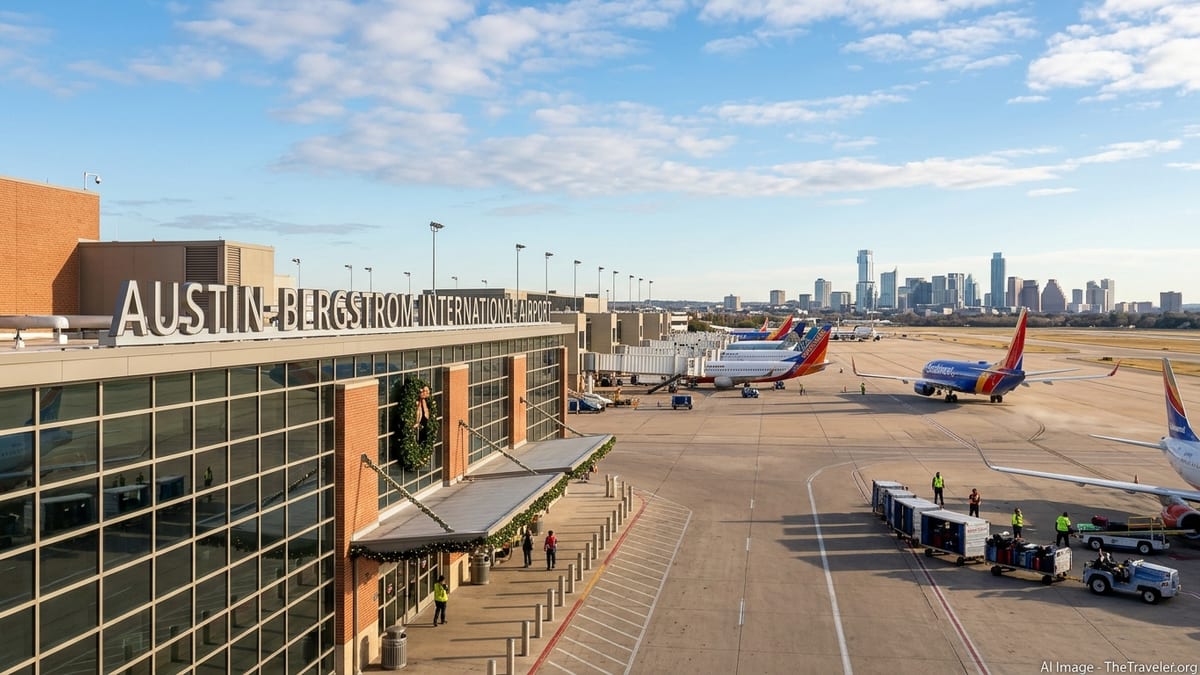
What the data say about Austin’s recent holiday punctuality
Holiday flight punctuality at Austin–Bergstrom International Airport has swung widely in recent years, according to federal statistics and multiple independent analyses of U.S. Department of Transportation records. One historical low point came in December 2022, when only about 73.8% of departures and 73.9% of arrivals were on time, as measured by flights arriving or leaving less than 15 minutes after schedule. Those figures, cited in later airport performance summaries, were closely tied to the nationwide disruption centered on Southwest Airlines’ operational meltdown that month, which heavily affected Austin.
By contrast, performance improved significantly a year later. A review of federal on-time statistics summarized by Axios Austin found that almost 83% of flights departed on time from Austin–Bergstrom in December 2023, a notable rebound from the prior year. That aligns with broader 2023 data showing that Austin’s annual on-time rates had moved back into the mid-70% range for both arrivals and departures, closer to typical U.S. large-airport performance.
More recently, rolling 12‑month figures through mid and late 2026 from several analytics services built on federal data place Austin’s overall on-time departure rate in the low to upper 70% range, with estimates around 73% to 77% depending on the exact period measured and methodology used. One tracker that compiles monthly delay statistics for every U.S. airport reported that 73.1% of flights left Austin on time over the 12 months ending in September 2026, with an average delay of about 19 minutes for late departures and a cancellation rate just over 1%.
Why December 2022 stands out, and how 2023 differed
The winter holidays of 2022 remain an outlier for Austin’s reliability. Federal data and subsequent performance roundups show that December 2022 was one of the airport’s weakest months of the last decade, with on-time departure and arrival percentages around 74%. The month coincided with a nationwide arctic storm and widespread airline disruptions, including a prolonged systems and crew-scheduling breakdown at Southwest Airlines. As one of Austin’s largest carriers by share of departures, Southwest’s difficulties translated directly into more late and canceled flights for local travelers.
Conditions a year later were notably calmer. Data cited in a March 2024 analysis of Austin flight performance reported that nearly 83% of departures from Austin–Bergstrom left on time in December 2023, based on Department of Transportation on-time filings. That placed the airport well above its 2022 holiday showing and more in line with its multi-year average, which independent airport comparison studies typically put around 75% to 77% on-time for both arrivals and departures.
These numbers matter for travelers trying to interpret “holiday chaos” headlines. Rather than a steady deterioration, the data indicate a sharp dip in 2022 followed by recovery in 2023. In practical terms, passengers flying in and out of Austin around Christmas 2023 faced a significantly lower statistical risk of a delay than those who traveled during the same period a year earlier, even though individual experiences could vary widely by airline, destination and time of day.
How Austin compares with other U.S. airports
Viewed against other major U.S. airports, Austin–Bergstrom typically lands near the middle of the pack on punctuality. One national airport performance ranking that compiled on-time departure and arrival data between May 1, 2023 and April 30, 2024 placed Austin in the national top 10 among domestic airports when combining schedule reliability, service quality and food and shopping scores, with on-time performance weighing heavily in the methodology. Another comparative study of airport on-time data from September 2023 through August 2024 ranked Austin 19th among large U.S. airports, with on-time arrivals at roughly 75.8% and departures at about 75.3% during that 12‑month window.
Independent delay dashboards built from Department of Transportation statistics reach similar conclusions. One long‑run tracker covering July 2023 through August 2026 reports that roughly 78% of flights departing from Austin arrived at their destination on time across more than 280,000 flights in that span. Another analysis of route-level performance from September 2025 through August 2026 shows that several of Austin’s largest carriers, including Alaska Airlines and certain regional operators, kept their on-time percentages near or above 80%, while others, particularly some low-cost and high-frequency operators, recorded lower punctuality and higher shares of long delays.
These comparisons highlight that Austin’s holiday travelers face reliability challenges similar to those at many fast-growing mid-sized hubs. Austin’s overall on-time percentages are somewhat lower than high-performing airports such as Salt Lake City or certain smaller regional fields, but broadly similar to many large coastal hubs. For passengers, that means holiday travel from Austin is neither unusually reliable nor exceptionally chaotic in statistical terms, although local bottlenecks, carrier choices and peak-day congestion can produce very different day-to-day experiences.
Patterns by airline, time of day and causes of delay
Breakdowns of Austin flight data help explain why holiday travelers sometimes feel that delays are common even when annual averages hover around three-quarters on time. One dataset that examined more than 56,000 late departures from Austin found that 44.5% of delay minutes during the July 2023 to June 2026 period were attributed to late-arriving aircraft. Another 32.6% were linked to airline operations such as maintenance or crew issues, around 17.6% to air traffic and airport congestion, about 5.1% to severe weather and a small fraction to security-related causes.
Time-of-day patterns are also significant. According to that same analysis, early-morning departures from Austin, particularly those leaving in the first several hours after the day’s operations begin, showed the highest on-time rates. One departure band recorded roughly 94.5% of flights leaving on schedule, based on data from July 2023 through June 2026, making those first-wave departures considerably more reliable than heavily booked afternoon and evening flights. Later in the day, schedule slippage accumulates as late arrivals cascade into subsequent departures, a dynamic that tends to be especially visible during busy holiday periods.
Airline-level differences add another layer. Across data through August 2026, some carriers serving Austin, including certain full-service and West Coast-based airlines, posted on-time outcomes in the low 80% range with relatively low cancellation rates. Others, particularly high-frequency domestic operators with dense schedules into weather-prone hubs, saw substantially lower on-time shares and greater variability by month. For holiday travelers, that means reliability can vary not only by route and time but also by airline choice, even within the same airport and travel window.
What Austin travelers should expect and check for the 2026 holidays
Looking ahead to the 2026 holiday season, current statistics do not point to a clear-cut forecast of smooth or difficult operations at Austin–Bergstrom, but they do offer useful context. One forecasting model built from each U.S. airport’s historical on-time record projects that roughly 80% of departures from Austin could leave on time in November 2026, though the same outlook cautions that actual results could fall anywhere from about 71% to 86% depending on weather, airline operations and broader system shocks. Those ranges underscore that past performance informs but does not guarantee future holiday outcomes.
Travelers planning Thanksgiving and Christmas trips from Austin in 2026 may want to factor in the recurring patterns seen in recent data. Early-morning departures have been measurably more reliable than late-afternoon and evening flights from the airport, and long-haul itineraries or tight connections through historically congested hubs add additional points of failure, especially at peak times. Because late-arriving aircraft account for nearly half of Austin’s recorded delay minutes in recent years, disruptions elsewhere in a carrier’s network can quickly ripple into departures from Central Texas, even when local weather is benign.
Passengers can also draw limited guidance from the contrast between the turbulent December 2022 and the more orderly December 2023. While there is no firm evidence that a similar breakdown is likely in 2026, the 2022 experience shows how quickly national carrier-specific issues can dominate local on-time statistics. In practice, that means holiday travelers from Austin should monitor airline communications closely in the days before departure, verify schedules in their airline’s app and airport displays, and allow additional buffer time for connections and same-day ground transport. With Austin’s recent annual on-time performance hovering near national averages and subject to month-to-month swings, preparation and schedule flexibility remain the most practical responses to a holiday flight record that has been uneven rather than consistently on time.