


Landing at Montego Bay’s Sangster International Airport (MBJ) is the start of most Jamaica vacations. For first-time visitors, though, the arrivals hall, taxi touts, and unfamiliar procedures can be overwhelming. This guide walks you step by step through what actually happens when you land in Montego Bay, with real examples of prices, services, and on-the-ground options so you can get from plane door to resort lounger with as little stress as possible.
Get the latest updates straight to your inbox!
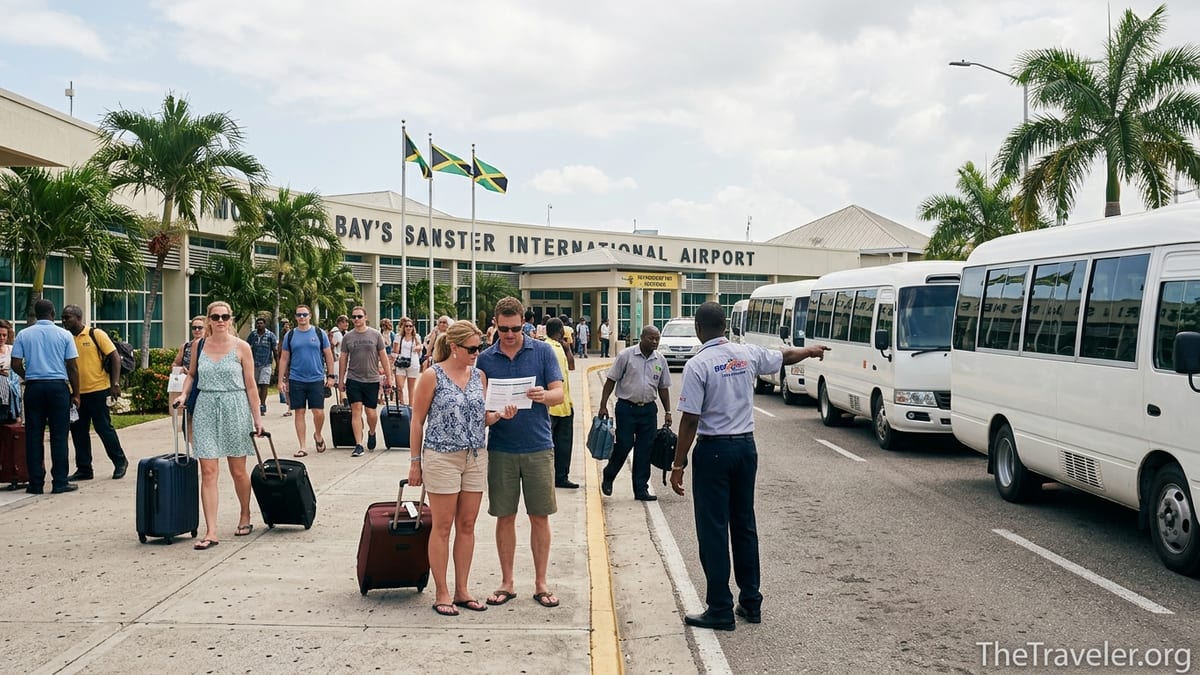
Arriving at Sangster International Airport: What to Expect
Sangster International Airport sits a short drive east of Montego Bay and is Jamaica’s busiest tourist gateway. Most North American and European vacation flights arrive in concentrated waves, so the experience can vary from a quick 30-minute transit to over an hour in immigration during peak Saturday afternoons in high season. After your aircraft parks, you walk through air-conditioned corridors with duty-free shops before reaching immigration, where you will join either the regular line or, if you booked it, the Club Mobay fast-track lane.
Jamaica uses an electronic immigration system for most visitors. You present your passport and sometimes your return flight details and accommodation name. Many travelers report that officers ask a few basic questions about the length and purpose of stay and then stamp you in with little fuss, particularly if you arrive on a weekday midday when the terminal is quieter. Families should stay together in line; couples and kids are usually processed at the same counter.
After immigration you head down to the baggage claim area. Screens show your flight number above each carousel. Luggage handling here can be slower than at large hubs, so it is common to wait 20 to 30 minutes before bags appear, especially on wide-body flights from London or Toronto. Porters in red or other uniformed vests circulate with trolleys and will offer to help with bags for a tip, usually a few US dollars; tipping the equivalent of about 1 to 2 US dollars per bag is considered fair if you accept assistance.
Once you collect your bags, you proceed through customs. You might walk straight through with a brief question or two, or be directed to X-ray. Officers occasionally ask about food items or high-value electronics. There is a declared goods channel if you are bringing in significant quantities of items. Immediately after clearing customs you step into the arrivals public area and transportation hall, where the atmosphere changes quickly from orderly queues to a bustling crowd of hotel reps, tour desks, and taxi agents.
Getting from MBJ to Your Resort: Taxis, Transfers and Shuttles
Montego Bay does not currently have Uber or major ride-hailing apps operating in the way you might be used to at home, so your practical options at MBJ are authorized airport taxis, pre-booked private transfers, or resort shuttles. Right outside the customs exit you will see an official Authorized Airport Taxi desk shared by the main licensed providers. They work with fixed, posted rates by zone rather than meters. For example, a one-way ride for two people from MBJ to a hotel in central Montego Bay is often in the region of 25 to 30 US dollars, while trips to popular all-inclusive areas like Rose Hall or Ironshore commonly run in the 30 to 40 US dollar range depending on party size and vehicle type.
If you are heading to Negril or Ocho Rios, be prepared for higher prices and longer journey times. A private airport taxi to Negril, roughly a 1.5 to 2 hour drive, typically costs somewhere around 90 to 140 US dollars per car, while Ocho Rios on the north coast can fall in a similar band. Drivers accept US dollars widely, and many will quote in US currency by default, though Jamaican dollars are also accepted. It is reasonable to confirm the fare at the desk before you are led to a vehicle and to pay the driver at the end of the ride in cash.
Many visitors prefer pre-booked private transfers, arranged through companies that specialize in Montego Bay airport runs or through their hotel. In this case, a driver or representative usually waits in the arrivals hall holding a sign with your name or company logo and leads you straight to a minivan or sedan in the ground transportation area. Prices are often similar to or slightly lower than grabbing a walk-up taxi, especially for couples or small groups. For instance, a shared shuttle transfer to large resort strips like the RIU hotels in Montego Bay or Iberostar can be notably cheaper per person, though you may stop at several properties along the way.
Major all-inclusive resorts such as Sandals, Secrets, RIU, Iberostar and many cruise and tour operators run their own arrival desks in the ground transportation hall. These counters are clearly branded and staff will check your name against reservation lists and direct you to resort buses parked just outside. These shared shuttles are often included in package prices from North American tour operators, meaning you have effectively prepaid your transfer. The trade-off is waiting time: you may sit in a small resort lounge or boarding area at the airport for 20 to 45 minutes as they assemble enough guests for each bus.
Car Rental and Driving Yourself from MBJ
For travelers who want to explore beyond their resort bubble, renting a car at MBJ is a realistic option, but it requires comfort with left-side driving and variable road conditions. Inside the arrivals public area and just outside in the transportation center you will find counters for international brands such as Hertz, Avis, Enterprise and Budget, alongside local agencies. Many people reserve in advance online, then complete paperwork at the desk; others walk up and rent on the spot, though selection can be limited at busy times.
Expect rates that are broadly comparable to other Caribbean islands rather than US mainland bargains. Compact cars may start somewhere around 40 to 60 US dollars per day before insurance, with SUVs and vans costing more. Jamaican law requires insurance, and agencies will strongly encourage additional coverage against collision and theft; this can significantly increase the daily total. Some travelers use coverage from a premium credit card, but you should confirm terms in writing before declining local options, as agencies may place relatively large holds on your card if you refuse their insurance packages.
When you exit MBJ by car you quickly reach the coastal A1 highway. The section between Montego Bay and Falmouth is relatively modern, but other stretches can be two-lane roads with frequent potholes, speed humps and aggressive overtaking. First-time visitors often report that driving through Montego Bay’s urban traffic shortly after a long flight feels stressful. If you are arriving jet-lagged or at night, it may be wise to use a taxi or transfer to your hotel on day one and, if you want a car, arrange to pick it up the next morning when you are rested and can familiarize yourself with local driving norms in daylight.
Fuel is available at several service stations near Montego Bay, and staff typically pump gas for you. Payment is commonly accepted in Jamaican or US dollars, and increasingly by card, though you should not rely solely on contactless payments. Before you depart the rental lot, photograph the car’s existing dings and scratches and confirm whether your contract includes a daily mileage limit, as this varies by company. Returning the vehicle at MBJ usually involves following signs back to the rental car park near the terminal and checking in at the same brand counter.
Staying Connected: SIM Cards, Roaming and Wi-Fi
Two companies, Digicel and Flow, dominate Jamaica’s mobile network. Visitors arriving at MBJ who want a local number and data can look for a small phone or connectivity shop in the arrivals public area. One example that travelers mention is a store branded as a general mobile or “Stay Connected” outlet, where staff sell prepaid SIM packages on behalf of the main carriers. Inventory and exact plans change, but you can usually purchase a local SIM with several gigabytes of data and local minutes, valid for 7 to 14 days, at a price that is typically competitive with roaming for heavy data users.
Because offerings shift frequently, it is wise to think in terms of rough brackets rather than fixed tariffs. For example, visitors in recent seasons have reported tourist bundles that cost the equivalent of a few tens of US dollars for enough data to navigate with maps, use WhatsApp, and stream some music over a one to two week vacation. Staff will normally install and activate the SIM for you on the spot. You should ensure your phone is unlocked before you travel; locked phones from US carriers may refuse foreign SIMs.
Many North American carriers, including T-Mobile and some AT&T and Verizon plans, now include basic roaming in Jamaica. This can range from low-speed but free data plus paid high-speed passes, to flat-rate daily roaming fees that allow you to use your phone as at home. One common pattern is a plan that gives unlimited texting and 2G-speed data for free, with the option to upgrade to 3G or LTE speeds for a small daily fee. If you only need messaging and occasional maps, this can be an easy option. Just remember that downloading large media files or streaming high-definition video over roaming can still become expensive.
Inside MBJ, free Wi-Fi is generally available in the terminal, particularly in departure areas and lounges, though reliability can fluctuate under heavy loads when multiple charter flights depart. Club Mobay and other lounges typically provide faster, more stable connections than the public concourse. Most resorts across Montego Bay, Negril, Ocho Rios and the north coast now include Wi-Fi in the room rate, though a few older properties may still charge extra for high-speed access. If you plan to work remotely or upload large photo batches, combine resort Wi-Fi with a local SIM for redundancy.
Money, ATMs and Paying for Things
Jamaica’s currency is the Jamaican dollar, but Sangster International Airport and tourist businesses across Montego Bay are very accustomed to US visitors, and US dollars are widely accepted. In the arrivals hall you will usually see at least one currency exchange counter and several ATMs operated by major Jamaican banks. You can exchange a small amount of cash for Jamaican dollars, but the rates at airport kiosks are often less favorable than those in town, and many travelers simply withdraw local currency directly from an ATM using a debit card instead.
ATMs at MBJ and in resort areas generally dispense Jamaican dollars, and your bank converts from your home currency at standard international rates plus any foreign transaction fees it charges. It is sensible to withdraw a moderate amount, perhaps the equivalent of 100 to 200 US dollars, to cover small purchases, local taxis away from tourist zones, and tipping. Keep in mind that Jamaican notes can feel high in denomination; a single 5000 Jamaican dollar bill represents a meaningful sum, so take a moment to understand the conversion before paying.
Most larger resorts, excursion operators, duty-free shops and many restaurants accept major credit cards like Visa and Mastercard. Card terminals may prompt you to choose between being charged in Jamaican dollars or in your home currency. In most cases, selecting the local currency is better value because dynamic currency conversion can add an extra margin to the rate. For very small purchases, such as a bottle of water from a roadside stand, vendors may prefer cash and may quote prices in Jamaican dollars or in US dollars at a simple rounded rate.
For arriving passengers, it can be convenient to carry some small US dollar bills in advance. Many porters and taxi drivers are happy to accept a 1, 5, or 10 US dollar tip or fare component. Once at your resort, front desk staff can often provide change in smaller Jamaican bills, and some properties operate a kind of informal exchange at the reception, allowing you to swap modest amounts of US cash for Jamaican at reasonable rates. As always, it is safest to avoid changing large sums at unlicensed street vendors or accepting unsolicited currency offers around the airport.
Club Mobay: Fast Track and Lounge Access Explained
One of the most talked-about features of Montego Bay Airport is Club Mobay, a combined fast-track and lounge service that operates separate arrival and departure experiences. You book Club Mobay in advance through its official channels or via tour operators and travel agents. Upon arrival, a representative waits just outside the jet bridge or in the arrivals hallway holding a sign with your name. They escort you to a dedicated immigration line, which can save significant time on busy days, then help you collect luggage and guide you through customs.
After clearing customs with arrival service, you are taken to the Club Mobay arrivals lounge located in the ground transportation area. Inside, you can relax in air-conditioned comfort with complimentary drinks, snacks, and Wi-Fi while waiting for your transfer or resort shuttle. Many visitors find this particularly welcome if their shuttle company requests that they remain in the airport for others arriving on slightly later flights, turning what could be an uncomfortable wait in the taxi area into a more civilized pause with refreshments and clean restrooms.
For departures, Club Mobay operates a larger airside lounge beyond security checkpoints. After you check in with your airline and clear security, you head to the Club Mobay desk near the gates, where staff admit you to the lounge using your reservation. Inside, there are comfortable seating areas, a small buffet with hot and cold Jamaican and international items, a self-serve or staffed bar with alcoholic and soft drinks, showers in some sections, children’s play spaces, and quiet nooks for working. Guests typically arrive two to three hours before their flight and use the lounge as a calmer alternative to the sometimes crowded main departure hall.
Pricing for Club Mobay changes periodically, but visitors frequently report ballpark figures in recent seasons of in the tens of US dollars per adult for departure-only access and a higher rate for arrival-only, with a bundled arrival-and-departure package costing more than either service alone but less than buying both separately. Children are usually discounted. Whether it is worth it depends on your travel style. Families with young children and travelers landing at peak times tend to value the arrival fast track and lounge highly, while some frequent visitors feel that, with recent upgrades to MBJ’s food court and seating, the departure lounge is more of a comfort upgrade than a necessity.
Essential First-Time Tips for a Smooth Jamaica Arrival
First-time visitors to Jamaica often remark that the energy at MBJ hits them immediately. Outside the terminal, a mix of official taxi agents, porters, excursion reps and a few informal hustlers all compete for attention. The most important rule here is to move slowly and deliberately. If you already have a transfer arranged, walk directly to your tour or resort desk in the transportation hall and check in with staff wearing branded uniforms. If you need a taxi, head to the authorized taxi desk rather than accepting unsolicited rides from individuals who approach you in the crowd.
Jamaica is generally relaxed about dress codes, and you will see many people stepping off the plane in beachwear, but the climate can still feel intense after air conditioning. The taxi and shuttle staging area just outside the arrivals doors is partially covered but can be very warm and humid, especially in the afternoon. It helps to have a bottle of water easily accessible in your carry-on and to dress in light layers you can adjust quickly. Sunscreen and sunglasses are useful immediately; the short walk from terminal to bus in full sun can be a shock for winter travelers from Canada or the northern United States.
When it comes to safety, MBJ functions much like other busy Caribbean tourist airports. Petty scams are more common than serious crime in the arrivals area. Examples include people offering to “help” with your luggage and then demanding high tips, or drivers quoting inflated off-the-books taxi prices. You can avoid most issues by using official desks, confirming prices upfront in a calm tone, and not handing your bags to anyone you have not clearly hired. If someone insists they have been assigned to you but you are unsure, step back into the terminal and ask at an information counter or your resort desk for confirmation.
Finally, remember that island time is real. Things often move more slowly than at large North American or European hubs, from baggage delivery to shuttle departures. Build this into your expectations and avoid booking tight onward connections, such as domestic flights or time-sensitive excursions, within a very short window of landing. For example, if you arrive at MBJ at 1 p.m. and your resort is an hour away, it is wise to assume you may not reach your hotel until 3:30 or even 4 p.m. after clearing formalities and waiting for transport, especially in high season. Viewing the airport as the unofficial start of your vacation, rather than a hurdle to be rushed through at all costs, can make the experience feel far more pleasant.
FAQ
Q1. How long does it usually take to get through Montego Bay Airport on arrival?
At quieter times it can take as little as 30 to 45 minutes from plane door to curb, but during busy weekend peaks it can stretch to 60 to 90 minutes, especially if several large flights land at once and you are not using a fast-track service.
Q2. Is it better to use US dollars or Jamaican dollars when I land at MBJ?
Both are accepted, but US dollars are widely used for taxis, tips and many tourist purchases. It is convenient to carry small US bills on arrival, then withdraw some Jamaican dollars from an ATM or change a modest amount at your hotel for local-priced shops and off-resort expenses.
Q3. Are airport taxis in Montego Bay safe and do they use meters?
Authorized airport taxis from the official desk are generally considered safe and operate on fixed, posted zone rates rather than meters. Always confirm the fare before leaving the airport and avoid unlicensed drivers who approach you directly outside the terminal.
Q4. Do I need to book my airport transfer before I arrive in Jamaica?
You do not have to, because authorized taxis are readily available, but pre-booking a private transfer or confirming an included resort shuttle can simplify your arrival, give you a clear price in advance, and minimize interactions with touts in the arrivals area.
Q5. Can I easily buy a local SIM card at Montego Bay Airport?
In most seasons there is at least one small mobile or connectivity shop in the arrivals public area that sells prepaid SIMs on the main Jamaican networks. Stock and plans can change, so it is best to treat on-site purchase as convenient rather than guaranteed and have roaming as a backup plan.
Q6. Is Club Mobay worth paying for on arrival?
Many travelers find Club Mobay’s arrival service worthwhile if they land at peak times, are traveling with children, or dislike queues. The combination of fast-track immigration, assistance through customs, and access to an air-conditioned lounge with snacks can significantly reduce stress after a long flight.
Q7. How early should I get to Montego Bay Airport for my departure flight?
For international flights, arriving at least three hours before departure is generally recommended. This allows time for check-in, security, possible lines at exit immigration, and a relaxed wait in the departure hall or a lounge such as Club Mobay.
Q8. Is it difficult to drive a rental car from MBJ as a first-time visitor?
It can be challenging if you are not used to driving on the left and sharing narrow roads with local traffic. Many visitors prefer to use taxis or transfers on arrival day and only rent a car later in their stay once they are rested and more familiar with local conditions.
Q9. Are there good food options at Montego Bay Airport if I skip the lounge?
Yes. Recent upgrades mean there is a food court and several cafes and bars in the departure area offering Jamaican favorites like patties and jerk chicken, as well as international fast food and coffee chains, so you will not go hungry without lounge access.
Q10. What is the best way to avoid scams or hassles when I exit the terminal?
Walk purposefully to your pre-booked transfer desk or to the official taxi counter, ignore unsolicited offers for rides or baggage help, confirm prices calmly in advance, and keep your valuables close. Sticking with clearly identified staff and licensed desks removes most of the common annoyances.