


I almost left Helsinki without stepping inside Temppeliaukio Church. I had it marked on my map as a “maybe, if there’s time.” After all, how different could another church really be? It was only when a local raised an eyebrow and said, “You do know it’s carved into solid rock, right?” that I changed course. An hour later I walked back into the spring light of Töölö genuinely stunned, and very grateful I had not skipped what turned out to be one of Helsinki’s most quietly spectacular experiences.
Get the latest updates straight to your inbox!
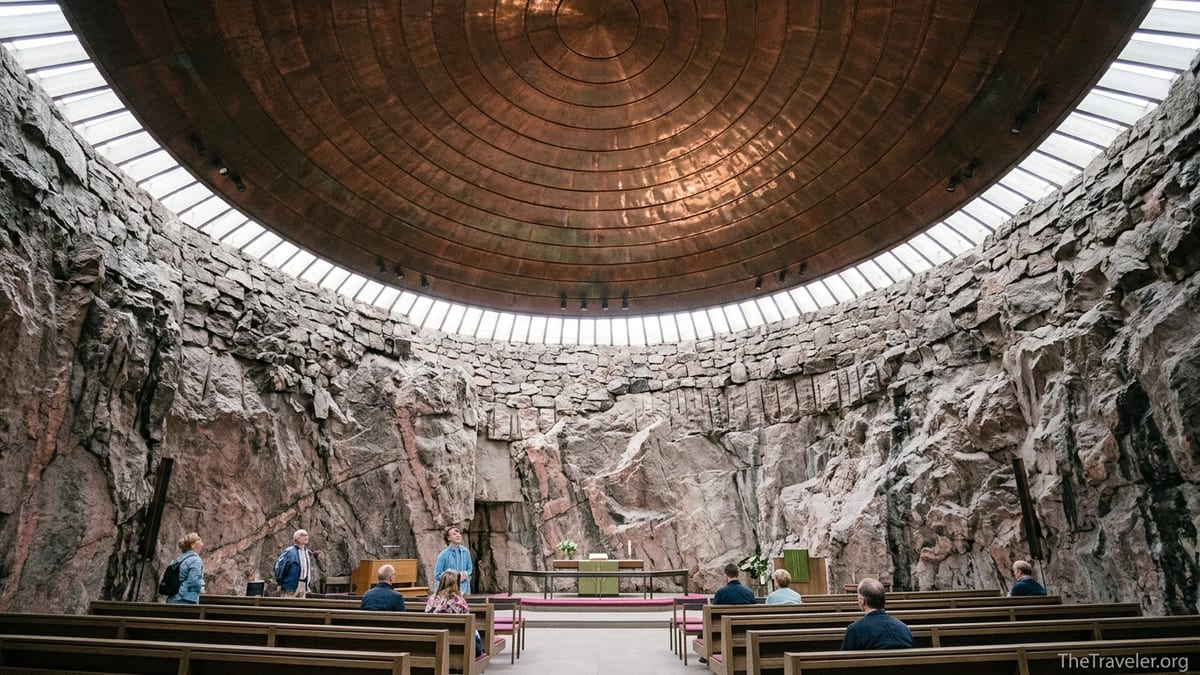
First Impressions: From Ordinary Street to Otherworldly Space
Temppeliaukio Church does not announce itself the way many European churches do. Walking up Lutherinkatu in the central Töölö district, you will not see a soaring spire or an ornate façade. Instead, the church sits low in a residential block, more like a curious mound of rock with a shallow copper dome than a landmark. It is easy to underestimate or even walk straight past, especially if you are coming from the grand white steps of Helsinki Cathedral or the red-brick towers of Uspenski Cathedral near the harbour.
Once you step inside, the contrast is immediate. Instead of stained glass and carved stone columns, you are surrounded by rough-hewn granite walls, the original bedrock of Helsinki blasted and polished into a circular sanctuary. Above you, a saucer-like copper dome spirals inward, made from long strips of metal that catch the light in subtle rings. Daylight filters in through 180 narrow windows set between the rock and the dome, so the entire space glows softly even on a typical overcast Finnish afternoon.
What surprised me most was the sound. Even when a guide spoke in a low voice or a visitor shuffled along the wooden benches, the acoustics wrapped every sound in a warm, lingering echo. It felt as if the rock itself was listening. This is the first moment when many visitors, myself included, realise they have not just entered another church, but one of the most distinctive interiors in all of Scandinavia.
The atmosphere is not solemn so much as contemplative. People sit quietly on the curved pews, some praying, some simply staring at the rock walls that still bear drill marks from the late 1960s construction. Children run their hands along the stone, tracing the mineral veins. The effect is both deeply human and deeply geological, a reminder that Helsinki is a city literally built on granite.
What Makes the Rock Church So Special
Temppeliaukio Church, completed in 1969, is the work of Finnish architect brothers Timo and Tuomo Suomalainen, who won a competition to design a church on this rocky hill. Instead of placing a conventional building on top of the outcrop, they decided to excavate directly into the rock, leaving the exterior as natural as possible. The result is a space that merges architecture and landscape so completely that it feels less like a building and more like a hollowed-out cavern adapted for worship.
The raw granite walls are not a decorative choice; they are structural. The church is essentially a circular pit blasted out of the bedrock, with the stone left exposed and stabilized. This means that when you sit in a pew, you can still see the natural fissures, the colour variations from pale grey to pinkish tones, and the marks where the rock was cut. Unlike many churches where restoration hides age and imperfection, here the process of creation remains visible.
Above, the copper dome is ringed by a band of glass that lets in daylight even in the short, dim days of a Finnish winter. The builders used nearly two dozen kilometres of copper strip to create the ceiling, which has gradually darkened into a rich brown-green patina. In photos it can look slightly futuristic, but in person the colour is warm and organic, complementing the stone rather than competing with it.
This design is not only visually arresting; it also creates exceptional acoustics. The combination of rough rock, circular shape and low dome turns the interior into a natural amplifier. A single note from the organ or a solo singer can hang in the air for several seconds. The church is therefore as much a concert venue as a place of worship, hosting regular performances that take advantage of this remarkable sound quality.
Planning Your Visit: Tickets, Times and Practical Details
Temppeliaukio Church is a working Lutheran parish church, which means it does not operate only as a tourist attraction. Opening hours for visitors vary according to services, weddings and concerts, but in a typical week the church is open most days, often from around 9:00 to mid or late afternoon. During busy cruise and summer seasons, morning to late afternoon visiting stretches are common, while on Sundays access is usually limited around services. Schedules can change at short notice for private events, so it is wise to check the church’s current visiting hours just before you set out rather than relying on an old guidebook.
As of mid 2026, the standard entrance fee for adult visitors is around 8 euros, with children and teenagers often entering at a reduced rate or free when accompanied by an adult. On some days, especially certain Fridays, entry for everyone may be free during specific hours, reflecting the parish’s wish to keep the church accessible. Payment is typically taken at a small ticket desk near the entrance, where staff can also answer questions about the building and any concerts that day.
If you prefer to plan ahead, several ticket platforms sell timed-entry tickets that cost roughly the same as paying at the door. These can be useful on very busy days when tour buses and cruise passengers arrive in waves, as timed tickets sometimes have a dedicated line. Travelers who only have a short window in Helsinki, such as those on Baltic cruises, often choose this option to avoid the risk of queuing outside or finding the church closed for a wedding.
Temppeliaukio sits in Töölö, about 15 to 20 minutes on foot from Helsinki Central Station. Many visitors walk via Kamppi and up the gentle hill, stopping for coffee en route. Trams and buses also stop within a short walk, and taxis or ride-hailing services from the Market Square area usually cost the equivalent of a few euros for the short ride. The church has a modest entrance on Lutherinkatu; if you arrive from the opposite side, you may first see only the rocky roof and copper dome peeking above the surrounding apartment blocks.
Experiencing the Space: What to Actually Do Inside
Many visitors assume they will stop into Temppeliaukio Church for only ten minutes, take a photo and move on. In practice, it is worth giving yourself at least 30 to 45 minutes. Start by simply sitting in one of the wooden pews and letting your eyes adjust to the light. Notice how the rock walls rise unevenly around the circular floor, how the copper ceiling spirals toward the centre, and how the curved balcony wraps around part of the space.
Organ music is often played at set times during the day, even when there is no formal concert. If you happen to be there when the organist begins to play, stay. The instrument, with its pipes projecting against the rock wall, fills the space with a sound that feels almost physical. Even a simple hymn or a few chords can demonstrate why musicians from around the world come to perform here. Visitors who normally skip church organs find themselves sitting quietly, listening until the last notes fade into silence.
Photography is allowed during visiting hours, but it is important to be discreet. Rather than immediately pointing your camera at the altar, consider moving up to the balcony for a wider perspective. From there you can frame the rock walls, seating and copper dome in a single shot, capturing the contrast between raw geology and carefully designed architecture. A standard smartphone camera is more than adequate; the even, indirect light makes it easy to avoid harsh shadows or blown-out highlights.
Do not forget to walk close to the walls. Running your fingertips lightly over the granite gives a surprising sense of connection to the place. You will see drill marks and natural fractures, as well as patches where the rock is surprisingly smooth. This tactile experience is something photos cannot capture and is one of the reasons many visitors remember Temppeliaukio long after they have forgotten other, more conventional churches.
Concerts, Quiet Moments and How to Time Your Visit
Because of its outstanding acoustics, Temppeliaukio Church doubles as a concert hall. Throughout the year, it hosts everything from classical chamber performances and choral evenings to organ recitals and occasional contemporary or world music events. Listings are often published a few weeks in advance and may be posted at the entrance or shared via local cultural calendars in Helsinki.
Attending a concert here is a markedly different experience from a daytime visit. In the evening, the church is usually lit more dramatically, with warm lights highlighting the rock and the copper ceiling while the rest of the space falls into a gentle semi-darkness. A 60- to 90-minute performance can feel almost like being inside a living instrument, as the music reverberates off the stone. Ticket prices for concerts vary, but many small-scale events are relatively affordable, comparable to a mid-range cinema ticket in Helsinki.
If your schedule does not allow for a concert, you can still catch shorter musical moments. Many days include brief organ demonstrations or mini-recitals included in the standard entrance fee. Staff often know when these will take place, so it is worth asking at the ticket desk. This can be a smart way to experience the sound of the building without committing an entire evening.
For those who prefer a more meditative visit, early morning or late-afternoon just before closing are often the quietest times outside of major holidays. Midday, especially in July and August or when Baltic cruise ships are in port, tends to be busier, with groups coming in and out. If you are combining Temppeliaukio with other attractions in Töölö, such as the nearby Sibelius Monument or the Finlandia Hall area, planning your church visit for the start or end of your walking route can help you avoid peak crowds.
Pairing Temppeliaukio with the Rest of Helsinki
One reason many travellers nearly skip Temppeliaukio is that Helsinki is often a brief stop on a longer Nordic or Baltic itinerary. With only a day or two in the city, it is tempting to focus on the postcard landmarks around Senate Square and the harbour. In reality, Temppeliaukio works perfectly as part of a compact self-guided walking tour that still leaves time for the markets, saunas and waterfront promenades.
A practical route might start at Helsinki Central Station, continue to the white Lutheran Cathedral and Senate Square, loop via the Esplanadi park and Market Square, then head inland past Kamppi to Temppeliaukio in Töölö. From the church, you can walk another 15 minutes to the Sibelius Monument in seaside Töölö Bay park, with its stainless-steel pipes echoing the organ you just heard underground. This creates a satisfying narrative: from traditional state church on the hill, to the rock-hewn Temppeliaukio, to an abstract outdoor monument celebrating Finland’s national composer.
Food and coffee are easy to find around the church. The residential streets of Töölö are dotted with neighbourhood cafés, bakeries and casual restaurants where locals stop for a cinnamon bun, rye bread sandwich or a bowl of salmon soup. Prices in 2026 are broadly in line with Helsinki’s reputation as a relatively expensive Nordic capital, but a coffee and pastry in this area still often comes in cheaper than a full meal around the harbour. Stopping for a fika-style break here is a pleasant way to process the experience before you move on.
Because Temppeliaukio is indoors and weatherproof, it is also an excellent backup plan if your day in Helsinki turns out windy, wet or cold, which can easily happen outside the height of summer. Unlike some outdoor attractions that lose their charm in sideways rain, the church arguably becomes even more atmospheric when you arrive with raindrops on your coat and settle into the warm, echoing interior.
The Takeaway
Looking back, my near-miss with Temppeliaukio Church seems almost absurd. I was ready to skip one of the city’s most distinctive places in favour of “just one more” waterfront stroll. It was only the insistence of someone who lived in Helsinki that nudged me to reroute my afternoon, and that small decision fundamentally changed my impression of the city.
Temppeliaukio is not grand in the traditional sense. You will not find gilded altarpieces, carved marble saints or towering stained-glass windows. Instead, you find raw rock, copper, light and sound arranged with a very Finnish restraint. It quietly demonstrates how architecture can respect the landscape rather than dominate it, and how a place of worship can also be a civic space, a concert hall and a pocket of calm for anyone who walks in off the street.
If you have only a single day in Helsinki, you might assume that adding a church that looks modest from the outside is optional. Yet for many visitors, this is the moment when the city’s character truly comes into focus. In a trip filled with ferries, saunas and seaside promenades, that hour inside the rock often becomes one of the most vivid memories. Put simply: do not relegate Temppeliaukio Church to your “maybe” list. Make room for it, even if you think you are not a “church person.” You may walk out feeling, as I did, that skipping it would have been the real mistake.
FAQ
Q1. Where is Temppeliaukio Church located in Helsinki?
Temppeliaukio Church is in the Töölö district, a mostly residential area about a 15 to 20 minute walk northwest of Helsinki Central Station, with the main entrance on a small street called Lutherinkatu.
Q2. Do I need a ticket to visit Temppeliaukio Church?
Yes, during regular visiting hours there is usually an entrance fee for adults, typically around 8 euros, while children and teenagers often pay less or may enter free with an adult.
Q3. How much time should I plan for a visit?
Most visitors spend between 30 minutes and one hour inside, which allows time to sit quietly, explore the balcony, take photos and, if you are lucky, listen to some organ music.
Q4. What are the usual opening hours?
Opening hours vary because the church is active with services, weddings and concerts, but on a typical weekday it is open most of the day, often from around 9:00 until mid or late afternoon, with shorter hours on Sundays.
Q5. Is it worth visiting if I have already seen other churches in Helsinki?
Yes, Temppeliaukio is very different from Helsinki Cathedral or Uspenski Cathedral, as it is carved into solid rock with a copper dome and unique acoustics, making the experience quite distinct.
Q6. Can I attend a concert at Temppeliaukio Church?
Yes, the church regularly hosts concerts and organ recitals, many of them in the evening, and information about specific events is usually available from local listings or at the church’s ticket desk.
Q7. Is photography allowed inside?
Photography is generally allowed during visiting hours, but visitors are expected to be discreet, respect services and concerts, and avoid using flash or disturbing others.
Q8. How do I get there by public transport?
You can walk from the city centre or take a tram or bus towards Töölö and get off within a few minutes’ walk of the church, with ticket machines and contactless payment widely available on Helsinki’s public transport.
Q9. Is the church accessible for visitors with limited mobility?
Access from street level is relatively gentle compared with many older churches, and there are ramps and reserved seating areas, but visitors with specific mobility needs may wish to confirm current arrangements before arriving.
Q10. What else can I combine with a visit to Temppeliaukio?
Many travellers pair a visit with a walk to the nearby Sibelius Monument, a stroll around Töölö Bay or a stop at a local café in the neighbourhood before heading back toward the harbour or city centre.