


Dubai International Airport has grown into one of the world’s busiest hubs, handling more than 90 million passengers a year across three terminals. For many travelers it is their first real contact with the city, and the scale can feel overwhelming. In practice, the airport runs on a clear, well signposted system. Understanding how that system works from the moment your wheels touch down to the moment you board your onward flight makes the experience far smoother, whether you are staying in Dubai or simply passing through.
Get the latest updates straight to your inbox!
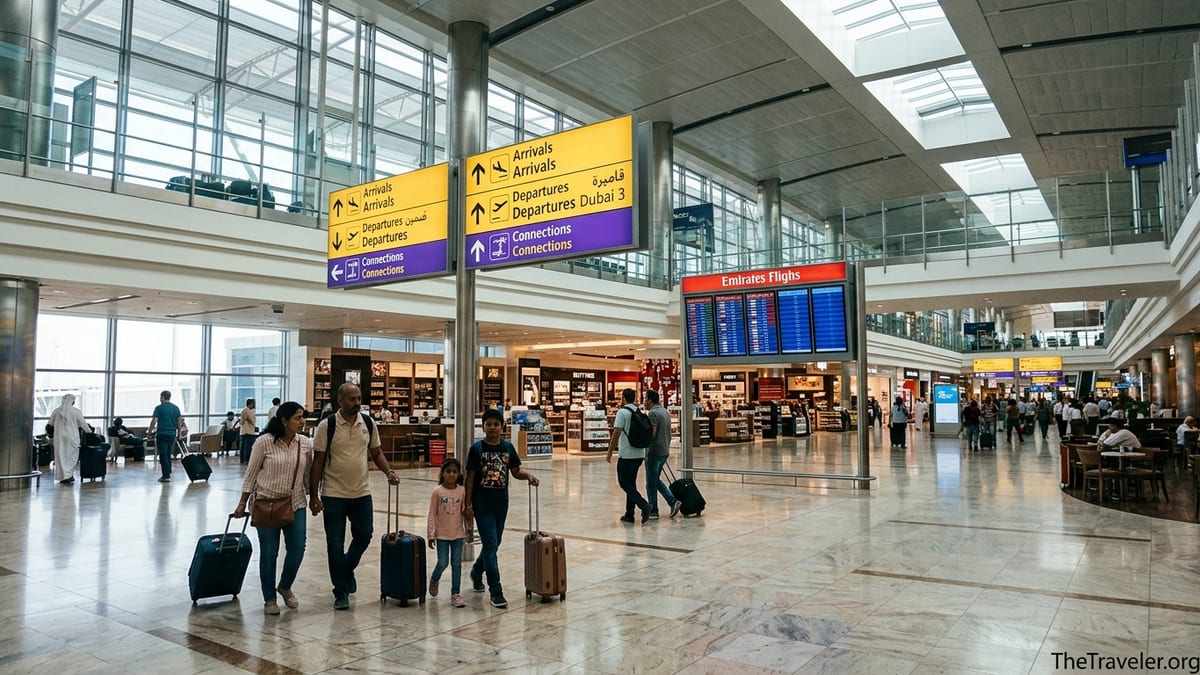
Understanding the Layout: Terminals, Concourses and Transfers
Dubai International Airport is built around three main terminals that each serve slightly different types of traffic. Terminal 3 is the dedicated home of Emirates and its close partner Qantas and handles the bulk of long haul flights. It is linked to Concourses A, B and C, which together form a long spine of departure gates with duty free, lounges and restaurants. Terminal 1 is used by most other full service international airlines and connects to Concourse D. Terminal 2, set a short drive away on the north side of the airfield, is smaller and primarily used by regional carriers and low cost airlines. This split matters because it determines where you arrive, which immigration hall you will see, and whether you can transfer airside or must change buildings.
In practical terms, if you fly from New York, London or Sydney to Dubai on Emirates, you will almost always arrive into Terminal 3. A traveler flying Paris to Dubai on Air France will use Terminal 1, while someone arriving from Muscat on flydubai may land in Terminal 2 or 3 depending on the route. When planning connections, this distinction is important. A traveler connecting from an Emirates flight in Terminal 3 to a Lufthansa flight in Terminal 1 remains airside and uses the dedicated connections route between concourses. By contrast, a passenger connecting from an Emirates long haul arrival in Terminal 3 to a low cost regional flight in Terminal 2 on a separate ticket will generally have to clear immigration, collect bags, and then move by road between buildings.
The airport itself acknowledges this difference in its passenger information. Official guidance and recent independent airport guides note that transfers within Terminals 1 and 3 are straightforward and airside, while movements involving Terminal 2 are often landside, requiring time for immigration and surface transport. This is why an apparently simple one hour connection can be comfortable if it is Emirates to Emirates in Terminal 3, but risky if it is an Emirates arrival followed by a separate low cost flight from Terminal 2.
For orientation, think of Terminals 1 and 3 as one large complex on the south side of the airfield, linked by a people mover, with Dubai Metro stations serving both. Terminal 2 sits across the runways near the Dubai Airport Free Zone. The airport provides internal airside buses for through passengers where possible, but if your itinerary is not protected on a single ticket you should assume you will need to go landside, use a taxi or shuttle, and reenter through departures.
From Touchdown to Immigration: What Happens After You Land
The arrival process begins as soon as the aircraft parks at the gate. At Dubai International, most widebody flights park directly at contact gates with jet bridges, though some regional and low cost services use remote stands accessed by bus. On Emirates long haul sectors into Terminal 3, passengers typically disembark via two doors and follow clearly marked “Arrivals” and “Connections” signs. In practice, you walk along a combination of fixed corridors and moving walkways that can feel long, especially in Concourses A and B where gates are spread out to handle multiple A380 aircraft at once.
Along the way, you pass through an initial screening area where security staff may visually check boarding passes and direct travelers either towards the transfer route or towards immigration. Overhead signs are color coded and repeat in English and Arabic. For example, a family arriving from Frankfurt with a stopover in Dubai would simply follow the yellow “Arrivals/Baggage Claim” signs all the way to passport control, while a solo traveler continuing to Manila on the same ticket would follow purple “Connections/Transfer” signs instead. Airport staff are numerous in these junction areas, and it is common to see them proactively asking passengers about their final destination to prevent people from accidentally leaving the transfer stream.
Immigration itself is housed in large halls beneath the concourses in Terminals 1 and 3. Dubai’s authorities have invested heavily in automation. Visitors from many countries can use Smart Gates featuring facial recognition, while others proceed to traditional manned counters. According to recent performance data published by Dubai’s tourism and economic department, around 98 percent of passengers clear passport control in under 10 minutes, with actual times varying by time of day and the number of widebody arrivals landing at once. In practice, that means that a midweek evening arrival during the busy 6 pm to 10 pm bank can involve a 20 minute queue at the worst, while a 2 am arrival may see you almost walking straight through.
For travelers who want additional support at this stage, Dubai offers a range of meet and assist services. Companies such as marhaba operate desks just before immigration. For a fee that recent price lists put at around 30 US dollars equivalent per adult for standard “Bronze” service in Terminals 1 and 3, an agent meets you at the aircraft door or at the end of the jet bridge, escorts you through the fast track line where eligible, and assists with any paperwork. In real terms this can turn a stressful connection with small children into a manageable experience, especially at peak times when regular lanes are crowded.
Baggage Claim, Customs and Stepping Landside
Once you clear immigration, you descend to the baggage claim halls. Both Terminal 1 and Terminal 3 have large carousels dedicated to individual flights, with display screens showing airline, origin and belt number. Regular announcements remind passengers that offloaded bags for flights that have closed will be moved to a central unclaimed baggage area. Dubai’s airport operator reports a baggage success rate above 99 percent, which matches the experience of most frequent travelers who find cases already circling by the time they arrive. On a typical Emirates long haul arrival into Terminal 3, it is common to reach the carousel 10 to 15 minutes after disembarkation and see luggage arriving shortly afterward.
Customs comes immediately after baggage claim. In Dubai this is usually a walk through process. There are two channels: green for passengers with nothing to declare and red for those carrying items above duty free allowances or commercial goods. Officers conduct occasional spot checks, with some focus on items such as tobacco, large electronics shipments and high value goods. For a standard leisure traveler bringing a reasonable amount of personal electronics and souvenirs, the process typically amounts to walking past officers and into the public arrivals hall. That said, rules around medication and controlled substances in the United Arab Emirates are strict, so it is wise to arrive with prescriptions and to avoid carrying banned items, rather than assuming customs will overlook them.
As you step into the public part of the terminal you pass an initial line of services that many passengers use immediately. Exchange counters, local SIM card vendors and mobile phone kiosks are clustered at the exit of customs. While it is convenient to change a small amount of cash here, frequent visitors point out that on-airport exchange rates are often less favorable than those in the city. By contrast, purchasing a local or eSIM package at the airport is often good value, with major local operators selling data bundles aimed at short stay visitors. A common pattern is to buy a seven day 5 GB visitor SIM at one of the branded operator stands, activate it on the spot with help from staff, and then use card payments or ATMs for most purchases in town.
Families and prearranged transfers often meet in clearly marked greeting zones just beyond customs. Hotel drivers and private car services stand behind railings with printed signs. It is normal in Dubai for chauffeurs from major hotels in Downtown or on the Palm to wait there with the property’s logo. If you have booked a meet and assist service that includes porterage, a staff member will also be waiting in this hall, often having already identified your baggage on the carousel and loaded it on a trolley.
Getting Into the City: Metro, Taxi and Private Transfers
Once landside, your next step is ground transport. For many travelers, the first decision is whether to take the Dubai Metro, a regular taxi, an app booked ride, or a prebooked private transfer. The metro is the most cost efficient and one of the fastest options during daytime hours. The Red Line serves both Terminal 1 and Terminal 3 directly, with stations connected to the terminals by covered walkways. A typical journey from Terminal 3 to Burj Khalifa / Dubai Mall station in Downtown takes around 25 to 30 minutes and costs the equivalent of roughly 1 to 2 US dollars using a Nol card, depending on distance and ticket type. Travelers arriving midmorning with light luggage often choose this option, buying a Nol card at the station, loading it with credit and tapping in at the gates.
Taxis are the default choice for many visitors, particularly those arriving late at night or with heavy bags. Official airport taxis line up outside each terminal with a clear queuing system. Vehicles are metered and regulated by Dubai’s Roads and Transport Authority. There is an additional airport flag fall that makes the starting fare higher than in the city. As of recent guides in 2026, a typical metered fare from Terminal 3 to Downtown Dubai falls in the 50 to 80 dirham range in light traffic, while trips to Dubai Marina or the Palm Jumeirah may run 80 to 130 dirhams. In real terms, a family of four landing at 11 pm and heading to a hotel near the Dubai Mall can expect to pay roughly the equivalent of 15 to 20 US dollars and arrive in about 20 minutes if roads are clear.
Private transfers and ride hailing services fill the gap between metro and standard taxis. Many travelers now prebook a car through international platforms or local operators, paying a fixed fee that includes waiting time. A typical quoted price in 2026 for a private sedan from Dubai International to Downtown is in the region of 120 to 150 dirhams, with SUVs costing more. The advantage is predictability and meet and greet service, useful for those arriving after a long flight or traveling with elderly relatives. At the same time, travelers should be aware that some hotel cars charge a significant premium over regular taxis for essentially the same journey, so comparing quoted prices against the expected metered range before booking is sensible.
For passengers arriving into Terminal 2, ground transport options are similar but with a few practical differences. The terminal does not have its own metro station directly attached, though the Dubai Airport Free Zone station on the Green Line is within a short taxi ride. Many Terminal 2 passengers therefore default to taxis, particularly those connecting to other parts of Dubai or Sharjah. Travel time by road from Terminal 2 to Dubai Marina, for example, is often 35 to 45 minutes depending on traffic, and fares are comparable to those from the main complex. Regardless of terminal, it is a good rule not to accept informal offers of rides in the arrivals hall, and instead to follow signs to the official taxi rank or your prebooked meeting point.
Connecting Through Dubai: Staying Airside or Going Landside
For many passengers, Dubai is a transfer point rather than a final destination. The transfer process is designed around whether your connecting flight is on the same ticket and airline group, or on a separate booking. If your flights are on one ticket and both operate from Terminals 1 and 3, the connection is straightforward. After disembarking your first flight, you follow the purple “Connections/Transfer” signs instead of heading towards “Arrivals.” You then pass through a dedicated transfer security checkpoint where your carry on luggage is screened, and you are released directly back into the departures concourse at your next terminal. Airline transfer desks are clustered along this route to handle seat changes, boarding passes and missed connections.
A typical example would be a traveler flying from Manchester to Sydney on Emirates via Dubai. On arrival from Manchester into Terminal 3, they would follow transfer signs, have their cabin bag scanned, optionally stop at a transfer desk to ask about a better seat, and then walk through the shopping and lounge area of Concourse B to their onward gate. Their checked luggage would be automatically transferred in the background. Even with a connection time of 90 minutes, there is usually ample time, provided the inbound flight arrived broadly on schedule.
Things become more complex with self connections or terminal changes involving Terminal 2. Suppose a passenger arrives on Emirates from Toronto into Terminal 3, but has booked a separate low cost flight out of Terminal 2 to a regional destination. In that case, their bags will normally be tagged only to Dubai, so they must go through the full arrivals process, collect baggage, clear customs, and exit into the public arrivals hall. From there, they need to take a taxi or shuttle to Terminal 2, recheck their luggage, clear departure security and passport control again. Recent traveler accounts suggest allowing at least three to four hours for such a transfer, longer at peak times, to account for possible immigration queues and road traffic.
There are some paid services that aim to simplify difficult connections. Marhaba, for example, offers transfer assistance that can include guiding passengers between terminals, while certain airlines have interline agreements that allow through checking of bags even on separate tickets. However, these options are highly dependent on airline policies and should not be assumed. Airports change procedures from time to time, so the safest approach is to treat any connection that involves going landside and changing buildings as almost a fresh departure, and to plan arrival at the new check in area at least two to three hours before your onward flight.
Departing From Dubai: Check In, Security and Boarding
The departure side of Dubai International mirrors the arrivals process, but in reverse. Airlines open check in counters several hours before departure. For long haul Emirates flights from Terminal 3, desks commonly open around three hours before scheduled departure time, with busiest periods in the late evening and early morning when multiple banks of flights to Europe, Asia and the Americas depart. Many airlines now encourage travelers to check in online and use bag drop counters, which can significantly shorten queuing at peak times. At Terminal 3, Emirates also operates separate dedicated counters for First, Business and Skywards elite passengers, reducing congestion for those cabins.
After check in, passengers proceed to departure immigration and security screening. Dubai’s airport statistics highlight a very high rate of passengers clearing security in under five minutes, thanks to multiple lanes and extensive use of automated systems. In real life, that translates into a smooth, consistently moving queue rather than the frustrating stop start congestion found at some other major hubs. Families with children and travelers with reduced mobility have access to priority lanes. Once past passport control, you emerge into the main duty free and departures hall, which spreads into the various concourses through long shopping galleries.
Boarding gates at Dubai often open around an hour before scheduled departure for widebody aircraft and a little later for smaller regional jets. Passengers are usually called in boarding groups based on cabin and row number, and staff check passports and boarding passes at electronic gates or manually. For aircraft parked at remote stands, passengers may be bussed from the gate to the plane. Because the concourses are long and gates can be far apart, it is sensible to start walking toward your gate 30 minutes or so before boarding time, even if you are relaxed and shopping, rather than waiting until the final call.
Airport lounges play a prominent role in the departure experience, especially for premium cabin and frequent flyer passengers. Emirates operates large First and Business Class lounges in each concourse of Terminal 3, including a vast facility in Concourse B that stretches almost the entire length of the building. Many other airlines share third party lounges run by companies such as marhaba. Access policies vary, but day passes can often be purchased for travelers flying in economy who want to relax during a long layover. A realistic example: a traveler with a four hour evening layover between Bangkok and London might pay a lounge fee to access showers, hot meals and quiet seating rather than wandering the main concourse.
Life Between Flights: Sleeping, Eating and Shopping at DXB
Because Dubai International is a major transit hub, many passengers spend significant time in the terminal between flights. The airport has adapted by building numerous facilities aimed explicitly at layover passengers. Sleeping options range from simple reclining chairs in quieter gate areas to paid sleep pods and capsule style micro hotels located inside the secure zone. For instance, Terminal 3 has purpose built rest zones with padded loungers, as well as small in terminal hotels where travelers can rent a room for several hours to shower and sleep without formally entering the country. These can be particularly valuable on itineraries with eight to ten hour overnight connections.
Food and beverage offerings are extensive and oriented towards international tastes. You will find global fast food brands serving burgers and pizza, coffee chains with familiar menus, and sit down restaurants offering everything from Lebanese grills to Asian noodles. Prices are typically higher than in the city, but comparable to other large international hubs. A sandwich and coffee at a well known chain in Concourse B, for example, might cost the equivalent of 10 to 12 US dollars, while a full meal with drink at a casual dining restaurant could run 20 to 30 dollars per person. Because of the 24 hour nature of Dubai’s operations, many outlets stay open all night, which is a relief for travelers whose body clocks do not match local time.
Shopping at Dubai Duty Free is a major part of the airport’s identity. The retail space runs almost continuously along the concourses, stocking liquor where permitted, cosmetics, fashion, electronics and gifts. Promotional campaigns are frequent, including raffles for luxury cars and gold. While regular travelers note that not every item is a bargain compared to city malls, certain categories such as perfumes, tobacco and mid range electronics can be competitively priced, especially during sales periods. It is common to see passengers picking up last minute gifts such as boxed dates or chocolates in the final minutes before boarding.
Beyond these basics, the airport also offers prayer rooms, quiet areas, children’s play zones and showers. Wi‑Fi is free throughout the terminals, and recent upgrades have improved both speed and coverage. Charging points for phones and laptops are plentiful. That said, seating in the busiest concourses can still feel crowded during peak banks of flights, so experienced travelers often walk a little further down the pier away from the central food courts to find calmer corners with available chairs.
The Takeaway
Dubai International Airport looks intimidating on a map, but on the ground it works to a few simple principles. Terminals 1 and 3 form a connected complex with efficient airside transfers, extensive duty free and direct metro access. Terminal 2 operates more like a separate regional airport, favoring taxis and requiring more time for landside transfers. Arrival flows are designed around fast moving immigration and straightforward baggage claim and customs, while departures rely on online check in, abundant security lanes and clearly signposted concourses.
For the typical traveler, the key to a smooth experience is planning around those basics rather than trying to memorize every detail. If you are connecting on a single ticket within Terminals 1 and 3, following “Connections” signs and trusting that your luggage will move behind the scenes is usually enough. If you are changing airlines or terminals on separate tickets, treating the process as two separate journeys and allowing generous time is the safest option. On the ground, having a rough idea of metro and taxi costs helps avoid surprises, and knowing that lounges, sleep pods and showers exist can turn a long layover from a chore into a usable rest break.
Above all, Dubai International is built to handle heavy volumes with minimal friction. Real world data released in recent years shows that the vast majority of passengers clear immigration and security in single digit minutes, and that baggage systems achieve a success rate well above the global average. Combined with extensive English signage and a large staff presence, that means even first time visitors can move from aircraft door to city taxi in under an hour in many cases. With a little preparation and an understanding of how the airport is laid out, your passage through DXB can be one of the more predictable legs of your journey.
FAQ
Q1. How long does it usually take to get from the plane to the exit at Dubai International?
For most arrivals it takes around 30 to 60 minutes from landing to reaching the public arrivals hall, including walking from the gate, immigration, baggage claim and customs. At very busy times it can take a little longer, while at off peak hours travelers sometimes clear the process in under half an hour.
Q2. Do I need a lot of time to connect flights in Dubai?
If your flights are on one ticket and both use Terminals 1 or 3, a connection of 90 minutes is generally workable because you stay airside and your bags are checked through. If you need to change terminals via the public side, especially involving Terminal 2 or separate tickets, you should allow at least three to four hours to be safe.
Q3. Is it better to take a taxi or the metro from the airport into Dubai?
The metro is cheaper and predictable, costing roughly the equivalent of 1 to 2 US dollars to central stations and taking about 25 to 30 minutes to Downtown. Taxis are more expensive but more convenient with luggage and for late night arrivals, with typical fares to Downtown in the 50 to 80 dirham range in normal traffic.
Q4. Can I sleep at Dubai International Airport during a long layover?
Yes. There are rest zones with reclining chairs, paid sleep pods and small in terminal hotels in the secure area, especially in Terminal 3. Many passengers on long overnight connections book a few hours in these facilities to shower and sleep without leaving the airport.
Q5. How early should I arrive for my departing flight from Dubai?
Most airlines recommend arriving at least three hours before international departures. At busy times, especially late evenings for Emirates and early mornings for regional banks, arriving three to four hours ahead gives comfortable margins for check in, security, a meal and some shopping before boarding.
Q6. Are immigration queues at Dubai International very long?
Dubai has invested in Smart Gates and large passport control halls, and recent official figures suggest the vast majority of passengers clear immigration in under 10 minutes. Actual waiting times depend on how many widebody flights arrive at once, so they can be longer during peak banks and shorter in the small hours of the night.
Q7. What happens if my bags are delayed or lost at Dubai?
If your baggage does not appear on the carousel, you should go directly to your airline’s baggage services desk in the arrivals hall with your baggage tag receipts. Staff can trace your bags in the system, arrange delivery to your Dubai address or onward destination where possible, and provide a reference file number for any insurance claim.
Q8. Is it easy to find my way around the terminals?
Yes. Signage is clear, in English and Arabic, and color coded for arrivals, departures and transfers. Moving walkways help cover long distances in the concourses, and staff are visible at major junctions. If you are unsure, showing your boarding pass to a staff member and asking which way to walk is normal and expected.
Q9. Can I leave the airport during a layover in Dubai?
If you meet the visa or visa on arrival requirements for the United Arab Emirates and have enough time, you can clear immigration, leave the airport and explore the city between flights. In practice, most travelers only attempt this with layovers of at least eight to ten hours, to allow for immigration, transport into town, some sightseeing, and the recommended early return for the onward flight.
Q10. Are there special services for families or passengers needing assistance?
Yes. Airlines and the airport provide special assistance for passengers with reduced mobility, including wheelchair support from check in to boarding. Families benefit from dedicated check in lines with some carriers, priority security lanes in some areas, children’s play zones in the terminals and optional paid meet and assist services such as marhaba that guide you through formalities.