


More news on this day
A new Federal Aviation Administration rule that tightens supervision of a common runway procedure known as “line up and wait” took effect nationwide on November 24, 2026, adding a new staffing requirement for airport control towers just as the agency forecasts more than 417,000 flights over the Thanksgiving holiday period.
Get the latest news straight to your inbox!
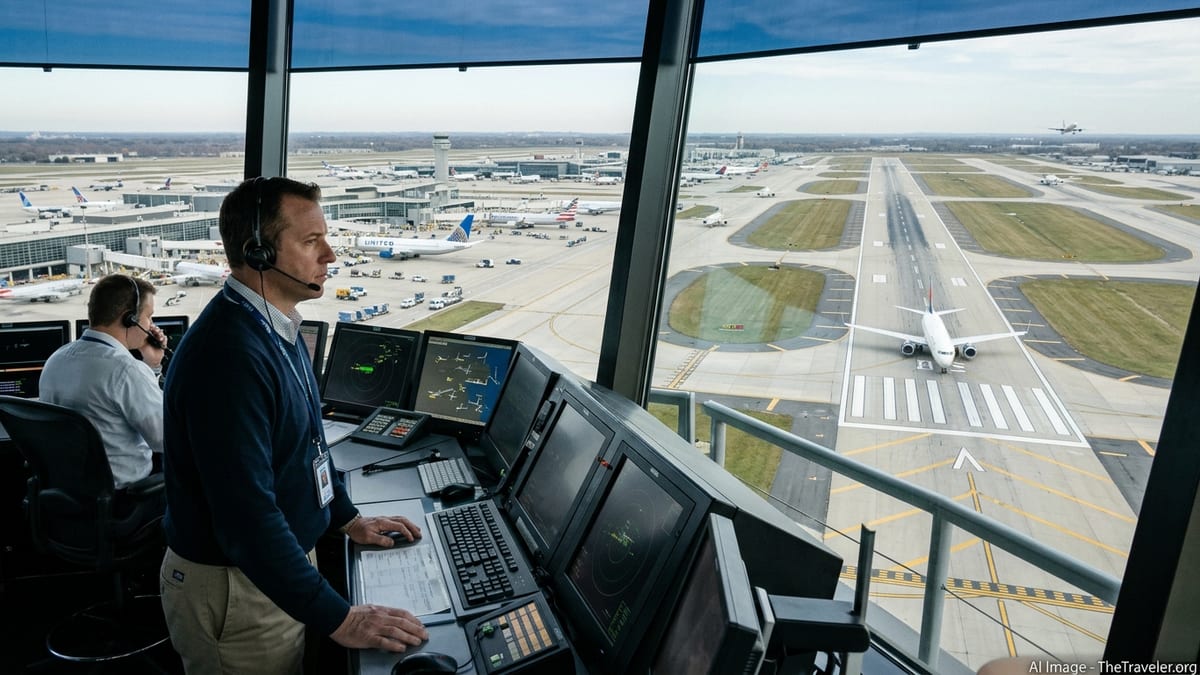
What the new LUAW supervision rule changes
The Federal Aviation Administration’s Notice JO 7210.979, titled “Line Up and Wait (LUAW) Operations Watch Supervision Requirement,” was issued on October 9, 2026 and became effective on November 24, 2026. It applies to FAA-operated airport control towers that use the “line up and wait” procedure, which allows controllers to direct an aircraft onto the runway to hold in position before receiving takeoff clearance.
Under the notice, a stand-alone watch supervisor or controller-in-charge position must be staffed whenever controllers conduct LUAW operations. That supervisor role must not be combined with any other operational position, such as working a control position or handling additional tower duties at the same time. The requirement is framed as a safety measure intended to ensure continuous oversight of aircraft that are instructed to enter and wait on an active runway.
The notice effectively codifies dedicated supervision for LUAW as a mandatory condition of using the procedure, rather than a recommended practice. Existing FAA orders governing facility operations and watch supervision are cross-referenced in the document, but JO 7210.979 specifically ties the ability to employ LUAW to the presence of a supervisor focused solely on that function.
Why LUAW is under scrutiny
“Line up and wait” is widely used at busy airports because it can reduce departure queues and help sequence traffic more efficiently. An aircraft can be positioned on the runway and be ready to depart as soon as landing traffic passes or gaps appear, which can be especially helpful during peak travel periods. The procedure is defined in FAA controller and pilot guidance and has been the subject of safety campaigns in recent years.
FAA analyses of past runway incursions and incidents have highlighted the risks when an aircraft remains in position on a runway for an extended period after receiving a LUAW instruction. Agency publications note that some serious events have occurred when two minutes or more elapsed between the LUAW clearance and a subsequent landing or go-around involving another aircraft. Those reviews have underpinned efforts to tighten phraseology, improve signage and lighting on airfields, and clarify roles inside control towers.
The new supervision rule fits within that broader focus on runway safety. In earlier notices on watch supervision assignments, the FAA emphasized that dedicated oversight is critical to both safety and efficiency in complex operations. JO 7210.979 extends that approach by explicitly linking the use of LUAW to a staffing condition that ensures someone in the tower is responsible for monitoring traffic on the runway and intervening quickly if needed.
How the rule could affect airport operations and delays
The immediate operational impact of JO 7210.979 depends heavily on local staffing levels and traffic patterns at individual airports. Where towers already schedule a stand-alone supervisor during busy periods, the change may simply formalize existing practice and have limited effect on throughput. At facilities where supervisors routinely combine oversight duties with working a control position, however, managers may need to adjust schedules or modify how and when LUAW is used.
Because the rule prohibits combining the LUAW watch supervisor role with other operational positions, airports that are short of qualified staff at a given time could find themselves temporarily unable to use LUAW. In those circumstances, controllers would have to rely on alternative sequencing techniques that may be less efficient, particularly on runways that routinely handle closely spaced departures and arrivals. That could, in turn, contribute to longer departure queues or minor reductions in capacity at peak times.
So far, there is no nationwide data quantifying the impact of the new supervision requirement on delays, in part because it has only just taken effect. Trade publications and online discussions among controllers indicate concern that some smaller or already stretched towers may curtail LUAW more often while they adjust staffing plans. At large hub airports with multiple supervisors on duty, early commentary suggests the change is being absorbed into existing watch structures with fewer immediate constraints on operations.
Timing with a busy Thanksgiving travel period
The rule’s start date of November 24 coincides with one of the busiest travel weeks of the year in the United States. The Department of Transportation and FAA project that more than 417,000 flights will operate nationwide during the nine-day Thanksgiving period from November 23 through December 1, 2026, the highest Thanksgiving-week total in 16 years. Agency forecasts and public briefings indicate that Tuesday, November 24 is expected to be the single busiest day of that span, with just over 52,000 flights scheduled.
Separate travel forecasts from AAA estimate that about 5.96 million people will fly over the Thanksgiving holiday period, within a broader total of roughly 81.5 million Americans traveling at least 50 miles from home by all modes between Tuesday, November 24 and Monday, November 30, 2026. While the overall travel volume is projected to be slightly below last year’s record, flights remain near recent highs, putting sustained pressure on both airlines and air traffic control facilities.
The start of JO 7210.979 also follows a series of recent aviation disruptions. On November 13, 2026, a telecommunications issue affecting FAA air traffic control facilities prompted a nationwide ground stop that temporarily halted many departures and led to cascading delays over subsequent days. The FAA said afterward that it traced the issue to instability in part of its telecommunications network and disabled certain router functions as a precaution while it worked on a longer-term fix.
Recent technical issues and local constraints
In addition to the November 13 nationwide ground stop, individual airports have experienced localized technical problems during the pre-Thanksgiving period. At Chicago O’Hare International Airport, a ground surveillance radar issue on November 24 led the FAA to briefly restrict arriving flights while technicians addressed the problem. According to agency statements at the time, arrivals were metered and some inbound flights were delayed until the equipment issue was resolved.
Major airlines have also reported operational outages in the days leading up to the holiday. Delta Air Lines, for example, experienced a malfunction of an automated system used to calculate aircraft weight and balance on November 22, causing significant delays across its network on a busy Sunday for Thanksgiving travel. The carrier said normal operations resumed after it corrected the system problem, but flight-tracking services recorded hundreds of delayed departures while the disruption was unfolding.
These technical issues are distinct from the new LUAW supervision rule, which concerns tower staffing rather than computer networks, radar or airline dispatch systems. However, for travelers encountering a delay or cancellation during this holiday period, the practical effect can be similar regardless of the underlying cause: longer lines at airports, missed connections and altered itineraries. The combination of heavy traffic, unsettled seasonal weather in parts of the country and tighter operational constraints means schedules can be more vulnerable to knock-on effects when something goes wrong.
What air travelers should monitor in the coming months
For passengers, the key point is that Notice JO 7210.979 is a runway-safety supervision requirement rather than a directive to reduce traffic nationwide. The rule does not, by itself, order any particular airport to cut movements or cancel flights. Its impact is likely to be uneven and most noticeable at facilities where staffing levels already limit tower flexibility, especially during peak periods or in complex runway configurations where LUAW has been used extensively to manage departures.
The notice is currently listed by the FAA as active through June 10, 2027. That end date reflects the agency’s standard practice of applying a time limit to internal notices that amend operational orders, with the option to replace, modify or incorporate the provisions into a later revision of its core facility operations manual. The FAA has also issued updated versions of its broader order on facility operations that reference watch supervision responsibilities, suggesting that LUAW oversight will remain under review as the agency evaluates safety data and operational feedback.
In the near term, travelers flying during Thanksgiving week and through the winter should continue to rely on the same practical steps that help during any busy travel period. Airlines remain the primary source of information about individual flights, and notifications through carrier apps or text alerts are usually the first indication of a schedule change. The FAA’s public National Airspace System Status portal provides an overview of airport-specific delays and ground stops, which can be useful to understand whether a disruption is localized or part of a broader system issue.
Looking beyond the holiday, any measurable effect of the LUAW supervision rule on delays or airport capacity is likely to become clearer only after several months of operation, as towers adjust staffing patterns and the FAA reviews how the requirement functions alongside its wider runway safety initiatives. Until then, travelers should be aware that staffing rules inside control towers, while largely invisible from the cabin, are one of several factors that can influence how flexibly airports manage traffic when skies are busy and conditions are changing.