


More news on this day
A FedEx Express McDonnell Douglas MD-11 freighter arriving from Memphis overran a runway at Miami International Airport on the evening of November 25, 2026, temporarily closing most of the airport’s runways, prompting a ground stop for inbound flights and causing delays for Thanksgiving-week travelers, according to airport officials and federal regulators.
Get the latest news straight to your inbox!
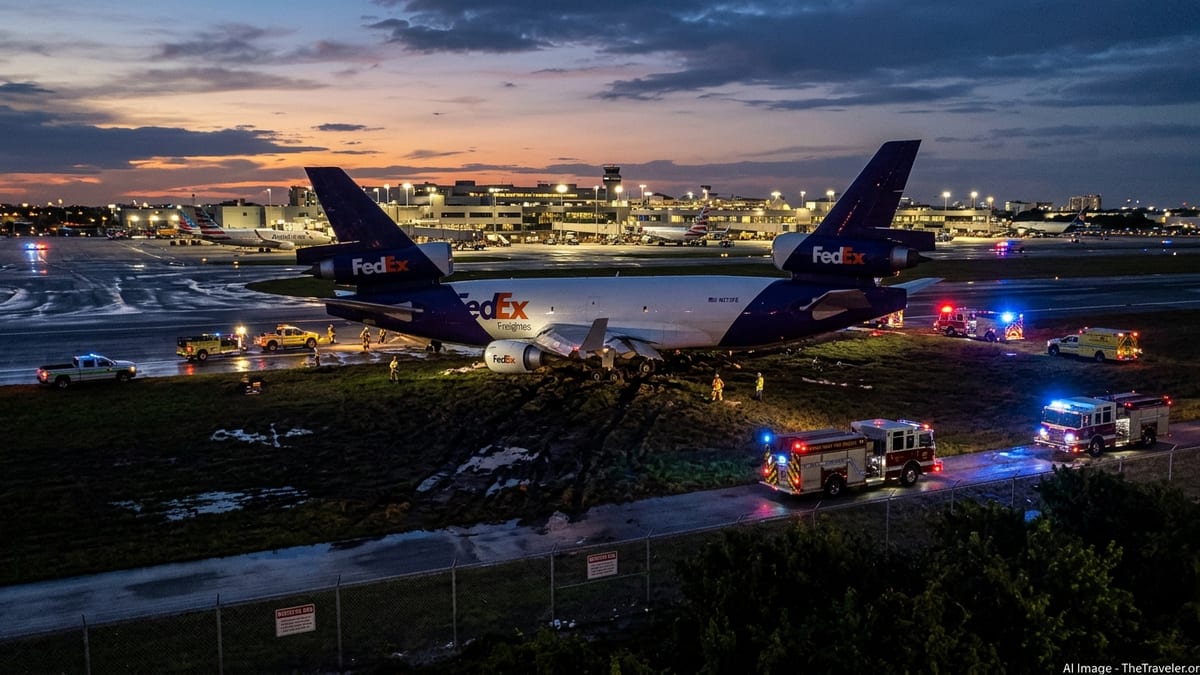
What happened during the FedEx landing at Miami
According to the Federal Aviation Administration, the incident involved a FedEx Express McDonnell Douglas MD-11 operating as a cargo flight from Memphis, Tennessee, to Miami. The aircraft landed on Runway 26R at Miami International Airport on Wednesday, November 25, at around 8:40 p.m. local time before overrunning the paved surface and coming to rest in a grassy area near the airport’s western perimeter. Early reports from aviation tracking and incident databases indicate the aircraft was registered as N605FE and operating as FedEx Flight 910, though those operational details have not yet been formally summarized in a public federal report.
Images and video published overnight show the widebody trijet upright on its landing gear, off the end of the runway but short of nearby roads and buildings. Emergency vehicles surrounded the aircraft as crews assessed the situation and began recovery planning. There was no post-incident fire, and authorities have not reported any fuel spill reaching public roads or facilities.
FedEx said in a written statement that the aircraft experienced “an issue upon landing” in Miami and confirmed there were no injuries to the crew. The company added that it is cooperating with investigators. Neither FedEx nor federal agencies have publicly detailed any cockpit communications, specific weather challenges or mechanical concerns that may have contributed to the runway excursion.
Impact on Miami operations and Thanksgiving travelers
The runway excursion immediately reduced Miami International Airport’s operating capacity on one of the busiest travel evenings of the year. Airport and FAA information show that all but one of Miami’s runways were temporarily closed on Wednesday night while responders secured the site and authorities inspected adjacent pavement and safety areas. Because the disabled aircraft remained near the end of Runway 26R, aircraft movements in the western part of the airfield were tightly constrained.
Shortly after the incident, the FAA issued a ground stop for flights bound for Miami International, halting many departures from other airports that were scheduled to land in Miami. That measure is used when an airport’s capacity is sharply reduced, and in this case it allowed controllers to manage limited runway availability while emergency crews and airport operations teams worked at the scene. By early Thursday morning on November 26, federal air traffic updates were showing delays of several hours on some Miami arrivals and departures, though the length and severity of disruptions varied by airline and route.
Miami International Airport urged passengers flying on Wednesday night and Thanksgiving Day to check directly with their airlines for the latest flight status before traveling to the airport. Carriers adjusted schedules by delaying, rerouting or, in some cases, canceling services into and out of Miami while the disabled cargo aircraft remained in place and recovery equipment was brought to the site. Travelers connecting through Miami, particularly on late-night and early-morning banked operations, faced the greatest risk of missed connections and rolling delays.
Recent safety incidents at Miami International Airport
Wednesday’s FedEx overrun is the latest in a series of incidents involving large aircraft at Miami International this year. On September 6, 2026, a Boeing 767-300 freighter operating as 21 Air Flight 7598 on behalf of Amazon overshot Runway 30 after landing, broke through the airport perimeter and struck two ground vehicles on a nearby road. Five people in the vehicles were killed and several others were seriously injured. The NTSB’s preliminary report on that crash confirmed the aircraft overran the runway and came to rest beyond airport property, and investigators are still analyzing flight data and cockpit voice recordings as part of an ongoing investigation.
The FedEx overrun occurred on a different runway from the Amazon-related accident, according to airport and investigative records. However, several of Miami’s runways converge in the western portion of the airfield, which means that serious excursions in this area bring large aircraft close to airport boundaries and nearby roads. Aviation safety specialists note that such geography, combined with heavy cargo and passenger traffic, underscores the importance of stabilized approaches, accurate landing performance calculations and effective runway safety areas at major hub airports such as Miami.
Miami has also seen at least one minor ground collision this month. Local media and airline statements reported that less than two weeks before the FedEx incident, a Copa Airlines aircraft and a UPS plane made contact on a taxiway, with the Copa aircraft’s wingtip striking the nose of the UPS jet at a taxiway intersection. That collision caused only minor damage and no injuries but prompted temporary taxiway closures and inspections. While there is no indication that the taxiway collision and the two runway excursions share a common cause, together they have drawn renewed attention to airfield safety at one of the United States’ busiest international and cargo hubs.
What is known about the aircraft type and recent fleet history
The aircraft involved in Wednesday’s incident is part of FedEx Express’s fleet of McDonnell Douglas MD-11 freighters, a three‑engine widebody type introduced in the 1990s and no longer in passenger service. The MD-11 has been used extensively in cargo operations worldwide and has previously been involved in several high-profile landing accidents and runway excursions, particularly in crosswind or unstable-approach conditions. Regulators and operators have over the years emphasized specific training on landing techniques for the type, including pitch control, flare management and touchdown zone discipline.
Public filings and aviation industry reports earlier this year indicated that FedEx had temporarily grounded portions of its MD-11 fleet following a fatal crash involving another operator’s MD-11 in Kentucky in 2025. That crash, which occurred on takeoff and not during landing, led regulators to mandate inspections and a series of modifications before the type could resume full operations in some fleets. In 2026, the FAA approved engineering fixes for the issue at the heart of that grounding, clearing airlines that implemented the approved modifications to return MD-11s to regular service. FedEx gradually placed its MD-11s back into cargo rotation after those approvals and has continued to use the type on high-volume routes such as Memphis to Miami.
As of Thursday morning, neither the FAA nor the National Transportation Safety Board had suggested a link between the FedEx runway excursion in Miami and the prior Kentucky MD-11 accident. Investigators have not publicly identified any specific system failure, structural issue or maintenance discrepancy on the Miami aircraft. At this stage, officials are treating the Miami event as a standalone runway excursion to be examined on its own facts, while acknowledging it adds to the broader safety record that regulators and operators track for the MD-11 over time.
Investigations, recovery efforts and what travelers should expect next
The Federal Aviation Administration opened an investigation immediately after the incident and issued initial advisories overnight detailing a runway excursion involving a FedEx MD-11 arriving from Memphis with no reported injuries. The National Transportation Safety Board stated early Thursday that it is gathering information and coordinating with local authorities and FedEx but had not yet released a formal investigative docket or named a probable cause. In a typical case of this type, NTSB investigators will review flight data recorder and cockpit voice recorder information, analyze weather conditions at the time of landing, examine braking and thrust reverser performance and interview the flight crew and air traffic controllers.
Recovery of the aircraft and repair of any runway or safety-area damage are key steps before Miami International Airport can fully restore its usual runway configuration. Heavy equipment is required to move a fully loaded MD-11 from soft ground back onto prepared surfaces, and those operations must be sequenced around other airfield activity to maintain safety for responding crews and for flights still using the open runway. Airport officials had not, as of Thursday morning, announced a precise timeline for when all runways would reopen, noting that assessments of pavement, lighting and instrument landing systems near the overrun area were ongoing.
For travelers with upcoming flights into or out of Miami, the most immediate implications are potential delays, schedule changes and aircraft substitutions through at least the rest of Thanksgiving Day and possibly into Friday, November 27, depending on how quickly the aircraft is recovered and all runway inspections are completed. Passengers are advised to monitor airline apps and text or email alerts closely, pay particular attention to any gate or time changes at connecting airports, and allow additional time at the airport in case of longer lines at check-in and security resulting from rolling waves of delayed flights. While there is currently no indication that the incident will lead to broader schedule reductions beyond the short term, it may affect the on-time performance of late-evening banked departures and arrivals that rely on full runway capacity at Miami.