


More news on this day
Norse Atlantic Airways has suspended all flight operations from 26 November 2026 after warning that its financial position is critical and that it will file for bankruptcy if it cannot secure emergency funding, disrupting long-haul links from the UK and Nordic countries and leaving thousands of travellers seeking alternatives.
Get the latest news straight to your inbox!
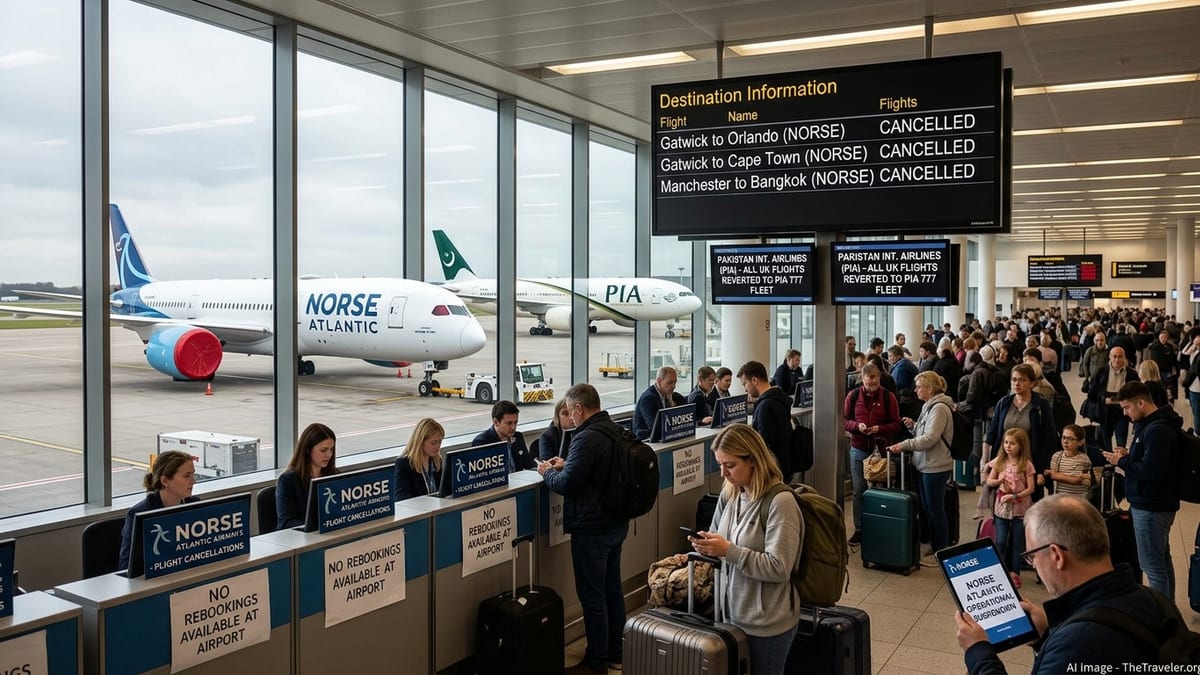
Operations suspended after emergency stock exchange notice
Norse Atlantic ASA confirmed in a stock exchange announcement on the morning of 26 November 2026 that all scheduled flights are suspended while it seeks urgent short-term financing and potential new investors. The Oslo-listed long-haul low-cost carrier said it had failed so far to secure an immediate financial solution and warned that bankruptcy proceedings would be initiated if fresh liquidity could not be arranged at very short notice.
The statement followed a market update on 25 November in which the airline described its financial situation as critical and said that continued operation depended on additional funding to meet near-term cash needs. Trading in Norse shares on Euronext Expand in Oslo has been placed in a special "Recovery Box" category as the company evaluates options, underlining the severity of the situation and the heightened risk for shareholders.
In its communication to investors, the board said it is continuing discussions with potential financial and strategic partners, including parties considering a possible takeover, new equity, debt restructuring or other recapitalisation measures. It also reiterated that there is no assurance that negotiations will lead to a viable solution, and that a court-administered insolvency process remains a probable outcome if no agreement is reached in time to restart operations.
UK routes hardest hit as Gatwick and Manchester services stop
The immediate suspension of flights has the greatest visible impact in the United Kingdom, where Norse Atlantic had built a sizeable operation from London Gatwick and, to a lesser extent, Manchester. In recent days the carrier had been operating long-haul services from Gatwick to Orlando, Bangkok and Cape Town, as well as seasonal and winter routes linking Manchester with Bangkok and Phuket. Flight-tracking and airport departure boards on 25 and 26 November show Norse-operated departures on these routes cancelled or removed from schedules following the announcement.
The disruption extends beyond Norse’s own ticket sales. Pakistan International Airlines had been using two Norse-operated Boeing 787-9 aircraft on a wet-lease basis for services from London Heathrow to Islamabad and from Manchester to Lahore. PIA confirmed on 25 November that flights PK786 and PK710 were cancelled at short notice after Norse notified the Pakistani carrier that its operations were being suspended while passengers were preparing to board. From 26 November, PIA says all UK routes are being transferred back to its own Boeing 777 fleet, with affected customers being rebooked or refunded according to its usual policies.
Cruise passengers are another group affected by the sudden loss of capacity. UK-based P&O Cruises has been using chartered Norse Boeing 787 Dreamliners for part of its winter Caribbean fly-cruise programme, carrying guests between UK airports and embarkation ports in the region. The cruise line has said it has contingency plans in place and is arranging replacement aircraft through other operators, but individual flight numbers, timings and carriers are being updated on a departure-by-departure basis, meaning passengers are advised to check pre-cruise documentation closely.
Nordic travellers and planned Thailand growth face uncertainty
Norse Atlantic’s decision to ground all flights is also disrupting travel plans in its home markets of Norway and Sweden. The airline has been operating transatlantic and seasonal long-haul services from Oslo and Stockholm, and had previously outlined plans to expand winter 2026–27 flying to Thailand from both cities, including additional frequencies to Bangkok and Phuket. Those Thailand growth plans were still at the announced and scheduled stage rather than in operation and are now in doubt unless the carrier can secure a restructuring that allows it to resume flying.
Nordic aviation authorities and airports have so far treated the situation as a commercial matter, and there is no indication of licence revocation or regulatory grounding. Slot records and advance schedules for Oslo Gardermoen and Stockholm Arlanda show Norse flight numbers remaining in future timetables for now, but these are purely indicative until the airline confirms whether it will resume operations. Passengers booked on later winter departures are therefore in a holding pattern, with no confirmed alternative arrangements publicly announced by Norse at the time of writing.
The impact within Scandinavia is amplified by the limited number of low-cost long-haul options based in the region. Norse had partly filled the gap left after Norwegian Air Shuttle exited most of its long-haul network earlier in the decade, offering lower-fare connections from Nordic capitals to leisure destinations in North America, southern Africa and Asia. With Norse flights now halted, many travellers targeting peak-season trips to Thailand or the United States from Oslo or Stockholm are likely to face higher prices from remaining full-service competitors or will need to connect via larger European hubs.
Charter and wet-lease partners scramble to replace capacity
Beyond its own-brand scheduled services, Norse Atlantic has built a substantial business providing aircraft and crews on a charter or wet-lease basis to other airlines and tour operators. The current suspension of operations therefore has knock-on effects for partners relying on its Boeing 787-9 fleet during the northern winter, some of whom had only recently transitioned to Norse aircraft. In addition to PIA’s UK routes and P&O Cruises’ Caribbean charters, industry reports indicate that Norse had supplied aircraft on damp- and wet-lease terms to carriers including IndiGo earlier in 2026, although those specific arrangements had already ended before the present crisis.
Pakistan International Airlines has so far provided the most detailed public response, explaining that its decision to revert to in-house Boeing 777 capacity on UK routes from 26 November is designed to avoid further disruption after the last-minute cancellations on 25 November. The carrier has said that its customer service teams are contacting passengers whose flights were due to be operated by Norse, with rebooking and refund options offered in line with existing PIA policies and regulators’ requirements for cancellations originating in the UK.
Tour operators and cruise lines, which typically have contracts allowing them to source alternative aircraft in the event of a supplier failure, are generally more insulated than individual ticket buyers but still face logistical challenges. They must secure replacement widebody capacity at short notice during a busy travel period, renegotiate timings with airports, and ensure that any substitute carrier meets safety oversight and consumer protection rules in each departure country. Passengers travelling on package holidays that included Norse-operated flights are usually protected under package travel regulations, meaning that the organiser rather than the airline is responsible for providing an alternative or a refund, although the precise rights depend on the jurisdiction and contract terms.
What affected travellers should do now
For passengers holding Norse Atlantic tickets in the coming days, the most important point is that, as of 26 November, the airline has suspended all flight operations while it seeks emergency funding. Norse has indicated that operations will not resume unless and until a financial solution is secured, and there is a material risk that the company will enter formal bankruptcy proceedings. Travellers are therefore advised not to go to the airport for a Norse-operated flight unless they have received explicit written confirmation from the airline, a codeshare partner or a package organiser that their specific service will operate.
Customers who booked directly with Norse and whose flights are cancelled should retain booking confirmations, cancellation notices and any correspondence, as these documents will be needed to seek refunds or pursue chargebacks through credit card providers if the airline ultimately becomes insolvent. In the UK and European Union, flights originating from those jurisdictions ordinarily fall under air passenger rights regulations that provide compensation and re-routing obligations when cancellations occur. However, if the airline ceases trading entirely, those rights become difficult to enforce in practice and passengers may instead need to claim through travel insurance or payment card protections.
Travellers booked on flights operated by partners such as Pakistan International Airlines or on package holidays and cruises using Norse aircraft should contact the company from which they bought their ticket or holiday rather than Norse itself. In many cases, those organisations are sourcing replacement aircraft or rebooking passengers onto alternative services, and they are responsible for advising customers of new flight numbers, timings and baggage arrangements. As the financial and operational situation at Norse Atlantic evolves, passengers should check for updated guidance from the airline, their travel agent or tour operator, and monitor official channels for any court filings or restructuring announcements that clarify whether any part of the network will resume operations.