


More news on this day
Thanksgiving Eve air travel at Miami International Airport was disrupted on November 25 after a FedEx Express MD-11 cargo jet arriving from Memphis overran a runway, prompting a temporary ground stop for inbound flights and the closure of all but one runway as emergency crews secured the scene.
Get the latest news straight to your inbox!
What happened during the FedEx landing at Miami
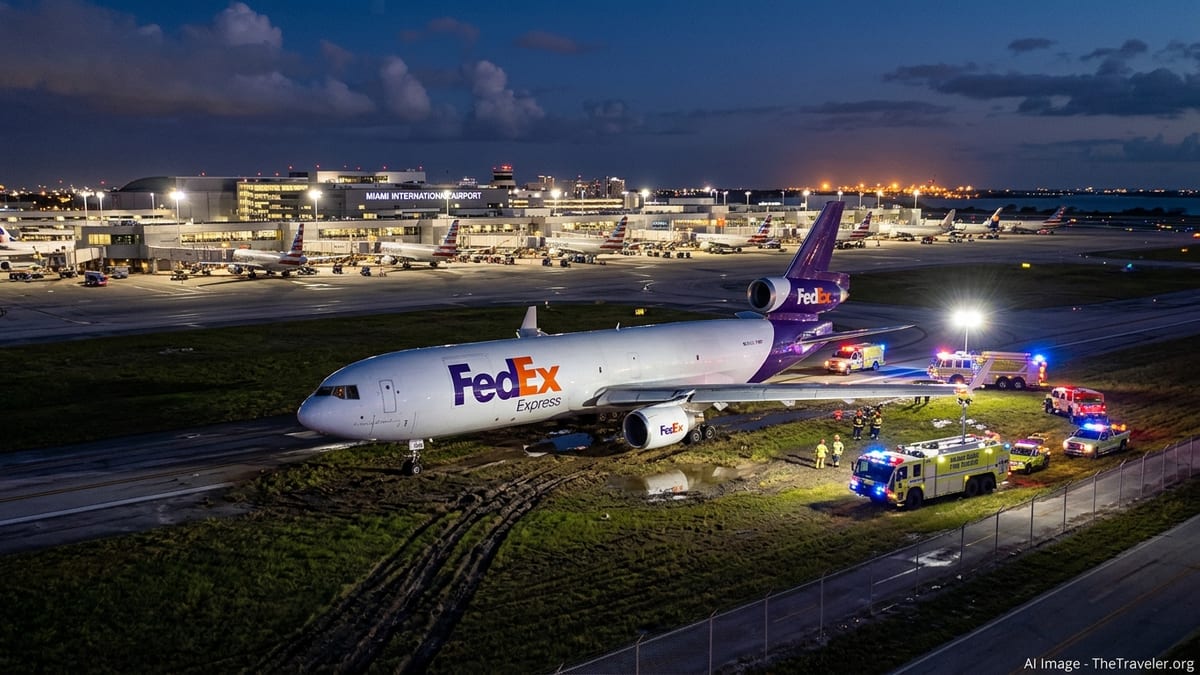
According to the Federal Aviation Administration, the incident occurred on Wednesday, November 25, at around 8:40 p.m. local time when FedEx Express Flight 910 from Memphis landed on Runway 26R at Miami International Airport and did not stop before the end of the paved surface. Preliminary descriptions from airport officials and aviation incident databases indicate that the McDonnell Douglas MD-11 freighter continued beyond the runway end, coming to rest in the runway safety area near the airport perimeter fence.
Local authorities reported that two pilots were on board the aircraft and that neither sustained injuries. Images and video published by news outlets and shared by aviation enthusiasts show the purple-and-white FedEx jet stationary off the runway, with its landing gear still intact and fire trucks positioned nearby. There were no passengers, as the aircraft was operating a cargo service, and there were no immediate reports of injuries on the ground or damage to vehicles or buildings adjacent to the airport.
Miami-Dade Fire Rescue units responded within minutes after air traffic controllers reported a runway overrun involving a FedEx aircraft. Firefighters laid down foam as a precaution and inspected the aircraft for fuel leaks or fire risk while airport operations teams assessed any damage to airfield infrastructure. Early visual assessments described in local coverage suggest that the aircraft did not catch fire and appeared largely intact, but authorities have not yet confirmed whether it will be repairable or written off.
Runway closures, FAA ground stop and travel disruption
The runway excursion immediately constrained Miami International Airport’s capacity on one of the busiest travel evenings of the year. With the FedEx MD-11 disabled beyond the far end of Runway 26R, airport officials closed that runway and at least one other parallel runway while emergency operations were underway. For a period on Wednesday night, only the south runway, identified in local reports as Runway 9R/27L, remained available for takeoffs and landings.
The FAA issued a ground stop for flights bound for Miami, instructing departing aircraft from other airports destined for MIA to remain on the ground until conditions improved. Advisory data and statements cited by U.S. media indicate that the ground stop lasted for a limited time but contributed to a ripple of delays across domestic and some international services heading to South Florida. Arrivals already en route were subjected to airborne holding or, in a small number of cases, diverted to alternate airports while runway availability and taxi routes were reassessed.
As of early Thanksgiving Day, November 26, airport status information and local news reports described operations at Miami International as recovering but still constrained, with some residual delays and a continued closure of the affected runway while investigators documented the aircraft’s position and arranged for its removal. Airlines serving Miami advised passengers to allow extra time at departure airports, monitor their flight status closely and be prepared for schedule changes as traffic at MIA was re-sequenced around the remaining active runways.
Aircraft type, flight details and initial safety investigation
Multiple aviation sources identify the aircraft involved as a FedEx Express McDonnell Douglas MD-11F, a three‑engine widebody cargo jet, operating under the call sign FedEx 910 on a scheduled freight service from Memphis International Airport to Miami International. Online flight-tracking records and specialist aviation outlets report that the aircraft landed toward the west on Runway 26R after an evening arrival pattern typical for overnight cargo operations into Miami.
The MD-11, introduced in the 1990s, has long been a mainstay of FedEx’s long-haul freight fleet, although the carrier has gradually been phasing out the type. Several reports note that FedEx had recently increased use of the MD-11 again after previous incidents, but company fleet decisions are not directly connected to any established cause of this event. At this early stage, officials have not indicated whether weather, runway conditions, aircraft performance, braking, or human factors played a role in the runway excursion.
The FAA confirmed that it has opened an investigation into the incident. In line with standard practice for significant runway overruns involving U.S. operators, the National Transportation Safety Board is expected to participate or lead a formal safety investigation, although the precise level of involvement had not yet been detailed publicly by Thursday morning. Investigators will analyze flight data and cockpit voice recorders, examine the aircraft’s braking and thrust-reverser systems, review air traffic control communications and consider weather reports and runway friction measurements from the time of landing.
Connection to earlier Miami cargo runway overrun
This FedEx incident comes less than three months after a separate cargo runway overrun at Miami International Airport involving a different operator. In early September 2026, a Boeing 767 freighter flying on behalf of an e-commerce carrier overran a different runway after landing and struck ground vehicles outside the airport perimeter. That earlier accident caused multiple fatalities and significant damage to both the aircraft and vehicles, and it remains under active NTSB investigation.
In the current FedEx case, authorities have emphasized that there were no injuries and no confirmed impact with road traffic or buildings beyond the airfield fence. The two incidents occurred on different runways and under different circumstances. Regulators and investigators have not suggested any direct link between the events, and there is currently no public evidence of a systemic infrastructure problem at Miami affecting all runways. Any broader conclusions will depend on the results of the detailed investigations into each overrun.
For travelers, the proximity of the two incidents in time and location may raise understandable concerns about safety at Miami International, which is one of the busiest airports in the United States for both passenger and cargo traffic. However, commercial aviation in the U.S. continues to operate under strict federal oversight, and runway excursions, while serious, remain rare compared with the total number of annual takeoffs and landings. Until investigators publish factual reports, it would be speculative to attribute the latest event to any single pattern or cause.
What travelers through Miami should know now
With U.S. Thanksgiving falling on Thursday, November 26, the timing of the FedEx runway excursion has created particular challenges for passengers passing through South Florida. Forecasts obtained by news outlets earlier in the week indicated that nationwide Thanksgiving air travel was expected to reach its highest levels in more than a decade, leaving limited slack in the system to absorb disruptions. The temporary loss of a key runway at Miami on the eve of the holiday has therefore had an outsized effect on schedules, especially for evening and overnight departures and arrivals.
As of Thursday morning, airlines serving Miami were advising customers to confirm their flight status on official channels before leaving for the airport, pay close attention to gate and departure time changes and be prepared for potential knock-on delays even if their flights were not directly affected on Wednesday night. Some carriers were offering rebooking options or waiving certain change fees for passengers whose journeys were disrupted by the ground stop and resulting congestion, although specific policies varied by airline and fare type and should be verified directly with the company concerned.
Travelers with tight connections at Miami on November 26 and over the following day were being urged to allow extra buffer time and to consider alternative routings if their itineraries were flexible. While most passenger facilities at Miami International remain open, authorities will keep segments of the airfield restricted until the FedEx aircraft is removed and safety inspectors complete their on-site work. The pace at which full runway capacity returns will depend on how quickly the disabled aircraft can be moved and on the needs of the ongoing investigation, so passengers should expect airlines and the airport to issue further operational updates as the situation evolves.