


More news on this day
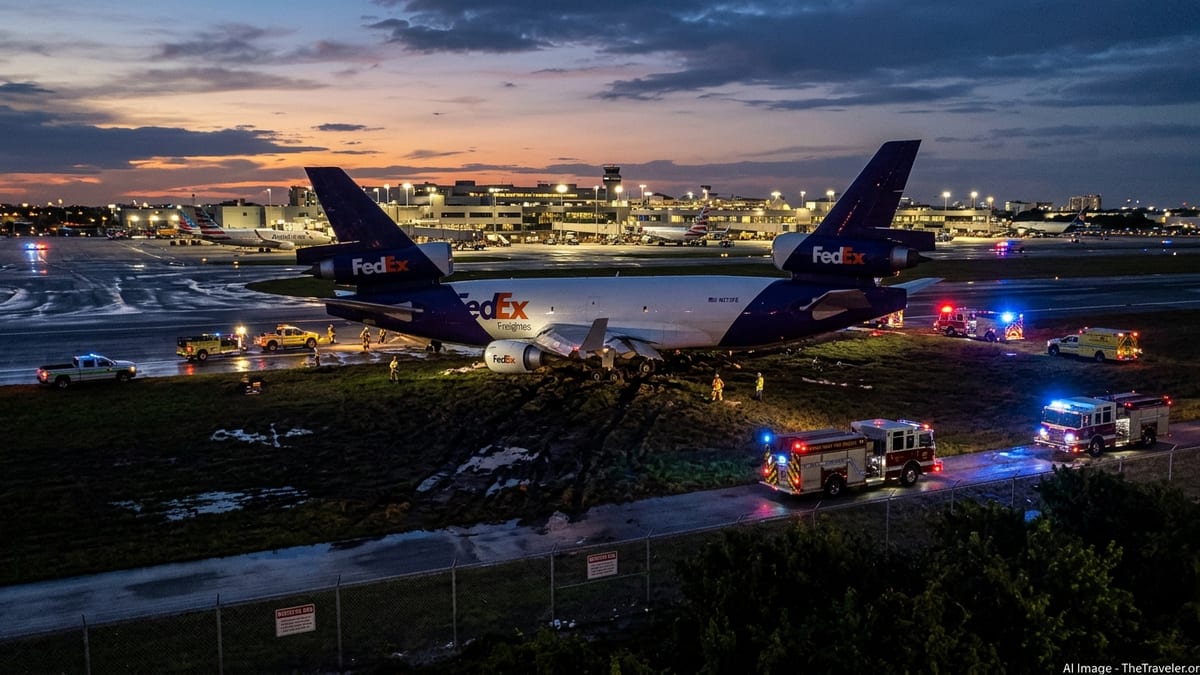
A FedEx Express MD-11F cargo jet arriving from Memphis overran a runway while landing at Miami International Airport on the evening of November 25, 2026, forcing the temporary closure of most runways during one of the busiest travel nights of the Thanksgiving period. No injuries were reported, but the incident disrupted flights at one of the United States’ key passenger and cargo gateways.
Get the latest news straight to your inbox!
What happened to FedEx Flight 910 at Miami
According to preliminary information from flight tracking services and accident databases, the aircraft involved was a McDonnell Douglas MD-11F registered N605FE, operating as FedEx flight FX910 from Memphis International Airport to Miami International Airport. The freighter departed Memphis behind schedule in the late afternoon and touched down at Miami at approximately 8:26 p.m. local time on Wednesday, November 25.
After landing on runway 26R, one of Miami’s four main runways, the aircraft failed to stop within the paved surface and continued beyond the runway end. Data compiled by several independent aviation tracking sites indicates the MD-11 ran several hundred metres into the engineered safety area, veered slightly to avoid navigation equipment and came to rest in grass near the western perimeter fence of the airport. Local media images published overnight showed the aircraft on its landing gear with emergency vehicles surrounding it.
The Federal Aviation Administration confirmed a “runway excursion” involving a FedEx cargo aircraft at Miami and said that an investigation is under way. Early reports from the airport and local outlets indicated that two crew members were on board and that there were no injuries to crew or people on the ground. There is no indication so far of a fuel spill or fire, and the aircraft appears to have remained largely intact, although the extent of structural or landing gear damage has not yet been detailed.
Because the jet came to a stop past the end of runway 26R, on soft ground close to airport infrastructure, responders needed time to secure the aircraft before it could be moved. The National Transportation Safety Board has opened an investigation and is expected to publish an initial preliminary report in the coming weeks outlining factual information such as the touchdown point, rollout path and the status of the braking and thrust-reverser systems.
Runway closures and disruption during peak Thanksgiving travel
Shortly after the incident, the FAA issued a ground stop for flights bound for Miami International Airport, instructing departures from other airports to hold before takeoff while the situation was assessed. For a period on Wednesday night, only one of Miami’s four runways was available, with airport and emergency crews focusing on securing the disabled freighter at the western end of runway 26R and confirming that surrounding pavement and lighting systems were safe.
Miami International is among the busiest airports in the United States for international passengers and a major hub for cargo operations into Latin America and the Caribbean. The incident occurred on the eve of Thanksgiving, a period when U.S. airports typically reach some of their highest traffic volumes of the year. While most impacts were concentrated in South Florida and on flights using Miami as a hub, the ground stop briefly affected airline operations systemwide as aircraft held on the ground awaiting clearance to depart for Miami.
Departing flights from Miami experienced delays as air traffic controllers managed operations with reduced runway capacity and prioritized arriving aircraft already in the terminal area. Some incoming flights diverted to nearby airports, including Fort Lauderdale and Orlando, to avoid extended holding. Airlines began gradually resuming more typical operations once the ground stop was lifted and controllers were able to increase landing and departure rates using the remaining open runways.
For travelers passing through Miami on Wednesday evening and into Thursday morning, the immediate implication was the potential for missed connections and longer-than-usual waits on the ground. Passengers connecting between North American, Caribbean and Latin American services through Miami were advised by airlines to monitor their flight status closely, as delays in one part of the network could ripple into subsequent rotations. Cargo customers shipping time-sensitive goods through the airport also faced potential knock-on effects as freighter schedules were adjusted.
Weather, runway layout and what investigators will review
Weather conditions at Miami around the time of the landing included rain and passing thunderstorms, with reports of wet runways and gusty winds. Hourly observations for the airport on the evening of November 25 indicate rain in the area and wind gusts near 18 knots in the period leading up to the arrival of FedEx flight 910. Wet or contaminated runway conditions are among the factors that investigators routinely examine following an overrun, alongside aircraft performance, braking action reports and crew decision-making.
Runway 26R is a west-facing runway on the northern side of Miami International’s airfield. Together with parallel runway 26L and the airport’s two east-west runways on the south side, it forms part of a complex layout that handles intensive movements of passenger jets and freighters. The western ends of both 26R and runway 30 extend toward the edge of the airport property, close to surface roads and other infrastructure. In this case, the FedEx MD-11 stopped inside the airport boundary, in a grassy safety area ahead of the perimeter fence.
Investigators from the NTSB and FAA are expected to focus on several core questions. These typically include where along the runway the aircraft first touched down, whether the approach speed and configuration were appropriate for the conditions, and how much runway remained available at touchdown. They will also look at the state of the braking and anti-skid systems, thrust reversers and spoilers, and assess whether all systems functioned as designed. Flight data and cockpit voice recorders, once recovered, should offer detailed insight into the crew’s actions and the sequence of events on the final approach and landing roll.
At this stage, officials have not indicated any suspected cause or contributing factor. While the rainy conditions and wet runway may be one element in the analysis, there is no confirmation that weather played a decisive role. It also remains too early to say whether factors such as runway condition reports, aircraft weight, landing performance calculations or operational pressures during a peak travel period had any influence. Until investigators release preliminary findings, any explanation remains speculative.
Another serious overrun at Miami involving a cargo jet
The FedEx runway excursion comes less than three months after a separate, far more severe cargo overrun at Miami International. On September 6, 2026, a Boeing 767-300 freighter operating for Amazon Air overran runway 30 after landing and left the airport property, crossing a road and striking vehicles. Five people on the ground were killed in that accident, and the aircraft sustained major damage, including a significant post-crash fire on one wing.
Following the September 6 accident, the NTSB dispatched a full investigative team to Miami, documented the site and began a detailed inquiry into factors such as landing performance, runway condition, crew decisions and the presence of engineered safety areas. That investigation is ongoing, and a final report may take several years. Authorities have not identified any common cause between the September accident and the November 25 FedEx incident, and there is currently no evidence that the two runway overruns are operationally linked.
From an infrastructure perspective, both events occurred on runways that extend toward the western side of the airport, an area with limited space between the runway ends and nearby roads and structures. The Amazon-operated 767 left the airport perimeter, while the FedEx MD-11 stopped inside the boundary. For regulators and airport planners, having two runway excursions involving cargo jets at the same airport within a single year is likely to intensify attention on runway overrun protection, arrestor systems and safety areas, although any specific changes will depend on the findings of the individual investigations.
For travelers and logistics customers, the immediate takeaway is that Miami remains under close scrutiny from both safety and operational standpoints following these high-profile incidents. However, runaway overruns remain rare events relative to the volume of daily operations at major U.S. airports, and the fact that the FedEx crew and people on the ground avoided injury underscores the role that existing safety margins and emergency response planning can play when things go wrong.
FedEx’s aging MD-11 fleet and the earlier UPS grounding
The aircraft involved in the Miami incident is part of FedEx Express’s MD-11 freighter fleet, one of the last large three-engine widebody types still in commercial cargo service. The FAA registry lists N605FE as a 1992-built airframe, making it about 34 years old. FedEx has been gradually reducing the number of MD-11s in its fleet as it introduces more modern twin-engine freighters such as the Boeing 767 and 777, but company filings show that a sizeable number of MD-11s remain active, particularly on higher-density long-haul cargo routes.
The incident also follows a period in which MD-11 operations in the United States came under heightened regulatory scrutiny. On November 4, 2025, UPS Airlines flight 2976, an MD-11F, crashed shortly after takeoff from Louisville Muhammad Ali International Airport when its left engine and pylon separated from the wing. All three crew members were killed and the aircraft was destroyed. In the months that followed, inspectors identified fatigue cracking in structural components associated with the pylon’s rear attachment to the wing on the UPS aircraft.
In response, the FAA issued airworthiness directives requiring detailed inspections and corrective action on MD-11 engine pylon mounts across U.S. fleets. FedEx temporarily withdrew its MD-11s from service to comply with these inspections and modifications. Company and regulatory documents indicate that FedEx began returning MD-11s to service gradually starting in May 2026, after the required work received approval. By late summer 2026, flight-tracking records showed that a growing number of FedEx MD-11s had re-entered commercial operations, even as the company simultaneously retired some airframes as part of a longer-term fleet renewal plan.
There is currently no evidence linking the structural failure that led to the UPS crash in Louisville to the runway overrun involving FedEx flight 910 in Miami. The earlier accident involved an in-flight engine separation on takeoff, whereas the Miami event occurred during landing and involved the aircraft’s ability to stop within the available runway distance. Investigators will nonetheless be aware of the heightened attention surrounding MD-11 safety and maintenance and will scrutinize both the airframe and its systems as part of the standard investigative process.
What travelers and shippers should expect next
In the near term, Miami International Airport is expected to continue operating its remaining runways while the FedEx aircraft is recovered from the safety area beyond runway 26R. Depending on the condition of the ground and any damage to lights or navigational equipment, parts of 26R may remain closed or restricted until repairs and inspections are complete. Travelers using Miami over the days following November 25 should check with their airline for any schedule changes or gate swaps that could result from altered runway availability and aircraft repositioning.
The NTSB typically releases a brief preliminary report within a few weeks of a significant aviation incident, summarizing factual information such as the flight’s timeline, crew complement, weather conditions and basic damage assessment. That first report does not assign cause or blame but can clarify key details that are often uncertain in the immediate aftermath, such as the exact overrun distance and the performance of braking systems. A fuller final report, including probable cause and any safety recommendations, usually takes many months or longer.
For shippers using FedEx’s global express network, the airline has alternative capacity through other aircraft types and hubs, but localized disruption around Miami is possible while the investigation and recovery continue. Time-critical cargo that would normally transit through Miami may be rerouted through other FedEx gateways in the southeastern United States or moved to later flights. Customers moving goods to or from Latin America through Miami should watch for updated tracking information and potential rebooking notices in the days after the incident.
Given the coincidence of multiple serious runway overruns at Miami in 2026, both airlines and regulators are likely to review landing policies at the airport during adverse weather, particularly for heavier freighters operating near maximum landing weight. Any changes to standard operating procedures, runway use priorities or infrastructure, however, will depend on the outcome of formal investigations. Until those findings are published, passengers and cargo customers can best prepare by allowing extra time for connections through Miami, closely monitoring flight status and remaining alert to any advisories from airlines and airport authorities.