


More news on this day
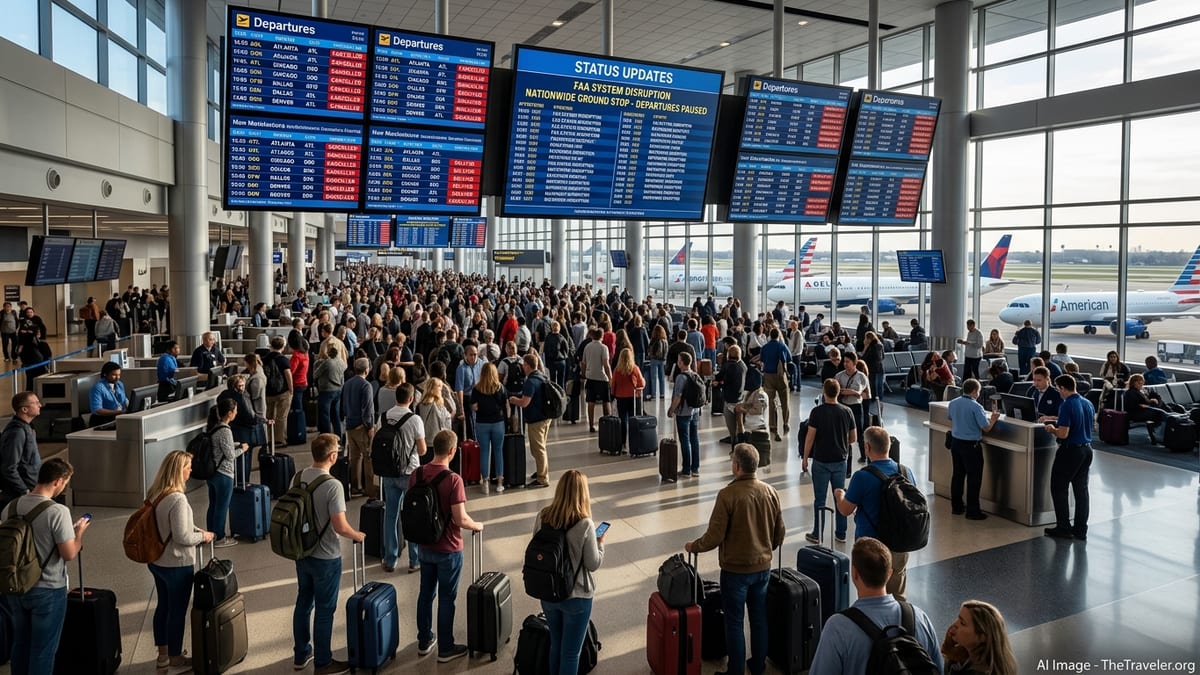
A router upgrade that destabilized parts of the Federal Aviation Administration’s telecommunications network triggered a nationwide ground stop on November 13, disrupting more than 18,000 flights just days before the peak Thanksgiving travel period and renewing scrutiny of how quickly the agency is modernizing its critical air traffic systems.
Get the latest news straight to your inbox!
What Happened On November 13
On the afternoon of November 13, 2026, the Federal Aviation Administration (FAA) issued a rare nationwide ground stop after a communications failure affected multiple air traffic control facilities. According to a formal question-and-answer document released by the agency, its network service provider L3Harris was performing work at a telecommunications site in El Dorado, Kansas, including the deployment of a new router, when the problem began. The FAA says that once the router came online, data traffic began to flood parts of the FAA’s Federal Telecommunications Infrastructure network, destabilizing older equipment that carries radar feeds and radio communications used by controllers to manage flights.
The ground stop began at 3:54 p.m. Eastern time and remained in place for nearly four hours while technicians worked to reconfigure the network and restore stable communications. During that period, departures from U.S. airports were largely halted, and the FAA directed carriers to cancel flights out of what it describes as an abundance of caution. In its public summary, the agency reports that operators ultimately canceled about 12,462 flights, including more than 9,000 cancellations by major airlines, and that thousands of other flights were delayed.
Although it was widely described as a systemwide communications outage, the FAA stresses that the failure was not absolute. Some radio frequencies and radar feeds remained available, and controllers were able to continue talking to aircraft that were already airborne and track them on backup displays. According to the agency’s account, more than 3,500 planes that were in the air at the time of the failure landed safely, using a combination of remaining feeds, fallback procedures and rerouted communications while new traffic was temporarily paused on the ground.
Technical Cause And How It Differs From Previous FAA Failures
In its initial explanations, Transportation Secretary Sean Duffy and FAA officials have linked the November 13 event to the introduction of the new router into a network that still included older telecommunications hardware. The FAA says the router began generating roughly a thousand connection attempts every four to five seconds across parts of its network. That volume of traffic did not constitute a cyberattack, according to the agency, but it was enough to make some legacy components unstable, forcing the network to repeatedly reset and interrupting the flow of data that feeds controller displays and voice circuits.
The FAA’s public statements emphasize that the problem occurred in a data aggregation and communications layer rather than in the core air traffic control or navigation systems themselves. The network impacted supports a system known internally as SMART, which consolidates radar and other data, but the FAA says SMART does not directly feed into the decision logic of the air traffic control system. Even so, the loss of reliable, real-time feeds to controller workstations meant the agency could not safely allow normal levels of traffic, prompting the nationwide pause while engineers isolated the misbehaving router traffic and shifted services to alternate paths.
This makes the November 13 incident materially different from the high-profile FAA outage on January 11, 2023, when the Notice to Air Missions, or NOTAM, system failed. In that earlier case, the FAA’s review concluded that contract personnel unintentionally deleted files while working to correct synchronization between a live database and its backup. That corrupted database halted the distribution of mandatory safety notices and led the agency to briefly ground all U.S. departures until NOTAM functions were restored. By contrast, officials say the 2026 ground stop did not involve file deletion or the NOTAM system, and current accounts from the FAA attribute the latest disruption to a hardware and configuration problem during a router upgrade rather than to software maintenance on a safety database.
Impact On Thanksgiving Travel And Airline Operations
The timing of the November 13 ground stop has sharpened its impact on travelers because it landed just as airlines were ramping up schedules for the Thanksgiving period. Data compiled by industry trackers and carrier statements suggest that more than 18,000 flights were directly affected by the four-hour disruption, including cancellations and delays, and that roughly one million passengers had their journeys altered. With aircraft and crew scattered out of position, several airlines took days to fully reset their networks, and some travelers whose flights were canceled on the 13th were rebooked on services closer to Thanksgiving week itself.
Separate but closely spaced technology issues at individual airlines have compounded those worries. In mid November, United Airlines reported a system outage that forced the carrier to temporarily hold some departures, and on November 22 Delta Air Lines experienced its own automation problem involving a system used for weight-and-balance calculations, which contributed to delays across its network. Both airlines have said they resolved their issues and resumed normal operations, and early data in the lead-up to Thanksgiving shows traffic volumes broadly in line with carriers’ expectations. Nonetheless, the cluster of failures has left some travelers uneasy about the resilience of the technology that underpins U.S. aviation during its busiest travel week.
Advance booking figures indicate that the overall scale of Thanksgiving travel in 2026 remains very high despite these jitters. For example, American Airlines has said it expects to carry around 8 million customers over the extended Thanksgiving period and to operate more flights than it did over the same stretch in 2025. Federal transportation statistics in recent years have shown that the Tuesday and Wednesday before Thanksgiving, along with the Sunday after, are among the heaviest air travel days of the year, with relatively little slack in schedules or airport capacity. That means a systemwide disruption like the November 13 ground stop can ripple forward for days as airlines work through backlogs and reposition aircraft, even after the immediate communications problem has been fixed.
Modernization Efforts And Remaining Vulnerabilities
The 2026 router failure has intensified scrutiny of the FAA’s broader technology modernization program. In a recent public briefing and follow-up materials, the agency notes that it has been replacing thousands of miles of copper telecommunications lines with fiber optic connections and upgrading hundreds of radio systems, funded in part by about 12.5 billion dollars in congressional allocations aimed at overhauling aging air traffic infrastructure. The El Dorado work that preceded the November 13 event was part of this wider effort to update network hardware and consolidate data feeds.
Although officials maintain that the U.S. air traffic system remained safe throughout the incident, they acknowledge that key systems still rely on legacy components that can interact in unpredictable ways with newer equipment. The description of a single router’s connection attempts destabilizing older gear has already prompted questions from lawmakers about redundancy, staging of upgrades and whether critical changes should be introduced during busier traffic periods. Aviation industry groups and carriers have also pointed to September’s regional communications outage in the Northeast, which authorities linked to a construction crew cutting a fiber optic line, as an example of how physical infrastructure problems can cascade into large-scale flight disruptions when backup paths are not fully resilient.
In response, the FAA says it has launched an internal review into the November 13 failure, focusing on how the new router was configured, what pre-deployment testing was conducted and why the resulting traffic patterns were able to destabilize legacy systems instead of being contained. For now, the agency has described the incident as an equipment and configuration issue rather than the result of a cyberattack, and there is no public evidence contradicting that characterization. However, officials have signaled that the final technical report may recommend changes to upgrade sequencing, additional monitoring and more stringent rules on when major network work can occur, particularly in the weeks leading into peak travel seasons.
What Travelers Should Watch For During The Holiday Period
For passengers planning trips around Thanksgiving and into the December holidays, the most practical implication of the November 13 disruption is the renewed focus on checking flight status frequently and allowing additional margin for connections. Following the ground stop, some airports continued to experience residual delays as airlines worked through congestion, and scattered disruptions are still possible if weather or localized issues intersect with tight schedules. Travelers with connections of less than an hour at major hubs may face a higher risk of missed onward flights when the network is recovering from large-scale disruptions.
Current U.S. Department of Transportation rules, which were strengthened in late 2024, provide that passengers are entitled to a refund when a flight is canceled or undergoes a significant schedule change and the traveler chooses not to accept the alternative offered by the airline. Those regulations apply regardless of whether the cause is an FAA system problem, an airline technology failure, staffing issues or weather, but they do not require airlines to provide compensation beyond a refund in such cases. As always, individual carrier policies on meal vouchers, hotel accommodations and rebooking flexibility vary, so travelers affected by knock-on delays from the November 13 event need to review both federal rules and their airline’s specific commitments.
Looking ahead, the most immediate developments for travelers will be the FAA’s formal technical findings on the router failure and any procedural changes the agency adopts for future network upgrades. The FAA has indicated that its investigation is ongoing, and it has not yet provided a firm date for releasing a final report or any associated recommendations. Until then, the practical reality for passengers is that occasional technology-related disruptions remain a possibility, particularly during peak travel weeks when the system is operating near capacity. For those flying over Thanksgiving, the most effective steps are to monitor flights closely, build in extra time for connections and ground transport, and be prepared with alternative options if a widespread delay or cancellation wave reappears in the days ahead.