


More news on this day
Delta Air Lines says an automated system used to calculate aircraft weight and balance is back online after a technical failure at its Atlanta hub on November 22 triggered ground delays and disrupted roughly half of the carrier’s Sunday schedule just days before the peak Thanksgiving travel period.
Get the latest news straight to your inbox!
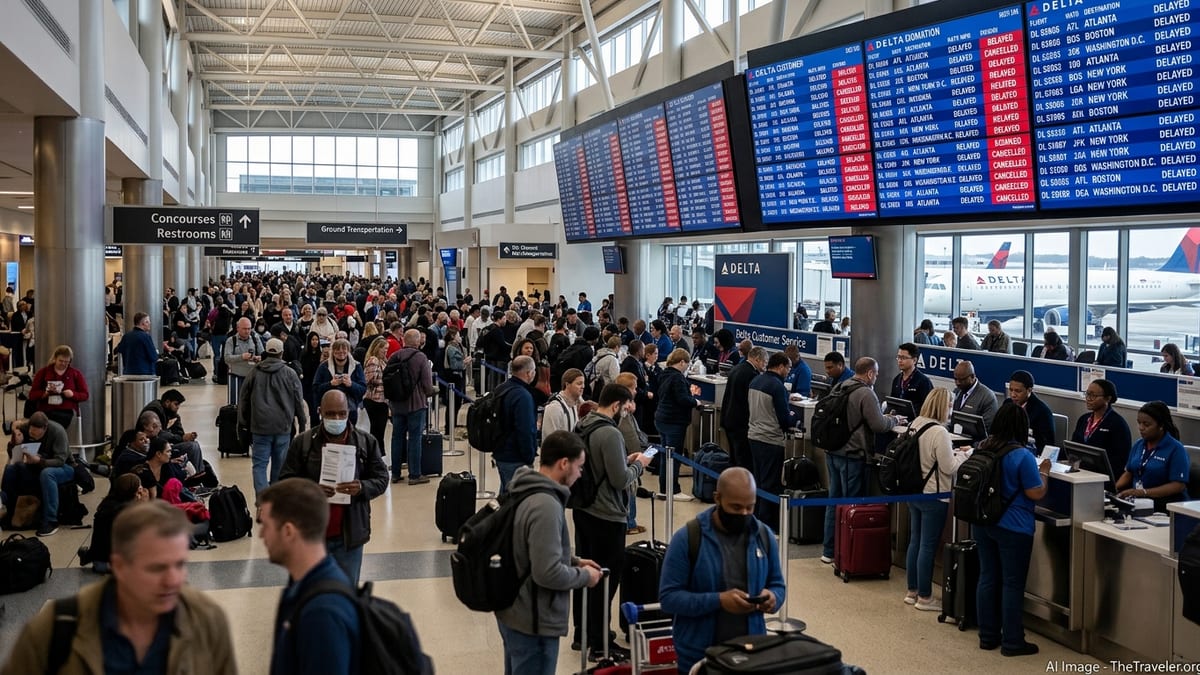
System outage at Delta’s largest hub and how operations unraveled
The disruption began early on Sunday 22 November 2026, when Delta reported an outage affecting its automation for calculating the weight and balance of departing flights, a key safety step before takeoff. As crews turned to manual workarounds, departures from Hartsfield-Jackson Atlanta International Airport slowed, prompting a ground delay program for Delta flights to and from Atlanta, according to advisories published by the Federal Aviation Administration. The FAA specified that the problem was confined to Delta’s system and not related to federal air traffic control networks.
By Sunday afternoon, Delta was still dispatching flights using manual calculations, which lengthened turnaround times at its busiest hub. Flight-tracking data from FlightAware cited in multiple outlets indicated that by Sunday evening roughly 58% of Delta flights, around 2,000 services, were running late, with hundreds more affected earlier in the day. The airline later said that about 70% of its reported delays and cancellations that day could be traced to the automation failure, with the remainder attributed to weather and air traffic control constraints in the Northeast United States.
Atlanta, which handles more passengers annually than any other airport in the world and functions as Delta’s primary hub, felt the brunt of the disruption. Local media and passenger reports described aircraft waiting at gates for revised paperwork, arriving flights holding for available stands, and knock-on delays on Delta services across the domestic network as aircraft and crews fell out of position. Some passengers reported sitting on planes in Atlanta and other cities for several hours before either departing or having their flights cancelled.
Scope of the disruption and how quickly systems came back
Publicly available delay statistics show the scale of the problem for Delta’s network on 22 November. Flight-tracking figures cited by national and local outlets varied slightly through the day as schedules evolved, but by evening they converged around approximately 2,000 delayed Delta and Delta Connection flights worldwide, representing close to half of the airline’s roughly 5,000 scheduled flights that Sunday. One data snapshot from FlightAware put the percentage of delayed Delta-operated services at 58% for the day, with several dozen cancellations on top of those delays.
At Hartsfield-Jackson Atlanta International Airport itself, aggregate delays across all airlines climbed as operations backed up. Local television reports, based on FlightAware data, said that by early evening nearly 1,250 flights in and out of Atlanta, across carriers, were delayed. Another national outlet, citing internal Delta figures, reported that the airline alone experienced more than 1,600 delayed flights nationwide attributed to the equipment outage affecting one of its weight and balance systems. Those numbers capture both the immediate effect of the automation failure and the subsequent ripple as aircraft and flight crews missed their planned rotations.
Delta said on Sunday afternoon that automation for departing flight weight and balance calculations had been restored and that the airline was working to complete its remaining schedule. The FAA’s ground delay measures were lifted once the carrier confirmed that its system was again functioning and that departures could accelerate. Nevertheless, social media posts and passenger accounts on Sunday evening and Monday morning indicated that residual delays and some cancellations continued into 23 November, particularly for early departures that required aircraft and crews to be in place after the prior day’s disruptions.
Technical fault, safety checks and Delta’s explanation
Weight and balance systems ingest data on passengers, baggage, fuel and cargo to calculate whether an aircraft is within safe operating limits and to determine performance figures such as takeoff speed. Delta has not publicly disclosed the precise cause of Sunday’s failure, describing it as a technical issue affecting automation for these calculations. The airline and the FAA have both emphasized that at no point was flight safety compromised, since crews and dispatchers reverted to manual processes that are designed to be used if automated tools are unavailable.
In statements on 22 November, Delta stressed that the outage was isolated to company systems and that federal air traffic infrastructure was operating normally. The airline acknowledged that the reliance on manual workarounds significantly slowed dispatch, extending time at the gate for aircraft awaiting updated paperwork. That, in turn, created a shortage of gates for arriving flights at Atlanta, compounding delays as inbound aircraft waited on taxiways for space to park. In its communications, Delta said that it worked with air traffic control to introduce programs aimed at preventing congestion on airport ramps and at gates while the system was being restored.
Delta also linked a minority of its schedule disruptions on Sunday to poor weather and air traffic control restrictions affecting New York City and other parts of the Northeast. These constraints, which can reduce the rate of arrivals and departures at affected airports, further limited the carrier’s flexibility to recover from the system outage. However, the airline’s own figures attribute roughly 70% of Sunday’s changes in schedule specifically to the automation issue, indicating that the technical failure at its Atlanta hub was the primary cause of the day’s disruption.
Recent FAA ground stop and wider strain on holiday travel
The weight and balance outage at Delta came less than two weeks after a rare nationwide ground stop linked to an FAA network malfunction temporarily halted all departures across the United States earlier in November. That separate federal incident, described by transportation officials as the most extensive nationwide stop in roughly a quarter-century, led to thousands of delays and cancellations and created lingering schedule imbalances at many airports. United Airlines also reported its own technology outage in mid November, contributing to a perception among travelers that aviation systems were under unusual strain heading into the peak holiday period.
The timing of Delta’s outage magnified its impact on passengers. National travel forecasts had already predicted one of the busiest Thanksgiving travel periods in recent years, with U.S. carriers scheduling dense Sunday and Wednesday operations and major hubs, including Atlanta, bracing for heavy passenger volumes. The combination of high load factors and limited spare aircraft or crew capacity meant that when the weight and balance system failed, options for same-day reaccommodation were constrained on some routes. Travelers reporting their experiences on social media described rebookings later in the day, overnight stays before onward flights, and detours through alternate hubs when seats were available.
For Hartsfield-Jackson Atlanta International Airport, Sunday’s events followed closely on what local officials had already labeled a significant operational test. In the days after the earlier nationwide FAA ground stop, the airport’s management characterized that federal disruption as a major trial run ahead of Thanksgiving, noting that lessons learned would be applied to handling peak volumes. Delta’s system issue, which was unrelated to the FAA event, created a second test in quick succession for Atlanta’s ability to absorb sudden, technology-driven disruptions during an already busy travel window.
How Delta is handling customers and what travelers should expect next
Delta has apologized for the disruption and said it is rebooking affected passengers on the next available itineraries. The airline has indicated that customers whose flights were cancelled and who chose not to travel can request refunds. For travelers forced to stay overnight because of cancellations or very long delays, Delta has stated that it is providing hotel accommodation and meal support where appropriate. The carrier’s conditions for such support are determined by internal policies and may vary depending on the cause of disruption and local availability, so passengers are being advised to confirm options through official Delta channels.
Because Sunday’s outage and its immediate knock-on effects occurred in the run-up to one of the busiest travel weeks of the year, some residual impacts have lingered beyond the day of the failure itself. Industry reporting and passenger accounts indicate that early morning departures on Monday 23 November in some cities departed later than scheduled as aircraft and flight crews were repositioned and required rest periods were observed. Travelers with upcoming itineraries on Delta, particularly through Atlanta, are being encouraged to monitor their flight status closely via the airline’s app or website and to allow additional time at the airport in case of continued congestion at check-in, security or boarding.
While Delta says its automated weight and balance system is again functioning normally, the airline has not yet published a detailed technical explanation or timeline for any further review of the incident. For now, there is no public indication of long-term schedule changes or capacity reductions linked directly to Sunday’s outage. However, as the broader U.S. aviation system contends with high holiday demand, recent technology failures at both airlines and the FAA, and seasonal weather patterns, travelers should be prepared for localized delays and to verify their departure times and connection windows on the day of travel.