


More news on this day
Italy-based disruption-care provider Value Group is preparing to demonstrate upgraded versions of its RUBIK irregular-operations platform and an expanded hotel and transport supplier network at the 27th Annual Ground Handling International (GHI) Conference, which is scheduled to run from 1 to 3 December 2026 at Olympia London and is set to gather more than 1,000 ground-handling, airline and airport decision-makers.
Get the latest news straight to your inbox!
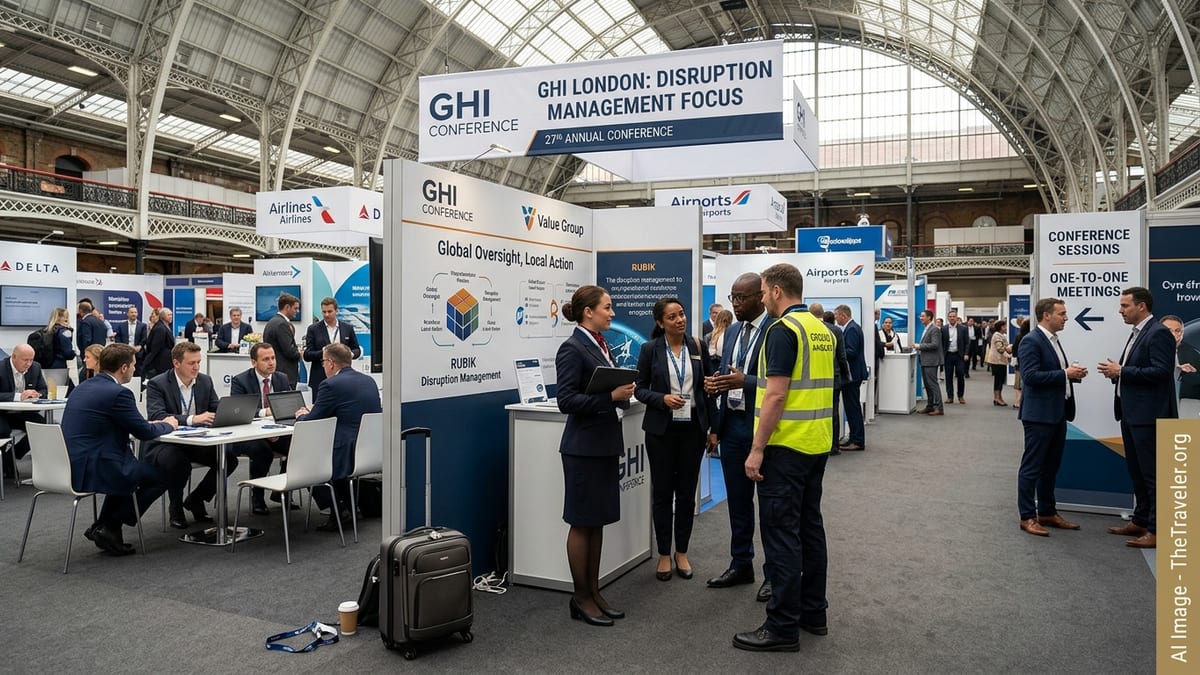
Flagship London ground-handling forum targets disruption, safety and regulation
The GHI Annual Conference’s official listings confirm that the 27th edition is planned at Olympia London from 1 to 3 December 2026, combining a three-day conference programme with an exhibition floor and pre-booked one-to-one business meetings between airlines, ground handlers, airports and suppliers. Conference information and recent partner announcements describe the event as Ground Handling International’s flagship global gathering, with the 2026 agenda shaped around operational safety, workforce pressures and new layers of global and regional oversight for ground handling.
Recent material promoting the London edition points to attendance in excess of 1,000 delegates, including representatives from more than 115 airlines and over 90 exhibiting suppliers, alongside ground-handling companies, airport authorities and technology providers. Those figures are presented as expectations for 2026 based on recent editions rather than final registration data, but multiple exhibitors and partner organisations are citing similar numbers in their pre-event communications, underlining the scale of the forum.
The published 2026 programme groups sessions under themes such as evolving ground-handling regulation, safety and human performance on the ramp, sustainability in ground-support equipment and the digitalisation of airport operations. Agenda highlights advertised by the organisers include keynotes on the impact of upcoming European Union regulatory changes, panels with ground-handling chief executives, technical discussions on automation and safety culture, and networking formats such as speed meetings with airline representatives and an awards ceremony for ground-handling performance. For suppliers of disruption-management tools, that mix provides an opportunity to present software and service offerings in the context of safety oversight and staffing constraints rather than purely as standalone IT projects.
RUBIK platform links passenger rights, airline policies and local suppliers
Value Group, headquartered in Italy, positions itself as a specialist in services for irregular operations, combining a 24-hour operations control centre with software and a network of hotel and ground-transport partners under the RUBIK brand. Company material describes RUBIK as the technology layer that connects airline operational systems, airport station teams and contracted accommodation and transport providers when substantial disruption requires an airline to provide care such as hotel rooms, meals and local transfers.
At the centre of the platform is a rules engine that translates an airline’s disruption-care policies and applicable passenger-rights legislation into configurable digital workflows. On routes covered by instruments such as EU Regulation 261/2004 and the United Kingdom’s post-Brexit equivalent, airlines must, under defined circumstances, provide care when flights are heavily delayed, cancelled or diverted. Value Group states that each airline using RUBIK defines its own disruption-care thresholds and business rules within the platform, taking account of these legal obligations and any higher internal standards. Once configured, the platform is designed to apply those rules consistently across the carrier’s network, aiming to reduce station-by-station variation when local teams face large volumes of affected passengers.
RUBIK also underpins crew-care processes, which share some components with passenger disruption management but are governed more by contractual rest requirements and company policies than by passenger-rights legislation. In this configuration, the platform’s booking functions and rules are tuned to crew hotel contracts, minimum rest times, transport standards and duty-time limitations. The goal in both cases is to shorten the time between an operational decision and the confirmation of hotels and transfers, particularly during high-pressure events such as weather-related schedule disruptions or airspace closures.
Modular deployment and self-service tools under scrutiny in London
In the lead-up to GHI London 2026, Value Group has promoted RUBIK as a modular ecosystem that can be deployed at different levels of integration, from fully embedded solutions at major hubs to lighter options suitable for outstations or newly opened routes. In a full-integration model, the platform connects via application programming interfaces to airline reservation, ticketing and operational-control systems, allowing it to receive structured messages when a flight disruption passes the thresholds that an airline has defined for offering care.
In that integrated set-up, once an event such as a cancellation or extended delay is confirmed as eligible, RUBIK can draw passenger lists, run automated entitlement checks against the airline’s configured policies and generate notifications. Product descriptions indicate that affected passengers typically receive SMS or email messages with personalised links to secure pages that outline what care they are entitled to and present a filtered list of pre-approved hotels and, where applicable, local transport offers. Filters can be based on nightly price caps, pre-negotiated hotel chains, distance from the airport, room occupancy limits and tailored criteria for specific cabin classes, frequent-flyer tiers or markets.
For stations where deep system integration is not yet in place, Value Group highlights a lighter configuration that relies on QR codes and browser-based interfaces rather than direct links to airline back-end systems. Under this model, airlines or their contracted ground handlers display event-specific QR codes or short web addresses at gates, check-in areas and information desks during irregular operations. Passengers are asked to confirm their disrupted flight details and identity before accessing a curated list of hotels and any transport options that reflect the parameters set by the airline for that specific event. Staff-facing dashboards allow agents to complete bookings for travellers who are unable or unwilling to use their own devices, including passengers needing special assistance, those travelling with young children and those without reliable connectivity.
Value Group has indicated that its demonstrations at Olympia will focus on how these distinct deployment models function in practice and on the practical steps required to move from a basic QR-only configuration toward more automated entitlement checks and messaging. Airlines considering the platform are expected to question how configuration changes will be implemented when internal policies or supplier contracts evolve, how long typical integrations take and what level of local training ground handlers will need during the initial rollout.
Operations control centre and network depth under new oversight frameworks
Alongside the software itself, Value Group presents its 24/7 Operations Control Center as the operational hub that connects RUBIK’s digital workflows with real-time events across airports. Public descriptions of the centre refer to staff monitoring airline schedules, weather developments, airspace restrictions and airport-capacity notifications in order to identify locations where disruption risk is rising. Where Value Group has agreements in place with airlines, it can issue early alerts to station teams and, within predefined limits, to local hotel and transport partners so that they can prepare capacity before demand peaks.
When irregular operations are underway, the control centre serves as a support resource for airport teams and ground handlers who need clarification on how individual cases fit within an airline’s rules, the status of hotel allocations or potential exceptions for vulnerable passengers. Final responsibility for decisions on each traveller remains with the airline or its nominated ground-handling company, but the central team is intended to promote consistent application of policies, particularly during multi-airport disruption caused by regional storms, air-traffic control restrictions or knock-on delays.
Value Group’s plans to spotlight its services in London come at a moment when global and regional regulators are formalising new oversight frameworks for ground handling. An amendment to ICAO Annex 14, Volume I, introduces, for the first time, a specific section on ground handling that requires states to regularly assess the impact of ground-handling operations on aviation safety and recommends that they establish criteria for safety oversight as part of their state safety programmes. These provisions are scheduled to become applicable on 26 November 2026, a few days before the GHI conference is due to open, with guidance set out in ICAO’s Manual on Ground Handling.
A second phase of ICAO work on ground handling, including more detailed proposals affecting Annexes 6, 9 and 14 and the Procedures for Air Navigation Services for aerodromes, has an applicability date in November 2028. In parallel, the European Commission and the European Union Aviation Safety Agency have advanced a regional regulatory package on ground handling, while the UK Civil Aviation Authority is examining how to address ground-handling performance under domestic law after the United Kingdom’s exit from the EU. Within this evolving framework, airline and handler delegates in London are expected to view disruption-care platforms not only as tools for reducing queues and phone calls but also as potential mechanisms for documenting decisions and supporting safety and compliance reporting.
Implications for ground handlers, airlines and passengers
For ground-handling companies that manage disruptions on behalf of multiple airlines at the same airport, one of the questions in London will be how multi-airline versions of RUBIK are presented to frontline staff. Operational concerns include whether the platform can clearly display and separate each airline’s policies, how logins and user permissions are structured for staff working under several contracts, and what initial and recurrent training is required in an industry that experiences frequent staff turnover. The answers are likely to influence whether handlers adopt the platform across their portfolios or restrict it to specific airline customers.
Another area of interest relates to passenger self-service tools and their real impact on waiting times at airport service points. Airlines and handlers that have begun testing QR-based flows and direct booking links have generally done so alongside staffed counters rather than as a replacement, reflecting caution about assuming rapid behavioural change from passengers who may be stressed, unfamiliar with digital processes or travelling without suitable devices. Observations from the 2026–27 winter season, including any deployments announced around the time of the London conference, are expected to shape decisions on how widely these tools are rolled out and which passenger segments they are targeted at.
For travellers, Value Group’s presence among exhibitors at the GHI Annual Conference is one indication that airlines and handlers are devoting structured attention to how disruption care is organised, but it does not guarantee a particular standard of service at any given airport. Adoption of RUBIK or comparable disruption-management platforms remains a commercial and operational decision for each airline and handling company, influenced by internal IT resources, data-protection reviews, contract negotiations with hotels and transport providers, and budget priorities. Some carriers may choose to deploy such tools initially at their main hubs or on selected routes and only extend them more broadly after testing, while others may focus first on crew layover and disruption management before offering passenger-facing self-service options.
Where an airline has implemented a fully integrated disruption-care platform by late 2026 or into 2027, passengers on eligible itineraries may increasingly receive targeted notifications containing secure links to hotel booking pages and, in some cases, transport arrangements when their flights experience significant disruption. At other airports, travellers may instead encounter QR codes or short web addresses displayed at gates, check-in areas or information desks, with staff available to assist those who cannot or prefer not to complete the process on their own devices. In all instances, the underlying entitlements to meals, accommodation and rerouting continue to be determined by applicable passenger-rights legislation, local consumer law and each airline’s conditions of carriage rather than by the particular technology used to deliver offers.
Passengers planning trips in late 2026 and 2027 who wish to understand how disruption would be handled on their itineraries can start by checking the disruption, care and compensation sections of their chosen airline’s website and ensuring that their contact details are up to date so that any notifications can reach them promptly. Travellers flying within or from jurisdictions with detailed passenger-rights rules, such as the European Union and the United Kingdom, may find it useful to familiarise themselves with those regulations so that they can distinguish between their legal entitlements and any additional assistance the airline offers on a discretionary basis. As airlines, handlers and regulators meet in London to discuss tools like RUBIK against the backdrop of new oversight frameworks, any visible changes in how hotel offers and other elements of care are communicated are likely to appear gradually, on a carrier-by-carrier basis, rather than as an immediate, industry-wide shift.