


More news on this day
Nine European countries have again pushed back parts of the EU’s Entry/Exit System (EES) rollout, extending a patchwork approach to biometric border checks just as late-summer travel volumes remain high at major airports and key sea crossings.
Get the latest news straight to your inbox!
Which countries are delaying, and what is actually being postponed
Published coverage indicates the latest requests for more time come from France, Greece, Portugal, Italy, Germany, Malta, the Netherlands, Belgium, and Switzerland. The delay is not framed as a total pause of the EES itself, but as a further postponement of full biometric capture at some high-traffic locations, particularly airports.
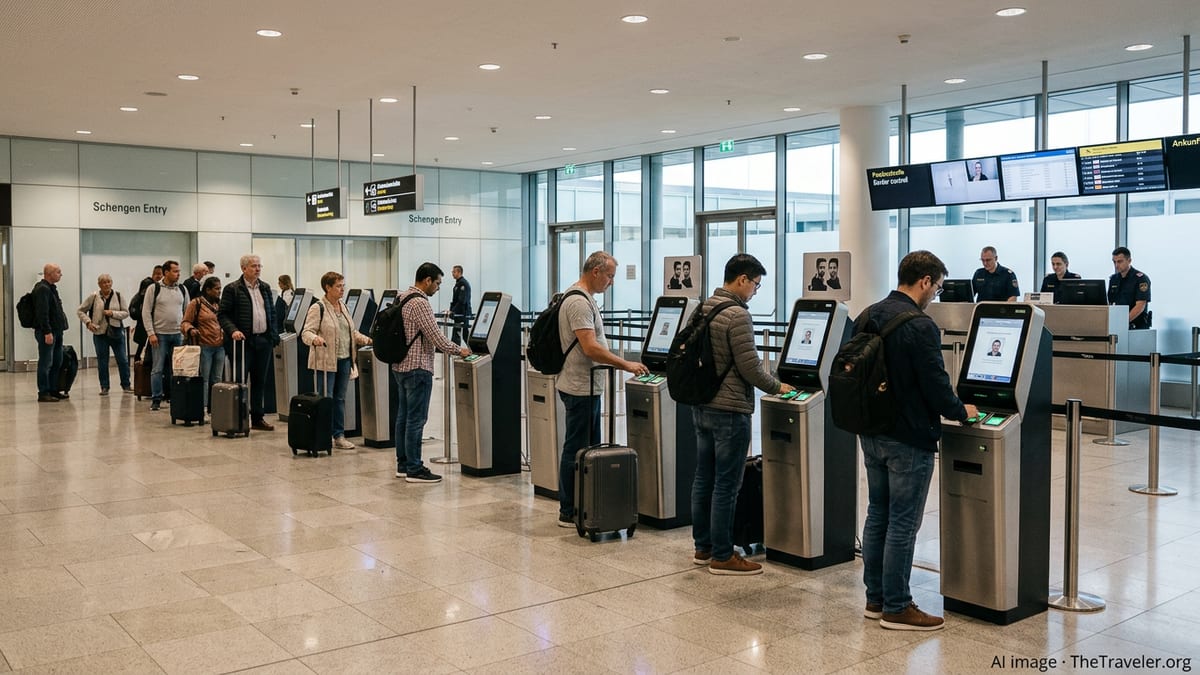
The practical impact is that EES procedures can differ by airport or border point within the same country. Reports describe situations where biometric checks are already happening in some places, while other locations remain on partial processes as they work through staffing, equipment, and passenger-flow constraints.
Spain is widely described as moving ahead with fuller implementation after earlier operational issues, underscoring that the EES experience is diverging by destination and by mode of transport rather than switching on uniformly across Europe.
What EES changes for US and other non-EU travelers
The EES is designed to replace manual passport stamping for short-stay visitors and instead create a digital record of entry and exit. Public EU information describes the system as applying to non-EU nationals traveling for short stays (up to 90 days within any 180-day period) in the Schengen Area countries that use EES.
At the border, first-time registration under EES can involve scanning the traveler’s passport details and capturing biometrics, including a facial image and fingerprints. On later trips, border checks typically focus on verifying those biometrics rather than collecting them again, unless re-enrollment is needed.
EU materials also outline exemptions, including EU citizens and citizens of Iceland, Liechtenstein, Norway, and Switzerland, plus categories of non-EU nationals holding long-stay visas or residence permits. Travelers in exempt categories continue with traditional document checks without EES biometric enrollment.
Why the delays matter most at airports and cross-Channel pinch points
The countries seeking more time include several of Europe’s most popular holiday gateways and high-capacity hubs, where even small increases in per-passenger processing time can translate into longer lines in peak arrival waves. Published coverage has linked the new delays to concerns about congestion and operational readiness at busy terminals.
Cross-Channel travel remains a standout pressure point because border checks for travel from the UK to France occur at juxtaposed controls. Reports indicate that France has not introduced EES biometric checks at the Port of Dover, where French officers conduct controls on UK soil, leaving travelers with a different experience than at many continental airports.
Separately, publicly available traveler guidance from the Port of Dover indicates EES is not yet fully implemented for cars traveling to France, highlighting how vehicle processing and kiosk deployment can lag behind other modes such as foot passengers and coaches.
A system already ‘live’ on paper, but uneven at the gate
EU institutional pages describe EES as having started with a progressive rollout beginning on 12 October 2025, with the system presented as becoming fully operational on 10 April 2026. In parallel, EU descriptions emphasize the shift from manual stamping to digital entry and exit records, supported by biometric verification.
The latest delays show a gap between central policy timelines and on-the-ground execution. Rather than stopping EES, the current phase appears to allow continued partial operation at some border points, with certain countries asking for additional flexibility as they expand equipment coverage and refine passenger processing.
For travelers, the key takeaway is that “EES is in force” does not guarantee identical procedures at every airport, port, or land crossing. The same itinerary can produce different experiences depending on terminal layout, staffing levels, kiosk availability, and whether the crossing is designed for pedestrians, vehicles, or mixed flows.
What travelers should do now when flying or transiting into Schengen
Because the EES experience can vary by location, travelers should plan extra time for arrival formalities, especially when entering Schengen at large hubs during peak periods or when traveling on routes known for constrained border infrastructure. The first EES registration is the likeliest point for additional time due to biometric enrollment.
Travelers should also keep their basic eligibility details clear before departure, including passport validity and their remaining 90/180-day short-stay allowance, since EES is designed to improve overstay detection and identity checks. Even where biometric capture is delayed at a specific location, border officials can still perform checks and create records using the tools available.
For those driving between the UK and France, published operator guidance suggests procedures can differ from airport processing and may evolve as new facilities and kiosks come online. The most reliable planning assumption for the coming weeks is continued variability, with the potential for sudden changes as authorities phase in equipment or adjust operations around high-demand travel days.