


On the southwest flank of Cozumel, where the island’s famous reef drops away into rich Caribbean blue, one section of Palancar has a particular pull on experienced divers. Palancar Bricks, the southernmost of the classic Palancar sites, combines big coral architecture, deeper multi-level profiles and easy drift conditions that can feel like flying past a living underwater city. It is dramatic without being extreme, and nuanced enough that you can dive it several times and still notice new canyons, towers and marine life patterns each visit.
Get the latest updates straight to your inbox!
Where Palancar Bricks Sits in the Cozumel Reef System
Palancar Reef is not a single dive but a chain of sections strung along Cozumel’s southwest coast inside the Arrecifes de Cozumel National Marine Park. Palancar Gardens, Caves, Horseshoe and Bricks each describe a slightly different slice of the same spur-and-groove reef, with variations in depth, coral relief and current. Bricks lies toward the southern end of this chain, typically reached after a 45 to 60 minute boat ride from the main marinas near San Miguel, depending on sea conditions and how many stops the boat makes to pick up divers.
Operators in Cozumel usually list Palancar Bricks as a deeper, first-tank dive paired with a shallower second site like Colombia Shallows, Yucab or Tormentos. You will often see it on weekly schedules from mid-range and boutique shops that cater to certified divers who want more than introductory reef tours. Because boat traffic spreads out along the Palancar system, Bricks tends to feel quieter and more spacious underwater than the shallower Gardens section, even on busy high-season days.
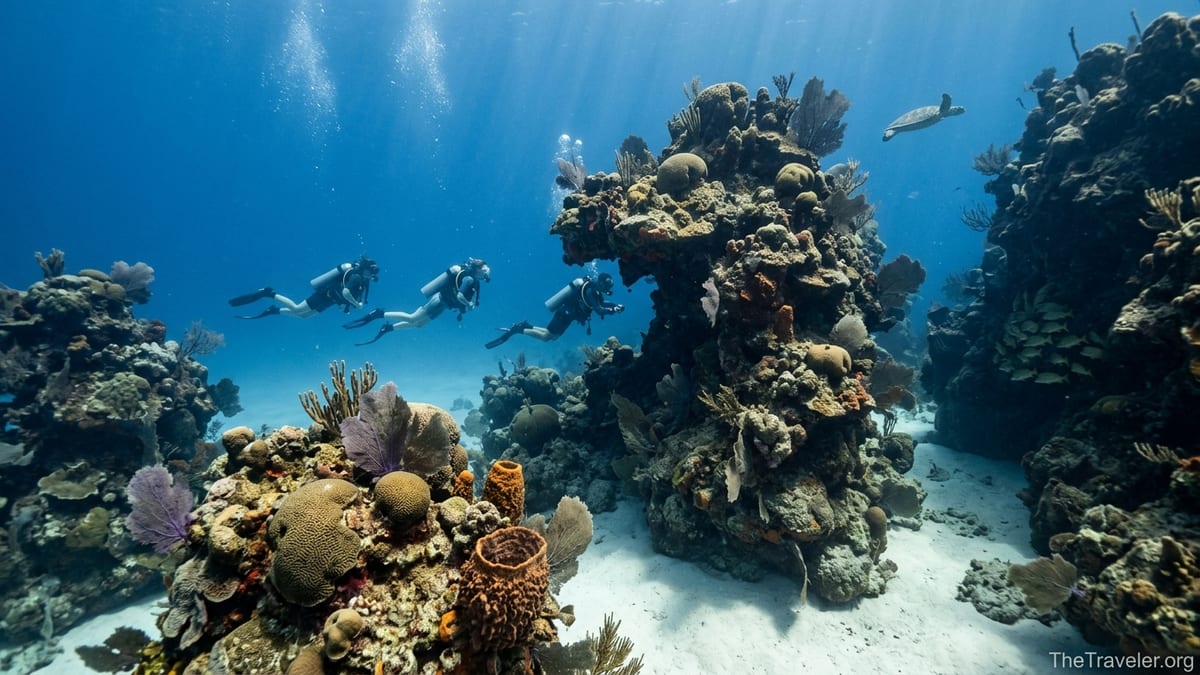
The site’s nickname comes from the stacked appearance of its buttresses and pinnacles. From the sand, these towers look like giant masonry blocks laid side by side and then softened by decades of coral growth. When visibility reaches its typical 25 to 35 meters, you can look along the reef edge and see these formations stepping away into the distance, each one separated by sand channels that lead out over the drop-off.
Like the rest of Palancar, Bricks sits within the protected zone of the national marine park, so park rules apply in full. Divers are expected not to touch or collect anything, to maintain good buoyancy, and to follow their guide’s instructions about where to descend and ascend. The benefit of this protection is that hard corals, sea fans and sponges here are comparatively intact, with large undamaged colonies still dominating the reefscape.
Depth, Profiles and Wall Sections
Palancar Bricks is typically dived between about 18 and 30 meters, with the top of the reef rising to around 15 meters in places and the sand at the base sloping away toward 35 meters or more. Most operators will brief a maximum depth in the 24 to 27 meter range for recreational groups, but experienced divers with appropriate training sometimes dip slightly deeper along the sand line while staying well within no-decompression limits. The key is that this is a natural multi-level profile: you start deeper along the base of the towers and gradually work your way shallower as the dive progresses.
A common profile for a nitrox-certified diver might be to drop onto the reef around 24 to 27 meters, spend 15 to 20 minutes drifting along the deeper ledges and wall-like sections, then rise to 18 to 20 meters to weave between coral buttresses, before finishing the last 10 to 15 minutes at 12 to 15 meters on top of the reef. With standard air instead of nitrox, guides are more conservative, and you may find the deepest part of the dive held closer to 21 to 24 meters to protect no-decompression time, especially on the first day of a trip.
The “wall” at Bricks is not a sheer vertical drop like Santa Rosa Wall, but there are definite wall-like stretches where the reef face steps down in terraces to the sand. In some places the buttresses line up so that looking down-current you see a line of dramatic overhangs, with schools of grunts and snappers sheltering under each ledge. It is common for dive guides to start the group at the outer edge, near where the drop begins, and then cut inward through gaps between towers so you experience both the open blue on one side and the intimate feel of coral alleyways on the other.
Because bottom time at depth can disappear quickly, having a clear understanding of your computer’s no-decompression limits and ascent rate is essential here. Many Cozumel operators emphasize slow ascents and generous safety stops, often extending the standard three minutes at 5 meters into five or even seven minutes while you drift across sand and low relief coral, scanning for rays or turtles making a last-minute appearance.
Coral Towers, Swim-throughs and Sand Channels
What sets Palancar Bricks apart, visually, is the texture of the reef. The coral towers rise like irregular columns, with some formations broad enough to hold multiple large swim-throughs side by side and others as narrow as a single diver’s width. From the top, these towers are carpeted with hard corals including brain, star and finger corals, interspersed with purple sea fans and orange barrel sponges. Down the sides, crevices and alcoves provide shelter for lobster, channel crabs and the endemic splendid toadfish that Cozumel is famous for.
Swim-throughs at Bricks are usually described as “tunnels” or “pass-throughs” rather than caves. They are short, often with light visible at both ends, and sit mostly in the 18 to 24 meter range. A typical route might see your guide drop slightly below a ledge, signal “overhead environment” and then lead the group in single file through a gently curving corridor with sponges and black coral reaching down from above. While they feel adventurous, these passages are generally wide enough that you can maintain trim without scraping gear, provided you stay neutrally buoyant and keep your fin kicks compact.
Between the coral buttresses, white sand channels create bright avenues that funnel both light and current. In good sun, these sandy lanes glow a vivid turquoise. Guides often use them as natural highways, letting the current pull the group while they scan the edges for nurse sharks or southern stingrays partially buried in sand. For photographers, these channels make ideal spots to turn back toward the reef and frame divers or coral towers against the blue, with sunbeams streaming through.
One thing to be mindful of in the channels is how the current can accelerate slightly where the gap narrows, similar to wind speeding through a mountain pass. It is not usually dangerous, but if you are not expecting it, a quick burst of speed can push you closer to coral than intended. Keeping a bit of extra distance from the walls in tight spots, and following the guide’s chosen line through the terrain, helps keep everyone clear of fire coral and fragile formations.
Visibility, Currents and Typical Conditions
Cozumel’s reputation for crystal-clear water holds true at Palancar Bricks. On a normal day, divers can expect visibility in the range of roughly 25 to 35 meters, occasionally more in dry winter conditions and sometimes a bit less after summer storms or periods of strong wind that stir up the water column. The clarity accentuates the sense of space: looking across several coral towers at once, you may see another group drifting parallel a long way off, their bubbles rising in a distant shimmer.
Currents at Bricks are generally described as moderate but can range from gentle to fairly strong, depending on seasonal shifts in the Caribbean current and recent weather. Most dives here are conducted as true drift dives, with the boat dropping groups up-current and following their bubbles from the surface to pick them up at the end. On the easiest days, new-to-Cozumel divers often report that they barely need to fin at all; they simply float along and steer with subtle adjustments, treating the current as a moving sidewalk that carries them past the reef.
When the current runs stronger, guides adapt the route to stay on the more sheltered side of buttresses and towers. You may feel gusts of faster water where a channel funnels flow, followed by pockets of relative calm in the lee of larger structures. Good practice is to keep your body horizontal and streamlined, using slow frog kicks or gentle sculling to hold position when the guide pauses to point out a seahorse or rare nudibranch, then relaxing again and letting the drift resume.
Sea conditions at the surface can vary with season. Winter cold fronts may bring choppier rides to the site and cooler water temperatures in the 25 to 26 degree Celsius range, so many divers opt for a full 3 mm wetsuit. In late spring and summer, water temperatures typically rise a few degrees, and some locals are comfortable in a shorty or even just a rash guard. Regardless of season, plan to bring sun protection for the boat, as surface intervals between Palancar Bricks and a second reef are often spent under Caribbean sun with only a simple canopy for shade.
Marine Life Highlights at Palancar Bricks
Marine life at Palancar Bricks reflects Cozumel’s position within the wider Mesoamerican Barrier Reef system, with a mix of classic Caribbean species and a few local signatures. On almost any dive here, you can expect to see schools of French and gray grunts stacked under overhangs, blue tangs grazing across coral tops, and pairs of colorful angelfish weaving in and out of sponge clusters. Spiny lobsters often peer out from ledges, antennae waving, while big channel crabs hunker deeper in crevices where divers’ lights sometimes pick out their red and white markings.
Larger animals appear frequently enough to keep divers’ heads on a swivel. Hawksbill turtles cruise along the reef edge, rising to breathe before dropping back to nibble on sponges. Nurse sharks are common; they are usually found resting under shelves in the deeper section or gliding slowly along the sand. Southern stingrays may be spotted half buried in channels, their outlines just visible when the light hits at the right angle. On less frequent but memorable days, divers report eagle rays passing in small groups along the blue or a solitary blacktip reef shark inspecting the wall from deeper water.
Cozumel’s endemic splendid toadfish is a special species to look for here. Typically found in small burrows at the base of coral heads, it shows electric blue and yellow striping when it emerges. Guides who know the reef well often have favorite spots where toadfish regularly sit, and will tap their tanks and gesture carefully so that divers can approach without spooking them. Good buoyancy is important when hovering low over sand or rubble to get a closer look, to avoid raising sediment or disturbing the fish’s shelter.
Macro life is less obvious at first glance than on some muck-diving destinations, but patient searching pays off. Flamingo tongues may decorate sea fans, neck crabs hang from gorgonians in odd shapes, and small lettuce sea slugs crawl over algae patches. Because most drift dives at Bricks move continuously, photographers who want time with tiny subjects often coordinate with their guide ahead of time to slow the pace and let the rest of the group know they will be pausing more often to shoot.
Who Should Choose This Dive and How to Prepare
Palancar Bricks is best suited to certified open water divers and above who are already comfortable with basic buoyancy control and have at least a handful of recent boat dives. You do not need to be an expert, but you should feel relaxed in mild to moderate current and be able to descend and equalize promptly when the group leaves the surface. Because this is normally offered as a first-tank, deeper dive, most operators prefer that very new divers do a shallower check-out site such as Paradise or Chankanaab before heading to Bricks later in their stay.
Divers with advanced open water or deep specialties, and those using nitrox, often find Bricks especially rewarding. The slightly extended bottom time at depth that enriched air can provide, within properly planned limits, allows more unhurried exploration along the base of the coral towers and a chance to linger when a turtle or shark appears. That said, many local guides emphasize that training level is only part of the equation: good trim, air consumption and comfort in drift conditions matter at least as much as the certification card in your pocket.
If you are planning a trip specifically to dive sites like Palancar Bricks, consider choosing a dive operator that runs small groups and is willing to organize by experience level. In Cozumel, you will typically find two-tank boat trips in the range of roughly 95 to 130 US dollars per day, depending on whether tanks and weights are included, what size boat is used, and whether snacks and marine park fees are rolled into the price. Smaller six-pack boats with experienced guides often command the upper part of that range but can offer more personalized route choices on the reef.
Before boarding for a day that includes Bricks, practical preparation makes a difference. Bring a reef-safe sunscreen and apply it well before the boat departs, pack a light windbreaker or towel for surface intervals, and double-check that your computer is set to the correct gas mix if you are using nitrox. In the pre-dive briefing, listen for maximum depth, expected current direction, and whether the guide plans to include overhead swim-throughs so you can speak up if you prefer to avoid any overhead environments.
The Takeaway
Palancar Bricks distills what many divers love about Cozumel into a single long, drifting panorama. The reef here offers depth without feeling forbidding, architecture that is both grand and intricate, and a current that, on most days, does the work while you simply steer. It is a site that rewards relaxed observation as much as adrenaline, where watching a turtle silhouette against the blue or seeing another team’s bubbles rise along a distant buttress can be as memorable as any single big sighting.
For divers planning a Cozumel itinerary, Bricks sits in a sweet spot between introductory reefs and the more advanced southern walls. It is deep enough to keep experienced visitors engaged over multiple dives, yet manageable for newer divers who have tuned up their skills on shallower sites earlier in the week. If you give yourself the time to drift it slowly, adjusting your depth to explore both the base and tops of its coral towers, you will understand why many local guides quietly list Palancar Bricks among their personal favorites.
As with all of Cozumel’s marine park, how you dive Palancar Bricks matters as much as how often. Staying off the coral, controlling your buoyancy in the current, and following your guide’s route through this three-dimensional maze help keep the site healthy for the next boatload of visitors. With that respect, and a bit of planning around your skill level and equipment, Palancar Bricks can easily become the highlight wall of a Cozumel trip that may already be rich with unforgettable reefs.
FAQ
Q1. What certification level do I need to dive Palancar Bricks?
Most operators accept certified open water divers for Palancar Bricks, provided you are comfortable in drift conditions and have recent experience. Advanced or deep training is helpful but not strictly required for typical guided profiles, as long as you follow the depth limits set in the briefing.
Q2. How deep does the dive usually go at Palancar Bricks?
Typical guided dives at Palancar Bricks range from about 18 to 27 meters, with the deepest portion often in the first third of the dive and then a gradual ascent along the reef. The exact maximum depth depends on your group’s experience, gas choice and the dive operator’s policies.
Q3. Is the current strong at Palancar Bricks?
The current is usually moderate, creating a relaxed drift that carries you along the reef without heavy finning. On some days it can be stronger, especially in narrow sand channels, and your guide will adjust the route accordingly and brief you on how to position yourself in the flow.
Q4. Can new divers or those with fewer than 20 dives safely enjoy this site?
Divers with limited experience can enjoy Palancar Bricks if they are already comfortable with buoyancy and have done at least one easier check-out dive in Cozumel first. It is important to be honest about your comfort level with your operator so they can place you with an appropriate group and guide.
Q5. What kind of marine life is common at Palancar Bricks?
Expect schools of grunts and snappers under ledges, angelfish and parrotfish on top of the reef, and frequent sightings of turtles, nurse sharks and stingrays. With a bit of luck, you might also see the endemic splendid toadfish in burrows and occasional eagle rays gliding along the blue.
Q6. Are there overhead environments or caves I should know about?
Palancar Bricks features short swim-throughs and tunnels formed by coral towers, but they are not technical caves. They are usually wide and well lit at both ends. If you prefer to avoid any overhead environments, let your guide know before the dive so they can choose open routes.
Q7. What exposure protection should I bring for a dive at Bricks?
Most divers are comfortable in a 3 mm full wetsuit in Cozumel, which offers warmth in the mid-20s Celsius water and protection from scrapes and stings. In the warmest months, experienced locals sometimes switch to thinner suits or shorties, but a full suit remains a good all-round choice.
Q8. Is Palancar Bricks suitable for underwater photography?
Yes, Palancar Bricks is excellent for photography thanks to its clear water, dramatic coral towers and natural sand channels that provide good backdrops. Wide-angle lenses work especially well for capturing the reef structure and divers, while careful, slower drifts can also reveal macro subjects on corals and fans.
Q9. How long is a typical dive at Palancar Bricks?
Most dives here run between 45 and 60 minutes, depending on your air consumption, depth profile and whether you are using nitrox or air. Multi-level routes that start deeper and finish shallower, combined with an extended safety stop, help stretch bottom time while staying within safe limits.
Q10. Do I need to book a specific trip to ensure we visit Palancar Bricks?
Many Cozumel operators visit Palancar Bricks regularly, but daily site choices depend on weather, currents and group experience. If Bricks is a priority, mention it when booking and again at check-in so the shop can plan a suitable day and pair it with a complementary second dive site.