


More news on this day
Nine European countries have again pushed back parts of the EU’s Entry/Exit System (EES) border checks, keeping biometric registration uneven across the Schengen area weeks after a wider ramp-up had been expected.
Get the latest news straight to your inbox!
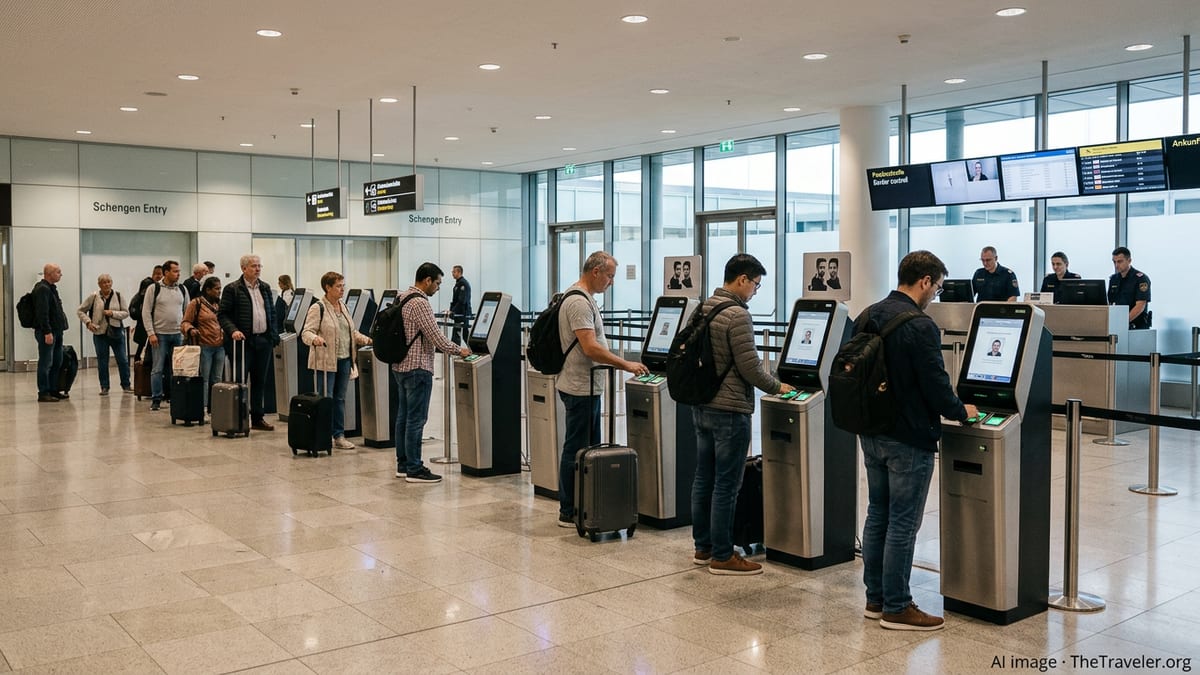
Which countries are delaying EES checks, and what is actually being postponed
Published coverage indicates France, Greece, Portugal, Italy, Germany, Malta, the Netherlands, Switzerland and Belgium have asked for additional time to fully implement EES biometric capture for non-EU travelers at certain external border points. The result is not a bloc-wide pause, but a country-by-country patchwork where some airports, ports and rail terminals are operating EES normally while others are still catching up.
The delay centers on the in-person capture of fingerprints and a facial image for travelers who are subject to EES registration. EES is designed to replace manual passport stamping with a digital record of entry and exit, while helping calculate compliance with the 90 days in any 180-day period rule for short stays in the Schengen area.
Reports also indicate Spain has moved further along and is implementing EES more comprehensively, following earlier operational problems. Elsewhere, the slowest progress has tended to be at high-volume holiday gateways and locations with limited space for new kiosks and staffed booths.
How EES is supposed to work, and why the timeline keeps slipping in practice
EES began operations with a progressive roll-out starting on October 12, 2025, and the system was described in EU communications as fully operational across all external Schengen border crossing points as of April 10, 2026. In day-to-day travel, however, the operational reality has varied by location, with some border points able to capture biometrics efficiently and others struggling during peak arrival banks.
The EES process is most noticeable for non-EU nationals arriving for short stays, including many U.S. and U.K. travelers, because first-time registration adds steps at the border. In addition to the standard document check, travelers may be directed to a kiosk or desk for fingerprints and a facial image before proceeding.
Published reporting has highlighted capacity constraints as a recurring issue, especially at smaller facilities that can receive large bursts of passengers but have only a handful of positions for biometric capture. That imbalance can quickly cascade into long queues at passport control, missed connections, and crowding risks in arrival halls.
Airports, ports, and rail terminals: where friction is showing up
Travel disruption concerns have been most visible at busy aviation gateways and cross-Channel pinch points. One unique pressure point is the Port of Dover in the United Kingdom, where French border police carry out Schengen entry checks under bilateral arrangements, creating an unusually complex setting for new biometric procedures.
Across the air network, industry warnings over the summer pointed to pinch points at a mix of major hubs and leisure airports, with particular attention on high-volume holiday routes. Ryanair communications in July flagged a range of airports where longer waits had been observed or anticipated during peak travel periods, including places in Spain, Italy, France and Germany.
Operational inconsistency can also confuse travelers: some may be fully enrolled with fingerprints and facial image on one trip, then encounter a different flow at another airport on their next entry. That inconsistency is one reason the current round of delays is being framed as targeted and practical, rather than a rollback of the overall policy direction.
What travelers should expect now: biometrics may be required, but not everywhere
For travelers heading to Schengen countries this fall and winter, the key takeaway is that EES is in force as a system, but biometric capture may still be implemented unevenly depending on where you arrive. Travelers should plan for extra time at first entry, particularly at major leisure gateways and during weekend peaks, even if prior trips through other airports were quick.
The EU has also promoted a companion tool, the “Travel to Europe” mobile app, which supports limited pre-registration within 72 hours of travel for eligible travelers. Public EU materials show the app’s functionality has been available in Sweden, and in Portugal for a more limited set of steps, with decisions on broader availability left to participating countries.
Even with pre-registration tools, travelers should still be prepared to complete steps at the border, follow signage to kiosks when directed, and keep documents handy. Airlines and airports may also adjust recommended arrival times depending on local queue patterns, so checking carrier communications close to departure remains important.
How this interacts with passport stamping, the 90/180 rule, and what comes next
EES is intended to replace passport stamping for short-stay travel by recording entries and exits electronically, using the traveler’s passport details alongside biometrics. That digital record is meant to make overstay detection more consistent across countries and reduce reliance on sometimes-unclear stamps.
For travelers, the underlying rule does not change: most visa-free visitors, including U.S. citizens, are still limited to 90 days in any 180-day period within the Schengen area. What changes is the enforcement mechanism, which becomes more data-driven once EES capture is consistently applied at entry and exit points.
The broader EU border modernization agenda also includes ETIAS, a separate travel authorization system that is not the same as EES. Travelers following EU policy updates should watch for evolving timelines and phased onboarding details, since the current EES delays show that practical implementation can diverge from earlier target dates, especially at the busiest border locations.