


Ortaköy is where Istanbul’s big postcard moment actually happens in real life: a baroque mosque floating at the edge of the Bosphorus, framed by the 15 July Martyrs Bridge, with ferries sliding past and the smell of street-side kumpir in the air. The scene looks effortless in photos, but getting clean, well-lit shots without a sea of people in your frame takes a bit of planning. This guide breaks down the exact photo spots, timing, and angles you need to capture Ortaköy at its best, from blue-hour stillness to the evening light show on the bridge.
Get the latest updates straight to your inbox!
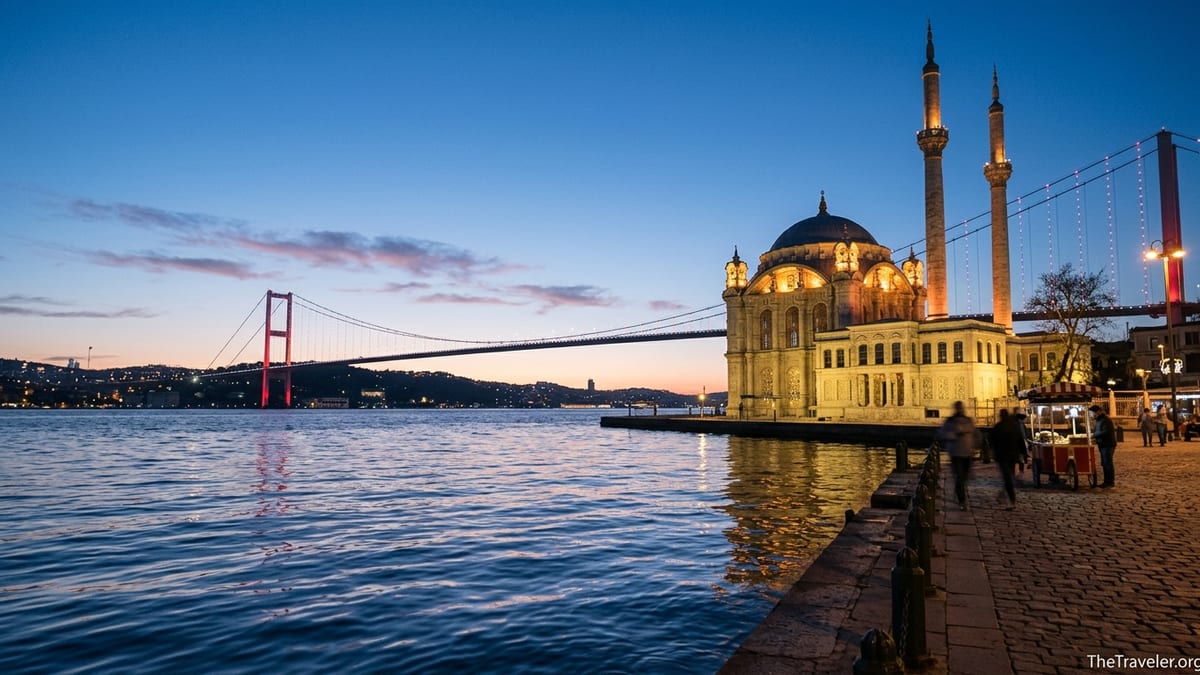
Understanding the Ortaköy View: Mosque, Bridge, and Bosphorus
The Ortaköy Mosque, officially the Büyük Mecidiye Mosque, sits almost on the waterline of the European shore of the Bosphorus, with the 15 July Martyrs Bridge (the first Bosphorus Bridge) rising directly behind it. The mosque faces roughly east toward the Asian side, while the bridge runs northeast to southwest overhead. That geometry matters for photographers, because sunrise will color the Asian shore behind the mosque, while sunset usually warms the sky off to the side and behind the bridge, often giving you pastel tones rather than a direct sunburst behind the minarets.
The classic Ortaköy image combines three elements in a single frame: the mosque in the foreground, the Bosphorus Bridge diagonally crossing the background, and the water with ferries or small boats in the lower third. Most visitors shoot this from the waterfront square directly in front of the mosque, where the cobblestones, iron bollards, and low stone wall all give you strong leading lines. Even with a basic smartphone camera, standing a few meters back from the water and angling slightly left allows you to fit both mosque and bridge in a single shot.
Because Ortaköy is a lived-in neighborhood as much as a landmark, your frame will almost always include details of everyday Istanbul: fishermen leaning on the railings, children chasing pigeons, or a simit seller pushing his red cart past the foreground. Rather than treating them as distractions, plan to use them as scale and atmosphere. A couple sharing tea on the low wall in front of the mosque or tourists buying stuffed baked potatoes from the kumpir stalls can turn a postcard shot into a real travel image.
Light and atmosphere change quickly over the Bosphorus. On clear autumn evenings the sky behind the bridge can shift from pale gold to rose pink in less than 20 minutes, while in winter you may have a low, hazy sun and softer, more muted tones for most of the afternoon. Because of frequent humidity and maritime haze over the strait, contrast is often lower than you expect; exposing slightly for the highlights helps keep the mosque façade from blowing out in bright conditions, especially around midday.
Best Photo Spots Around Ortaköy Square
Most people start at the main open square in front of the mosque, which is ideal for wide, establishing photos. Stand just to the right of the mosque entrance, facing the Bosphorus, and then turn left until the bridge pylon frames the mosque dome. From this position you can place the mosque on the right third of your frame and let the bridge sweep across the top left, with the water and a few boats anchoring the lower edge. With a 24–28 mm equivalent lens or a standard smartphone, this gives the most recognisable Ortaköy shot with minimal distortion.
For a more intimate angle, walk to the far left corner of the square, near the small pier where short Bosphorus tours sometimes depart. From here you are slightly farther from the mosque, which compresses the scene and allows the bridge deck to sit visually lower behind the minarets. This spot is especially useful if you are shooting with a 35–50 mm lens on a full-frame camera and want the mosque to dominate the frame while still keeping a clear slice of bridge and water.
Another useful location is along the low stone wall directly in front of the railings, a couple of steps down from the main square level. Here you can sit or crouch and shoot at a lower angle so that the sky fills most of the background, minimizing cluttered buildings along the shore. Travel photographers often use this angle to capture a subject sitting on the wall, with pigeons or seagulls in motion around them and the mosque soft in the background. For example, with a 50 mm lens at f/2.8, you can keep your subject sharp while softly blurring the bridge lights and mosque details behind.
Finally, do not ignore the narrow streets that feed into the square. Looking back toward the mosque from 30–40 meters inland, you can frame the dome and minarets between hanging café signs and old apartment facades. These streets are where you will find waffle and kumpir stands, often brightly lit in the evening. Positioning these in your foreground while keeping the mosque small but distinct at the end of the street can capture the feel of Ortaköy as a neighborhood rather than a single sight.
Waterfront, Piers, and Bosphorus Angles
The immediate waterfront gives you the simplest compositions, but stepping just a little away from the square can transform your angles. If you walk north along the promenade toward Kuruçeşme, passing under the bridge, you gain a perspective where the bridge stretches further into the frame while the mosque becomes more distant. This is useful with longer focal lengths, such as 70–85 mm, to compress the layers of waterfront cafes, the mosque, and the massive bridge structure. Even a mid-range zoom on a mirrorless camera can capture a dramatic scene of traffic streaming across the bridge above a line of tea gardens at water level.
Looking the other direction, a short walk south from the square toward Beşiktaş gives you side-on views of the mosque façade. Here the baroque details and windows read more clearly, and the bridge is often just out of frame. This angle works well when the square is packed and you want architectural shots without a forest of selfie sticks. Press yourself to the railing and tilt down slightly to avoid cranes or construction on the opposite shore creeping into your composition.
If budget allows, consider a short Bosphorus cruise or even just boarding a public ferry and timing your ride to pass Ortaköy when light is favorable. Many shared Bosphorus tours leaving from Kabataş or Eminönü swing past the neighborhood, giving you the chance to shoot back toward the square with the mosque and bridge perfectly layered. From the water, use a 35 mm lens for a natural perspective or a 24 mm if you want to include more sky and strait. Because ferries move, set a relatively fast shutter speed, such as 1/250 or faster, to keep details sharp as you bob in the wake.
For smartphone shooters, leaning your elbows on the ferry rail or using the top of a bench as a support can stabilize your frame. Turn on burst mode when passing Ortaköy so you can later select the frame where a seagull, ferry, or sunset cloud aligns exactly with your composition. The reflection of the mosque in mild ripples of the Bosphorus can be especially pleasing just after sunset, when lights are on but the sky still holds a deep blue tone.
Sunrise, Sunset, and Night Lights
At sunrise, Ortaköy is one of the quietest central waterfront areas in Istanbul. On most weekdays you will find a handful of commuters, early dog-walkers, and maybe one or two other photographers. The sun comes up behind the Asian shore, so the first light hits the façade of the mosque and the underside of the bridge. On clear mornings this creates a warm, directional glow on the stonework while the water remains cool-toned. Arrive 20–30 minutes before official sunrise to capture the transition from blue hour to golden light, especially in late autumn and winter when the air is crisper.
Sunset plays out differently. You will not usually see the sun drop directly behind the mosque, but rather off to the southwest, lighting clouds and bridge cables from the side. This can yield subtle pastel skies and a gentle rim light along the outlines of the minarets and bridge pylons. The busiest period tends to be from about one hour before sunset until 30 minutes after, particularly on Fridays and weekends. If your goal is to shoot a clean skyline with space around your subject, aim to finish your key shots at least 45 minutes before official sunset, then stay to capture the shift into blue hour when the day-trippers thin out slightly.
Night brings a different personality. The bridge is illuminated in programmable colors, often deep reds or violets that cycle slowly, while the mosque glows in a warm white against the dark water. Reflections in the Bosphorus become more pronounced on calm evenings, and street lamps create pools of light along the cobblestones. Use a tripod or stable surface and a low ISO if you can; exposures of 1–4 seconds at f/5.6 to f/8 often work well for capturing both bridge lights and some movement from passing ferries. If you are shooting handheld on a smartphone, enable night mode and brace against a lamppost or the mosque fence.
Because this is an active mosque, be mindful of prayer times, especially after sunset when evening and night prayers bring more worshippers. Access to the immediate front steps may be restricted, and tripods at the very edge of the courtyard can get in the way. Instead, set up a few meters back in the square or along the waterline, where security is less likely to intervene and you can frame both lights and worshippers in a respectful, wide context.
Camera Angles, Lenses, and Practical Settings
For most travelers, a standard smartphone or a mirrorless camera with a wide-to-normal zoom is enough to cover every important Ortaköy angle. A 24–70 mm equivalent lens lets you go from broad square scenes at the wide end to tighter details of the mosque windows, textures of the stone, or portrait shots with the bridge blurred behind. If you carry a second prime lens, a 35 mm or 50 mm lens is ideal for environmental portraits of friends or family with the mosque and Bosphorus clearly readable but not overpowering.
Low and high angles make a big difference with such a vertical subject. Crouching at the waterline and tilting your camera slightly upward exaggerates the height of the minarets and bridge cables, emphasizing the scale of the city. Conversely, if you can access a nearby terrace or rooftop café, shooting slightly downward can flatten the scene into layers: tables and tea glasses in the foreground, the square and mosque mid-frame, and the bridge and Asian shore in the distance. For instance, at a café terrace with a clear railing, placing a Turkish tea glass out-of-focus in the lower corner while keeping the mosque sharp at f/4 can create a strong sense of place.
In bright daylight, the contrast between white stone, blue water, and deep shadows can be challenging. Shooting in RAW on a dedicated camera or enabling your phone’s HDR mode helps retain details in both highlights and shadows. Typical base settings on a sunny afternoon might be ISO 100, f/8, and a shutter speed around 1/250, adjusted depending on how much movement is in your frame. On cloudy or hazy days, open up the aperture to f/4 or f/5.6 and raise ISO moderately so that people walking through your frame remain sharp.
Travelers who enjoy capturing candid street scenes can use the edges of the square as a stage. Stand just inside the flow of people where waffle and kumpir stalls line the street, and pre-focus on a spot in front of the mosque. As locals and visitors move through, lift your camera for quick frames that combine food, architecture, and bridge. To stay unobtrusive, keep your camera at waist level and use a tilting screen if you have one, shooting with a 28–35 mm focal length so composition remains flexible.
Crowd-Free Timing and Local Rhythm
Ortaköy’s popularity means that the difference between a serene scene and a chaotic one often comes down to timing. On most days, the square begins to fill by mid-morning, around 10:00, as tour buses and small-group excursions arrive. From late morning through mid-afternoon, especially on weekends and during peak European holiday months, you can expect constant selfie traffic in front of the mosque and occasional lines for the prime spots near the water. If your schedule is flexible, avoid planning your main Ortaköy photo session for Saturday or Sunday afternoons, when local visitors also surge.
For relatively crowd-free shots, aim for early morning. Arriving around 07:00 to 08:00, or shortly after sunrise depending on the season, usually means you share the square with only a small handful of people. Vendors will just be setting up, and the mosque stairs and railings are often completely empty for several minutes at a time. On weekdays outside summer, you may be able to shoot uninterrupted sequences from multiple angles before 09:00, even in high season. Another window of opportunity is late at night, after about 22:30 or 23:00, when day-trippers and most tour groups have left and only local café-goers and a few couples linger by the water.
Prayer times slightly adjust the rhythm of visitors. During Friday midday prayers, for example, the interior is busier and exterior access can be partially controlled. If you just need exterior shots, plan to arrive either well before or after Friday prayer time, when worshippers have dispersed and security is more relaxed. In summer, consider also the heat: midday sun can make the square uncomfortably hot and cause people to cluster in the shade, concentrating crowds exactly where you want to shoot.
Transport timing plays a part. Buses and taxis that serve Ortaköy from Taksim, Beşiktaş, or Kabataş often face heavier road traffic in the late afternoon, leading many visitors to arrive just before sunset. By coming earlier, say around 15:30–16:00, you can enjoy a slower build-up, scout your angles, and secure your positions before the peak. If you plan to combine Ortaköy with a Bosphorus cruise, one practical pattern is to shoot in the quiet of early morning on land, then return on a ferry or sightseeing boat later in the day to capture the mosque again from the water, when light is warmer and crowds do not affect your frame.
Using Cafés, Terraces, and Nearby Neighborhoods
Some of the best Ortaköy views are from a table rather than the square itself. Several Bosphorus-facing cafés and restaurants offer terraces where you can shoot over railings, avoiding the crowds below. Expect to pay slightly higher prices for coffee or tea than in back streets, but the trade-off often includes an uninterrupted line of sight to both mosque and bridge. A typical Turkish tea might cost the equivalent of a few euros in 2026 at a prime waterfront spot, which many photographers treat as the price of a temporary private viewing platform.
Terraces work especially well for capturing the transition from daylight to night. From a higher vantage point, you can layer foreground details like glasses of Turkish tea, hookah pipes, or plates of meze against the soft glow of the mosque and the changing colors on the bridge. If you are shooting with a mirrorless camera, keep a fast prime lens handy, such as a 35 mm f/1.8, to handle the low light while preserving background detail. Always ask staff politely before leaning cameras over railings or moving chairs to the very edge; in most cases they are used to photographers and only ask that walkways stay clear.
When you have finished shooting in Ortaköy itself, consider walking or taking a short ride to neighboring Kuruçeşme, Arnavutköy, or Bebek along the Bosphorus. From these districts, especially from Arnavutköy’s wooden waterfront houses or Bebek’s promenade, you can look back toward the bridge and capture longer perspectives that include Ortaköy’s section of the shoreline. This gives more context to your photo set and emphasizes the Bosphorus as a continuous landscape rather than a series of isolated landmarks.
On the Asian side, districts such as Üsküdar and smaller viewpoints along the coast also offer distant but atmospheric views of the bridge with European lights behind. While you will not clearly pick out the mosque from these distances without a long lens, pairing a wide shot of the lit bridge from the Asian shore with your close Ortaköy frames can tell a more complete story of crossing between continents.
The Takeaway
Ortaköy rewards the traveler who takes a little time to understand its rhythm. The postcard view of the mosque and Bosphorus Bridge is unmistakable, but the most satisfying images usually come when you combine that classic frame with your own angle: a reflection from the waterline, a portrait over a tea glass on a terrace, or a quiet blue-hour scene shared with a few locals and the soft hum of the bridge overhead. By arriving early or staying late, walking a few minutes along the shore, and using both wide squares and intimate side streets, you can collect a set of photos that feel personal rather than generic.
Whether you are shooting with a flagship mirrorless camera and a bag of lenses or a well-used smartphone, Ortaköy gives you all the raw materials: strong architecture, big skies, moving water, and the constant presence of everyday Istanbul. Pay attention to the light, respect the mosque as a place of worship, and move with the local flow of the square, and you will leave with images that do justice to one of the city’s most iconic corners on the Bosphorus.
FAQ
Q1. What time of day is best for photographing Ortaköy Mosque and the Bosphorus Bridge?
Early morning shortly after sunrise offers the calmest conditions and soft light on the mosque, while late afternoon into blue hour provides warmer color and illuminated bridge lights, at the cost of larger crowds.
Q2. How crowded is Ortaköy during sunset?
On most days from spring through autumn, the square becomes busy about an hour before sunset, with peak crowds right at sunset, especially on Fridays and weekends when both tour groups and locals gather.
Q3. Can I use a tripod around Ortaköy Mosque?
Small travel tripods are generally tolerated in the open square and along the waterfront, but placing them directly on mosque steps or blocking pathways may attract security attention, so it is best to set up a few meters back.
Q4. Do I need a professional photography permit in Ortaköy?
For casual travel photography and small personal cameras, you normally do not need a permit; formal shoots with lighting, models, or commercial crews may require permissions, especially if you want to use mosque grounds extensively.
Q5. Which lens is most useful for Ortaköy views?
A wide-to-normal zoom in the 24–70 mm equivalent range covers almost all key angles, from wide shots of the mosque and bridge to tighter details and portraits, while a 35 mm or 50 mm prime works well for atmospheric street and café scenes.
Q6. Are there good photo spots if the main square is too crowded?
Yes, walking a few minutes north or south along the Bosphorus promenade gives alternative angles, and nearby terraces above waterfront cafés can provide elevated views that avoid the densest crowds on the square.
Q7. Is it safe to carry camera gear around Ortaköy at night?
The area is generally busy and feels reasonably safe in the evening, but standard city precautions apply: keep bags closed, avoid leaving gear unattended on tripods, and use well-lit routes when returning to main transport hubs.
Q8. Can I combine Ortaköy with a Bosphorus cruise for better photos?
Yes, many visitors shoot in Ortaköy on foot and then join a public ferry or short Bosphorus cruise that passes the neighborhood, allowing you to capture the mosque and bridge again from the water in different light.
Q9. What should I wear or bring for a sunrise shoot in Ortaköy?
Mornings by the Bosphorus can feel cooler than inland, so bring an extra layer, gloves in winter months, and a lens cloth to clear occasional sea spray or mist from your camera or phone lens.
Q10. Are there restrictions on photographing people near the mosque?
There are no special legal rules beyond normal privacy expectations, but it is courteous to avoid close-up shots of worshippers without consent and to frame people more broadly as part of the general atmosphere of the square.