


Between Ortaköy’s lively mosque square and Bebek’s polished marina lies one of Istanbul’s most rewarding short waterfront walks. Following the Bosphorus shoreline through Kuruçeşme and Arnavutköy, this route combines big‑sky water views, historic wooden mansions and a steady stream of locals jogging, fishing and strolling. It is not a wilderness hike but a very urban seaside promenade, with traffic on one side, the strait on the other, and frequent temptations to stop for Turkish tea, ice cream or a proper sit‑down breakfast.
Get the latest updates straight to your inbox!
Overview: What to Expect From the Ortaköy to Bebek Walk
The classic walking route runs north along the European shore of the Bosphorus, starting from Ortaköy Square and finishing in Bebek. Measured directly, Ortaköy to Bebek is roughly 4 kilometers, but with small detours into side streets or café stops most visitors end up walking 5 to 6 kilometers in about 1.5 to 2.5 hours. The path is almost entirely flat, following the seaside road and paved promenades that locals use for jogging and cycling.
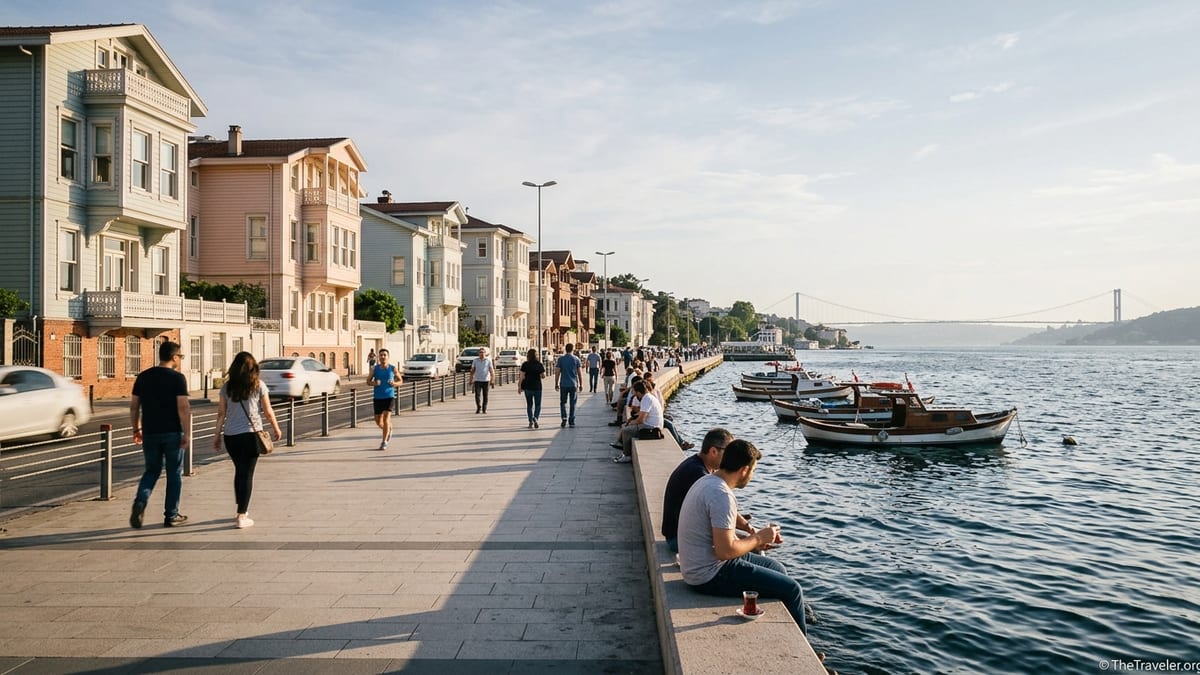
This is very much an urban walk. You will pass under the 15 July Martyrs Bridge, cross busy junctions around Kuruçeşme, and in some sections share space with cyclists and electric scooters. At the same time, you are never far from the water. Long stretches offer an uninterrupted guardrail between you and the Bosphorus, with fishermen lining the edge and small fishing boats passing close to shore. On clear days you see all the way across to Üsküdar and the Asian side’s green hills.
Most travelers choose this walk for the atmosphere rather than for exercise alone. Along the way you can pause at Ortaköy Mosque for photos, browse the handicraft stalls around the square, linger at a waterfront café in Arnavutköy, and finish with coffee or ice cream in Bebek Park. You can also combine the route with a Bosphorus ferry ride, for example walking from Ortaköy to Bebek, then later returning to Kabataş or Beşiktaş by bus or taxi.
Because the coastal road is one of Istanbul’s main arteries, conditions change with the time of day. On weekday mornings and late afternoons, traffic between Ortaköy, Arnavutköy and Bebek can be heavy and noisy, and vehicle exhaust can be noticeable at junctions. Early mornings, late evenings and Sunday afternoons tend to be more relaxed, with more joggers and families than commuters.
Getting Started in Ortaköy: Square, Mosque and Snacks
Most walkers begin in Ortaköy, a neighborhood that feels like a small Bosphorus village wrapped inside a big city. The focal point is Ortaköy Square, right on the water, framed by the 19th‑century Ortaköy Mosque on one side and a cluster of low streets filled with cafés, kumpir (stuffed baked potato) stands and waffle counters on the other. It is common to see visitors buy a takeaway kumpir loaded with olives, cheese and pickles, then sit on the steps overlooking the Bosphorus before they set off.
If you are coming from Sultanahmet or Taksim, a typical route is to take the tram or metro to Kabataş or Beşiktaş, then continue by bus or taxi to Ortaköy. The ride from Beşiktaş usually takes 10 to 20 minutes depending on traffic. As of mid‑2026, a short taxi trip from Beşiktaş to Ortaköy often falls in the range of 150 to 250 Turkish lira, while public buses are much cheaper, charged via Istanbulkart. Expect buses and taxis to slow near the bridge ramps, especially at rush hour.
Before you begin walking, allow at least 20 to 30 minutes to enjoy Ortaköy itself. Step inside the mosque if it is open outside prayer times, or at minimum walk around to its side terrace, which offers one of the most photographed views in Istanbul: the mosque in the foreground, with the Bosphorus and 15 July Martyrs Bridge rising behind. On weekends, handmade jewelry and handicrafts fill market stalls just behind the square, making it an easy place to pick up small souvenirs.
When you are ready to start, keep the water on your right and walk north, away from the bridge, following the seafront. The first few hundred meters take you past informal tea gardens, a small park and a line of stalls selling simit (sesame bread rings) and grilled corn. Sidewalks are slightly uneven in places, but they quickly widen as you leave Ortaköy’s center and approach Kuruçeşme.
Following the Bosphorus: Route Breakdown and Distance
From Ortaköy Square to Kuruçeşme, you walk about 1.5 kilometers. This stretch is mostly straightforward, with a consistent sidewalk along the water. You pass modest apartment blocks and a few waterfront restaurants, as well as entrance gates to private clubs and event venues. At several points, the promenade opens up, giving a full panorama of the Asian side and, further north, a first glimpse of the Fatih Sultan Mehmet Bridge far in the distance.
Kuruçeşme marks a subtle shift from neighborhood bustle to a more open waterfront feel. Here you find small parks, benches and, in summer, mobile vendors selling cold ayran and fresh‑squeezed orange juice. Many locals use the Kuruçeşme waterfront as an exercise loop: weekend mornings, it is common to see residents jogging from Kuruçeşme toward Arnavutköy and back, using fitness stations set up along the path.
From Kuruçeşme to Arnavutköy is another 1 to 1.5 kilometers. The road bends slightly and narrows, but a raised pedestrian path continues on the water side. You will see anglers lining the railings, their buckets of small fish beside them, and occasionally small boats pulling up to the shore. A few segments feel squeezed between parked cars and the low sea wall; watch for cyclists and e‑scooters sharing the path, especially on sunny weekends.
The final part, Arnavutköy to Bebek, adds about 1.5 to 2 kilometers depending on where you end in Bebek. This is arguably the most scenic segment, with uninterrupted water views, pastel‑painted wooden mansions and some of the prettiest café terraces on the European Bosphorus. Overall, by the time you reach central Bebek from Ortaköy, most fitness apps will show somewhere between 4 and 6 kilometers walked, allowing for detours and photo stops.
Arnavutköy: Wooden Mansions, Side Streets and Café Culture
Arnavutköy is the atmospheric heart of this walk. Once a fishing village, it still retains a low‑rise, small‑town character, despite sitting on one of Istanbul’s busiest roads. As you enter from the south, the first thing you notice is a line of late 19th and early 20th‑century wooden mansions right on the water, many painted in soft greens, creams and blues, with ornate balconies and Art Nouveau flourishes. These waterfront houses, known as yalı, are among the most photographed in the city.
Just behind the seafront, narrow streets climb the hill, lined with older apartment blocks, local grocery stores and bakeries. It is worth leaving the main road for 10 or 15 minutes to explore this grid. In the backstreets you are more likely to stumble across small, family‑run lokantas offering daily stews and vegetable dishes, or classic tea houses where older residents gather to play backgammon. Prices here are often lower than on the main waterfront; a simple plate of beans, rice and salad might cost little more than a takeaway coffee on the promenade.
Arnavutköy’s waterfront today is well known for its fish restaurants and café culture. You will find a concentration of meyhanes and seafood places with covered terraces, popular with Istanbulites for long dinners. At lunchtime many also offer simpler fixed menus. For a casual stop mid‑walk, look for smaller cafés in between the big restaurants, where you can sit with a glass of Turkish tea, a pastry and uninterrupted Bosphorus views. On warm evenings, tables sometimes creep very close to the water’s edge, and the combination of music and conversation creates a lively, almost Mediterranean feel.
Despite the charms, keep in mind that the main road behind you remains busy. Large coaches and city buses run through Arnavutköy all day, and traffic can back up here at peak times. When crossing side streets or stepping around parked cars, be alert. The upside is that if you are tired, this is an easy place to stop and catch a bus or taxi to your next destination without leaving the waterfront.
Bebek: Bayside Finish, Parks and Photo Spots
Bebek sits in a shallow bay, with a small marina, waterfront park and several of Istanbul’s most talked‑about cafés. Compared to Ortaköy and Arnavutköy, it feels more polished and upscale, with international boutiques and patisseries mixed into the side streets. Many locals treat Bebek as a destination for weekend brunch and evening walks, which means the area around the park and marina can be crowded, especially on sunny Sunday afternoons.
The waterfront park in Bebek is the natural finish line for your walk. Here you can sit on the grass or on low steps facing the Bosphorus, watching small pleasure boats move in and out of the marina and, further away, large container ships gliding toward the Black Sea. Joggers loop around the bay, and teenagers gather on the low walls with takeaway coffees. It is a relaxed scene, particularly at golden hour as the light softens across the water.
Bebek is also one of the best points on this route for photographs. From the marina area, if you angle your camera north, you can capture the curve of the bay, the line of modern apartment buildings, the second Bosphorus bridge in the distance and, in the foreground, traditional wooden fishing boats. Looking south, you get layered views back toward Arnavutköy’s wooden houses and the slowly receding form of the 15 July Martyrs Bridge.
Cafés and restaurants in Bebek tend to be more expensive than in Ortaköy or Arnavutköy. A specialty coffee or elaborate dessert can cost as much as a full simple meal at a neighborhood lokanta in central Istanbul. Still, many visitors choose to end the walk with at least one indulgence: perhaps a slice of cake with Bosphorus views, or an ice cream from a popular gelato shop eaten while wandering the park.
Traffic, Safety and Practical Walking Tips
Because the coastal road between Ortaköy, Arnavutköy and Bebek is a key artery, traffic is part of the experience. On sunny weekends and during holiday periods, it is not unusual to see the car lanes nearly at a standstill while the pedestrian promenade remains lively with walkers. From time to time local news channels run stories showing congested images of this exact stretch, highlighting how quickly it fills up when Istanbul residents head for the water.
For walkers, the main implication is noise and air quality rather than physical danger. The pedestrian area is usually separated from the road by at least a curb or low barrier, and in many places by a wide sidewalk. Nonetheless, when the road narrows near bus stops and underpasses, you may need to step closer to parked cars or briefly walk behind a queue of vehicles. If you are sensitive to exhaust fumes, consider starting early in the morning when traffic is lighter and cooler air helps disperse pollution.
In terms of personal safety, this is one of Istanbul’s more public, well‑used walking routes. Families with children, couples and groups of friends use it throughout the day. Pickpocketing is not a major issue, but basic city awareness is wise: keep bags zipped, avoid leaving phones unattended on low walls while taking photos, and be cautious if someone approaches you with an overly persistent sales pitch. After midnight, some stretches, particularly between neighborhoods, can feel quiet; most visitors prefer to walk in daylight or early evening while foot traffic is steady.
Footwear and clothing matter less for distance than for pavement quality. The promenade is paved but not perfectly smooth, with occasional broken tiles, low steps and curb ramps. Comfortable walking shoes or trainers are recommended, especially if you plan to continue past Bebek toward Rumeli Hisarı. In summer, the waterfront can feel several degrees cooler than inland thanks to the Bosphorus breeze, but the sun reflects strongly off the water. A hat, sunglasses and sunscreen are practical, particularly for midday walks.
Cafés, Food and Drink Stops Along the Route
One of the pleasures of this walk is how easy it is to punctuate it with food and café breaks. Ortaköy is ideal for a casual breakfast before you set off: a simple option might be menemen (Turkish scrambled eggs with tomatoes and peppers) and bread at a local café tucked into the backstreets, followed by a shared waffle or kumpir from one of the stalls in the square. Many places offer views of the mosque and bridge, but prices on the main square are typically higher than one or two streets back.
Along the stretch between Ortaköy and Arnavutköy, you will encounter mobile carts selling simit, roasted chestnuts in cooler months and boiled or grilled corn in summer. These are convenient, inexpensive snacks if you prefer to keep moving. Small kiosks also sell bottled water, soft drinks and basic ice cream bars. It is perfectly normal to buy a tea from a kiosk and drink it sitting on the low walls facing the water, sharing the space with local residents doing the same.
Arnavutköy offers a denser concentration of sit‑down options. Waterfront fish restaurants range from mid‑range to special‑occasion levels, often with white tablecloths and a long list of meze. For something more low key, look for smaller cafés or patisseries on the parallel streets uphill, where you might find Turkish coffee and a slice of chocolate cake at prices closer to what locals pay day‑to‑day. Some travelers choose to time their walk so they arrive in Arnavutköy just before lunch, enjoy a proper meal, then continue to Bebek in the late afternoon.
In Bebek, coffee culture is strong. Several well‑known spots serve specialty brews, elaborate brunch plates and pastries that draw both locals and visitors. Expect to pay a premium for a table right on the water, especially at popular times like late Sunday morning. If you are watching your budget, you can buy takeaway coffee or ice cream from smaller shops on the backstreets and bring it into Bebek Park, where plenty of people picnic informally on the grass.
Is It Worth Doing the Route on Foot?
Whether this walk is “worth it” depends on what kind of travel experience you are seeking. If your priority is to move quickly between sights, then buses or taxis along the Bosphorus road are faster in theory, though they can be slowed significantly by traffic. You will still see the water from the vehicle windows, but you will miss the small details: the sound of fishermen chatting, the smell of grilled fish from Arnavutköy’s restaurants, the feel of the breeze as you round the curve into Bebek Bay.
For many travelers, the Ortaköy to Bebek walk becomes a highlight precisely because it is not about ticking off major monuments. It functions more as a window into everyday Istanbul, where you are surrounded not only by other visitors but also by people out for a run, parents pushing strollers and older residents strolling arm in arm. It is also flexible: you can stop at any point, cross the road and catch a bus heading back toward Beşiktaş or onward toward Sarıyer.
The walking route is especially appealing on days when you want a slower schedule after intense sightseeing in Sultanahmet or the Grand Bazaar. You might, for example, spend the morning at Dolmabahçe Palace or in Beşiktaş’s bustling market streets, then head to Ortaköy for a late lunch and begin the walk north as the afternoon cools. Ending in Bebek gives you options: linger over a long coffee, continue even further toward Rumeli Hisarı and the Aşiyan Museum, or simply hop on a bus back toward your accommodation.
The main reasons not to do the walk are poor weather and time pressure. During winter storms, the Bosphorus can be cold, windy and rainy enough that an open waterfront promenade is more of a struggle than a pleasure. Similarly, if you only have a few hours in Istanbul, you may prefer to spend that time at indoor attractions or on a structured Bosphorus boat tour. For those with at least half a day to spare and an interest in city life between the landmarks, however, walking from Ortaköy to Bebek via Arnavutköy is highly recommended.
FAQ
Q1. How long does it take to walk from Ortaköy to Bebek?
Most people take 1.5 to 2.5 hours, including photo stops and a short café break, to walk the roughly 4 to 6 kilometers between Ortaköy and Bebek.
Q2. Is the route from Ortaköy to Bebek clearly marked for pedestrians?
There are no special hiking signs, but the route is straightforward: keep the Bosphorus on your right and follow the continuous sidewalks and promenade through Kuruçeşme and Arnavutköy to Bebek.
Q3. Is it safe to walk this route in the evening?
Early evening is generally busy and feels safe, with many locals out walking. Very late at night some stretches become quieter; most visitors prefer daylight or early evening hours.
Q4. Can I do the walk with children or a stroller?
Yes, many families use this promenade, but expect occasional uneven pavements, curb ramps and crowded sections. Take extra care near bus stops and road crossings.
Q5. Are there toilets along the Ortaköy to Bebek walk?
Public toilets can be found in larger parks and near some ferry piers, and many cafés and restaurants have facilities for customers. Do not rely on frequent public restrooms.
Q6. What is the best time of day to walk from Ortaköy to Bebek?
Mornings and late afternoons into sunset are ideal, with softer light and generally lighter traffic. Midday in summer can be hot and very bright on the reflective water.
Q7. Do I need to book anything in advance to walk this route?
No booking is needed. You only need your public transport card or taxi to reach Ortaköy and, if desired, to return from Bebek or Arnavutköy afterward.
Q8. Can I combine this walk with a Bosphorus boat trip?
Yes. Many travelers take a short Bosphorus cruise from central piers earlier or later in the day, or use ferries to reach Kabataş or Beşiktaş before starting the walk from Ortaköy.
Q9. Is the path suitable for running or cycling instead of walking?
Locals often jog this route, and some sections are shared with cyclists. It is possible to run, but you will need to weave around pedestrians, especially on weekends.
Q10. What should I wear for the Ortaköy to Bebek walk?
Comfortable walking shoes, a light windproof layer in cooler months and sun protection in summer are recommended, as the Bosphorus breeze and strong light can be deceptive.