


More news on this day
Air traffic across the United Arab Emirates has endured a new wave of disruption, with over 400 flight delays and at least 32 cancellations reported at major airports as carriers adjust schedules in response to renewed regional tensions and shifting airspace restrictions.
Get the latest news straight to your inbox!
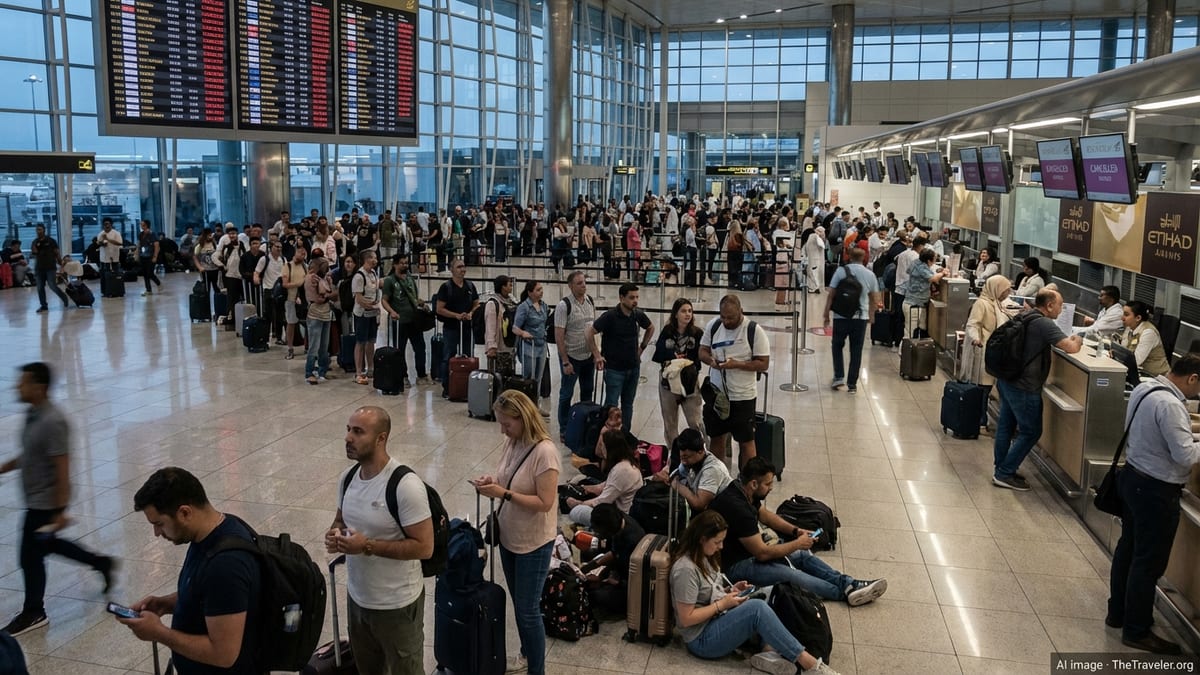
Delays Mount Across UAE’s Major Hubs
Published data from flight-tracking platforms and aviation analytics providers indicates that Dubai International, Abu Dhabi International and Sharjah International have all recorded elevated levels of disruption over recent days, with more than 400 flights delayed and 32 cancelled across the country’s main gateways.
The disruption is concentrated in peak evening and overnight departure banks, when long-haul services typically converge on the UAE’s hub airports. Network carriers operating dense connection banks are especially exposed when regional routings change at short notice, creating knock-on effects that ripple through schedules for hours.
Operational updates from airlines show a pattern of rolling delays, aircraft reassignments and last-minute schedule changes, reflecting the effort to keep as many flights operating as possible while avoiding conflict-affected air corridors and accommodating new air traffic control restrictions.
Although many flights are still departing and arriving, passengers are encountering extended ground holds, revised departure slots and late aircraft arrivals, with connecting itineraries particularly vulnerable to missed onward services.
Regional Tensions and Airspace Restrictions Drive Disruption
According to publicly available information on Gulf airspace, the latest disruptions are linked to renewed hostilities and intermittent airspace constraints affecting routes over parts of the Middle East. When sections of airspace are restricted or closed, flights are forced to take longer diversionary paths, putting pressure on available routes into and out of the UAE.
These conditions follow months of instability in regional air traffic flows, during which airspace closures and precautionary routing changes have periodically affected services into Dubai and Abu Dhabi. Even after formal notices indicate that UAE airspace is open, traffic levels can remain uneven as airlines gradually rebuild schedules and reassess risk and capacity.
For hub airports that depend heavily on overflying traffic and connecting itineraries, small shifts in routing availability can translate quickly into large numbers of delayed flights. Aircraft may arrive off-schedule from upstream airports, forcing carriers to push back departure times from UAE hubs while crews and ground services are reallocated.
The situation is further complicated by the broader regional network, as delays at neighboring airports in the Gulf and wider Middle East often propagate into UAE operations, affecting turnaround times and reducing schedule resilience.
Impact on Passengers and Connection Banks
The immediate impact for travelers has been a surge in missed connections, disrupted itineraries and extended waits in terminals. Passengers on multi-leg journeys through Dubai or Abu Dhabi are particularly exposed when an initial delay on a feeder flight narrows or eliminates the time available to transfer to a long-haul departure.
Published coverage of recent disruption patterns shows that many affected travelers are being rebooked onto later flights or rerouted through alternative hubs, with some itineraries pushed back by a full day or more. For those traveling on time-sensitive trips, such as business journeys or onward cruise or tour departures, the consequences can be especially challenging.
Ground operations teams are contending with increased demand for customer support at transfer desks and call centers, as well as higher pressure on airport facilities. Longer dwell times in terminals translate into crowded gate areas, fuller lounges and greater strain on airport services during peak disruption windows.
While some passengers are able to continue their journeys on the same day, others are receiving hotel accommodation or meal vouchers where carrier policies and local regulations require it, particularly in cases where delays extend significantly or cancellations prevent same-day rebooking.
Airlines Adjust Networks and Recovery Plans
Airlines operating in and out of the UAE are using a mix of schedule padding, equipment swaps and tactical cancellations to manage the disruption and protect the integrity of their broader networks. Publicly available timetables show selective suspension or reduction of frequencies on certain routes, particularly where alternative routings are complex or where demand can be consolidated onto fewer flights.
Some international carriers have already reduced or postponed services to UAE airports in recent weeks as part of a wider reassessment of Middle East operations, implementing longer-term schedule adjustments that are now intersecting with the latest wave of short-notice delays. This combination has tightened available seat capacity on certain city pairs just as disruption has increased.
Industry analysts note that hub-and-spoke carriers face a difficult balance in such conditions. Maintaining connectivity requires preserving key trunk routes and bank structures, yet each additional flight operated during a disruption window increases operational complexity and the risk of further knock-on delays.
Recovery typically involves gradually re-synchronizing arrival and departure banks, repositioning aircraft that have ended up out of place, and restoring normal crew rotations. Given the scale of the delays and cancellations, this process can take several days even after airspace and traffic flows stabilize.
What Travelers Through UAE Airports Should Expect
Given the cumulative effect of more than 400 delays and 32 cancellations, travel specialists suggest that passengers due to fly through UAE airports in the coming days should expect a higher-than-usual risk of schedule changes, even if their flights are currently listed as operating.
Common recommendations in publicly available travel advisories include checking flight status frequently on airline and airport channels, allowing extra time for connections through Dubai, Abu Dhabi and Sharjah, and maintaining flexible plans at the destination where possible.
Travel insurance with disruption and missed-connection cover is also being highlighted as a useful safeguard, particularly for itineraries involving multiple carriers or complex routings. Policy details vary, but some products provide compensation for additional accommodation, meals and rebooking costs when delays or cancellations meet specified thresholds.
While aviation authorities and airport operators in the UAE continue working to normalize air traffic flows, the latest figures on delays and cancellations underline how quickly regional developments can impact one of the world’s most important aviation crossroads, with effects felt by travelers far beyond the Gulf.