


More news on this day
More than 10,000 flight delays and over 2,300 cancellations across key Asian hubs in recent days are disrupting peak-season travel, stranding passengers and exposing persistent weak spots in the region’s aviation recovery.
Get the latest news straight to your inbox!
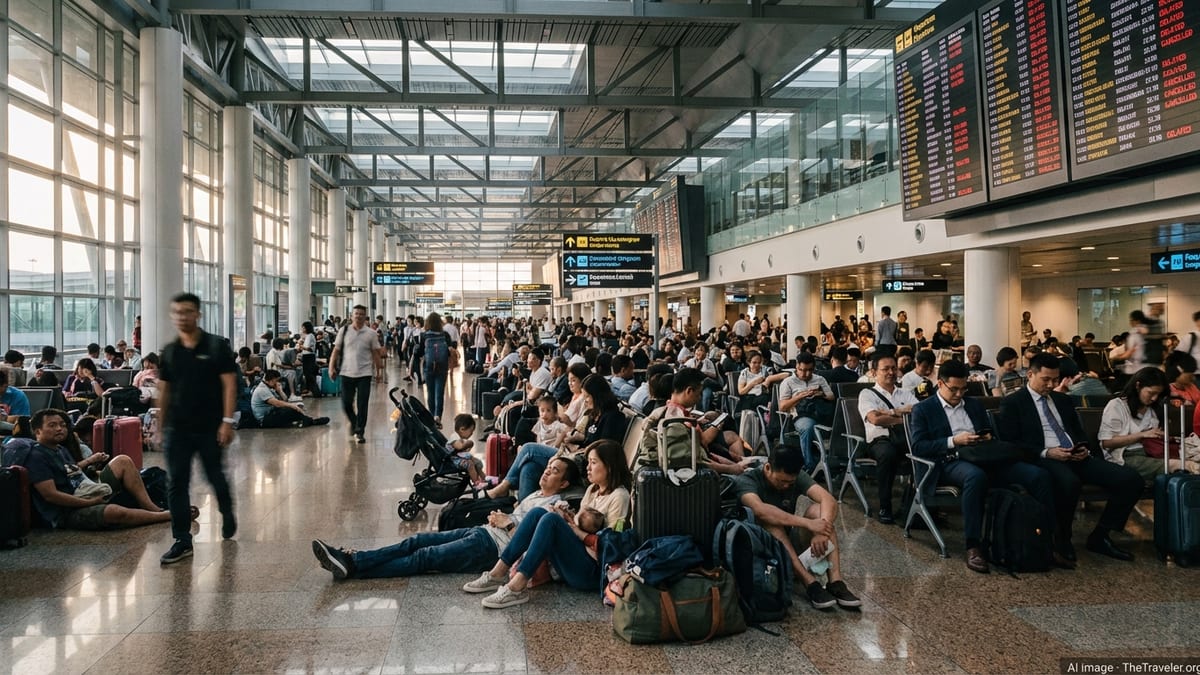
Wide-Ranging Disruptions Across Major Asian Hubs
Publicly available flight-tracking and regional media reports indicate that airports in China, Hong Kong, Singapore, the United Arab Emirates and major South Asian cities have collectively recorded more than 10,000 delayed departures alongside over 2,300 cancellations in a short window of time. The pattern is heavily concentrated at busy international gateways, creating a ripple effect that stretches far beyond individual countries.
Recent coverage focused on China’s coastal airports and leading regional hubs such as Hong Kong and Singapore describes a day in which roughly 10,336 flights were delayed and close to 600 were cancelled across Asia, underscoring how even routine operational strain can snowball into a continent-spanning disruption. These figures, aggregated from real-time data feeds, are broadly consistent with wider global trends in which single-day delay totals now regularly reach five figures during peak periods.
The cumulative impact on travelers is significant. With many Asian routes operating at or near pre-pandemic capacity, even a small percentage of cancellations can translate into tens of thousands of affected passengers. Airlines then face the challenge of finding spare aircraft, available crews and open seats during already congested travel windows.
For airports, the immediate pressure shows up in longer queues, gate crowding and overburdened customer service desks. As aircraft miss their scheduled slots, congestion on taxiways and at gates can further slow operations, compounding the original disruption.
Weather, Congestion and Knock-on Effects Drive the Chaos
The spike in delays and cancellations is being linked to a combination of seasonal weather systems, high traffic density and the knock-on effects of earlier operational shocks. Reports from mainland China point to powerful storm systems, including recent typhoon-related weather, which temporarily grounded or delayed hundreds of flights at major airports such as Guangzhou, Shenzhen, Chengdu and Xiamen. When severe weather disrupts tightly timed departure banks, the recovery often stretches well beyond the initial storm.
Elsewhere in the region, summer thunderstorms and tropical systems are interacting with congested schedules and limited slack in crew and aircraft availability. Aviation analysts routinely highlight how modern airline networks are optimized for efficiency, with tight turnaround times and high aircraft utilization. While this improves profitability in normal conditions, it leaves little margin when storms, technical issues or airspace restrictions occur.
The current wave of Asian disruptions is also unfolding against a backdrop of global operational fragility. In the past two years, data from North America and Europe has shown that single-day totals of around 10,000 delays combined with several thousand cancellations can result from a single winter storm or a large-scale IT outage. Similar dynamics now appear to be playing out in Asia, where networks are heavily interconnected and disruptions in one hub quickly affect others.
Once rotations fall behind, airlines must reroute aircraft, reposition crews and rebuild schedules, sometimes over several days. This means that even when weather improves or technical issues are resolved, travelers may continue to encounter irregular operations well after the original problem has passed.
Airlines and Airports Under Pressure as Peak Season Builds
The timing of the current disruption is particularly difficult for the region’s carriers. Industry data shows that forward bookings for summer 2026 travel are higher than a year earlier, even as airlines grapple with elevated fuel costs and lingering staffing issues. Many Asian carriers have restored extensive networks and frequencies, but some remain short of the personnel buffers they had before 2020.
Low-cost and full-service airlines alike are contending with the operational demands of dense point-to-point schedules layered on top of traditional hub-and-spoke systems. Recent punctuality rankings highlight how some Asian budget carriers have maintained strong on-time performance, yet the overall statistics from the latest disruption underscore that no segment of the market is immune when multiple large hubs experience strain at once.
Airport operators, meanwhile, are working to manage terminal flows and maintain service standards as irregular operations mount. Passenger handling systems, security checkpoints and immigration controls all come under stress when large numbers of travelers are rebooked, miss connections or are forced to remain airside for longer than planned. Overnight disruptions, in particular, can push terminal capacity to its limits as passengers seek accommodation, food and information at the same time.
The situation is also drawing attention to the resilience of regional air traffic management. High traffic volumes over East and Southeast Asia mean that any capacity reduction in crowded airspace queues aircraft for longer, burns more fuel and adds further delay minutes to an already strained system.
What the Numbers Mean for Travelers Heading to Asia
For travelers planning trips to or within Asia in the coming weeks, the recent figures on delays and cancellations serve as a warning that itineraries may be more vulnerable to disruption than schedules alone suggest. While the raw totals of over 10,000 delays and 2,300 cancellations cover a vast number of flights and airlines, they also highlight specific pinch points in the network.
Studies of major disruption events in other regions have shown that a high proportion of passenger delays stem not only from the initial cancelled flight but from missed connections and cascading schedule changes. The same mechanics are now evident in Asia’s tightly timed hub waves, where a delay on a feeder flight into a megahub can cause onward services to depart late or with rebooked passengers spilling into later departures.
Travel industry guidance increasingly emphasizes flexible planning in response. Publicly available advisories from airports and tourism boards typically urge passengers to check flight status frequently, allow extra time for transfers and consider booking longer connection windows when traveling through busy hubs such as Hong Kong, Singapore or major Chinese coastal cities during active weather periods.
Consumer advocates also point out that understanding local passenger rights regimes is critical. Rules governing compensation, rebooking and accommodation vary widely across jurisdictions and carriers, and can influence how quickly travelers are able to resume their journeys after a disruption.
Outlook for Asian Air Travel Reliability
Despite the current turbulence, industry forecasts still project continued growth in Asian air travel demand through the second half of 2026. International bookings into the Asia Pacific region remain robust, even as some travelers recalibrate expectations around punctuality and build more slack into their itineraries.
Airlines are investing in more sophisticated operations control systems, enhanced weather forecasting tools and closer coordination with air navigation service providers in an effort to reduce the scale and duration of future disruption cycles. However, recent experience suggests that when multiple stressors converge, even technologically advanced networks can experience widespread delays and cancellations.
Analysts expect that operational lessons from the latest Asian disruption will inform schedule planning for upcoming peak periods, including national holidays and major regional events. Some carriers may opt to introduce slightly longer block times, hold additional reserve crews or adjust bank structures at key hubs to improve resilience.
For now, the headline figures of more than 10,000 delays and over 2,300 cancellations stand as a vivid illustration of how interconnected and vulnerable modern air travel has become. For travelers heading to or through Asia, the episode is a reminder that flexibility, preparation and real-time information are increasingly essential parts of long-haul journey planning.