


More news on this day
Some air passengers remained stranded at Hong Kong International Airport on Monday after Typhoon Noul disrupted hundreds of flights over the weekend, leaving airlines and airport staff racing to clear a mounting backlog of travelers and baggage.
Get the latest news straight to your inbox!
Backlog Persists After Weekend of Cancellations
Typhoon Noul moved away from Hong Kong on Sunday, but its impact on air travel has extended into the new week. Published coverage indicates that the storm led to the cancellation or delay of several hundred flights at Hong Kong International Airport across Saturday and Sunday, as strong winds and heavy rain swept the city and the wider Pearl River Delta.
Airport updates and local news reports describe how normal flight operations have been resuming gradually, but not fast enough to accommodate all affected travelers at once. Carriers have been consolidating services, rebooking passengers on later flights and working with limited spare aircraft and crews that were repositioned or grounded during the height of the storm.
While many travelers managed to depart on Sunday evening and early Monday, others have faced extended waits as available seats remained scarce on popular regional and long haul routes. In some cases, aircraft reached capacity quickly, leaving remaining passengers to queue for standby lists or wait for additional services to be scheduled.
Overnight Crowds and Limited Accommodation
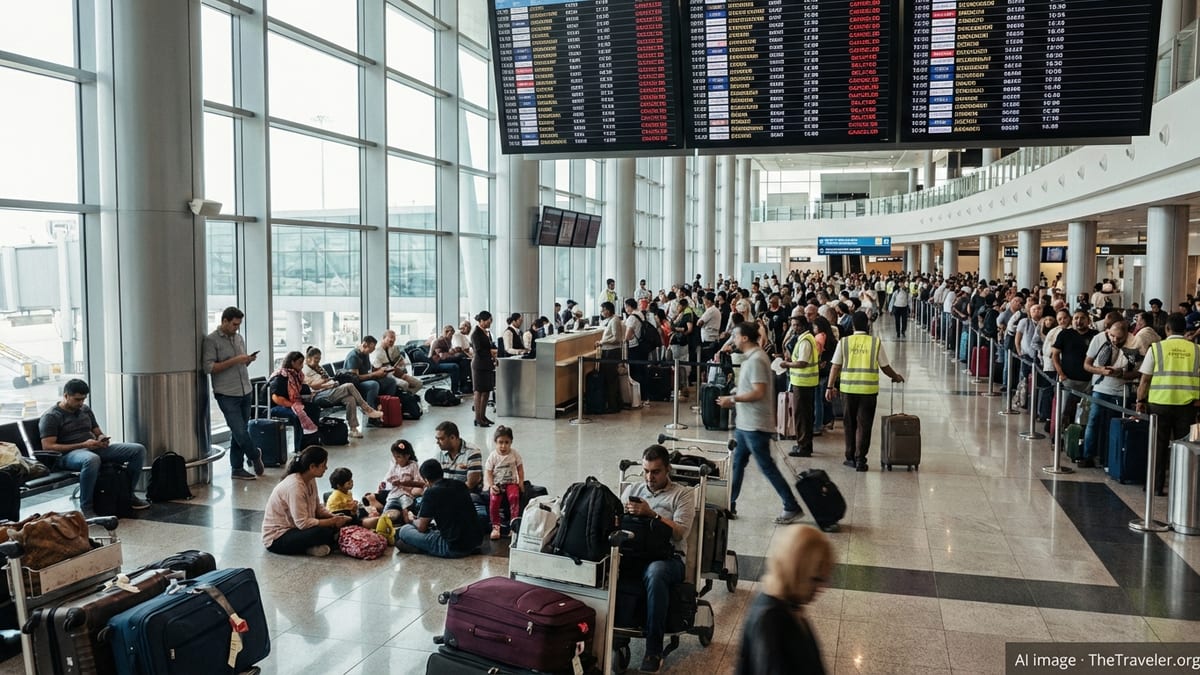
Reports from the airport over the weekend described crowded departure halls where passengers slept on benches and the terminal floor after services were canceled at short notice. Publicly available information from local media suggests that around 2,000 people were stranded overnight at one point as the worst of Noul passed close to the city and public transport services were disrupted.
Travelers who attempted to secure hotel rooms near the airport or in urban districts reportedly encountered sharply higher prices and limited availability. With roads and bridges periodically affected by strong winds, some passengers chose to stay inside the terminal rather than risk traveling into the city without a guaranteed room for the night.
As conditions improved and transport links were progressively restored, more people were able to move between the airport and the urban areas of Hong Kong. However, for those booked on early morning flights or still waiting to be rebooked, remaining inside the terminal was often seen as the most practical option, adding to congestion in seating and check in areas.
Airport Support Measures for Stranded Travelers
Information released by the airport operator over the weekend indicates that the Airport Emergency Centre was activated as Noul approached, coordinating responses among airlines, ground handling agents and government departments. According to published statements, measures included enhanced staffing in passenger areas, distribution of basic supplies and the use of crowd management systems around key transport points such as taxi ranks.
Meal vouchers and bottled water were made available to some passengers during the highest typhoon warning signals, according to official airport notices and media summaries. Additional staff were deployed to help manage long queues at airline service counters, assist with rebooking information and guide travelers unfamiliar with the layout of the large terminal complex.
Despite these efforts, images and descriptions circulating in local coverage portrayed scenes of frustration among travelers facing long waits for information, particularly those with onward connections or time sensitive commitments. The high proportion of transfer passengers using Hong Kong as a regional hub meant that disruptions cascaded through connecting itineraries, leaving some people stranded even after their immediate departing flight had been rescheduled.
Slow Restoration of Airline and Transport Networks
As Noul weakened and moved further inland, airlines began restoring their schedules, but the process has been gradual. Flight tracking data and airline notices cited in media reports show that carriers prioritized clearing earlier cancellations while also operating newly scheduled services, creating pressure on aircraft availability and crew duty limits.
For regional destinations in mainland China and Southeast Asia, additional sectors were added where possible, yet demand from stranded passengers often exceeded the number of seats that could be offered in a single day. Long haul flights to Europe, North America and Australia posed a particular challenge due to their length and the complexity of crew rostering after a weather disruption.
Ground transport to and from the airport has also taken time to normalize. Local reports highlight that high speed links and buses gradually returned to service after typhoon warnings were lowered, but residual delays and partial suspensions earlier in the day contributed to passengers arriving late for rebooked flights or struggling to leave the airport once their journeys were postponed.
Renewed Focus on Weather Resilience at a Major Hub
Hong Kong International Airport is one of Asia’s key aviation hubs, and the disruption caused by Typhoon Noul has renewed attention on how major airports in the region prepare for increasingly volatile weather patterns. Historic typhoons have caused similar large scale delays and cancellations in the past, and planning documents show that the airport operator has invested in dedicated emergency centers, staff rest facilities and coordination mechanisms to manage extended closures.
Analysts note that even with detailed contingency plans, the combination of high passenger volumes, limited hotel capacity near the airport and complex international networks makes a complete avoidance of disruption unrealistic when strong tropical cyclones pass close to the territory. The situation after Noul has highlighted the importance of clear communication with travelers, advance warnings of potential cancellations and flexible rebooking policies by airlines.
For now, publicly available flight information indicates that operations at Hong Kong International Airport are steadily moving back toward normal levels, but with some flights still showing delays and scattered cancellations. For the passengers who remain in the terminal waiting for a seat, the lasting legacy of Typhoon Noul is measured less in wind speeds and rainfall figures than in missed connections, disrupted plans and an unexpected, extended stay at one of the world’s busiest aviation hubs.