


For budget travelers landing at Phuket International Airport, the Phuket Smart Bus has quietly become one of the most useful ways to reach the island’s big west-coast beaches. For around the price of a street-food meal, you can ride in air-conditioned comfort from the terminal all the way down the coastline to Patong, Karon, Kata and right to Rawai, hopping off at Surin or Kamala along the way. It is slower than a private taxi, but for solo travelers, backpackers and anyone watching their baht, it can cut arrival transfer costs dramatically if you understand how the route, timing and luggage rules work in real life.
Get the latest updates straight to your inbox!
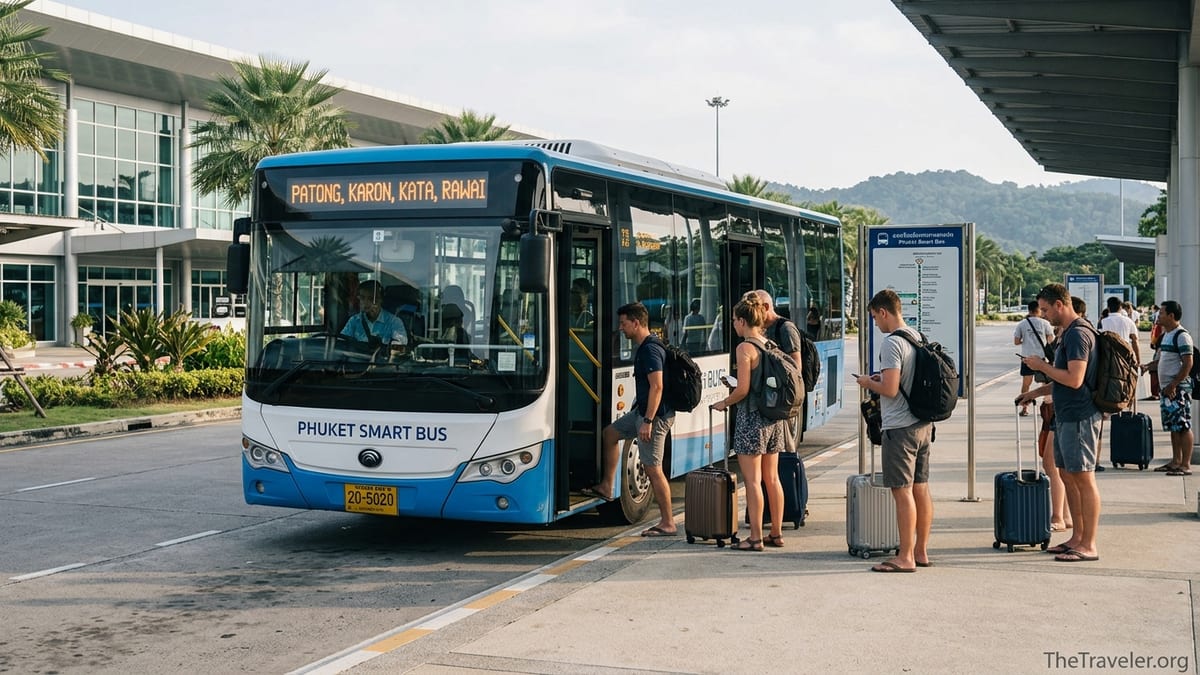
What Is the Phuket Smart Bus and Who Is It For?
The Phuket Smart Bus is a west-coast shuttle linking Phuket International Airport with the island’s major beach areas, running south along the coast and finishing near Rawai in the south. The main line many visitors use is Route 1, which connects the airport with Bang Tao, Surin, Kamala, Patong, Karon, Kata, Chalong and Rawai. The concept is simple: a flat fare, air-conditioned coaches and a clearly defined route that roughly mirrors where most tourists stay on the island’s western side.
In practice, the Smart Bus fills the gap between slow, local blue buses and far more expensive taxis or pre-booked vans. On a typical afternoon in high season, a private taxi quoted at the official counters in the terminal for Phuket airport to Patong might run around 700 to 800 baht, and up to around 1,000 baht to Karon or Kata. By comparison, the Smart Bus currently charges around 100 baht per person for any segment on Route 1, so a solo traveler can save the equivalent of several meals by choosing the bus instead of a taxi for the airport run.
This service is best suited to travelers with time and patience. The journey from the airport to Patong often takes about 1 hour 45 minutes to 2 hours depending on traffic, and reaching Kata or Rawai can stretch closer to 2.5 hours. If you arrive mid-morning or early afternoon and are not exhausted, the ride doubles as a relaxed orientation tour of Phuket’s famous beaches. You watch the scenery change from the airport’s coconut groves to the busy resort strips of Kamala and Patong before rolling into the quieter curves of Kata and the local streets around Rawai.
On the other hand, the Smart Bus is not ideal if you are arriving late at night when the last departures have already left, or if you are traveling with very young children who are tired after a long-haul flight. It is also less convenient for large family groups carrying multiple big suitcases each. For those situations, a pre-booked minivan or taxi straight to your hotel door is usually worth the extra cost.
Route Overview: From Phuket Airport to Surin, Kamala, Patong, Karon, Kata and Rawai
The main Smart Bus route operates in a long coastal arc. Starting from Phuket International Airport, it leaves the terminal area and heads south, passing local stops inland at Thalang before reaching the first resort zones around Bang Tao and Laguna. From there it continues through Surin and Kamala, then over the hill into Patong, further on to Karon and Kata, then across the headland towards Chalong Circle and down to Rawai near the southern tip of the island.
For many visitors, some stops matter more than others. At Surin Beach the bus stops on the main road opposite the large Surin Beach sign, which makes it easy to recognise even if it is your first time. In Kamala, common stops include the area near Phuket FantaSea and a stop close to a local supermarket, making it practical for guests staying in mid-range hotels just back from the beach. In Patong, southbound buses from the airport typically stop near Jungceylon shopping mall, while northbound services towards the airport stop on the beach road near the start of Bangla Road. That split can matter when you book your hotel, as staying within walking distance of these points can save both time and local taxi fares.
Further south, the bus serves Karon at the busy Karon Circle roundabout and near Karon Stadium, which works well for the large strip of hotels running along Karon’s central beach road. In Kata, common reference points include the Kata Night Plaza behind Club Med and hotels such as Kata Palm, allowing backpackers and resort guests alike to walk to their accommodation in 10 to 15 minutes. The final section runs past Sai Yuan Road and down to Rawai, ending near the pier area where long-tail boats depart for nearby islands.
Because the Smart Bus mostly follows the main road rather than weaving down every small side street, you should expect a short walk from the bus stop to your hotel. For example, a guest staying at a mid-range resort on Patong’s second road might walk 10 minutes from Jungceylon with luggage, while someone at a guesthouse on Kamala’s back road might plan a 5 to 8 minute walk from the Kamala stop. If you are staying up a steep hill, such as in parts of north Patong or around some Karon cliffside resorts, you may need a short motorcycle taxi ride from the bus stop, which usually costs a modest extra fee.
Fares, Payment and How Much You Really Save
As of mid 2026, the standard publicised fare on the main Smart Bus line between the airport and any west-coast stop on Route 1 remains about 100 baht per person. The price is designed as a simple flat fare, so a rider going just from Surin to Kamala pays the same as someone traveling the full distance from the airport to Rawai. For short local hops this can be more expensive than a shared songthaew, but for the popular airport-to-beach sectors it is extremely competitive.
Payment options have expanded beyond cash. You can usually pay with cash in Thai baht directly to the onboard staff, but many recent travelers report using contactless cards like Visa or Mastercard, or local QR-code mobile payments, to tap in when boarding. There is also a stored-value card system sometimes marketed as a Rabbit-style card for Phuket, which allows frequent users and local residents to preload value and tap in easily. Using a foreign bank card can be convenient for visitors arriving with limited cash, though it is still worth carrying small notes in case of any technical issues with card readers.
The savings compared with other options are clearest for solo travelers and couples. A taxi from the airport to Patong commonly costs around 700 to 800 baht plus an additional airport surcharge, so a single traveler using the Smart Bus instead can save roughly 600 baht on day one. Even a couple arriving together would still save several hundred baht overall. For a group of four adults traveling together, however, the math shifts. Four Smart Bus tickets at 100 baht each will come to roughly the same cost as a pre-booked van split between them, so at that point many groups prefer the door-to-door convenience of a private transfer.
The bus can also make sense for budget transfers between beaches during your stay. For instance, a traveler based in Kata who wants to spend the afternoon in Kamala for a sunset visit to a popular beach club could ride the Smart Bus for around 100 baht each way instead of paying much higher local taxi rates that vary by negotiation and time of day. This is particularly appealing for long-stay guests who are exploring multiple areas over several days, using the bus to string together a beach-hopping itinerary at low cost.
Timetable, Frequency and Realistic Travel Times
The Smart Bus schedule generally starts around 06:00 from Phuket Airport and runs until early evening, with the last buses leaving Rawai and the airport roughly around 21:00. In both directions the frequency tends to be about every 60 to 90 minutes. These times can shift with season and operational adjustments, so it is wise to check the official Smart Bus timetable or dedicated app shortly before you travel, especially if you are catching a flight later the same day.
Real-world experiences suggest you should treat the published timetable as an approximation, not a precision rail schedule. Traffic can get heavy around Kamala and Patong, especially during the late afternoon and early evening when workers and tourists are all on the move. Travelers posting recent reviews often describe the bus arriving 10 to 20 minutes later than the theoretical schedule, which is normal in Phuket’s stop-and-go coastal traffic. Most riders build in extra buffer time and monitor the live bus location where available.
As a rule of thumb, allow at least 2 hours from Patong to the airport on the Smart Bus, and 2.5 hours from Kata or Karon, including a safety margin for traffic or boarding delays. If you have a morning flight just after sunrise, the first Smart Bus departure might not be early enough to get you there comfortably, and in that case a taxi or pre-booked car still makes more sense. On the flip side, if you land at midday with no schedule pressure, the bus can be an easy, stress-free way to drift down the coast while you shake off jet lag and watch the island roll past your window.
At the airport, the stop is usually located near the domestic terminal, close to one of the terminal exits where small cafes and convenience stores cluster. Many first-timers describe simply walking out through the domestic arrivals doors, looking for a coffee shop, and then spotting the Smart Bus parked opposite with clear branding. At the southern end of the line near Rawai, the bus typically turns around near the pier and Sai Yuan area. When in doubt, you can always confirm with the onboard staff where the bus is heading before you pay your fare.
Luggage Limits and How Much You Can Bring Aboard
Unlike airlines, the Phuket Smart Bus does not publicise a strict weight allowance for baggage, but it does operate more like a city coach than a long-distance tour bus. In practice, passengers routinely board with one standard suitcase and one small carry-on each, using overhead racks or keeping smaller bags at their feet. Larger checked-style suitcases are usually stored in dedicated luggage areas or on floor space near the front, while backpacks slide easily into racks above the seats.
Recent rider reports suggest that one medium suitcase plus a cabin-size bag per person is generally accepted without issue. For example, a couple traveling with two 24 to 26 inch rolling suitcases and two small daypacks would typically have no trouble boarding. However, turning up with oversized, hard-shell cases plus sports equipment, or traveling as a group of five all carrying multiple large bags, can quickly strain the limited storage space on a busy departure. The driver or attendant may refuse excessively large items or ask you to wait for a quieter bus if safety or aisle access is affected.
Because the Smart Bus is meant to serve both locals and tourists, it is important not to block the aisles or emergency exits. When boarding, place your big suitcase in the designated luggage bay if there is one, then keep your backpack or handbag with valuables under your seat. Do not leave passports, wallets or electronics in luggage that you cannot see. For day trips between beaches, many riders simply carry a soft tote or beach bag with towels, sunscreen and a change of clothes, which fits easily in the overhead rack.
If you are traveling with items like surfboards or very large baby strollers, the Smart Bus is usually not the right choice. Taxis or private vans can handle bulky gear far better. Similarly, if you are moving between long-term rentals and carrying several boxes or very heavy luggage, a private transfer or even a local pickup truck service will be less stressful than trying to squeeze everything into the Smart Bus.
How to Board, Buy a Ticket and Choose the Right Stop
Using the Smart Bus at Phuket Airport is straightforward once you know where to look. After collecting your luggage, exit the terminal, following signs for public transport rather than the taxi counters. At the domestic terminal, the Smart Bus stop is usually located near one of the main doors, with the bus itself easily recognisable by its branding and blue or white livery. If you are unsure, ask airport staff for the Smart Bus to Patong or Rawai and they will typically point you in the right direction.
When the bus arrives, you normally board through the front door, tell the attendant your destination area such as Patong or Kata, and then pay your fare in cash or by tapping a card. If you are using a contactless bank card, wait for the staff member to signal when to tap to avoid accidental double charges. They may give you a printed ticket or a digital confirmation, but the process is quick, and you then move inside to find a seat.
Choosing the right stop requires a little preparation. Before your trip, check your hotel’s address on a map and see which main Smart Bus stop is closest. For instance, if you are staying near the southern end of Patong Beach, getting off near the Bangla Road area might leave you with a manageable walk along the beachfront. If your resort is in north Kamala near a landmark like Phuket FantaSea, you will want to watch for that stop on the way. Many travelers keep an eye on their phone’s map using the bus’s onboard Wi-Fi or mobile data so they can alert the driver or attendant a minute before they want to disembark.
On board, seats are typical coach-style, with air conditioning and often free Wi-Fi. The ride can be slightly bumpy over the hills between Kamala and Patong, especially in older vehicles, but most travelers find it comfortable enough for the journey length. There is usually no onboard toilet, so it is sensible to use airport facilities before boarding, particularly if you are heading all the way to Rawai or coming from there back to the airport.
Who Should Use the Smart Bus and When to Choose a Taxi Instead
The Smart Bus is ideal for independent travelers whose priorities are cost and simplicity rather than speed and door-to-door convenience. Solo backpackers, digital nomads and couples on a long Thailand itinerary are typical riders. Someone spending a month in Phuket on a modest budget, for example, might happily spend 100 baht and 2 hours riding from the airport to Patong instead of paying 800 baht for a taxi, then use the savings on local food or scooter rental later in the week.
It is also a good option for confident first-timers who do not mind a short walk with luggage. A traveler staying at a mid-range hotel on Karon’s main road, such as one near Karon Circle, might walk 5 to 10 minutes from the bus stop to their lobby on flat pavement. For many, that trade-off is worth it for the lower fare and the chance to get their bearings along the coast on the way in.
On the other hand, a private taxi or minivan makes more sense in several situations. Families with small children arriving late in the evening often prefer a direct ride to the hotel, avoiding the possibility of waiting nearly an hour for the next bus and then enduring multiple beach stops before reaching their destination. Travelers with mobility challenges or difficulty walking hills may also find the Smart Bus less practical, given that many Phuket hotels are located up side roads or on slopes above the main road.
The Smart Bus also does not serve the east coast or Phuket Old Town directly from the airport. If you are staying in Phuket Town, in luxury resorts on the east coast marinas, or in areas south-east of Chalong, you will usually need either a different bus service or a taxi. Similarly, if you are on a tight schedule, such as arriving just two hours before a ferry departure from Rassada Pier, the indirect Smart Bus route along the west coast is not appropriate. In those cases, book a direct transfer that takes you straight across the island.
The Takeaway
Used thoughtfully, the Phuket Smart Bus is one of the most budget-friendly and relaxed ways to travel between Phuket International Airport and the island’s headline beaches at Surin, Kamala, Patong, Karon, Kata and Rawai. A flat fare around 100 baht keeps costs predictable, and the straightforward route gives you a gentle introduction to the west coast as you roll past bays, headlands and resort towns on your way to your hotel.
For solo travelers, long-stay guests and anyone who prefers to save on transfers to spend more on experiences, the trade-off between time and money usually works in the Smart Bus’s favour. As long as you are not arriving too late at night, do not carry excessive luggage, and are comfortable walking a short distance from the main road to your accommodation, the bus offers excellent value and a glimpse of everyday Phuket life that you might miss from the back seat of a taxi.
Before you travel, check the latest timetable, confirm the closest stop to your hotel and allow plenty of buffer time if you are heading to or from the airport. With a bit of planning and realistic expectations about journey times, the Phuket Smart Bus can turn what might have been a forgettable airport transfer into an easy, scenic and budget-smart start or end to your island stay.
FAQ
Q1. How much does the Phuket Smart Bus cost from the airport to Patong, Karon or Kata?
The main Smart Bus route currently charges a flat fare of around 100 baht per person from Phuket International Airport to any of the major west-coast stops, including Patong, Karon and Kata. This makes it significantly cheaper than a typical taxi fare on the same routes.
Q2. Where do I find the Smart Bus stop at Phuket International Airport?
At Phuket International Airport, the Smart Bus usually stops near the domestic terminal exits in the public transport area. After exiting arrivals, look for signs or ask staff for the Smart Bus to Patong or Rawai and follow directions to the clearly marked bus stop outside the terminal.
Q3. How often does the Phuket Smart Bus run and what are the operating hours?
The Smart Bus typically runs every 60 to 90 minutes in each direction. First departures are usually around 06:00 and the last buses leave in the early evening, often around 21:00, though exact times can vary by season and operational updates.
Q4. How long does the Smart Bus take from the airport to Patong, Karon and Kata?
In normal traffic, the journey from Phuket Airport to Patong often takes about 1 hour 45 minutes to 2 hours, while reaching Karon or Kata can take closer to 2 to 2.5 hours. Heavy traffic or peak season conditions can add extra time, so always allow a buffer.
Q5. Is there a luggage limit on the Phuket Smart Bus?
The Smart Bus does not advertise a strict weight limit, but practically each passenger is expected to bring no more than one medium suitcase plus a small carry-on or backpack. Oversized items or very large amounts of luggage may be refused if they block aisles or take up too much space.
Q6. Can I pay with a credit or debit card on the Phuket Smart Bus?
Yes, many recent riders report being able to pay using contactless Visa or Mastercard, along with local QR-code payments. Cash in Thai baht is still widely accepted, and it is sensible to carry small notes in case card systems are temporarily unavailable.
Q7. Does the Smart Bus go to Phuket Town or the east coast?
No, the main Smart Bus route focuses on Phuket’s west coast, running between the airport, Bang Tao, Surin, Kamala, Patong, Karon, Kata, Chalong and Rawai. It does not serve Phuket Town, Rassada Pier or east-coast marinas directly from the airport.
Q8. Is the Phuket Smart Bus safe and comfortable for families?
The Smart Bus is air conditioned and generally considered safe and comfortable, with standard coach seats and a calm onboard atmosphere. Families with older children often use it happily, but parents with very young or tired kids may prefer a private taxi for a shorter, door-to-door transfer.
Q9. How do I know when to get off at my stop?
Before boarding, note the nearest main stop to your hotel, such as Surin Beach, Kamala, Patong Jungceylon, Karon Circle or Kata Night Plaza. Many travelers track the bus location on their phone’s map and press the stop button or speak to the attendant a minute before their stop so the driver can pull over safely.
Q10. When should I choose a taxi instead of the Smart Bus?
A taxi or private minivan is usually better if you arrive very late at night, have an early-morning flight, carry a lot of luggage or bulky items, travel with people who have mobility issues, or simply prefer a fast, door-to-door ride directly to your hotel without multiple intermediate stops.