


Landing at Phuket International Airport can feel chaotic after a long flight, especially when you step into the humid night and are immediately surrounded by calls of “Taxi? Taxi?” This guide explains, in simple practical terms, how the official taxi system at Phuket International Airport works in 2026, what you should expect to pay, where to find the right counters, and how to avoid the persistent unofficial drivers that still operate around the terminal.
Get the latest updates straight to your inbox!
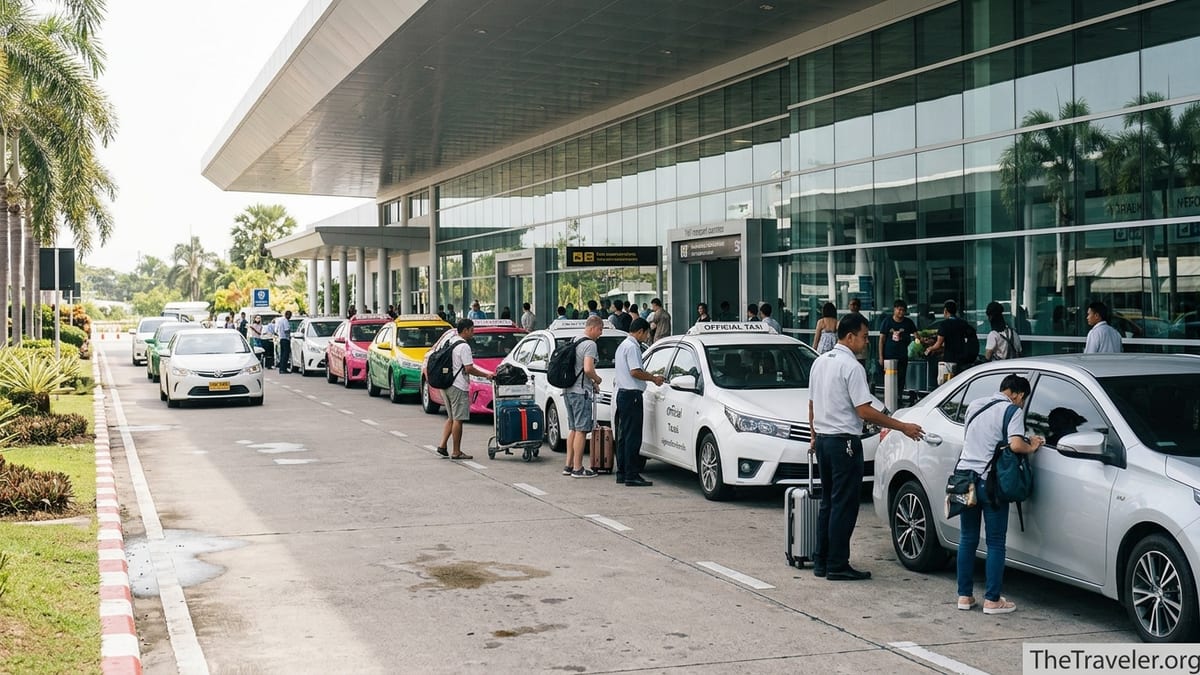
How Phuket Airport Taxis Work in 2026
Phuket International Airport (HKT) sits in the island’s north, around 35 to 45 minutes by road from popular beach areas like Patong, Kamala and Laguna, and up to an hour from Kata or Rawai. Most visitors arriving in 2026 will use either the official airport taxi counter, the metered taxi stand just outside the terminal, or a pre-booked car through a transfer company or ride-hailing app. All of these are regulated options, but they operate slightly differently and the experience can vary a lot in terms of comfort and price.
Thailand’s Public Relations Department lists taxi meter and so-called VIP taxis, including EV options such as CABB and EVME, among the official modes of transport out of Phuket Airport, alongside buses and car rentals. In practice, this means that you can expect to see both regular petrol taxis and newer electric vehicles lining up outside Arrivals, all operating under airport-approved schemes. Ride-hailing apps like Grab are also present, though pick-up rules for app cars are stricter inside the airport perimeter than in town.
Official messaging from airport authorities and local transport offices consistently warns that only taxis authorized by Airports of Thailand (AOT) may pick up passengers at Phuket International Airport. Signs at the entrance state that unauthorized drivers entering the airport area to solicit passengers may be fined under Thai transport regulations. For travelers, this is a clear hint: if someone approaches you directly in the terminal offering a bargain taxi without sending you to a staffed counter or marked stand, you should assume they are operating outside the official system.
In day-to-day terms, most visitors will either walk directly to the line of taxi counters in the Arrivals hall and buy a fixed-price ride, or head outside to the right to find the metered taxi stand. The key advantage of using these official options is that your journey is logged, prices are displayed on boards at the counter, and if something goes wrong you have at least a receipt or plate number to report.
Where to Find Taxi Counters and Stands at HKT
Phuket Airport has both international and domestic terminals, but from a passenger perspective they sit side by side, connected by a short walk under cover. In each terminal, once you exit customs or baggage reclaim, you will step into the Arrivals area where a row of transport counters lines the wall. Here you will see booths for “Airport Taxi,” “Limousine,” “Minibus,” car rentals, and sometimes hotel transfer desks. These official counters typically operate 24 hours a day, reflecting Phuket’s late-night flight schedule.
Prices are shown on large printed boards behind the desks, divided by zone. For example, in 2026, recent visitors report posted taxi prices from the airport to Patong of around 700 to 800 baht for a standard car, plus an airport surcharge of about 100 baht that is already built into the displayed rate. Rides to Phuket Town are usually somewhat cheaper, while longer trips to Kata, Karon or Rawai cost more. The advantage of these counters is simplicity: you pay or receive a voucher, are assigned a driver, and walk straight to the waiting area outside with no negotiation.
For those looking for a metered taxi, head out of the terminal doors and walk slightly to the right. A number of up-to-date traveler reports and airport guides describe a clearly marked metered taxi stand here, with a sign in English indicating “Metered Taxi.” Typically a dispatcher gives you a slip with the taxi’s plate number and leads you to the next available car. Technically, these taxis should use the meter plus a fixed airport surcharge of around 50 to 100 baht, similar to the structure seen at other Thai airports, although in Phuket many drivers will still propose a flat price instead of running the meter.
Some hotels and resorts, particularly in the Laguna, Mai Khao and Kamala areas, offer their own transfer desks inside the terminal or maintain a small sign where pre-booked guests meet a driver. This can be convenient if you are arriving with young children or a lot of luggage. In most cases, the driver will wait at the exit from customs holding a card with your name and walk you past the taxi queues to a parked minivan or SUV in the car park.
Typical Taxi and EV Fares: What You Should Expect to Pay
Exact prices change over time, but in 2026 a realistic expectation for a standard taxi from Phuket Airport to Patong is roughly 700 to 800 baht for a sedan taxi booked at an official counter, or around 600 to 700 baht plus an airport service fee when using the metered stand. Journeys to Karon or Kata might run closer to 900 to 1,000 baht, while Phuket Town is often around 500 to 600 baht. Remote areas like Nai Harn or Cape Panwa can cost over 1,000 baht due to distance and limited return rides.
EV taxis and VIP cars, including services branded locally as CABB or EVME, normally charge a premium over regular sedans. Passengers choosing these options often pay a few hundred baht more for a quieter ride with more space and sometimes better English-speaking drivers. For instance, a VIP or EV car to Patong might be quoted in the 1,000 to 1,200 baht range in 2026, depending on the operator and time of day. These vehicles are popular with families carrying multiple suitcases or travelers arriving after midnight who appreciate a more comfortable transfer.
Several independent Phuket travel blogs and transfer comparison sites regularly publish fare estimators. As of mid-2026, they broadly agree that official airport taxi prices are higher than ride-hailing apps during off-peak times, but can be similar or even cheaper during late-night periods or high demand when app prices surge. For example, some travelers report Grab quotes to Patong in the 700 to 900 baht range at busy evening hours, occasionally exceeding the posted airport counter rates.
As a rule of thumb, if you are quoted a figure far below 500 baht for any destination south of Kamala or east to Phuket Town, be suspicious. Deeply discounted offers usually come from unofficial drivers trying to bypass airport rules, and those drivers may attempt to raise the price en route, insist on cash only with no receipt, or stop at jewelry and tour shops along the way. Paying a little more for an official car generally buys you a smoother experience and reduces the risk of disputes.
Metered Taxis, Ride-Hailing Apps and EV Options
Metered taxis are theoretically the fairest system, charging according to distance and time rather than zones, with a small airport surcharge on top. In Phuket, however, the reality has long been more complex: some drivers prefer to quote a flat fare and will resist turning on the meter, particularly for popular destinations like Patong and Karon where they know the standard price. If you specifically want a metered ride, make this clear to the dispatcher at the stand, not just the driver, and confirm whether the meter will be used.
Ride-hailing apps such as Grab, and more recently other platforms, operate throughout Phuket, but their presence at the airport itself has gone through several stages of restriction and gradual acceptance. Recent traveler accounts from 2025 and 2026 describe a designated pick-up zone for app-based rides outside the terminal, though rules can change and there may be signs discouraging passengers from activating certain apps inside the immediate arrival area. Practically, many visitors now book a Grab or similar service once they step outside, then follow in-app directions to the pick-up point, which is usually a short walk away from the main taxi lanes.
Electric taxis and so-called VIP vehicles are promoted by Thai authorities as greener and more comfortable options. Some operate as part of the official airport fleet, while others are accessible via apps. Their advantages include quieter cabins, modern safety equipment, and often drivers used to airport-hotel routes. The trade-off is price: expect to pay around 20 to 40 percent more than a typical sedan taxi for the same journey, which adds up for a family but may be worthwhile if you value comfort on arrival.
When comparing options in real life, it can help to do a quick check while standing in the Arrivals hall. Look at the posted rate board at the taxi counter for your destination, then open a ride-hailing app on your phone and check the current estimate for the same route. If the app is significantly lower and pick-up is allowed, you might accept the slightly longer walk to the app pick-up point. If the difference is small, many travelers prefer the simplicity and clear process of the airport counter, especially after a long flight.
Practical Tips for Luggage, Families and Late-Night Arrivals
Luggage is one of the biggest practical factors in deciding which taxi to take from Phuket Airport. Regular sedans have limited trunk space, and Thai regulations allow drivers to charge small additional fees for oversized or numerous bags. Signs at some official taxi counters specify that very large suitcases above a certain size, or sports equipment such as golf bags or surfboards, may incur an extra charge per item. For a couple with two medium suitcases and carry-ons, a standard sedan is usually sufficient, but a family of four with multiple large bags might be far more comfortable in a minivan or VIP vehicle.
Families traveling with young children should be aware that Thai taxis are not generally equipped with child seats. If you require a car seat, you have three main options: bring your own and install it in the taxi; pre-book a private transfer company that offers child seats at extra cost; or accept the local norm of children traveling without dedicated restraints. Many European and North American parents choose the first or second options for peace of mind. It is wise to inform your chosen transfer provider in advance if you need a child seat and to confirm whether the request has been noted.
Late-night arrivals are common at Phuket, with flights from the Middle East and Europe often landing after midnight. The good news is that the airport taxi counters and stands generally operate 24 hours, meaning you should still find official transport options at 2 or 3 a.m. However, some counters may apply a late-night surcharge of around 100 to 200 baht on top of daytime rates. In practice, this might push a Patong fare from 700 baht in the early afternoon to perhaps 800 or 900 baht in the small hours of the morning.
Travelers arriving very late with children or elderly relatives often find it worthwhile to pre-book a private transfer. In that scenario, a uniformed driver meets you at the exit holding a sign with your name, helps with luggage, and takes you directly to a waiting vehicle. Prices for these pre-booked services are typically similar to or slightly above airport taxi rates, but the convenience and reduced stress at 2 a.m. can be significant, especially after a long-haul flight.
Recognizing and Avoiding Unofficial or Problem Drivers
Despite repeated crackdowns and signs warning of penalties for unauthorized taxis, Phuket Airport still has its share of unofficial drivers and aggressive touts. These individuals may approach you inside the terminal, just after you exit customs, or near the doors leading outside, often with lines like “Taxi? Cheap price, no need to queue.” Some may claim that official taxi counters are closed, that ride-hailing apps are banned, or that there is a “new rule” preventing your pre-booked driver from coming inside. These tactics are designed to rush you into accepting a ride before you compare options.
To protect yourself, follow a few simple rules. First, ignore anyone who approaches you directly offering a taxi, especially if they steer you away from the clearly marked counters or metered stand. Instead, walk calmly to the official rows of counters or to the signed metered taxi area outside to the right of the exit. Second, check that the vehicle you are getting into has appropriate airport and taxi stickers, a visible license plate, and a driver who is comfortable showing you their ID card or taxi license if you ask. Third, confirm the price or that the meter will be used before the car starts moving.
Travel forums and social media regularly share stories of passengers overcharged or intimidated by drivers who started with a friendly offer in the terminal. Some report drivers demanding extra money halfway through the journey, claiming there were more passengers than quoted, or that heavy traffic justified a higher fare. Others describe being taken to a tour office or shop “on the way” where staff try to sell excursions or timeshares. These problems are much less common when you book via the official airport taxi system or through ride-hailing apps, where the fare is pre-agreed and the journey is tracked.
If you feel unsafe during a ride, stay calm and avoid confrontation. In most cases of disagreement over price, firmly but politely restate the amount agreed at the start, referencing the receipt or screenshot from your app if you have one. You can also mention that you will contact your hotel or the tourist police if necessary. The presence of CCTV at hotel entrances and major intersections, along with the risk of complaints affecting a driver’s license, usually encourages disputes to be resolved without escalation.
Real-World Scenarios: From Smart Choices to Common Pitfalls
Consider a couple arriving from Singapore at 11 a.m., headed to a mid-range hotel in Patong with two medium suitcases and backpacks. After exiting customs, they walk to the “Airport Taxi” counter, see the rate board, and are quoted 800 baht for a standard car, payable in cash. At the same time, they open a ride-hailing app and see an estimate of around 650 baht to the same hotel, with a five-minute wait. They decide that saving 150 baht is worth a short walk and order the app ride, then follow the in-app map to the pick-up point outside. The driver arrives, helps with luggage and takes the fastest route via the main highway. For them, the app offers an easy, slightly cheaper experience.
Now imagine a family of five arriving from Europe at 1:30 a.m. with two adults, three children, and four large bags. At that hour, app prices may be higher due to fewer drivers on the road, and it can be harder to fit everyone and their luggage into a standard sedan. In this case, the parents head straight to the official counter, request a private minivan, and are quoted around 1,300 to 1,500 baht to Kata, including a late-night surcharge. A staff member escorts them to a spacious minivan where the children can doze on the seats, and the driver takes them directly to their villa without any confusion or waiting in the car park.
A less positive story involves a solo traveler arriving in the early evening. Feeling tired and overwhelmed, they accept an unsolicited offer in the Arrivals hall from a man holding a generic “Taxi Service” card. He leads them past the official counters to a parked car with no clear taxi markings. During the drive to Karon, he suggests that the original quote of 700 baht did not include tolls or luggage and demands 1,200 baht instead, raising his voice when the passenger hesitates. Without a receipt or clear record of the agreed fare, the traveler feels pressured and ends up paying more than expected to avoid conflict.
These examples highlight a simple pattern that repeats itself across countless trips each month. When travelers use the official counters, metered stand or established apps, most journeys are uneventful and fairly priced, even if the cost feels high by Thai standards. Problems tend to occur when passengers accept off-the-books deals with drivers who lack airport authorization or when prices are not clearly agreed in advance. Being aware of this dynamic before you land helps you make better choices the moment you step into the arrivals area.
The Takeaway
Phuket International Airport can feel like a puzzle on arrival, but the taxi system becomes far simpler once you know where to go and what to expect. Official counters in the Arrivals hall and the metered taxi stand outside provide clear, regulated options, with zone-based or metered fares that are broadly known among locals and frequent visitors. EV taxis and VIP vehicles add comfort and space for those willing to pay a bit more, while ride-hailing apps give another layer of choice, particularly at quieter times of day.
The main risks for travelers are not violent crime or major safety issues, but rather overcharging, high-pressure sales tactics, and occasional detours to tourist shops. These are largely avoidable if you ignore unsolicited offers, insist on using official channels, confirm fares before departure, and keep basic records such as receipts or app screenshots. For families and late-night arrivals, pre-booked transfers and minivans often provide the best balance of convenience and peace of mind.
Ultimately, a smooth start to your Phuket trip begins before you land. Take a few minutes while still on the plane to check current app prices to your hotel, glance at recent online reports of airport taxi fares, and decide whether you prefer the certainty of an official counter, the flexibility of an app, or the comfort of a pre-booked car. With a clear plan and realistic expectations, your first journey from Phuket International Airport to your hotel can be an easy, uneventful ride rather than the stressful ordeal that so many forum posts warn about.
FAQ
Q1. How much should I expect to pay for a taxi from Phuket Airport to Patong?
Most travelers in 2026 report paying around 700 to 800 baht for a standard taxi from the official airport counter or metered stand to Patong, with VIP or EV cars costing more.
Q2. Where exactly do I find the official taxi counters at Phuket Airport?
After you collect your luggage and pass through customs, you will see a row of transport counters along the wall in the Arrivals area of both terminals, clearly marked for taxis, limousines and minibuses.
Q3. Are metered taxis really using the meter at Phuket Airport?
Some do, but many prefer a fixed fare for popular routes. If you want the meter, ask the dispatcher at the stand before getting in and confirm with the driver that the meter will be switched on.
Q4. Can I use ride-hailing apps like Grab at Phuket Airport?
Yes, but pick-up is usually from a designated area outside the terminal. Rules can change, so after landing check your app for the latest instructions and be prepared for a short walk.
Q5. Is it safe to take a taxi at 2 or 3 a.m. from Phuket Airport?
Using official airport taxis, pre-booked transfers or reputable apps is generally considered safe even late at night, though you may pay a small nighttime surcharge.
Q6. What should I do if a driver approaches me inside the terminal offering a cheap ride?
Politely decline, walk past them and use the official counters or metered stand instead. Unsolicited offers inside the terminal are a strong sign the driver is not operating under the official system.
Q7. How can families with young children best arrange airport transfers?
Families often pre-book a private minivan with a transfer company, especially if they need child seats or have lots of luggage. This avoids squeezing into a small sedan and simplifies things late at night.
Q8. Do taxis from Phuket Airport charge extra for luggage?
They may add small fees for very large suitcases or sports equipment such as surfboards or golf bags. Ask at the counter or stand whether your luggage will incur extra charges.
Q9. What if my driver tries to increase the fare during the trip?
Stay calm, remind them of the agreed price, and show any receipt or app confirmation you have. If necessary, mention that you will ask your hotel or the tourist police for help resolving the dispute.
Q10. Is it worth pre-booking a transfer instead of using the airport taxis?
For late-night arrivals, families, or travelers who value a smoother experience, pre-booking can be worthwhile. For solo travelers or couples arriving in daytime, the official airport taxis or apps usually work fine.