


Landing at Phuket International Airport for the first time can feel overwhelming. The terminals are busy, taxi touts call out the moment you step outside, and jet lag makes every decision feel harder than it should. With a little preparation, though, your arrival at HKT can be straightforward, safe, and even pleasantly efficient. This guide walks you through the airport layout, arrivals, transport into Patong, Kata and Karon, how Grab and the Phuket Smart Bus work in real life, plus customs and first-time Phuket tips based on 2026 conditions.
Get the latest updates straight to your inbox!
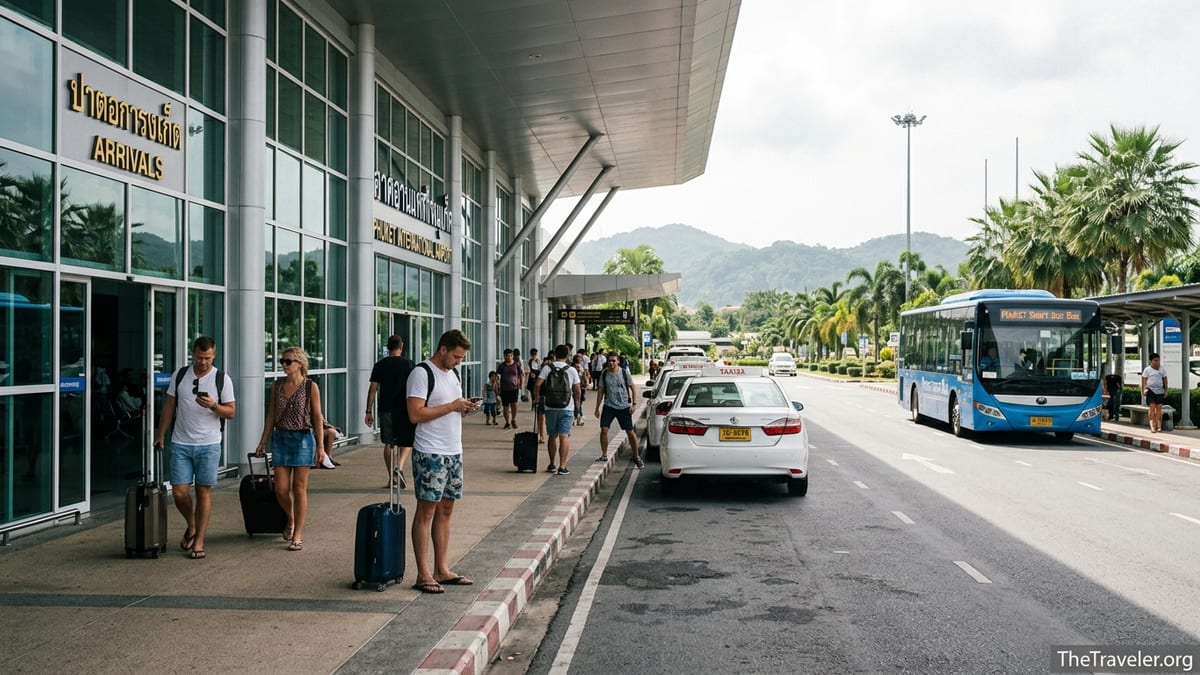
Understanding Phuket International Airport: Terminals and Layout
Phuket International Airport (HKT) is Thailand’s third busiest airport and the main gateway to the island. It sits on the northwest coast near Mai Khao Beach, roughly 35 kilometers from Patong and about 45 kilometers from Kata and Karon. In practice that means a 45 to 60 minute drive to the main west coast resorts, depending on traffic and time of day. For a first-time visitor, the airport feels compact compared with major hubs like Bangkok Suvarnabhumi, but it is busy and can be crowded at peak times.
The airport currently operates with separate international and domestic terminals. The newer international terminal handles most flights arriving from outside Thailand. The older but modernized domestic terminal handles internal flights to and from Bangkok, Chiang Mai, and other Thai cities. Walking time between terminals is about five to ten minutes via an outdoor but covered walkway, so if you arrive internationally and connect to a domestic flight, you will need to exit one building and follow the clearly signed path to the other.
Most ground transport options, including official taxis, shared minibuses, and rental car desks, are clustered around the arrivals level of both terminals, with a slightly larger concentration on the domestic side. If you are meeting friends or a pre-booked driver, many people use the arrivals exit at the international terminal as a common meeting point, then walk together if necessary. After baggage claim you pass through customs, exit through sliding doors, and find yourself in a hall filled with transfer counters, tour desks, and money changers.
Orientation tip: When you come out of the international arrivals area, the official taxi counters are usually to your right, car rental desks are mostly straight ahead or slightly left, and the Phuket Smart Bus stop is outside the terminal building at the far end. If you are tired and unsure, it is worth pausing inside the air-conditioned arrivals hall to get your bearings before you step outside into the heat and noise.
Arrivals, Immigration, and Customs: What to Expect
For international arrivals, the first step after leaving the aircraft is immigration. At busy times in high season, queues can be long. In 2026, many travelers report 30 to 60 minutes from landing to clearing passport control, although off-peak flights can be much faster. If you are flying in from elsewhere in Thailand, you will skip immigration in Phuket because that is handled at your first point of entry into the country.
Thailand offers visa exemption or visa-on-arrival for many nationalities, but the rules can change, so it is safest to check current requirements with a Thai consulate or official government source before you fly. In practical terms at Phuket, immigration officers typically ask for your passport with six months’ validity, a completed arrival card if required by your airline, and sometimes proof of onward travel or accommodation. Most first-time tourists staying in hotels on Patong, Kata or Karon just present their booking confirmation on their phone if asked.
After immigration you collect your bags from the carousel area. Baggage carts are widely available and free. Customs is usually straightforward. Most people simply walk through the green lane with nothing to declare. Officers may randomly scan bags, especially if they look unusually large or heavily wrapped. Thailand is strict about drugs, weapons, vaping devices and e-cigarette liquids, as well as counterfeit goods. Bringing an extra bottle of wine or a laptop in your carry-on is rarely an issue, but large quantities of alcohol or cigarettes beyond the standard duty-free allowance can attract fines.
Before you leave the secure zone, consider whether you need local cash or a Thai SIM card. There are ATMs inside and just outside the arrivals area. Withdrawal fees are relatively high for foreign cards, so many visitors take out a larger amount once rather than making multiple small withdrawals. For mobile data, you will see counters for the main Thai providers such as AIS, DTAC and True. Typical tourist packages offer 7 to 15 days of unlimited data for a few hundred baht. Buying a SIM on arrival can make it much easier to book a Grab, message your hotel, or check maps for the Smart Bus stop.
Getting into Town: Taxis, Ride-Hailing, and Private Transfers
Once you exit customs, the first real decision is how to get from HKT to your hotel. The most common options for first-time visitors are official airport taxis, ride-hailing apps like Grab or Bolt, shared minibuses, and pre-booked private transfers. The right choice depends on your budget, how tired you are, and how much luggage you are carrying.
Official airport taxis operate on fixed-zone pricing. In mid 2026, common rates from the AOT (Airports of Thailand) counters are around 800 baht for Patong and roughly 900 to 1,000 baht for Karon or Kata for a standard car. These prices are for the vehicle, not per person, so a couple or small group often finds this the simplest door-to-door solution. You pay or at least take a ticket at the counter inside the terminal, then a staff member walks you outside to your driver. This system is designed to avoid haggling and reduce scams, and for most first-timers it is worth the small premium over the cheapest options.
Ride-hailing apps are widely used in Phuket in 2026, with Grab and Bolt the main players. In practice, Bolt often comes out slightly cheaper, while Grab sometimes has more cars available. A typical quoted fare on these apps from the airport to Patong in normal traffic might be around 350 to 600 baht for a standard car, and slightly more for Kata or Karon. Exact prices fluctuate with demand and time of day. Pick-up points for app rides are usually in designated zones outside the terminal; the app instructions will tell you whether to meet your driver at “International Arrivals” or “Domestic Arrivals.” If you already have local data or airport Wi-Fi is working well, opening the app after baggage claim, comparing fares with the official counter, and deciding on the spot is a practical real-world approach.
Shared minibuses are the budget-friendly compromise between the Smart Bus and a private car. Counters in the arrivals hall sell seats on minibuses for around 200 to 300 baht per person to Patong, Kata or Karon. The van usually leaves once it fills up, so you may wait 15 to 30 minutes. The van drops people at different hotels along the way, which means your actual travel time can be 60 to 90 minutes or more. For solo travelers or backpackers arriving during the day, this can be a good balance of cost and convenience. For families with tired children or late-night arrivals, the door-to-door certainty of a taxi or app car is usually worth the extra spend.
Phuket Smart Bus and Other Public Transport Options
The Phuket Smart Bus is one of the best-value ways to travel from the airport along the west coast beaches if you are not in a hurry. In 2026, the flat fare is about 100 baht per person for any destination along its Route 1, which runs from Phuket International Airport down the west coast through Bang Tao, Surin, Kamala, Patong, Karon, Kata and finally Rawai. For a first-time visitor staying on Patong, Kata or Karon, this can cut your arrival cost to a fraction of a taxi.
In practice, using the Smart Bus works like this: After you exit the terminal, follow the signs or ask an airport information desk for the Smart Bus stop. Buses typically run every 60 to 90 minutes, with more services in the daytime and fewer at night, so you may need to wait. You pay on board, usually with cash or a contactless card. Luggage is stored in a dedicated area near the front. The buses are air-conditioned and relatively comfortable, but they stop at many points along the way, so the journey to Patong can take 90 minutes or more, and to Kata or Karon closer to two hours.
Real-world example: A budget traveler landing around midday might clear arrivals by 13:00, grab a coffee, then catch the 13:30 Smart Bus. They pay 100 baht, ride to Patong in about 90 minutes, and get off at a stop on the main beach road. From there they walk ten minutes to a guesthouse on a side street. Total transport cost: 100 baht. Time from plane door to hotel: about three hours. Compare that with a 900 baht taxi that would deliver them door-to-door in roughly 60 minutes and you can see the trade-off clearly: money saved versus time and convenience.
Beyond the Smart Bus, Phuket has other forms of public transport, but they are less useful directly from the airport to the main beaches. Local blue buses and pink buses focus on routes between Phuket Town and various beach areas, not airport-to-resort trips. There are also older “airport bus” services that run to Phuket Town. For a first-time visitor whose hotel is on Patong, Kata or Karon, these usually require a change of vehicle in town, which adds complexity and travel time. If you are staying long term or on a very tight budget, learning these routes can make sense, but for a short holiday it is often easier to choose between Smart Bus, shared minibus, or taxi.
Getting to Patong, Kata, and Karon: Real-World Scenarios
Most first-time visitors to Phuket head straight for the west coast beaches. Patong is the busiest, with nightlife, shopping and a wide range of hotels. Kata and Karon are slightly quieter and more family-friendly, though still developed. Your arrival strategy may differ depending on which of these you are aiming for, what time you land, and how you feel about cost versus comfort.
If you are staying in Patong and arriving in the afternoon, the most common real-life choices are an app-based car, official taxi, or Smart Bus. A couple with two suitcases might look at Grab or Bolt first: if the app shows a fare around 400 baht and a driver five minutes away, ordering the car usually makes sense. If the app is quoting high surge prices or shows a 20-minute wait, they might instead walk to the AOT taxi counter and pay around 800 baht for a guaranteed car. A solo backpacker with a big rucksack who is not in a rush might choose the Smart Bus for 100 baht, accepting the longer journey.
For Kata and Karon, distances are slightly longer and prices a little higher. Expect official taxi quotes in the region of 900 to 1,200 baht and ride-hailing fares somewhat less, depending on demand. The Smart Bus still costs about 100 baht to these beaches, which makes it extremely economical, but the travel time can approach two hours as the bus stops in Kamala, Patong and Karon before reaching Kata in the south. A real-world strategy many people use is to take the Smart Bus during the day when they are fresh, and pay for a taxi or app car for early morning flights or late-night arrivals when waiting for a bus feels more draining.
One key tip: ignore the unofficial touts who approach you as you step out of the terminal with lines like “Taxi, taxi, where you go?” They often quote prices significantly higher than the official counters, for example 1,200 baht to Patong for a standard car that the AOT counter might sell for 800 baht. As a first-time visitor, you can avoid confusion by either using the official desks inside the arrivals hall or booking through a reputable ride-hailing app where the fare is displayed before you confirm.
Car Rental at HKT and Driving in Phuket
Renting a car directly at Phuket International Airport can be a smart option for travelers who want maximum flexibility, especially families or groups planning to explore beaches beyond Patong, Kata and Karon. Well-known international brands such as Hertz, Avis and Budget operate desks in the arrivals halls, alongside several reputable local companies. Typical prices in 2026 start from around 800 to 1,200 baht per day for a small sedan, rising to 1,500 baht or more for SUVs or larger vehicles, with variations depending on season and insurance coverage.
In practice, the rental process usually involves presenting your passport, a valid driving license, and in many cases an International Driving Permit. A credit card is normally required for the deposit. Many travelers choose full insurance coverage or “super CDW” to reduce the excess, which adds to the daily rate but offers peace of mind in busy traffic. Before driving off, walk around the car with an agent, photograph any existing scratches or dents, and check that a spare tire and basic tools are in the boot.
Driving in Phuket is left-hand side, similar to the United Kingdom and Australia. The main roads from the airport to Patong, Kata and Karon are paved and generally in good condition, but can be narrow and winding in sections, particularly over the hills between Kathu and Patong or Karon and Kata. In real life, the biggest hazards are impatient overtaking, motorbikes appearing suddenly from blind spots, and heavy rain reducing visibility during the wet season. First-time visitors who are not confident in these conditions may prefer to rely on taxis and Grab for the first couple of days before deciding whether to rent a car.
Parking in Patong, Kata and Karon can be tight, especially near the beach and around popular nightlife areas. Hotels often provide limited guest parking; contacting your hotel before arrival to confirm whether they have on-site or nearby parking is a useful step. If you plan to rent a car only for day trips rather than your entire stay, another real-world strategy is to travel from the airport by taxi, then rent a car from a local office near your hotel for specific days when you want to explore.
First-Time Phuket Tips: Money, Safety, and Local Etiquette
Arriving at Phuket International Airport sets the tone for your trip, and a few small decisions can make your first 24 hours go more smoothly. For money, it is sensible to carry at least a small amount of Thai baht in cash for incidentals such as snacks, small tips, or bus fares. Many taxis, Grab drivers and hotels accept cash only, although ride-hailing apps charge your card directly. ATMs at the airport and around Patong, Kata and Karon are plentiful, but almost all charge a fee for foreign cards. Using a fee-free travel card or withdrawing a larger amount once can reduce the overall cost.
Safety around HKT and on the way to the beaches is generally good. The biggest practical risks are petty overcharging and confusion rather than crime. Always confirm the fare before getting into a taxi if you are not using an official counter or app. Keep your valuables in a zipped bag and avoid placing phones or wallets on the seat beside you in case of sudden braking. In shared minibuses, keep your smaller bags with you rather than in the rear luggage area if they contain passports or electronics.
Local etiquette is straightforward but important. Thais are generally friendly and polite, and a calm tone goes a long way if there is a misunderstanding over price or directions. Raising your voice rarely helps. Dress modestly inside the airport and when dealing with officials; beachwear is fine once you reach Patong or Kata, but less appropriate in the arrivals hall. When you reach your hotel and start exploring, remember that scooters are common, helmet use is legally required, and tourist accidents on rented motorbikes are unfortunately frequent. If you have never ridden in similar conditions, think carefully before renting one just because they are cheap.
Finally, plan for the heat. Stepping out of the air-conditioned terminal into midday humidity can be a shock, especially after a long-haul flight. Keeping a refillable water bottle in your bag, putting sunscreen and sunglasses within easy reach, and wearing light clothing for the flight can make that transition more comfortable. If your room is not yet ready when you arrive at your hotel, using the time to take a short walk, have a light meal, and then rest in the shade will help you adjust to Phuket time faster than collapsing into bed immediately.
FAQ
Q1. How long does it take to get from Phuket Airport to Patong?
In normal traffic, a taxi or Grab from Phuket International Airport to Patong takes about 45 to 60 minutes. The Phuket Smart Bus can take 90 minutes or more because it makes many stops along the way.
Q2. What is a typical taxi fare from Phuket Airport to Kata or Karon?
From the official airport taxi counters, expect to pay roughly 900 to 1,200 baht for a standard car to Kata or Karon in 2026. Prices from ride-hailing apps such as Grab or Bolt are often slightly lower but vary with demand.
Q3. Is Grab or Bolt allowed at Phuket International Airport?
Yes, both Grab and Bolt operate at Phuket International Airport in 2026. Pick-ups are usually from designated points outside the international or domestic arrivals areas, and the app will show you exactly where to meet your driver.
Q4. How much does the Phuket Smart Bus cost from the airport?
The Phuket Smart Bus charges a flat fare of about 100 baht per person from the airport to any stop along its route, including Patong, Karon, Kata and Rawai. You pay on board, usually with cash or a contactless card.
Q5. Is the Phuket Smart Bus practical if I have a lot of luggage?
Yes, the Smart Bus has dedicated luggage space and is used by many travelers with suitcases. However, if you have very bulky bags or multiple large cases, a taxi or ride-hailing car may be more comfortable.
Q6. Can I easily transfer between international and domestic flights at HKT?
Transfers usually involve walking between the international and domestic terminals via a short covered walkway. Plan at least a couple of hours between flights, especially in high season, to allow time for immigration, baggage, and security.
Q7. Do I need cash at Phuket Airport, or can I use cards everywhere?
You can pay by card at many airport shops, SIM card counters and taxi desks, but some transport options, like the Smart Bus and smaller food stalls, often prefer cash. Having at least a few hundred baht in cash on arrival is very useful.
Q8. Is it safe to arrive at Phuket Airport late at night?
Yes, Phuket International Airport operates late into the night and is generally safe. Official taxis, ride-hailing cars and pre-booked transfers still run, though public options like the Smart Bus may be limited, so door-to-door transport is recommended after midnight.
Q9. Should I rent a car directly at the airport or later from my hotel area?
If you are confident driving and want immediate independence, renting at the airport is convenient. If you are tired after a long flight, a common approach is to take a taxi to your hotel, rest, and rent a car locally for specific days when you plan to explore.
Q10. What is the simplest option for a first-time visitor with jet lag?
For most first-time travelers arriving tired, the simplest choice is to use the official airport taxi desk or a pre-booked private transfer. Both give you a clear price up front and direct, air-conditioned transport to your hotel without needing to navigate apps or bus timetables.