


Landing at Phuket International Airport with tired kids and a stack of suitcases can make the last 50 kilometers to Kata Beach feel like the longest part of the journey. The good news: there are several reliable ways to get from the terminal to your resort, from budget Smart Bus rides to door to door private transfers. The challenge is choosing the right option for your family’s budget, comfort level and arrival time.
Get the latest updates straight to your inbox!
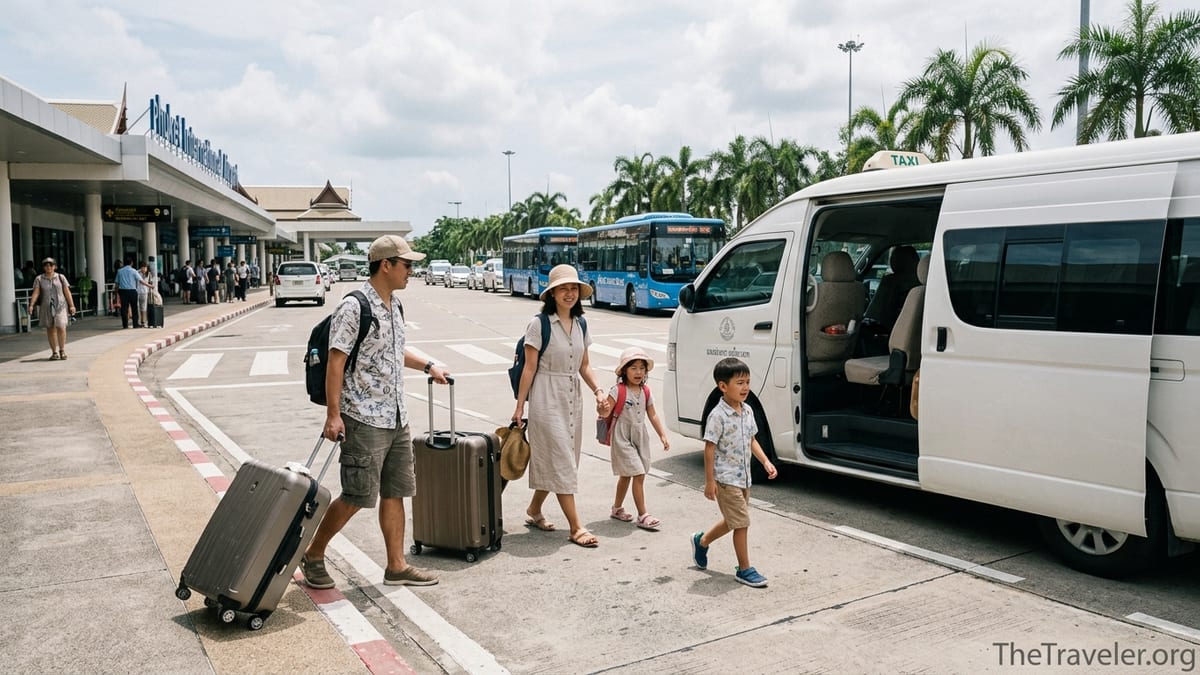
Understanding the Phuket Airport to Kata Beach Route
Phuket International Airport sits at the far north of the island, while Kata Beach is on the southwest coast. The distance is roughly 45 to 50 kilometers depending on your exact hotel location, with most journeys following the main highway down the island before cutting across to the west coast beaches. In typical daytime traffic this trip takes about 60 to 80 minutes by car. In heavier evening or weekend congestion, you should allow up to 90 minutes door to door.
Kata Beach itself is split into two main areas: the busier Kata Yai zone around Club Med and Kata Beach Resort, and the quieter Kata Noi stretch near luxury resorts such as The Shore at Katathani. When you book or board any transfer, it helps to have your resort name ready and, if possible, the Thai-language address your hotel provides in its confirmation email. This makes it easier for drivers, especially on shared services where passengers are heading to multiple stops in the same area.
Unlike Patong or Phuket Town, there is no direct government public bus from the airport to Kata Beach. Instead, travelers rely on a mix of official airport taxis, ride hailing apps, pre booked private cars, shared minivans and the Phuket Smart Bus, which runs along the west coast and stops near Kata. Each option has different implications for cost, time and how easy it is to manage children, car seats and luggage.
For families staying at larger resorts such as Katathani Phuket Beach Resort, Beyond Kata, Novotel Phuket Kata Avista or OZO Phuket, it is worth checking whether they offer their own transfer service. Many mid to upper range properties can arrange a private car or minivan for a fixed fee, often comparable to third party transfers but with the comfort of being greeted by a sign with your family name at the arrivals exit.
Official Airport Taxi: Easiest Door to Door Option
The official airport taxi counters are one of the most straightforward options after a long flight. Inside the arrivals hall, just after customs, you will see signposted taxi desks with clearly printed zone based fares. As of mid 2026, the published prices to Kata and Karon generally fall in the region of about 900 to 1,100 baht for a standard sedan and more for a larger vehicle, with rates adjusted periodically. The key advantage is that you pay a fixed price at the counter, receive a slip and avoid any haggling outside.
For a family of four with two large suitcases and a couple of smaller bags, a standard sedan typically works, but it can feel tight. Many families therefore request an SUV or minivan at the counter, which usually pushes the fare closer to 1,200 to 1,500 baht one way. This still compares favorably to paying for multiple seats on some shared shuttles, and you get a private, air conditioned ride directly to the lobby of your hotel without intermediate stops.
Travel time in an airport taxi from Phuket International Airport to most Kata Beach resorts is usually around 60 to 75 minutes in normal conditions. Drivers are used to serving tourists and are familiar with popular family hotels like Chanalai Flora Resort, ibis Styles Phuket Kata and Avista Grande Phuket Karon. For smaller guesthouses tucked into backstreets, it helps to show a pin on your phone map so there is no confusion about the drop off point.
For families arriving late at night or with jet lagged children, the official taxi desks are particularly useful because they operate around the clock. While ride hailing services can surge in price or show limited availability during peaks or late hours, the airport taxi counter maintains its posted fares. This reliability, combined with the simplicity of paying once at the desk and not worrying about apps or local SIM cards, makes it one of the best default options for first time visitors with kids.
Grab and Other Ride Hailing Apps: Flexible but Variable Pricing
Grab and similar ride hailing apps operate in Phuket, including around Kata Beach, and many repeat visitors prefer them for transparency and digital payments. The airport area, however, is a partial exception. Local regulations and agreements mean app drivers cannot simply wait at the arrivals curb in the same way as in Bangkok. In practice, many travelers open the Grab app after collecting luggage, compare the quoted fare with the official taxi counter price, and choose whichever looks more attractive on the day.
For a daytime arrival, you might see a GrabCar quote from Phuket Airport to Kata in the range of roughly 800 to 1,200 baht depending on demand, vehicle type and exact resort location. When several long haul flights arrive close together, dynamic pricing can push that higher. For example, a family arriving on a busy Saturday afternoon might see a spike to around 1,400 baht for a larger Grab vehicle that can handle a lot of luggage and a stroller, while a late morning midweek arrival could be significantly cheaper.
One advantage of Grab for families is the ability to input your precise hotel and see the route and estimated arrival time on your phone. This reduces the risk of miscommunication, especially if your resort has a similar name to another property. It also lets one adult monitor the drive while the other settles the children. However, because the airport is something of a “blackspot” for app drivers, you may need to walk to a designated pickup area outside the most heavily controlled taxi zones or wait slightly longer for your car to arrive compared with using the official taxi queue.
For families who want to rely on Grab during their stay in Kata for beach hopping and restaurant trips, using it for the airport transfer can be a good introduction to the app’s interface. That said, if you are landing late at night, traveling in peak season from December to February, or carrying several large suitcases and sports equipment such as surfboards, it is safer to have an official taxi or pre booked private transfer as your primary plan and treat Grab as a useful backup rather than a guarantee.
Private Transfers and Resort Cars: Maximum Comfort for Families
Pre booked private transfers are often the most comfortable solution for families, especially those traveling with young children, grandparents or a large amount of luggage. Many local agencies and hotel concierge teams offer airport transfers in air conditioned SUVs or minivans with drivers who meet you in the arrivals hall holding a sign. Prices generally start at around 1,000 to 1,200 baht for a standard car and can range from approximately 1,400 to 2,000 baht for a private minivan that seats up to seven or eight passengers with luggage, depending on vehicle type and resort distance.
To understand how this works in practice, consider a family of five staying at a Kata resort such as Katathani or Beyond Kata. A pre booked private minivan might cost in the region of 1,600 baht one way. Split between five people, that equates to about 320 baht per person, not much more than a seat on some shared shuttles, yet there is no waiting for other passengers and the driver can go straight to your resort. For families with car seats, a private transfer also allows you to request an appropriate child seat or bring your own and have the driver install it before departure.
Resort organized transfers may be slightly more expensive than booking with an external company, but they come with the reassurance that your hotel has vetted the provider and coordinated the pickup details. For example, a high end resort in Kata Noi might quote a flat rate for a Toyota Commuter van to or from the airport that includes tolls, fuel and meet and greet service. Families arriving on late flights often find the extra few hundred baht worthwhile for the smooth experience: luggage trolleys are pushed for you, children’s questions are answered in English, and the vehicle is waiting regardless of minor flight delays.
When comparing private transfer prices, check what is included. Some companies advertise low base fares but add charges for late night pickups, extra luggage or child seats. Others bundle everything into a single, slightly higher but more transparent price. For a family juggling naps, snacks and time zones, the peace of mind of a fixed, all inclusive fare can be more valuable than squeezing every last baht from the transfer budget.
Shared Minivans and Shuttles: Budget Friendly but Slower
Shared airport minivans have been a staple in Phuket for years and remain one of the cheaper door to door options for solo travelers and couples. These air conditioned vans usually seat around ten passengers and run from counters in the arrivals hall that advertise shared transfers to various beach zones, including Kata. Typical fares to Kata for a shared van hover around 200 to 300 baht per person, sometimes slightly higher in peak season, making them attractive for backpackers and budget travelers.
For families, the equation is more nuanced. A family of four paying 250 baht per person for a shared van would spend about 1,000 baht in total, which is similar to or even more than the price of a private sedan from the official taxi desk. On top of that, shared vans only depart once they are reasonably full. This can mean an additional wait of 20 to 40 minutes at the airport while staff sell the remaining seats, which is not ideal with tired children who have already been in transit for many hours.
The route design also affects family comfort. Shared vans might drop passengers in a sequence that runs from nearer beaches to farther ones. If your family is staying in southern Kata or Kata Noi, you could be the last of several drop offs, turning an otherwise one hour transfer into a 90 minute or even two hour journey as the van threads through Patong, Karon and multiple Kata stops. With small children prone to motion sickness or impatience, those extra hotel stops can feel very long.
Another consideration is space. While most shared vans can physically accommodate multiple suitcases and strollers, the luggage area can become crowded when several passengers have large bags. Families may find themselves juggling backpacks on laps or at their feet. If your priority is minimizing hassle and keeping everyone comfortable, especially late at night, a private taxi or transfer is usually a better fit, even if the per person cost is slightly higher than a shared van.
Phuket Smart Bus: Cheapest West Coast Option with a Trade Off
The Phuket Smart Bus is the main budget friendly public style service running along the island’s west coast from the airport through major beach areas to Rawai. The route includes stops at Bang Tao, Surin, Kamala, Patong, Karon and Kata, typically near central points such as beach roads or night markets. As of 2026, the Smart Bus charges a flat fare of around 100 baht per person from the airport to any stop on its route, paid via a stored value card or contactless methods purchased or topped up at kiosks or on board.
For cost conscious travelers, that flat 100 baht ticket from the airport to a Kata stop is excellent value, especially compared with taxi fares. A couple could, in theory, reach Kata for about 200 baht total instead of close to 1,000 baht in a private car. The bus is air conditioned, has luggage space and is designed to serve tourists heading to beach areas. In shoulder seasons and quieter times of day, it can be a pleasant and surprisingly scenic introduction to the island as the bus winds past a succession of bays and hills.
The trade offs for families are time and convenience. The Smart Bus makes many intermediate stops and can take 2 to 2.5 hours from the airport to Kata, depending on traffic and how long it dwells at bus stops. If your children are patient and you are traveling light with backpacks and maybe one suitcase, this may be acceptable. But if you have a stroller, multiple suitcases and a toddler who desperately needs a nap, the slow pace and occasional crowding can be challenging.
You also need to factor in the “last mile” from the Smart Bus stop to your resort. At Kata, the bus typically stops near the main beach road or night plaza, which might be a 5 to 15 minute walk from hotels set back on hillsides or closer to Kata Noi. With larger luggage, many families choose to take a short local taxi or tuk tuk from the bus stop to their hotel, adding a bit of extra cost and another mini transfer to manage. For this reason, the Smart Bus works best for light packing families staying within a few hundred meters of the beach road, or for those arriving during the day who are more relaxed about taking the scenic slow route.
Travel Time, Luggage and Choosing the Best Option for Your Family
When deciding which transfer to book from Phuket Airport to Kata Beach, think in terms of three key factors: time, luggage and family composition. Time wise, private taxis, Grab cars and pre arranged transfers typically take around 60 to 80 minutes door to door, shared vans can easily stretch to 90 minutes or more due to multiple stops and boarding delays, and the Smart Bus can take up to 2.5 hours including any walking or short taxi ride from the bus stop to your resort.
Luggage is just as important. A couple with one suitcase each and older children can cope with moving bags on and off a Smart Bus or shared van, and walking a short distance in the tropical heat. A family with a baby, stroller, travel cot and three or four large suitcases will almost always be happier walking straight out of the terminal into a waiting private car, even if the fare is higher. For example, a family of four paying around 1,000 baht for an official taxi direct to a mid range Kata resort is often a better trade off than four seats on the Smart Bus for 400 baht plus a tuk tuk ride and a long walk.
Family composition matters too. With very young children who might need car seats, a pre booked private transfer gives you the best chance of having appropriate restraints fitted and checked before departure. With teens who are comfortable on buses and happy to watch the scenery, the Smart Bus can become part of the adventure and free up budget for more fun at surf schools or snorkeling trips once you reach Kata. Multigenerational groups with grandparents often value the quiet, air conditioned privacy of a resort car or private minivan, especially after overnight flights.
In practice, many families adopt a mixed strategy. They book a comfortable private transfer or official taxi for the airport to hotel leg when everyone is tired and adjusting to the climate, then explore cheaper options such as Smart Bus segments or local songthaews for daytime trips between beaches once they have settled in. This approach keeps the most stressful leg as smooth as possible while still allowing room to experiment with local transport during the holiday.
Sample Scenarios: What Works Best for Different Families
Consider a family of four from Australia arriving into Phuket at 9 p.m., heading to a popular mid range resort like Chanalai Garden Resort near Kata Beach. The children are eight and ten, and the family has three large suitcases and two backpacks. In this scenario, the best fit is usually either the official airport taxi counter or a pre booked private transfer. For around 1,000 to 1,400 baht, they can secure a private car or SUV, load all their luggage into the boot and have the kids asleep against the windows before they have even left the airport parking area. Shared vans and Smart Bus services, with their longer waits and slower routes, are far less appealing when bedtime has already passed.
Now imagine two adults and a six year old traveling light with carry on backpacks, landing in the late morning and staying at a guesthouse only 300 meters from Kata Beach. They have half a day to reach their hotel and are watching their budget closely. Here, the Phuket Smart Bus becomes a realistic option. They can buy their 100 baht tickets, board an air conditioned bus and watch the coastline unfold. Once at the Kata stop, they walk ten minutes along the beach road to their guesthouse. The journey takes longer than a taxi, but it saves enough money to cover a family lunch at a beachfront restaurant.
For a group of six staying in a villa on the hill between Kata and Karon, a private minivan shines. A single pre booked van priced at around 1,600 to 1,800 baht splits comfortably across six adults, making it both economical and convenient. The driver can navigate directly to the villa’s sometimes tricky access roads, which might confuse some taxi drivers or app based services. The van also easily accommodates a week’s worth of luggage, including groceries or baby gear, and everyone arrives at the same time without the need to coordinate multiple cars.
Even returning to the airport from Kata, your choice may change based on departure time. Families with early morning flights often ask their resort to call a reliable taxi the night before and confirm the pickup time, accepting a slightly higher fare than if they tried to bargain on the street. Those with mid afternoon departures and flexible schedules might book a private transfer back to the airport but leave a little earlier than strictly necessary to account for traffic around Patong and the central crossroads on the way north.
The Takeaway
For most visiting families, the most practical ways to get from Phuket International Airport to Kata Beach are the official airport taxis, ride hailing apps like Grab, pre booked private transfers and, for more adventurous or budget focused travelers, the Phuket Smart Bus. Shared minivans sit in the middle, offering savings for solo travelers and couples but less clear advantages when you multiply fares across an entire family.
If your priority is a smooth, low stress arrival with tired children and multiple suitcases, an official taxi from the airport desk or a pre arranged private car or minivan is almost always worth the extra cost over buses and shuttles. If you are traveling light, arriving in daylight and want to keep costs down, the Smart Bus can deliver you within walking distance of many Kata resorts for a fraction of the price.
Ultimately, the best choice blends budget, comfort and timing. Think about how your family will feel when you clear customs, not just what looks cheapest on paper. A little planning before you fly, including checking your resort’s location relative to Smart Bus stops and confirming current indicative taxi or transfer fares, will help you pick the route that turns the final leg of your journey into a relaxed introduction to Kata’s beaches rather than an exhausting ordeal.
FAQ
Q1. How long does it usually take to get from Phuket Airport to Kata Beach?
Most direct car journeys, including taxis, Grab and private transfers, take around 60 to 80 minutes in normal traffic. At peak times, especially late afternoon and early evening in high season, the trip can stretch to about 90 minutes.
Q2. What is a typical taxi fare from Phuket Airport to Kata for a family?
Official airport taxi counters generally quote fixed fares that work out at roughly 900 to 1,100 baht for a standard sedan to Kata, with larger SUVs or minivans costing more. Prices can vary slightly by season and vehicle type.
Q3. Is Grab cheaper than a regular taxi from the airport to Kata Beach?
Grab can sometimes be slightly cheaper, similar or more expensive than official taxis, depending on demand and time of day. It is worth checking the app after landing and comparing the live quote with the posted taxi counter rate before deciding.
Q4. Is the Phuket Smart Bus a realistic option for families with children?
Yes, but mainly for families traveling light and arriving during the day. The Smart Bus is very affordable and air conditioned, but it is slower than a taxi and usually involves a short walk or local taxi ride from the Kata stop to many resorts.
Q5. Do I need to book an airport transfer in advance if I am staying at a Kata resort?
You do not have to book in advance because airport taxis are available on arrival, but pre booking a private transfer or resort car can make the process smoother, particularly in high season, late at night or if you need a larger vehicle or child seats.
Q6. Are child car seats available in Phuket airport taxis or transfers?
Standard airport taxis typically do not carry child seats as a matter of course. Some private transfer companies and higher end resorts can provide them on request, often for an extra fee, so it is best to arrange this ahead of time or bring your own travel seat.
Q7. Is it safe to arrive late at night and take a taxi to Kata Beach?
Yes, late night arrivals are common and the official airport taxi service operates around the clock. Sticking to the counters inside the terminal and using fixed fare services is generally safer and more predictable than bargaining with touts outside.
Q8. Can shared minivans handle a lot of luggage and strollers?
Shared minivans have space for luggage, but it can become crowded when many passengers have large bags. Families with a stroller, multiple suitcases or bulky sports gear usually find a private taxi or minivan more comfortable and convenient.
Q9. What is the best option for a large family or group staying in a Kata villa?
A pre booked private minivan or two is usually the most efficient choice. It allows everyone to travel together, ensures there is enough space for luggage and makes it easier for the driver to navigate directly to villa addresses on the hills around Kata and Karon.
Q10. How far in advance should I arrange a private transfer to or from Kata Beach?
During quieter months, booking a few days ahead is usually enough. For peak periods such as December and January, or if you require a specific vehicle type or child seats, it is wise to confirm your private transfer at least one to two weeks before arrival.