


Phuket International Airport is the main gateway to Thailand’s most famous island, but the real trip starts the moment you walk into the arrivals hall and have to choose how to reach your hotel. With touts calling out, counters competing for your attention and apps sending you notifications, it is very easy to overpay or pick an option that does not fit your schedule. This guide walks you through every major way to leave Phuket Airport in 2026, with realistic prices, examples and practical tips to avoid the classic arrival-hall mistakes.
Get the latest updates straight to your inbox!
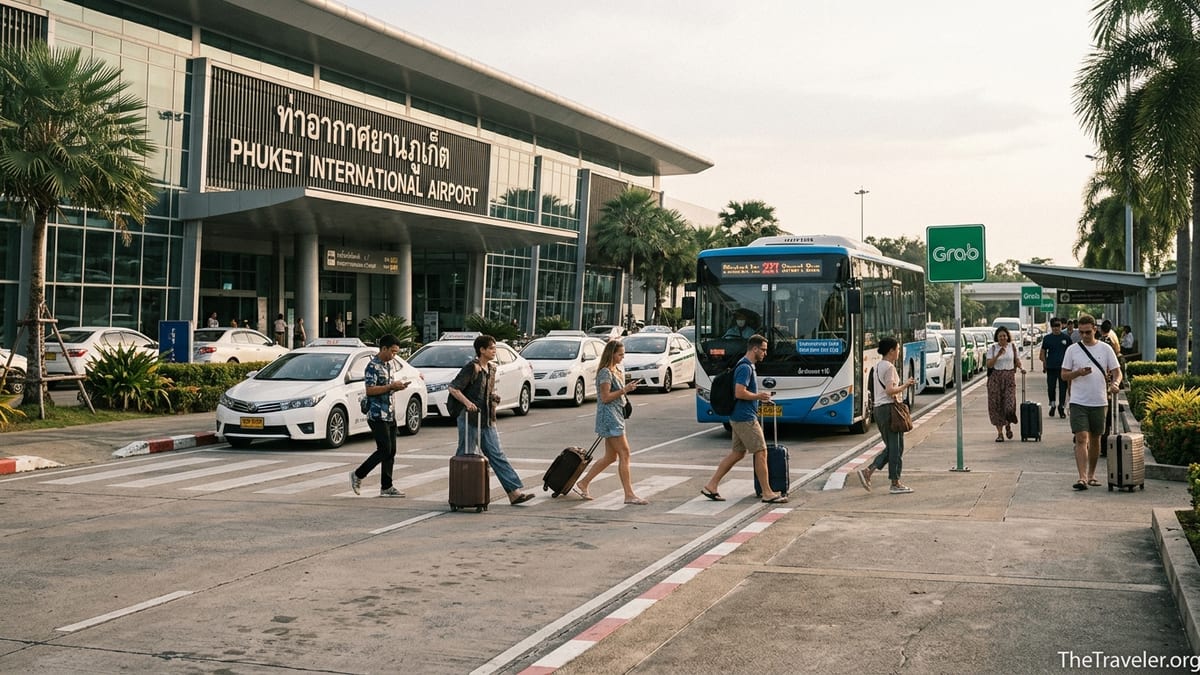
Understanding Phuket International Airport and Where Transport Starts
Phuket International Airport (HKT) sits in the far north of the island near Mai Khao Beach, around 35 to 40 kilometers from Patong and the main west-coast resort areas. That distance means your arrival transfer is rarely cheap, and your choice of transport will affect not only your budget but also how long it takes to finally check in, shower and start your holiday. Most visitors land at the international terminal, but the domestic terminal is just a short walk away and uses almost the same ground transport options.
As you exit customs into the arrivals hall, you will encounter an organized but crowded ecosystem of transport providers. On the inside you will see official taxi and limousine counters, plus desks selling shared minivans to various beaches. Outside, near the curb, there are taxi ranks and clear boarding points for the Phuket Smart Bus and other buses. App-based rides like Grab and Bolt use a designated pick-up area rather than the main taxi lane, usually signposted near one of the exits of the international terminal. Understanding where each option operates from in the building will save you wandering around with luggage and dodging touts.
The key thing to remember is that almost everything at the airport operates on fixed or semi-fixed fares. Phuket does not have a cheap city rail link and there is no metro or tram to the terminal. For a solo backpacker, the Smart Bus or a shared minivan can keep costs low, while families with children or groups of friends usually find that a pre-booked van or app ride is better value on a per-person basis. Before you land, think about your group size, arrival time, and luggage, then match those to the options below.
For illustration, if you are staying in Patong, a typical journey to your hotel takes 45 to 75 minutes depending on traffic. Multiply that by a late flight or jet lag and you can see why many frequent visitors now pre-book a transfer or use ride-hailing rather than negotiating in the arrivals hall. The aim of this guide is not to push one option, but to help you pick the one that genuinely makes sense for how you travel.
Official Airport Taxis and Limousines
The most visible option when you step into the arrivals hall is the line of official taxi and limousine counters. These are airport-approved operators that sell fixed-price rides to different zones of the island. For example, in 2026 many travelers report seeing rates of roughly 700 to 900 baht for a standard car from the airport to Patong, and slightly more to farther beaches like Kata or Karon. Larger vehicles or VIP limousines can quote 1,000 baht or more for the same journey, but usually offer newer cars and more luggage space.
Using the airport counter is straightforward, which is why so many first-time visitors choose it. You walk up to the desk, tell the staff your destination, are shown a price list or quote, then pay on the spot in cash and sometimes by card. You receive a printed slip and are escorted to a vehicle waiting in the taxi lane outside. There is typically an airport surcharge already built into the price, so you should not pay any extra toll or airport fee on top. For a couple with two large suitcases going directly to a mid-range hotel in Patong, this is usually the simplest solution, even if it is not the cheapest.
There are, however, a few points to watch. First, you may encounter touts in the halls offering a “cheaper taxi” if you follow them outside; it is safer to ignore these offers and stick to an official counter or the metered taxi stand. Second, while some taxis display meters, most airport rides are sold on a flat fare basis. Trying to insist on a metered rate after you have accepted a fixed fare rarely ends well and can cause an argument the moment you leave the terminal. Third, during peak landing times in the high season, especially evenings from November to March, it is not unusual to wait 20 to 30 minutes in line before being assigned a car.
If you are landing late at night and did not pre-book anything, the official taxi counters and rank remain one of the most reliable choices. They operate well past midnight as long as flights are arriving. You will pay more than the Smart Bus or a shared minivan, but you gain direct, door-to-door service. For solo travelers trying to keep costs down, though, a 700 to 900 baht fare can feel steep, which is where the other options come in.
Grab, Bolt and Other Ride-Hailing Apps
In recent years, ride-hailing services like Grab and Bolt have become an important part of the Phuket airport transport mix. They are now recognized options rather than something you have to hide from local taxi groups. The main advantage is price transparency: you can see the estimated fare before booking, compare vehicle types, and check ratings. For a daytime arrival into Phuket in 2026, many visitors report typical Grab or Bolt quotes in the range of roughly 600 to 1,050 baht from the airport to Patong for a standard car, depending on traffic, time of day and demand.
To use an app at Phuket Airport, you need mobile data or access to the airport’s Wi-Fi. Before traveling, install the app, set up your payment method and save your hotel address in English. After collecting your luggage, connect to Wi-Fi, request a ride and follow the app’s instructions to the designated pick-up zone. At the international terminal, this is usually near a side exit rather than the main taxi lane, and is often marked with signage or a small booth. Drivers are used to collecting tourists with luggage, so do not worry about having a large suitcase, but if you have surfboards or an unusual amount of baggage, consider ordering a larger vehicle type.
Ride-hailing is particularly attractive for travelers who want to avoid the arrival-hall sales pressure. For example, a family of four arriving at 3 pm might open Grab and see a 750 baht quote to Patong. If the official taxi counter is quoting 900 baht for the same route, the family can make a quick calculation: the app ride saves around 150 baht and payment is cashless, though they may have to walk a little further to the app pick-up point. On the other hand, if they land after midnight or during heavy rain, surge pricing can push app fares above the airport taxi rate, in which case the official counter might suddenly become the better option.
One common mistake is assuming the app price will automatically be lower than the airport taxis. In high season or during a burst of arrivals when many people are booking at once, dynamic pricing can push Grab and Bolt fares up significantly, especially to popular destinations like Kata, Kamala or Bang Tao. Always compare the live app quote with the posted taxi price before deciding. Another thing to note is that some hotels, especially in remote or hilly locations, can be hard for drivers to find; sending a location pin or landmark description in the app chat can prevent a stressful last five minutes of the journey.
Phuket Smart Bus and Other Public Buses
For budget-conscious travelers who do not mind a slower journey, the Phuket Smart Bus has become one of the best-value ways to leave the airport. The Smart Bus runs along the island’s west coast from Phuket International Airport all the way down to Rawai, stopping at major beaches including Bang Tao, Surin, Kamala, Patong, Karon and Kata. As of mid-2026, the commonly reported fare is a flat 100 baht per person from the airport to any stop along this route, which is significantly cheaper than taxis or shared vans for solo passengers.
To use the Smart Bus, follow the signs outside the terminal toward the bus stop area. Services typically run about once per hour during the day, with the first departure in the morning and the last in the evening; schedules can change, so it is wise to check the latest timetable shortly before you fly. You pay the driver or conductor on board, usually in cash, and there is a luggage area where you can leave larger suitcases. The buses are air conditioned but basic, and the trip from the airport to Patong can take around 90 minutes or more depending on traffic and the number of stops.
This option works particularly well if you are staying very close to one of the Smart Bus stops. For instance, if your hotel in Kata is a five-minute walk from a stop on the main beach road, you might pay just 100 baht for the bus and then roll your suitcase along the pavement. By comparison, a taxi for one person on the same route could easily reach 800 baht. For two backpackers or a solo digital nomad with light luggage, that difference adds up over multiple legs of a longer trip.
However, there are several limitations. The Smart Bus does not operate 24 hours, so if you land after the last departure, you will need a different option. It also does not deviate from the main road, so if your hotel is up a steep hill or tucked inland, you may face a hot or rainy walk, or need to arrange a secondary ride such as a tuk-tuk. Finally, because it stops at many beaches, the journey is relatively slow. After a long-haul flight, some travelers decide that the time saved by a taxi or private transfer is worth the extra cost.
Shared Airport Minivans and Hotel Transfer Desks
Shared airport minivans are a middle ground between public buses and private taxis. You will find several counters in the arrivals hall selling seats in minivans to popular areas like Patong, Karon, Kata, Kamala and Phuket Town. Prices in 2026 are often around 200 to 300 baht per person from the airport to Patong, with similar or slightly higher rates to farther beaches. You pay at the counter, receive a colored sticker or ticket, then wait until enough passengers are gathered to fill a van, typically 8 to 12 people.
Once the van leaves, it will drop passengers at their respective hotels in roughly geographic order. This door-to-door element is the shared van’s main advantage over the Smart Bus. For example, a solo traveler staying at a small guesthouse in the back streets of Karon might pay 250 baht for the van and be dropped directly at the reception, rather than taking the bus, getting off at the main road and then walking 15 to 20 minutes with luggage in the heat. The downside is time: if your hotel happens to be last on the driver’s mental map, you might spend well over an hour watching everyone else’s resort before finally reaching yours.
Many hotels and guesthouses also offer their own transfer services, which you can book directly or via travel platforms. A typical hotel-arranged private car transfer from the airport to Patong might cost around 1,500 to 2,500 baht one way, depending on the class of vehicle and whether it includes extras like cold towels and bottled water. In some cases, hotels mark up third-party drivers quite heavily for the convenience of organizing everything on your behalf. For families staying at upscale resorts in areas like Bang Tao or Mai Khao, paying the extra for a seamless hotel-branded transfer can still make sense, but it is rarely the cheapest option on the island.
If you are considering a shared minivan, pay attention to the operating hours and the fine print. Vans generally run late into the evening but not always all night. They also sometimes make a “tour office stop,” where staff try to sell excursions or tours to passengers before continuing to the hotels. This can add 20 to 30 minutes of delay, particularly in the busy season. If you are tired and not interested, you can politely but firmly decline any offers and request that the van proceeds to your accommodation.
Pre-booked Private Transfers and Commercial Services
Pre-booked private transfers have grown in popularity as booking platforms and local operators compete on price and reviews. Many travelers now arrange their Phuket airport ride on sites and apps before they fly, choosing between sedans, SUVs and private vans. Prices to Patong for a standard private car transfer commonly fall in the range of around 800 to 1,500 baht, with larger vans for five to eight passengers often in the 1,500 to 2,500 baht bracket. These rates usually include the driver waiting in the arrivals hall with a sign, helping with luggage and taking you directly to your hotel.
One clear advantage of pre-booking is predictability. If you are landing with a family of five at 10 pm in December, for example, you may not want to juggle kids, luggage and an unfamiliar app while comparing on-the-spot taxi prices. A pre-arranged van for, say, 1,800 baht split across five people effectively costs 360 baht per head, which is similar to or cheaper than each person paying 300 baht for a shared minivan that involves waiting and multiple hotel drops. When viewed that way, the higher headline price can actually represent good value.
Commercial transfer services also tend to offer extras that appeal to first-time or nervous travelers. Some packages bundle in VIP immigration fast track, luggage assistance and even SIM card installation in the car. Others specialize in surfboard or golf bag transport, using vehicles with extra-long cargo space. If you are arriving in the late hours of the night or early morning, you can search specifically for providers that guarantee 24-hour service and track delayed flights, so that a driver is still waiting even if your plane is late.
The main risk with pre-booked transfers is choosing a low-quality provider based solely on price. When comparing options, look at recent customer reviews and photos of the vehicles, and check the cancellation terms. Avoid services that demand full cash payment in advance by bank transfer. Reputable operators will usually accept card through a booking platform or allow you to pay the driver in cash on arrival with at least a small deposit held online. As always in Phuket, if an advertised price seems far lower than everyone else for the same route and vehicle size, be cautious and read the details carefully.
Prices, Travel Times and How to Choose the Right Option
By mid-2026, broad price patterns for Phuket airport transfers have become fairly consistent, even though individual quotes change with demand and season. For a typical journey from the airport to Patong, a Smart Bus ticket is around 100 baht per person, a shared minivan is roughly 200 to 300 baht per person, an official taxi or app ride usually runs between about 600 and 1,050 baht for the vehicle, and private transfers or hotel cars range from about 800 baht for a basic sedan up to 2,500 baht or more for a large van or premium car. Times range from roughly 60 to 120 minutes depending on the mode and traffic.
To see how this plays out in practice, imagine three different travelers. A solo backpacker landing at noon with only a small backpack might choose the Smart Bus for 100 baht, accept the 90-minute ride to Patong and then walk 10 minutes to a hostel near the beach. A couple on a mid-range honeymoon, arriving in the early evening with two big suitcases, might opt for a Grab ride at 800 baht, valuing door-to-door comfort and some savings compared with the airport taxi counter. Meanwhile, a family of five with young children arriving on a late international flight might have pre-booked a private van for 1,900 baht, so that they can step out of customs, meet their driver with a name sign and be at their hotel in around an hour with no extra decisions to make.
When deciding, consider several key factors: your group size, your budget, your tolerance for uncertainty, and your arrival time. For one or two people, the Smart Bus or shared minivan will almost always be the cheapest way to reach the main beaches, but you trade money for time and flexibility. For three or more people, private options quickly become competitive on a per-person basis. Arrival time is also critical: public and shared services thin out late at night, and missing the last Smart Bus can mean an unplanned taxi fare that wipes out any savings you hoped to make.
Finally, leave room in your budget for small extras and realistic expectations. Traffic on the coastal road can be heavy in high season evenings, and even a private transfer cannot change that. Some drivers will politely suggest a short stop at a convenience store or viewpoint, while others will head straight to your hotel. Tipping is not mandatory in Thailand, but rounding up the fare or adding 20 to 50 baht for helpful service is appreciated. Keeping a small amount of cash ready in 20 and 100 baht notes will make every option smoother.
Common Arrival-Hall Mistakes and How to Avoid Them
Phuket Airport has a reputation for being confusing for first-timers, not because it is badly signed, but because so many people are trying to sell you something in a short span of time. One frequent mistake is agreeing to a ride with an unofficial tout the moment you exit customs. These drivers may offer what sounds like a cheaper price than the counters, but you lose the protection of dealing with an airport-approved operator or a known app. If there is a problem with the car, the route or the fare, your ability to complain or seek help is very limited.
Another common error is not checking operating hours and then planning around a service that is not running. For example, travelers sometimes land at 11 pm expecting to take the Smart Bus, only to discover that the last departure left earlier in the evening. At that point, the only realistic options left are taxis or ride-hailing services at late-night prices. Similarly, some people book a very cheap shared minivan without realizing it will make a prolonged stop at a tour office en route, turning what should be a one-hour transfer into a 90-minute sales pitch and drop-off loop.
A third mistake is underestimating how tired and stressed you will be after a long-haul flight. It is easy to say you will “just see what is cheapest when we land,” but standing in a noisy arrivals hall at 1 am comparing inconsistent offers in a foreign currency is very different from doing the same calculations on your sofa at home. If you know you get overwhelmed easily, pre-book at least your first transfer so that landing in Phuket feels calm. You can always be more adventurous with local transport once you are rested and have had a chance to understand the island.
Lastly, travelers often forget to prepare basic logistics that affect every transport option: having some Thai baht in small notes, installing necessary apps, and keeping your hotel address printed in both English and Thai if possible. Even official taxi drivers may not recognize every new boutique hotel by name, but almost all of them will know major landmarks or intersections nearby. Showing a clear written address or map screenshot can prevent wrong turns and disputes about whether the hotel was “too far” from the agreed destination.
The Takeaway
Leaving Phuket International Airport does not need to be stressful or expensive, but it does reward a few minutes of planning. The island now offers a full spectrum of choices, from the ultra-budget Smart Bus at around 100 baht per person to fully private vans with meet-and-greet service that can comfortably carry a large family. In between sit shared airport minivans, official taxi and limousine counters, hotel transfers and ride-hailing apps like Grab and Bolt that bring competition and transparency to an environment once dominated by fixed fares.
The best option for you depends mainly on how many people you are traveling with, what time you land and how much convenience you value over saving a few hundred baht. Solo backpackers and digital nomads can stretch their budgets with buses and shared vans, while couples and families often gain more from pre-booked cars or app rides, particularly if they arrive late or with lots of luggage. No single mode is perfect for everyone, but almost every traveler can find a sweet spot that balances cost, time and comfort.
If you remember a few simple rules, you will start your Phuket trip on the right note: ignore unofficial touts, know roughly what your route should cost, check the latest Smart Bus and shared van schedules, and line up at least one reliable option before you fly. With that sorted, Phuket Airport becomes just another step between the plane and the beach, not a stressful obstacle. Once you are rolling past the palm trees toward Patong, Karon, Kata or beyond, you will be glad you made a clear plan for that first crucial ride.
FAQ
Q1. What is the cheapest way to get from Phuket Airport to Patong?
The cheapest options for most travelers are the Phuket Smart Bus at around 100 baht per person, or a shared airport minivan at roughly 200 to 300 baht per person, depending on current rates and availability.
Q2. Are taxis from Phuket Airport fixed price or metered?
Most airport taxis work on fixed zone fares rather than the meter. You pay a posted price at the official counter or agree a flat rate with the driver, which usually includes the airport surcharge.
Q3. Is Grab allowed to pick up at Phuket International Airport?
Yes, ride-hailing services like Grab and Bolt are generally allowed to pick up at Phuket Airport using designated pick-up zones. You must book through the app and follow the instructions to the correct meeting point.
Q4. How much does a Grab or Bolt ride from Phuket Airport to Patong cost?
Prices vary with time, demand and traffic, but many visitors see typical quotes in the range of roughly 600 to 1,050 baht for a standard car from the airport to Patong in 2026.
Q5. Does the Phuket Smart Bus run late at night?
The Phuket Smart Bus usually runs during daytime and evening hours on an hourly schedule, but it does not operate through the night. Late-night arrivals should plan on taxis, ride-hailing or pre-booked transfers instead.
Q6. How long does it take to reach Patong from Phuket Airport?
Travel time from the airport to Patong is typically 45 to 75 minutes by taxi, Grab or private transfer, and around 60 to 120 minutes by shared minivan or Smart Bus, depending on traffic and stops.
Q7. Are hotel-arranged airport transfers in Phuket worth the price?
Hotel transfers are often more expensive than booking a taxi or private car yourself, but they can be worth it for late-night arrivals, families with children or travelers who want maximum simplicity and direct support from their hotel.
Q8. Can I pay for Phuket airport transport by credit card?
Some official counters and pre-booked services accept cards, but many taxis, shared vans and buses prefer cash. Carrying Thai baht in small notes is strongly recommended for a smooth arrival.
Q9. Do I need to book my Phuket airport transfer in advance?
You do not have to book in advance, but pre-booking is wise if you arrive late, travel in peak season, or are a larger group needing a van. It guarantees a vehicle and a known price on arrival.
Q10. Is it safe to use shared minivans from Phuket Airport?
Shared minivans are widely used and generally considered safe for tourists. The main drawbacks are potential delays while waiting for the van to fill and longer travel times due to multiple hotel drop-offs along the route.