


Landing at Punta Cana International Airport and heading straight to Santo Domingo is a classic long-distance route in the Dominican Republic. The two hubs are only about 180 kilometers apart, but the choice between private transfer, taxi, intercity bus via Bávaro or Verón, and rental car can change your travel time, budget, and stress level considerably. This guide breaks down each option with real-world examples, approximate prices, and practical tips, including whether it makes sense to stay near Punta Cana first before continuing on to the capital.
Get the latest updates straight to your inbox!
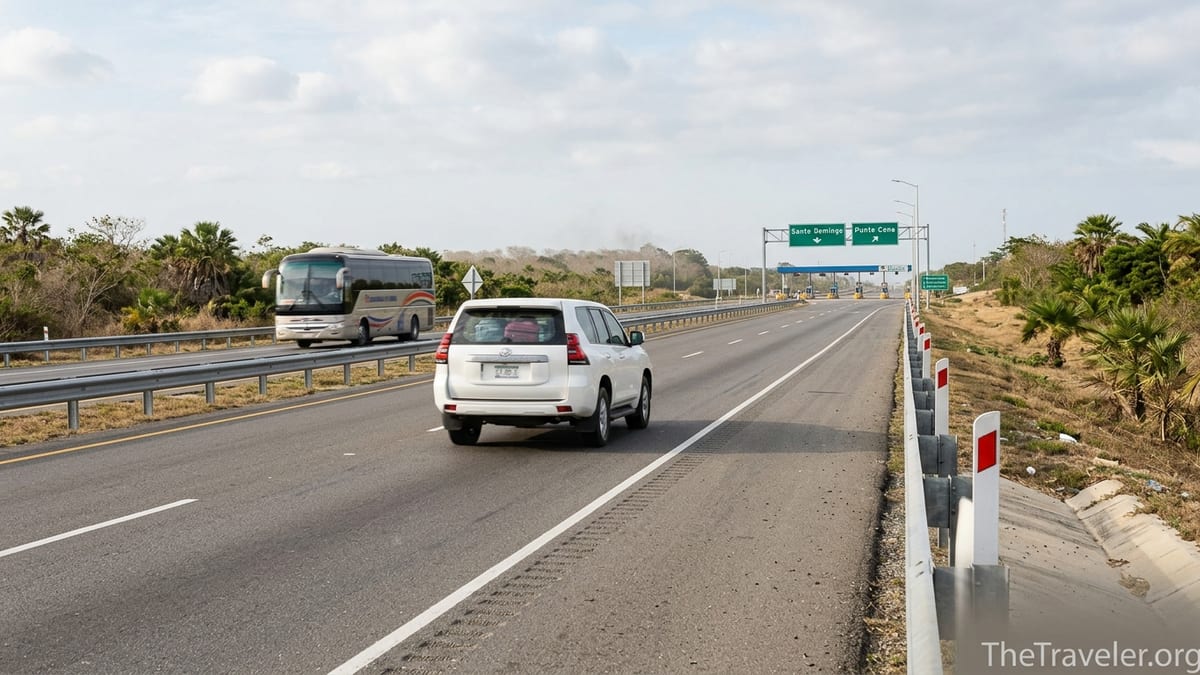
Understanding the Route from Punta Cana to Santo Domingo
Punta Cana International Airport (PUJ) sits on the far eastern tip of the Dominican Republic, surrounded by resort areas like Bávaro and Cabeza de Toro. Santo Domingo lies to the west on the Caribbean coast. The two are linked by a chain of modern toll highways, typically referred to as Autovía del Coral and DR-3 / Autopista de Las Américas. In normal traffic, a direct road transfer between PUJ and central Santo Domingo takes around 2.5 to 3 hours, depending on where in the capital you are staying.
The most common routing for private cars and taxis runs from PUJ through Verón and Higüey, onto the Autovía del Coral toward La Romana and San Pedro de Macorís, and then along DR-3 into Santo Domingo. These are among the best-maintained roads in the country, with divided lanes, regular toll booths, and service stations along the way. The same corridor is used by long-distance buses that connect Bávaro and Verón with Santo Domingo’s eastern bus terminals.
When planning your transfer, it is important to distinguish between three key points: Punta Cana Airport (PUJ), the hotel zones of Punta Cana and Bávaro, and Santo Domingo city versus Las Américas International Airport (SDQ) just outside the capital. A route from PUJ to Santo Domingo’s Colonial Zone is not quite the same as PUJ to SDQ, and some transport providers quote separate prices for each.
Finally, while the distance is not huge, this is a genuine intercity journey. After a long international flight, you will be dealing with toll payments, possible traffic at the approaches to Santo Domingo, and the logistics of luggage and timing. That is why understanding the strengths and weaknesses of each transfer option is critical before you land.
Private Transfer: Fastest and Easiest Door-to-Door Option
For most travelers who value time and simplicity, a prebooked private transfer from Punta Cana Airport to Santo Domingo is the easiest solution. Several reputable Dominican companies specialize in this route, advertising fixed prices, English-speaking dispatchers, and 24/7 availability. Recent sample quotes for PUJ to central Santo Domingo typically start around 160 to 200 US dollars per vehicle, one way, for up to three or four passengers in a standard sedan or SUV. Larger vans cost more but can bring the per-person cost down for families or small groups.
In practice, this means that a couple arriving on an evening flight could book a private transfer with a company that tracks their arrival, meet their driver just outside customs, and be on the highway within 20 to 30 minutes of clearing immigration. If traffic cooperates, they could be checking into a hotel in the Colonial Zone in under three hours. This is especially appealing for travelers landing after dark, those with multiple suitcases, or visitors unfamiliar with driving in the Dominican Republic.
Companies operating in this space usually offer simple online booking forms. You enter your flight number, arrival time, destination in Santo Domingo, and number of passengers. The system then calculates a flat rate. For example, a 2026 price table from one Punta Cana transfer operator lists Punta Cana Airport to Santo Domingo from about 160 US dollars with an estimated travel time of 2.5 hours for a private car. Others advertise PUJ to Santo Domingo city or PUJ to Las Américas Airport from roughly 180 to 220 US dollars depending on vehicle size and service level.
The main downside is cost for solo travelers or budget-minded backpackers. Compared with the roughly 500 Dominican pesos one-way bus fare between Bávaro/Verón and Santo Domingo, a private transfer can be five or six times as expensive. However, once you factor in the cost of a taxi or rideshare to the bus terminal, plus the additional time and transfers required, many travelers still justify the premium, especially if they are carrying surfboards, golf bags, or multiple checked bags.
Taxi from Punta Cana Airport: On-Demand but Pricey for the Distance
Official taxis based at Punta Cana International Airport offer another straightforward option. You will see a taxi desk or price board near arrivals, and uniformed drivers waiting just outside. Traditional airport taxi tariffs from PUJ to Santo Domingo have historically been in the region of 200 US dollars for a one-way ride to the capital, based on older published airport rate sheets that list similar long-distance routes like Boca Chica and San Pedro de Macorís at lower steps and Santo Domingo closest to the top of the scale. Since those rates were set several years ago and fuel prices and tolls have changed since then, you should treat them as a baseline rather than an exact figure.
In reality, many visitors end up negotiating or confirming the fare in US dollars or Dominican pesos at the taxi counter before boarding. For example, a family arriving without a prebooked transfer might ask at the desk and receive a quote around 200 to 250 US dollars for a direct ride from the airport to a hotel in the Colonial Zone. The advantage is absolute convenience: no online booking in advance, no walking off property, and a driver who is licensed to operate from the airport.
The drawbacks are similar to those of private transfers, but with less price transparency. Taxis are meterless for long-distance trips, relying on zone-based flat fares. It is essential to confirm the full price, including luggage and tolls, before you get in. Some drivers will include tolls in the quoted fare, while others may ask you to pay the toll booths directly in cash as you go, which can add approximately 10 US dollars in toll charges between Punta Cana and Santo Domingo each way. Carrying small bills in Dominican pesos makes this much easier.
For travelers comfortable with ride-hailing apps, another hybrid approach is to use an app-based service like Uber or inDriver to reach the bus terminal in Verón or Bávaro for far less than a full intercity taxi. However, these platforms are not officially authorized at the airport, and availability can fluctuate. If your flight lands late at night or during peak tourist weekends, relying on an app alone can be risky; in those cases, an official airport taxi or prebooked private transfer remains the more dependable option.
Bus via Bávaro or Verón: Budget-Friendly but Requires Multiple Steps
There is no true public bus that runs directly from the arrivals curb at Punta Cana Airport to Santo Domingo. Instead, budget travelers typically combine a short local ride from the airport to a bus terminal in Verón or Bávaro with an intercity bus to the capital. Two well-known companies, often referred to as Expreso Bávaro and APTPRA or Expreso Punta Cana, operate scheduled services between Bávaro/Verón and Santo Domingo, using highway coaches with air conditioning and underfloor luggage compartments.
In recent traveler reports, the one-way fare from Bávaro or Verón to Santo Domingo is around 400 to 600 Dominican pesos per person, which generally equates to under 10 US dollars at common exchange rates. Buses depart several times a day, often morning and early afternoon, from terminals near Friusa in Bávaro and the Cruce de Verón. The trip to Santo Domingo takes roughly 3 to 3.5 hours depending on traffic and the exact route. Schedules can change, and company websites are basic, so it is wise to confirm departure times locally or through your accommodation before you travel.
To reach the bus, you will need a short transfer from the airport to the terminal. Many visitors use a local taxi, which might cost the equivalent of 20 to 40 US dollars from PUJ to the Verón or Bávaro bus stop, depending on time of day and negotiation. Some have successfully arranged a rideshare trip for slightly less, while others ask their Punta Cana hotel to drop them at the bus station if they are staying one or two nights before heading to the capital. Your luggage will be stowed in the bus’s undercarriage; staff are accustomed to dealing with large suitcases, but keep valuables and travel documents in your small carry-on inside the cabin.
On arrival in Santo Domingo, most long-distance buses from the east terminate at stations in Santo Domingo Este, not right in the Colonial Zone. For example, travelers frequently mention getting off near Las Américas Highway or at an eastern bus terminal and then taking a city taxi or rideshare 20 to 30 minutes into central Santo Domingo. That city transfer might cost another 5 to 15 US dollars depending on traffic and demand. All told, a solo traveler could realistically complete the journey for under 25 US dollars, but at the cost of at least two or three vehicle changes and less predictable travel time than a door-to-door private car.
This bus-based route makes the most sense for backpackers, digital nomads, and long-term travelers who have flexible schedules and lighter luggage. If you are arriving after a red-eye flight with two children and three large suitcases, the repeated loading and unloading, ticket buying in Spanish, and navigation of unfamiliar terminals may feel like more hassle than the savings are worth.
Driving Yourself: Rental Car Pros, Cons, and Toll Costs
Renting a car at Punta Cana Airport and driving yourself to Santo Domingo appeals to travelers who value flexibility or plan to explore both regions over several days. Major international brands and local agencies operate counters at PUJ, and recent rate aggregators show basic economy rentals starting around 20 to 30 US dollars per day before insurance and fees, though realistic all-in daily costs often end up higher once mandatory coverage and deposits are factored in.
The route itself is relatively straightforward: follow signs from the airport toward Verón and Higüey, merge onto the Autovía del Coral toward La Romana and San Pedro de Macorís, then continue along DR-3 / Autopista de Las Américas toward Santo Domingo. The full drive typically takes about 2.5 to 3 hours. Toll booths along the way currently add up to roughly 10 US dollars one way for a standard car, split across several plazas. Many Dominican drivers use an electronic toll pass lane, but rental companies may or may not equip their cars with this device; if not, be prepared to pay in cash at each booth.
Driving standards in the Dominican Republic can be challenging for first-time visitors. Outside the highway network, you may encounter aggressive lane changes, motorcycles weaving between cars, and occasional livestock or pedestrians near the roadway. Approaching Santo Domingo itself, traffic density increases significantly, particularly at rush hours and near major intersections and tunnels. While experienced drivers often report that the Punta Cana to Santo Domingo corridor is one of the country’s better roads, others who have rented cars for similar routes describe it as stressful and say they would choose a private transfer next time.
On the positive side, a rental car can pay off if you are staying several days in Santo Domingo and later returning to the east coast or visiting other cities like La Romana or Bayahibe. Instead of paying for multiple private transfers or excursions, you can use the same vehicle to visit beaches east of the capital, day-trip to mountain towns inland, or return to PUJ or SDQ on your own schedule. Just be realistic about total costs: daily rental rate, insurance or credit card coverage, fuel, tolls, and parking fees at hotels in the Colonial Zone, some of which charge extra for secure garages.
One practical strategy is to rent the car only when you are ready to leave Punta Cana. Some visitors report spending their first days car-free at a beachfront resort, then picking up a rental car in town or at the airport on the morning they drive to Santo Domingo. This avoids paying for a car that would otherwise sit unused in a resort lot while you enjoy all-inclusive amenities, and it gives you a chance to rest before tackling a multi-hour drive in a new country.
Luggage, Comfort, and Travel Time: Matching the Option to Your Trip
Luggage is often the deciding factor when choosing between private transfer, taxi, bus, and rental car. Private transfers and official airport taxis are accustomed to travelers with two checked bags and carry-ons each, along with strollers or golf clubs. You can usually specify your luggage count when booking a private car so the dispatcher sends a vehicle with adequate trunk space, such as an SUV or minivan. Some companies charge a small supplement for very bulky items like surfboards, but in most cases, standard vacation luggage is included in the quoted fare.
Intercity buses via Bávaro or Verón also handle luggage, but capacity in the underfloor compartment is shared among all passengers. On busy days, you may be asked to tag bags and load them yourself with the driver’s assistance. It is secure enough for normal suitcases, yet you should still keep electronics, cash, and passports in a small bag that stays with you in the cabin. This is particularly important if you plan to get off at an intermediate stop rather than the line’s final terminal, as you will need to retrieve your bags quickly.
In terms of pure travel time, a direct door-to-door private transfer is usually the fastest option, averaging 2.5 to 3 hours outside worst-peak conditions. A self-drive rental car can be similar if you are comfortable navigating and do not hit heavy traffic at the Santo Domingo approach. A bus-based route adds time at both ends: perhaps 20 to 40 minutes from PUJ to the bus stop, 3 to 3.5 hours by bus, and another 20 to 30 minutes by taxi within Santo Domingo, not counting waiting time for departures. As a result, the total door-to-door journey by bus can easily approach 5 hours.
Comfort expectations should also guide your choice. Private transfers and taxis allow you to recline, control the air conditioning, and stop at service stations when needed. Intercity buses are generally air-conditioned with fixed seats and onboard restrooms or roadside stops, but they can be crowded and have limited personal space. Rental cars give you full control over temperature, music, and stops, but the mental load of driving and navigating in a foreign country is the trade-off for that autonomy.
Should You Stay Near Punta Cana First or Go Straight to Santo Domingo?
Many travelers landing at Punta Cana face a strategic question: go straight to Santo Domingo the same day, or spend a night or two near the airport first. The answer depends on your arrival time, energy level, and trip goals. If your flight from North America or Europe lands at PUJ before early afternoon and you feel rested, going directly to Santo Domingo in a private transfer often makes the most efficient use of your time. You will arrive before late-evening traffic peaks and wake up the next morning already in the capital, ready to explore the Colonial Zone or connect with an onward bus or domestic flight.
By contrast, if you are arriving on a late-evening or red-eye flight, or if you have young children in tow, staying one night in the Punta Cana or Bávaro area can be a smart move. Several mid-range hotels and guesthouses lie within a 20 to 30 minute drive of the airport, including options in Cabeza de Toro and central Bávaro that offer easy access to local restaurants and small supermarkets. You can arrange a short transfer from PUJ, rest up, enjoy the beach the next morning, then catch an afternoon bus from Verón or book a private car to Santo Domingo once you are refreshed.
Another factor is where you are flying next. Some itineraries use PUJ as an entry point and SDQ as the exit or vice versa. For example, you might land in Punta Cana, spend three nights at an all-inclusive resort, travel by private transfer to Santo Domingo for two nights of city sightseeing, then fly out of Las Américas Airport to your next destination. In this case, splitting your time between the two areas and planning one intercity transfer in the middle makes sense.
On the other hand, if your primary interest is cultural and historical, and the beach is a minor side trip, you might treat Punta Cana simply as an efficient entry airport. In that scenario, heading directly to Santo Domingo, spending the bulk of your days in the city, and then returning to PUJ or SDQ only to fly out can reduce the number of hotel moves and long drives.
Real-World Scenarios: Which Option Fits You Best?
To make these choices more concrete, it helps to imagine real itineraries. Consider a couple from Toronto landing at Punta Cana at 1:00 p.m. on a Saturday with two checked bags and a hotel booked in Santo Domingo’s Colonial Zone. They want minimal hassle and are comfortable spending a bit more. For them, a prebooked private transfer makes the most sense. They walk out of customs, meet their driver holding a sign, and reach their Santo Domingo hotel around 4:00 p.m., just in time to stroll to the main square for an early dinner.
Now imagine a solo backpacker arriving on a mid-morning flight with just a carry-on and a tight budget. They might prefer to take a local taxi or rideshare from PUJ to the Verón bus terminal, where they buy a ticket on an afternoon Expreso Bávaro or APTPRA bus to Santo Domingo for the equivalent of a few US dollars. Once in the capital’s eastern bus station, they hop in a short city taxi to a hostel in Gazcue or the Colonial Zone. The total cost is a fraction of a private car, though the journey takes up much of the day.
For a family of five with teenagers, surfboards, and several suitcases, a private van transfer can be surprisingly cost-effective. While the flat rate might be 220 to 260 US dollars one way, the per-person cost becomes reasonable once divided among five passengers. The driver can load boards and oversized bags in or on top of the van, and the family avoids juggling luggage through bus terminals. This is particularly attractive if they are arriving after dark and prefer a single, safe, door-to-door trip.
Finally, consider a pair of digital nomads spending a month in the Dominican Republic. They plan a week in Punta Cana, then two weeks in Santo Domingo, with side trips to beach towns east of the capital. In their case, renting a car on the day they leave Punta Cana provides the best blend of flexibility and cost control. They pick up a compact car at a rental counter near their resort, drive to Santo Domingo over the course of the afternoon, and then keep the car for trips to Boca Chica, Juan Dolio, and back to the airport at the end of their stay, spreading the rental cost over multiple travel days.
The Takeaway
The journey from Punta Cana Airport to Santo Domingo is straightforward on the map yet surprisingly nuanced in practice. Private transfers and official taxis offer the fastest and least stressful way to cover the roughly three-hour drive, at a price point that suits couples, families, and anyone who values a smooth arrival after a long flight. Intercity buses via Bávaro or Verón open up a very economical route for those willing to handle multiple transfers and longer travel times, while rental cars appeal to travelers planning extended itineraries that cover both the capital and the country’s eastern beaches.
When choosing your transfer, think about your arrival time, tolerance for navigating unfamiliar roads, luggage volume, and budget. A red-eye arrival with small children and heavy bags points strongly toward a prebooked car. A midday touchdown with only a backpack and no firm schedule might make the bus route an attractive adventure. Deciding whether to overnight in Punta Cana first or head straight to Santo Domingo is equally situational. If you want to start your trip with a dose of Caribbean beach time, it can be worth staying near PUJ for a night or two before tackling the long-distance route.
Whichever option you choose, a bit of advance planning pays off. Confirm approximate prices before you travel, keep enough local currency on hand for tolls and small taxi rides, and build a time buffer into your itinerary, especially if you have same-day connections or fixed tour departures in Santo Domingo. With realistic expectations and the right transport choice for your travel style, the highway between Punta Cana and the capital can become a scenic and comfortable introduction to the Dominican Republic rather than an exhausting ordeal.
FAQ
Q1. How long does it take to get from Punta Cana Airport to Santo Domingo?
The drive between Punta Cana Airport and central Santo Domingo usually takes about 2.5 to 3 hours by private transfer, taxi, or rental car in normal traffic. Using the bus via Bávaro or Verón often stretches the total door-to-door journey to 4.5 to 5 hours once you include local transfers and waiting time.
Q2. How much does a private transfer from Punta Cana Airport to Santo Domingo cost?
Recent examples from Dominican transfer companies show starting prices around 160 to 200 US dollars one way for a standard car carrying up to three or four passengers, with larger vans and premium vehicles costing more. Prices vary by provider, season, and exact drop-off location in Santo Domingo.
Q3. Is there a direct public bus from Punta Cana Airport to Santo Domingo?
No, there is currently no direct public bus from the airport itself to Santo Domingo. Budget travelers typically take a taxi or local ride to bus terminals in Verón or Bávaro and then board an intercity coach operated by companies such as Expreso Bávaro or APTPRA, which run several daily departures to Santo Domingo.
Q4. Are taxis from Punta Cana Airport to Santo Domingo reliable?
Official airport taxis operating from the designated taxi stand are generally reliable and accustomed to long-distance trips. However, they can be expensive for the distance, and fares are usually based on fixed zones rather than meters. Always confirm the total price and whether tolls are included before starting the journey.
Q5. Is it safe to drive a rental car from Punta Cana to Santo Domingo?
The main toll highways between Punta Cana and Santo Domingo are among the better roads in the country, and many visitors drive them without issues. That said, driving styles can be aggressive, especially near Santo Domingo, and unfamiliarity with local rules can be stressful. Confident drivers with prior experience in Latin America tend to cope better than those unused to busy, fast-paced roads.
Q6. How much do tolls cost between Punta Cana and Santo Domingo?
Tolls for a standard car on the route between Punta Cana and Santo Domingo generally add up to around 10 US dollars each way, spread across several toll booths. You can usually pay in local currency at the cash lanes, while some lanes are reserved for electronic toll tags used by local drivers and rental cars with passes.
Q7. What is the cheapest way to travel from Punta Cana to Santo Domingo?
The cheapest practical way is a combination of local transport to Verón or Bávaro and an intercity bus to Santo Domingo. The bus fare itself is typically the equivalent of under 10 US dollars per person, with additional small costs for the local taxi or rideshare to the bus station and a short city taxi on arrival in Santo Domingo.
Q8. Should I go straight to Santo Domingo or stay in Punta Cana first?
If you arrive in Punta Cana early in the day and feel rested, going straight to Santo Domingo by private transfer can be efficient and saves a hotel change. If you land late at night, are traveling with children, or want immediate beach time, spending a night or two in Punta Cana or Bávaro before making the long-distance trip is often more comfortable.
Q9. Can I take the bus with large luggage like suitcases or surfboards?
Intercity buses between Bávaro or Verón and Santo Domingo routinely handle suitcases in the underfloor luggage compartment, though space is shared among passengers. Surfboards and very large items may be more complicated and sometimes incur extra fees or special handling. In such cases, a private van transfer is usually more convenient and predictable.
Q10. Do I need to book my transfer from Punta Cana to Santo Domingo in advance?
For private transfers, booking in advance is strongly recommended, especially in high season or for late-night arrivals, so that a driver is waiting and the price is confirmed. Buses and airport taxis can usually be arranged on the day, but you should still check bus departure times ahead of time and have a backup plan in case a particular service is full or delayed.