


Landing at Rafael Núñez International Airport in Cartagena and heading straight for the cobbled streets of the Walled City is one of the easiest airport transfers in Latin America. The airport sits only a few kilometers from the Centro Histórico, so with the right information you can be at your hotel, cocktail in hand, in as little as 15 minutes. This guide walks you through every practical option, from official airport taxis and Uber to private transfers and public transport, with specific tips for handling luggage and arriving smoothly at hotels inside the historic center.
Get the latest updates straight to your inbox!
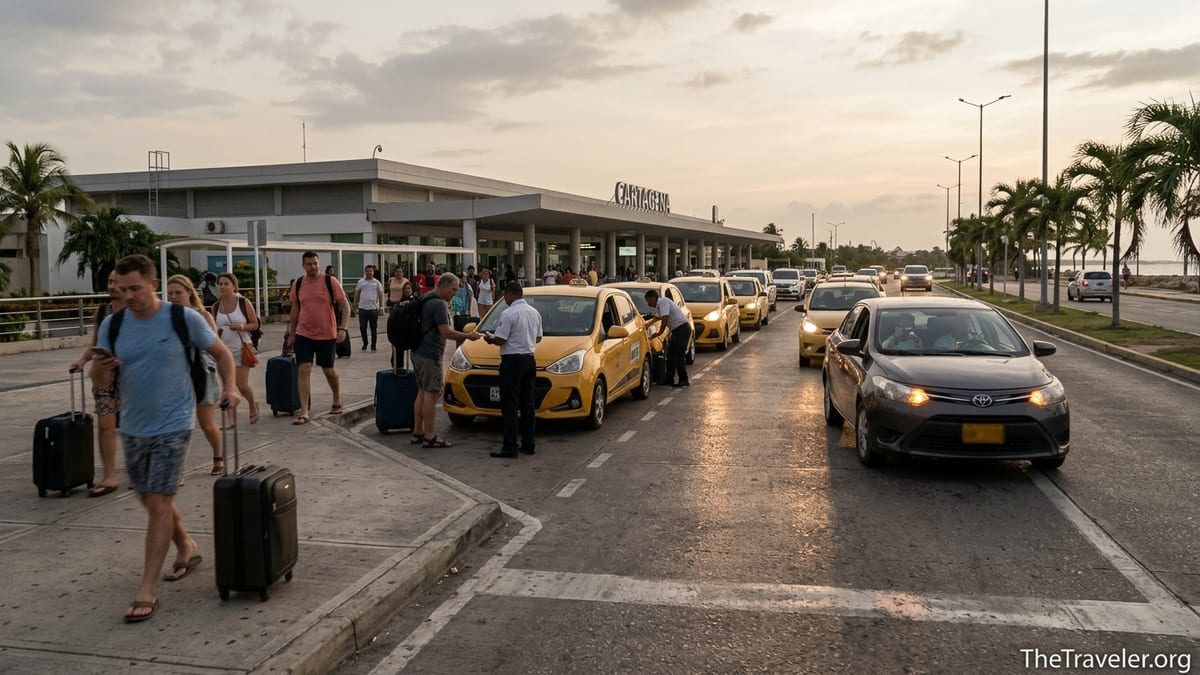
What to Expect When You Land at Rafael Núñez International Airport
Rafael Núñez International Airport (CTG) is located in the seaside neighborhood of Crespo, roughly 3 kilometers from Cartagena’s Walled City. In normal traffic, the ride from the terminal to Centro Histórico or Getsemaní usually takes about 10 to 20 minutes, making this one of the quickest airport-to-old-town transfers in the region. Even in peak holiday periods, delays on this short route are more about congestion at hotel drop-off points than long stretches of highway.
The airport itself is compact, with international and domestic arrivals feeding into the same general public hall. After immigration and baggage claim, you exit directly into a concourse where you will find ATMs, a currency exchange booth, mobile phone providers and clearly marked transport counters. Because many flights from North America and Panama arrive in the evening, there is a steady flow of passengers until late, and taxis are normally available until the last flights of the night.
Outside the terminal, the first thing you will notice is a line of yellow city taxis waiting at the curb and an official taxi desk just before the exit doors. If you plan to use a rideshare app such as Uber or InDrive, you will not find a dedicated pickup zone; instead, drivers wait along the access road that loops in front of the terminal and in nearby parking areas. This layout makes it easy to compare options on arrival and choose the one that best matches your budget and comfort level.
Because the distance is short, the cost of the transfer is usually modest compared with other Caribbean destinations. As a rule of thumb, most visitors pay less than the price of a single simple dinner in the Walled City for the entire ride from the airport to their hotel. Understanding how fares are calculated and how the different services operate will help you avoid overpaying and get into the city quickly and safely.
Official Airport Taxis: Fast, Regulated and Simple
For many travelers, the official airport taxi is the most straightforward way to reach the Walled City. Inside the terminal, just before the main exit, you will see an authorized taxi counter displaying an official fare chart based on destination zones such as Centro Histórico, Getsemaní, Bocagrande, Manga and La Boquilla. You tell the attendant the general area or, better yet, the name of your hotel, and they print a ticket with the fixed price for that zone. Recent decrees from the city government update taxi tariffs periodically, and minimum urban taxi fares are adjusted each year, so the amount on your ticket reflects current regulations rather than a price invented on the spot.
As of 2026, travelers commonly report paying in the range of roughly 16,000 to 20,000 Colombian pesos for a standard airport taxi from CTG to the Walled City, depending on the exact zone and the latest municipal decree. This typically covers up to four passengers with standard luggage and is paid directly to the driver at the end of the ride in cash. Because the fare is printed, there is no need to negotiate, which is reassuring if it is your first time in Cartagena or if you have just landed after a long overnight flight.
The process is simple in practice. Imagine you land on an afternoon flight from Miami, collect your suitcase and follow the crowd towards the exit. At the taxi desk you say “Hotel Charleston Santa Teresa, Centro Histórico.” The clerk checks the zone, prints a ticket showing a fixed price, and points you to the taxi line outside. You hand the slip to the next driver in the queue, confirm that you are going to the Walled City, and off you go. Ten to fifteen minutes later you are stepping out at the hotel’s stone archway on Plaza Santa Teresa.
Official airport taxis are usually compact sedans with limited trunk space, so if you are carrying several large suitcases or bulky sports equipment like golf bags or kitesurf boards, you may need to take two vehicles or consider a larger private transfer. Drivers are used to visitors with basic Spanish and know all the main hotels inside the walls, from luxury properties on Calle del Colegio to small guesthouses on Calle de la Moneda. Tipping is appreciated but not obligatory; many travelers round up the fare by a few thousand pesos if the driver handles multiple bags or makes an extra effort with directions.
Uber and Rideshare Apps: Flexible and Price-Transparent
Rideshare apps such as Uber and InDrive operate in Cartagena and are widely used by both locals and tourists across the city. While regulatory debates continue in Colombia, in practice these services are available to and from Rafael Núñez International Airport, and recent conference visitor guides and local travel reports note them as common options. For a solo traveler or a couple with light luggage, a rideshare can be as economical as a taxi, and the advance price estimate shown in the app helps set clear expectations before you get into the car.
On arrival, it is best to request your Uber or other rideshare only once you are close to exiting the terminal, as drivers tend to circulate around the airport rather than wait in a fixed bay. Many visitors arrange to meet their driver slightly beyond the main taxi queue, for example near the parking entrance or at a specific landmark such as a fast-food outlet or the domestic departures sign. You can send a quick message in the app in simple Spanish, such as “Estoy en la salida principal, frente a los taxis amarillos,” so the driver knows where to stop.
In terms of price, rideshare fares to the Walled City often fall in a similar band or slightly below official taxi rates, particularly outside peak demand hours. For example, on a weekday evening in low season, an Uber from CTG to a boutique hotel on Calle del Curato might show an estimated fare in the mid-teens in thousands of pesos, comparable to the printed airport taxi rate. At very busy times, such as Saturday nights or when there is a major festival in town, dynamic pricing can push the app fare higher than the fixed taxi zone price, so it is worth checking both options before you commit.
Rideshare apps are especially appealing if you prefer to pay by card or through the app instead of handling cash immediately after landing. They also help with peace of mind, since you can see the driver’s license plate, name and previous ratings, and your route is tracked within the application. That said, because there is no exclusive rideshare bay at CTG, you should avoid long discussions with drivers at the curb and be discreet when boarding if local tensions between taxi drivers and app drivers are running high. In most cases, however, travelers report using Uber to and from the airport without incident.
Private Transfers and Hotel Cars: Comfort and Certainty
For honeymooners, families with small children or travelers arriving late at night, booking a private transfer in advance can provide an extra layer of comfort. Many hotels inside the Walled City, from upscale properties on Plaza de Bolívar to design hotels in San Diego, offer airport pick-up services through trusted drivers or partner agencies. These arrangements generally involve a driver waiting in the arrivals hall with a sign bearing your name, helping with luggage and escorting you directly to an air-conditioned vehicle parked nearby.
Prices for private transfers are higher than standard taxis but often remain relatively reasonable because the distance is short. As a rough example, a pre-booked private sedan for up to three people from CTG to a luxury hotel near Plaza Santo Domingo might cost the equivalent of several taxi rides within the city, while a larger van for a group of six with multiple suitcases will cost proportionally more. Some agencies include a small premium for late-night arrivals, between roughly midnight and 5 am, when flight schedules are leaner and driver availability drops.
Private transfers are particularly useful if you are traveling with bulky or valuable equipment. A small group arriving for a kitesurfing holiday in nearby La Boquilla, for instance, may prefer a pre-arranged van with ample cargo space rather than trying to fit multiple board bags into the trunk of a standard yellow taxi. Likewise, a family staying in a rental house on a narrow lane near Calle de la Sierpe in Getsemaní might value having a bilingual driver who already knows exactly where the property is located and can coordinate by phone with the host.
Another advantage of private services is the ability to communicate your needs in advance. If you require a child seat, extra time at an ATM, or assistance for an elderly parent, these can usually be organized ahead of time. That level of predictability can be worth the additional cost, especially after a long-haul journey. When booking, make sure the company or hotel clearly confirms whether the quoted price includes parking or airport access fees and whether payment is required in advance or directly to the driver in cash or card.
Public Transport and Budget-Friendly Options
Although most visitors choose taxis, rideshares or private transfers, budget-conscious travelers and backpackers sometimes opt for public transport between the airport and the city center. Cartagena’s integrated bus system, Transcaribe, operates routes that connect Crespo and the airport area with other parts of the city, including stations within a reasonable walking distance of the Walled City and Getsemaní. The ride itself is inexpensive compared with taxis, which can be appealing if you are traveling very light.
In practice, public transport from the airport is only convenient under certain conditions. You need to be comfortable navigating Spanish-language signage, purchasing or using a transit card, and walking with your luggage from the nearest stop to your accommodation. For example, a solo traveler carrying only a small backpack might take a Transcaribe bus from the airport area and then walk the remaining distance through the busy streets around Avenida Venezuela to reach a hostel near Plaza de los Coches. Someone arriving with two rolling suitcases and a laptop bag late at night, however, is unlikely to find this option attractive or relaxing.
Safety considerations also play a role. Daytime rides on Transcaribe are generally considered acceptable for experienced travelers used to Latin American public transport, but you should always keep valuables out of sight and stay aware of your surroundings, especially when the bus is crowded. After dark, or if you are unfamiliar with the neighborhoods around the bus stops, a taxi or rideshare to your hotel door is a far safer and more convenient choice.
Finally, some visitors attempt to walk part of the way from Crespo towards the Walled City to meet a cheaper rideshare fare, but given the modest official airport taxi rates and the heat and humidity of Cartagena, this usually does not save enough money to justify the effort. For most tourists, especially those arriving from abroad, the small additional cost of a regulated vehicle at the terminal is well worth paying.
Travel Time, Traffic Patterns and Best Times to Arrive
Under typical conditions, the drive from Rafael Núñez International Airport to the Walled City takes around 10 to 15 minutes by car, stretching to 20 minutes or a bit more during peak times. The route normally follows the coastal road that runs along Crespo and Marbella before turning inland near the old city walls and entering through access points close to the historic gates. Even when traffic slows, the distance is too short for gridlock to become as severe as in larger metropolitan areas like Bogotá or Mexico City.
Traffic patterns vary with time of day and season. Morning rush hour, roughly between 7 am and 9 am on weekdays, can bring heavier congestion near major intersections and along the seafront roads, while evening rush between about 4:30 pm and 7 pm often coincides with airport departures and city commuters. During major events and holidays, such as New Year’s Eve, the Cartagena International Music Festival or large cruise ship days, streets around popular plazas like Santo Domingo and San Diego can become particularly busy, which may add several minutes to taxi or rideshare journeys.
Weather rarely disrupts the transfer itself, but high heat and humidity can make even short waits outside feel intense, especially between late morning and mid-afternoon. Arriving in the evening can sometimes be more pleasant, as cooler temperatures make the first glimpse of the illuminated city walls and balconies more atmospheric. However, very late-night arrivals may face slightly longer waits for taxis or app drivers if several flights land simultaneously.
To minimize stress, factor in a small buffer when planning onward activities. If you are landing at 3 pm and have a dinner reservation at 6 pm at a restaurant near Plaza San Diego, you will almost certainly arrive on time, but it is wise not to schedule anything inflexible, like a sunset boat charter, too close to your scheduled landing. While the ride itself is short, variable immigration queues, baggage claim delays and occasional traffic near the old city gates can all eat into your margin.
Luggage, Cobblestones and Narrow Streets: Practical Arrival Tips
One of the first surprises in Cartagena’s Walled City is how different the streets feel compared with a modern district. The charm of colorful colonial facades and bougainvillea-draped balconies comes with cobblestone paving, narrow lanes and limited vehicle access. This matters when you are arriving from the airport with luggage and expecting to be dropped at your hotel’s front door.
Many hotels and guesthouses in Centro Histórico are located on one-way streets or pedestrian-priority lanes where vehicles can only enter slowly or must stop at the nearest corner. For example, if you are staying at a small boutique hotel on a narrow part of Calle de la Mantilla, your taxi may need to stop at a wider intersection and allow you to walk the remaining 30 to 50 meters with your bags. Similarly, some properties in San Diego or around the cloisters near Plaza Fernández de Madrid are tucked behind small squares, so drivers will park as close as legally possible and you will roll your suitcase over uneven stones for the final stretch.
To make this easier, consider packing with short walks in mind. Wheeled suitcases with sturdy, larger wheels handle cobblestones better than slim business rollers, and a small backpack is more practical than an over-the-shoulder bag for longer walks between the car and your lodging. If you have mobility issues or are traveling with very heavy luggage, it is worth emailing your hotel in advance to ask from which gate or corner taxis should approach; reception staff can often give the driver a local point of reference such as “junto a la Iglesia de Santo Toribio” rather than only the street address.
When traveling with multiple bags, communicate clearly with your driver at the airport so they can arrange the luggage efficiently. A typical taxi can fit two medium checked bags in the trunk and a couple of smaller items in the back seat. For a group of four each with large suitcases staying at a vacation rental on a small street like Calle de la Ronda in Getsemaní, it may be more practical to reserve two taxis or a larger private van. Always keep passports, electronics, medication and other valuables in a carry-on or personal bag that you take with you when you step out to handle payment or check in.
Once you reach your street, keep an eye on uneven steps and sudden curbs. The historic center’s pavements can be irregular, especially after rain, and puddles sometimes form near gutters in the lower parts of the city. Taking a few extra seconds to orient yourself, especially at night, will reduce the risk of twisting an ankle or damaging your suitcase wheels before your holiday even begins.
Safety, Payments and Avoiding Common Pitfalls
Cartagena’s main tourist areas, including the route between the airport and the Walled City, are generally considered safe for visitors, particularly in daylight. Nonetheless, standard big-city precautions apply. Use only official airport taxis, recognized rideshare apps or pre-arranged private transfers, and avoid accepting unsolicited rides from individuals approaching you inside or just outside the terminal. These informal offers may be more expensive, less secure or both.
Payment is typically made in Colombian pesos. While some private transfer companies and higher-end hotels accept card payments, most standard airport taxis expect cash. ATMs are available inside the terminal, but it is wise to withdraw only what you need for immediate expenses and to store the rest securely. If you arrive with no local currency, you can still take a taxi by withdrawing a modest amount at the airport or, if necessary, exchanging a small sum at the currency desk even if the rate is not ideal. Rideshare apps that allow card or digital wallet payments are a practical alternative if you want to avoid handling cash on arrival.
To avoid disputes, confirm the price before your ride starts. With official taxis, this is done through the printed slip from the airport counter. If, for any reason, you speak to a taxi driver directly outside the terminal, ask the fare to “Centro Histórico” or “Getsemaní” in advance and be prepared to walk back inside and use the official desk if the quoted amount seems significantly higher than what other travelers report for the same route. Many visitors also use the Uber or InDrive app to check an approximate fare, even if they plan to take a yellow taxi, which helps them recognize a reasonable price.
Finally, keep your small bags closed and on your lap or between your feet during the ride, and avoid displaying large amounts of cash or high-end electronics near the car windows when stopped in traffic. While incidents are relatively rare on this short transfer, these simple habits are good practice in any large city and will help you start your stay in Cartagena with confidence and peace of mind.
The Takeaway
Getting from Rafael Núñez International Airport to Cartagena’s Walled City is refreshingly quick and straightforward. With only a few kilometers separating the runway from the colonial streets of Centro Histórico and Getsemaní, you can be checking in at your hotel within minutes of clearing customs, provided you choose the transfer option that best fits your style, budget and luggage situation.
Official airport taxis offer a simple, regulated solution, rideshare apps like Uber provide transparent pricing and card payments, and private transfers add comfort and certainty for those arriving late, with family, or carrying extra gear. Public transport exists but is best suited to experienced travelers with very light bags and good Spanish. By understanding how fares work, planning for cobblestones and narrow streets, and following basic safety and payment tips, you will turn a routine airport transfer into a smooth introduction to Cartagena’s historic heart.
FAQ
Q1. How long does it take to get from Rafael Núñez International Airport to the Walled City?
In normal traffic, the drive usually takes about 10 to 15 minutes, and rarely more than 20 minutes, given the short distance of roughly 3 kilometers.
Q2. How much does an official airport taxi to Centro Histórico typically cost?
With current tariffs, travelers commonly report paying in the ballpark of 16,000 to 20,000 Colombian pesos from the airport to the Walled City, depending on the exact zone and latest decree.
Q3. Where do I find the official taxi counter at Cartagena airport?
After exiting baggage claim into the arrivals hall, you will see the authorized taxi desk near the main doors leading outside, usually with a fare chart showing zones such as Centro Histórico, Getsemaní and Bocagrande.
Q4. Can I use Uber or other rideshare apps from the airport to the Walled City?
Yes, apps like Uber and InDrive operate in Cartagena and are commonly used to and from the airport. There is no exclusive rideshare bay, so you meet drivers along the access road or in nearby parking areas.
Q5. Is it safe to arrive late at night and take a taxi to the Walled City?
Most visitors arrive safely at all hours using official taxis, rideshares or pre-booked transfers. For very late arrivals, some travelers prefer arranging a private pick-up through their hotel for added peace of mind.
Q6. Will the taxi or Uber drop me directly at my hotel door inside the Walled City?
Often yes, but many streets are narrow or partially pedestrianized. In some cases the driver will stop at the nearest accessible corner and you will walk a short distance over cobblestones with your luggage.
Q7. What is the best option if I have lots of luggage or bulky equipment?
For multiple large suitcases or sports gear, a pre-arranged private transfer or larger vehicle is usually more comfortable than a standard city taxi, which has limited trunk space.
Q8. Can I pay for my airport transfer by card instead of cash?
Rideshare apps often let you pay by card or digital wallet, and some private transfer companies accept card payments. Most regular yellow taxis expect cash in Colombian pesos.
Q9. Is it worth using public transport from the airport to the historic center?
Public buses like Transcaribe are very inexpensive but only practical if you travel light, speak some Spanish and are comfortable walking from the nearest stop to your accommodation.
Q10. How can I avoid being overcharged for the ride from the airport?
Use the official taxi desk for a printed fixed fare, or check the approximate cost on Uber or a similar app before accepting a price. Decline offers from unlicensed drivers who approach you directly in the terminal.