


Rodney Bay and Pigeon Island sit less than 5 kilometers apart on Saint Lucia’s sheltered northwest coast, but the options for traveling between them can feel surprisingly varied. Whether you are staying at a resort on Reduit Beach, in an Airbnb near Rodney Bay Marina, or arriving on a cruise tender at the marina, understanding how taxis, minibuses, hotel shuttles and walking all fit together will help you make the most of a day at Pigeon Island National Landmark, and even combine it with Reduit Beach or Gros Islet.
Get the latest updates straight to your inbox!
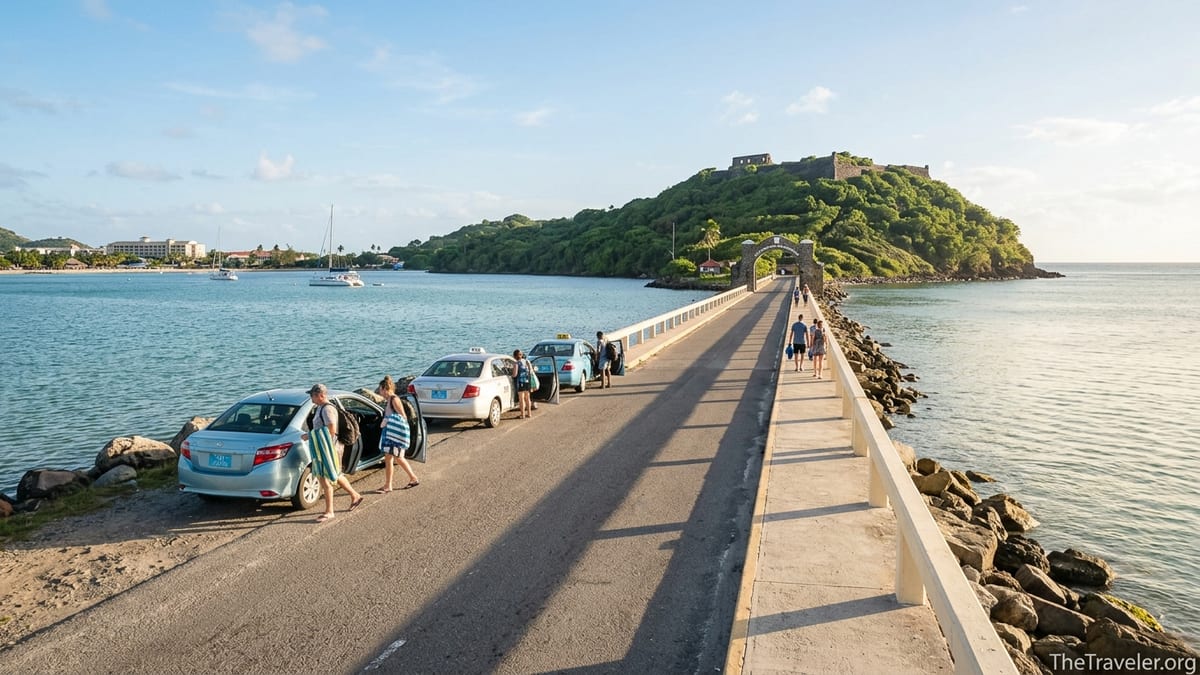
Orientation: Rodney Bay, Gros Islet and Pigeon Island
Rodney Bay lies in the Gros Islet district at the northern end of Saint Lucia, with a crescent of hotels and guesthouses stretched around Reduit Beach and the lagoon-style Rodney Bay Marina just inland. Pigeon Island sits at the very northern edge of the bay, connected to the mainland by a manmade causeway built in the 1970s. In practical terms, most visitors are traveling from the hotel zone around Reduit Beach or the Rodney Bay Marina area up to the entrance gate of Pigeon Island National Landmark.
The distance from central Rodney Bay (near the main shopping malls) to the Pigeon Island gate is roughly 4 to 5 kilometers by road, depending on your exact starting point. Travel times are generally short. By taxi or rental car, the drive usually takes 10 to 15 minutes outside of heavy traffic, with the route following the Castries–Gros Islet Highway north before turning left across the causeway. Local minibuses that run the Castries to Gros Islet corridor pass along this same main road and can drop you near the Pigeon Island turnoff.
Pigeon Island is managed as a national landmark, with an admission fee paid at the visitor entrance. Travelers report that entrance charges and opening hours can change occasionally, so it is wise to confirm current details through your hotel front desk or a local tourism office shortly before visiting. The site has small beaches, trails up to Fort Rodney, and basic facilities, which makes it easy to spend anywhere from a relaxed half day to a full day on the peninsula.
Because Rodney Bay, Gros Islet village and Pigeon Island all sit in close proximity, many visitors choose to treat them as one compact area. It is realistic to spend the morning on Reduit Beach, head to Pigeon Island for the afternoon, and then continue to Gros Islet for an evening street food or the famous Friday night jump-up, provided you plan your transport carefully.
Taxi Options: Fastest and Most Flexible
For most travelers, especially on a short visit or cruise stop, taxis are the simplest way to get from Rodney Bay to Pigeon Island. Official taxis in Saint Lucia have light blue license plates marked with “TX,” and you will find them waiting outside major Rodney Bay resorts, at Rodney Bay Marina and near the main shopping plazas. From the central Rodney Bay hotel strip to Pigeon Island, recent traveler reports suggest a typical one-way fare in the region of 30 to 40 Eastern Caribbean dollars, or around 12 to 15 US dollars, for up to four passengers.
Taxi fares in the north are often discussed and agreed in advance. It is common and perfectly acceptable to ask your driver the price before you get in. For example, a couple staying at a midrange hotel near Reduit Beach might agree a fare of 15 US dollars to Pigeon Island, then arrange for the same driver to collect them three hours later for the return at a similar price. Families or small groups can keep costs reasonable by sharing one vehicle; a family of four paying 15 US dollars total compares favorably to four separate local bus rides plus walking.
If you are visiting on a cruise ship tender that lands at Rodney Bay Marina, there are usually several taxis just outside the marina entrance. Drivers are used to taking cruise passengers straight to the Pigeon Island causeway, often offering an informal round trip rate with a specified pickup time. A common arrangement is a return fare of roughly 25 to 30 US dollars per couple, with two to three hours on the island, which can be good value if you prefer not to negotiate again later or worry about finding a taxi for the trip back.
Taxi availability is generally good during the day in and around Rodney Bay. In the evening, particularly after sunset or late on a Friday when many locals are heading to Gros Islet, taxis are still available but you may need to ask your hotel or restaurant to call one for you. As with anywhere, confirm whether your quote is per ride or per person, and carry some smaller denomination cash in Eastern Caribbean dollars or US dollars for easier payment.
Local Minibuses: Cheapest Route with Some Trade-offs
Saint Lucia’s local buses are actually privately operated minibuses, usually 12 to 16 seat vans with an “M” on the license plate. On the north of the island, the main Route 1A runs between Castries and Gros Islet, passing through Rodney Bay along the highway. For visitors, this can be an extremely cost-effective way to get close to Pigeon Island, though it does involve some walking or a short extra ride at the end.
Recent users report that a one-way fare between Rodney Bay and Gros Islet on the 1A bus costs the equivalent of roughly 1 to 2 US dollars per person or a few Eastern Caribbean dollars in cash. Buses do not run on fixed timetables but tend to pass quite frequently during the day. In Rodney Bay, you typically flag them down near the main highway by the shopping malls or near the roundabout; locals and hotel staff can point you to the most convenient spot. In Gros Islet, there is a small bus terminal and a cluster of stopping points by the main road.
Minibuses do not usually drive all the way into Pigeon Island National Landmark itself, but they can get you to one of two convenient points. One option is to ask the driver to let you off at the Pigeon Island or Pigeon Point junction on the main highway, then walk along the causeway and shoreline for around 15 to 20 minutes to reach the park entrance. Another is to ride to the last stop in Gros Islet village, then navigate to the waterfront and follow the beach and roads north-west toward the causeway. Some travelers report that, for a small additional amount beyond the standard fare, certain drivers may agree to continue off the usual route and drop passengers nearer to the Pigeon Island gate, but this is always at the driver’s discretion.
Using minibuses requires flexibility. There is no published schedule, vehicles can be crowded at school or commuting times, and services tend to taper off in the evening, especially after around 8 or 9 pm. The experience can be noisy and informal, but for budget-conscious travelers or those wanting to experience local life, it is a memorable and very inexpensive way to travel the short distance between Rodney Bay and the Pigeon Island turnoff.
Walking, Rental Cars and Practical Limitations
On maps, Rodney Bay and Pigeon Island look very close, and it is technically possible to walk the entire route. For example, a traveler staying near Rodney Bay Marina could walk along the marina front, follow the sidewalk by the main road and then cross the causeway to Pigeon Island in around 45 to 60 minutes at a comfortable pace, depending on heat and stops. However, this is not an ideal option for most visitors, mainly due to strong sun, limited shade along parts of the highway, and occasional fast traffic.
A more realistic approach is to use walking as part of a combined trip. Many visitors take a bus or taxi to the Pigeon Island junction or Gros Islet, then walk the final segment along the shoreline or causeway. For instance, one traveler described taking a minibus from near a Rodney Bay hotel to the Pigeon Island turnoff for a very small fare in local currency, then walking the 15 to 20 minutes to the national landmark entrance. This kind of hybrid strategy can suit reasonably fit travelers who are comfortable walking in warm conditions with a hat, sunscreen and water.
Rental cars offer another flexible option, particularly if you plan to explore other parts of the island. Recent price examples suggest small rental cars in the north of Saint Lucia often start in the region of 60 to 120 US dollars per day, depending on season, insurance and pickup point. Driving is on the left, and the roads in and around Rodney Bay and Gros Islet are considered among the easier areas on the island to drive. The route to Pigeon Island involves only a short stretch of main highway and clearly signed turns, so confident drivers often find it straightforward.
Even with a rental car, consider traffic at peak times. The stretch between Rodney Bay and Gros Islet can become congested in late afternoon or early evening, especially on Fridays when people travel for the Gros Islet street party. Journey times that are usually 10 minutes can stretch to 20 minutes or more. If you plan to drive yourself, leaving earlier in the day can keep the trip to Pigeon Island smooth and quick.
Hotel Pickups, Tours and Cruise Arrangements
Many larger hotels and resorts around Rodney Bay, as well as some guesthouses, can arrange transport to Pigeon Island on request. In some cases, this may be a private taxi that the hotel books and charges to your room at an agreed rate. In others, hotels partner with local tour operators who run half-day excursions that include return transport, entry fees and sometimes a guided walk up to Fort Rodney or snorkeling time on the beaches.
For example, a resort on Reduit Beach might offer a morning Pigeon Island excursion that departs from the lobby at 9 am, includes round-trip vehicle transport of 10 to 15 minutes each way, and gives guests three hours on the island before returning in early afternoon. Prices for such hotel-organized outings are typically higher than a simple taxi, but they bundle in the convenience of a known schedule and assistance with tickets. Boutique hotels and villas often have a preferred local driver who can be contacted the day before to confirm your desired departure and pick-up times.
Cruise passengers tendering into Rodney Bay Marina sometimes find that independent boat tour companies and shore excursion providers offer packages that combine a short drive or boat ride to Pigeon Island with other nearby stops. For instance, a half-day trip might include a guided walk on Pigeon Island followed by beach time back on Reduit Beach or a snorkeling stop near the causeway. Booking one of these can make sense if you have limited hours in port and prefer a single point of contact who handles all transport logistics.
Ride-hailing apps are still limited in Saint Lucia as of the mid-2020s, and most on-the-ground advice suggests not relying on an app-based service. Instead, use your hotel’s concierge or reception team as a resource; they are accustomed to arranging taxis and connecting guests with reputable drivers for short hops like Rodney Bay to Pigeon Island, and they can give you an up-to-date feeling for typical pricing during your stay.
Parking, Facilities and On-the-Ground Tips
For those arriving by rental car or taxi, there is vehicle access along the causeway right up to the entrance to Pigeon Island National Landmark. Drivers typically drop passengers near the gate or in the adjacent parking area, which is usually unpaved but straightforward. Parking policies can change, and in busy holiday periods spaces can fill, so if you are traveling in your own car it is sensible to arrive earlier in the day, especially on weekends or public holidays when local families also come to enjoy the beaches.
Once inside Pigeon Island, you will find basic facilities including restrooms, small beaches with calm water, and trails leading up to historic viewpoints like Fort Rodney. There is usually at least one casual spot for food and drinks either within the landmark or close to the entrance, though opening hours may vary seasonally. Carrying some cash is useful, both for entrance fees and for small purchases, since card facilities can be inconsistent.
Sun exposure is a major consideration. Even during cooler months, the combination of Caribbean sun and the modest climbs on Pigeon Island’s hills can be challenging. If you arrive by taxi, bus or car, plan to have sufficient water, sunscreen, hats and comfortable footwear for walking on rocky or uneven paths. Families with young children may wish to focus on the beaches and lower trails, while fitter visitors can climb to the higher ruins for wide views over Rodney Bay and the open Caribbean Sea.
Safety-wise, the Rodney Bay and Pigeon Island area is generally regarded as one of the more relaxed parts of Saint Lucia’s north. Normal travel common sense applies. Avoid leaving valuables visible in parked cars, keep an eye on your belongings on the beach, and plan your return transport in advance if you intend to stay close to sunset, particularly if you arrived by minibus and might need a taxi back to your hotel.
Combining Pigeon Island with Reduit Beach or Gros Islet
Given how close everything lies, combining Pigeon Island with Reduit Beach or Gros Islet in one day is both practical and popular. One common pattern for visitors staying along Reduit Beach is to start with a relaxed early swim there, then take a mid-morning taxi up to Pigeon Island for hiking and history before the day gets too hot. After exploring the forts and viewpoints, they return by taxi or bus to Rodney Bay for a late afternoon on the sand or a waterfront dinner.
Reduit Beach and Pigeon Island offer subtly different experiences. Reduit tends to feel livelier, with beach bars, water sports operations and a line of hotels and restaurants backing the sand. Pigeon Island’s beaches, by contrast, are usually quieter and framed by the historic headland and fortifications. For a visitor with only one full day in the area, splitting time between them can provide a good sense of the region’s variety without the need for long transfers.
Gros Islet village lies just beyond Pigeon Island and becomes especially lively on Friday nights for its weekly street party, often called the jump-up. Travelers who enjoy nightlife sometimes plan a full Friday in the area: hiking and swimming on Pigeon Island in the afternoon, returning to their hotel in Rodney Bay to freshen up, then heading to Gros Islet by taxi or minibus after dark for food stalls, music and dancing. In this case, taxis are often the easiest late-night option, while the minibus makes sense earlier in the evening when services are still frequent.
On cruise calls that use Rodney Bay Marina rather than Castries, you can also create a compact shore day by combining the short trip to Pigeon Island with a few hours at Reduit Beach or a stroll and meal around Rodney Bay’s malls and restaurants. Build in a buffer of time for traffic when returning to the marina before your last tender, and pre-arrange your taxi pickup if you are visiting on a particularly busy weekend or holiday.
The Takeaway
Traveling from Rodney Bay to Pigeon Island is a short hop in distance, but the choice of taxis, local minibuses, hotel pickups, rental cars and walking routes allows you to tailor the experience to your budget, schedule and comfort level. Taxis remain the most straightforward choice for most visitors, delivering you from hotel lobby to park entrance in around 10 to 15 minutes at a predictable cost that can be shared among your group.
For those watching their spending or seeking a taste of local life, the Route 1A minibus that links Rodney Bay and Gros Islet provides a very inexpensive alternative, though you will need to be comfortable with informal schedules and a short walk at the end. Rental cars and partial walking routes add flexibility if you are exploring the wider north of the island and enjoy mixing scenic drives with time on foot.
Whichever option you choose, planning ahead is critical. Check current entrance fees and opening hours for Pigeon Island, speak to your hotel about up-to-date taxi or shuttle rates, and decide whether you want to combine your visit with Reduit Beach or Gros Islet’s evening scene. With a clear plan, the trip from Rodney Bay to Pigeon Island becomes not just a transfer, but an easy gateway to some of Saint Lucia’s most appealing coastal scenery and history.
FAQ
Q1. How long does it take to get from Rodney Bay to Pigeon Island by taxi?
In normal daytime traffic the journey usually takes about 10 to 15 minutes from the main Rodney Bay hotel area to the Pigeon Island entrance.
Q2. How much does a taxi cost between Rodney Bay and Pigeon Island?
Recent travelers commonly report one-way fares around 30 to 40 Eastern Caribbean dollars, or roughly 12 to 15 US dollars, for up to four passengers.
Q3. Is there a public bus from Rodney Bay directly into Pigeon Island?
No. Local minibuses run along the main highway between Castries, Rodney Bay and Gros Islet. You get off at the Pigeon Island turnoff or in Gros Islet and then walk or arrange a short additional ride.
Q4. Can I walk all the way from Rodney Bay to Pigeon Island?
It is physically possible, and some fit travelers do so in 45 to 60 minutes, but there is limited shade and traffic along parts of the route, so most visitors prefer a taxi or bus plus a shorter walk.
Q5. Is parking available at Pigeon Island if I rent a car?
Yes. Vehicles can drive along the causeway to a parking area near the Pigeon Island National Landmark entrance, though spaces may be busier on weekends and holidays.
Q6. Do hotels in Rodney Bay offer shuttles to Pigeon Island?
Many larger resorts and some smaller hotels can arrange transport, either through a private shuttle, a preferred taxi driver or a bundled excursion that includes Pigeon Island.
Q7. Can I easily combine a visit to Pigeon Island with time on Reduit Beach?
Yes. The two are only a short drive apart. Many visitors spend part of the day hiking and exploring Pigeon Island, then return to Reduit Beach for swimming and sunset.
Q8. Is the local minibus safe for tourists to use around Rodney Bay and Gros Islet?
The minibus system is widely used by local residents and many visitors. It is informal and can be crowded, but daytime trips on the Rodney Bay to Gros Islet route are generally considered straightforward.
Q9. What is the best option for families with young children?
For families, taxis or hotel-arranged transport are usually the most comfortable, as they avoid crowded minibuses and reduce walking time in the heat with beach gear and strollers.
Q10. Is it worth visiting Gros Islet on the same day as Pigeon Island?
It can be, especially on Fridays when Gros Islet hosts its famous evening street party. Many travelers visit Pigeon Island in the afternoon, then take a taxi to Gros Islet for food and music.