


Landing in Santiago and heading straight for the colorful hills of Valparaíso is one of the classic arrivals in Chile. The route is straightforward once you understand how the airport buses, Santiago’s Pajaritos hub, long‑distance coaches, private transfers, and rental cars fit together. This guide walks you through the real options available as of 2026 so you can choose the best route for your budget, luggage, and schedule.
Get the latest updates straight to your inbox!
Understanding the Route: From SCL to the Pacific Coast
Chile’s main international gateway, Arturo Merino Benítez International Airport (SCL), sits on the western edge of Santiago, roughly 115 kilometers from Valparaíso by highway. In normal traffic, a direct drive to Valparaíso takes about 1 hour 15 minutes by private car or taxi and around 2 hours by bus, not counting any waiting time or city traffic at either end. The entire journey follows Route 68, the main highway linking the capital with the coast.
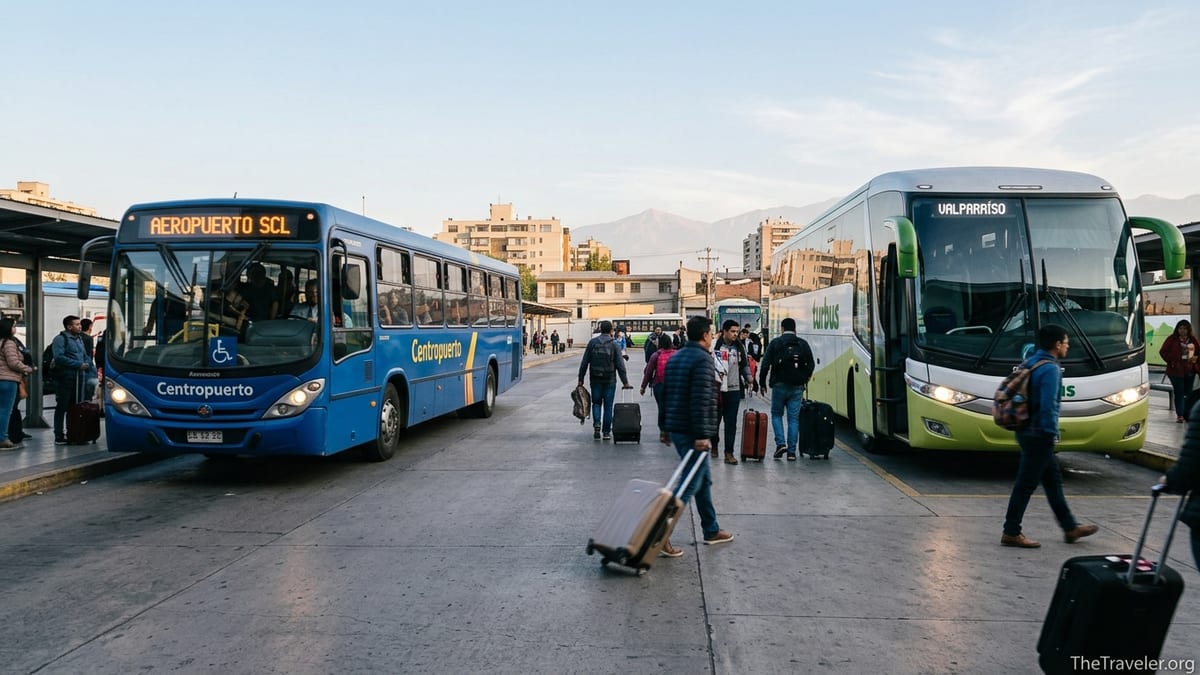
Most travelers will either go indirectly via Santiago’s Pajaritos transport hub or book a direct transfer from the airport. Pajaritos is a metro and intercity bus station on Santiago Metro Line 1, with a busy bus terminal serving Valparaíso, Viña del Mar, and other coastal destinations. The airport bus companies Centropuerto and Turbus, along with the public bus route 555, connect the airport with this hub, making Pajaritos the logical springboard for coastal travel.
Valparaíso itself has a central bus terminal near the flat downtown area, relatively close to major hotels, hostels, and city transport. For many visitors, the connection is as simple as airport bus to Pajaritos, then a long‑distance coach to Valparaíso. Others, especially those arriving late at night, with bulky luggage, or traveling in a small group, often prefer a private transfer or rental car to avoid changes and waiting around at terminals.
Before you choose your route, think about three basics: your arrival time, how much luggage you are carrying, and whether you are comfortable navigating Spanish‑language ticket counters and bus terminals after a long flight. Once you are clear on those, the choice between the bus‑plus‑bus route, a private transfer, or a rental car becomes much easier.
Route 1: Airport Bus to Pajaritos, Then Coach to Valparaíso
For most independent travelers, the standard route is airport bus to Pajaritos, then an intercity coach to Valparaíso. At the airport, the main private shuttle bus companies are Centropuerto and Turbus. They run blue and green airport buses from the dedicated bus station between Terminals 1 and 2, as well as from curbside stops on the arrivals level. Services typically run every 10 to 20 minutes during the day, with slightly longer gaps late at night, and stop at key metro stations such as Pajaritos and Los Héroes.
As of mid‑2026, a one‑way ticket on Centropuerto from the airport to Pajaritos costs in the low 2,000s of Chilean pesos per person, roughly a few US dollars at prevailing rates, with small discounts for round trips. Tickets can be bought at counters in the airport bus terminal, at vending points in the terminal buildings, or from staff when boarding, usually payable in Chilean pesos by cash or card. Turbus operates at a similar price point and runs to Universidad de Santiago and Pajaritos, so either company will get you where you need to be.
On arrival at Pajaritos, you step off the airport bus directly into a compact intermodal hub. One side connects to the Line 1 metro, while another side serves as an intercity bus terminal with frequent departures to Valparaíso and Viña del Mar. Several companies, including well‑known national brands, run this route. Schedules vary by operator and season, but you can usually expect a departure every 10 to 20 minutes during daytime and early evening hours. Journey time to Valparaíso is typically around 1 hour 30 minutes, depending on traffic along Route 68.
This two‑step route is particularly attractive if you are traveling light and arrive during the day. For example, a solo backpacker landing at 10:00 can often be in Valparaíso by early afternoon. After clearing immigration and customs, they can walk straight to the airport bus terminal, ride to Pajaritos in about 30 minutes, buy a coach ticket on the spot for the next departure, and roll into Valparaíso bus terminal in time for a late lunch on the seafront. Costs remain relatively low compared with private options, and the system is well used by locals and international visitors alike.
Alternative Bus Link: Public Route 555 and Budget Combinations
Beyond the private airport buses, there is also a regular public bus route, known as the 555, connecting the airport with the Pajaritos intermodal station. This service is part of Santiago’s integrated public transport network and is generally aimed at commuters, but budget‑minded travelers sometimes combine it with the metro and intercity buses to keep costs down. The 555 runs between the airport’s intermodal terminal and Pajaritos, normally from early morning to late evening, with frequencies that depend on the time of day.
Using the 555 is cheapest if you already plan to rely heavily on Santiago’s public transport and have or intend to purchase a Bip contactless card, which is required for payment on the city network. A traveler arriving for a long stay in Santiago might, for instance, buy a Bip card at Pajaritos, load it with credit, and then use the 555 when shuttling between the airport and the city, combining the card with metro rides and local buses over several days.
For someone whose main goal is simply to reach Valparaíso after landing, however, the cost savings versus a private airport bus are modest, while the added complexity is significant. You need to understand the public bus boarding points, navigate Spanish‑language signage, and potentially manage tight connections between three different services: public bus, metro, and long‑distance coach. In practice, many visitors find that paying slightly more for Centropuerto or Turbus, which depart directly from the main airport terminal area and drop them at the right side of Pajaritos for the Valparaíso coaches, is worth the reduced stress.
If you are traveling with large suitcases, the public 555 bus also tends to be less comfortable, since it is designed with standing room and quick boarding in mind rather than airport‑style luggage racks. The private airport buses are not luxury coaches, but they are more used to passengers with cases and backpacks, with underfloor luggage storage available on many departures and a clearer routine around baggage handling.
Private Transfers: Door‑to‑Door Convenience from the Airport
At the other end of the comfort spectrum are private transfers, which take you directly from Santiago Airport to your accommodation in Valparaíso without any transfers. Several international and local operators offer this service, including established transfer platforms that specialize in city‑to‑city rides. You typically prebook online, provide your flight details, and meet your driver in the arrivals hall or at a designated pickup point. The car is usually a late‑model sedan or minivan, depending on your group size.
Typical transfer times are around 1 hour 30 minutes under normal traffic conditions, and many providers monitor flight delays to adjust pickup times. For a solo traveler, this is a premium option. For a couple or a small group with heavy bags, it can be surprisingly cost‑effective compared with multiple bus tickets. Prices fluctuate by season and provider, but for a private car carrying up to three passengers with standard luggage, you can expect to pay the equivalent of a low to mid‑three‑figure amount in US dollars for the entire vehicle, not per person, in 2026. Larger vans that can handle surfboards, bicycles, or significant luggage loads cost more but may still make sense when costs are shared among four to six people.
Private transfers are particularly appealing for late‑night arrivals, families with young children, or travelers carrying bulky or specialized gear. A family landing from Europe at 23:00, for example, might not want to navigate bus schedules, crowded terminals, and unfamiliar Spanish announcements. Booking a private driver to meet them, help with luggage, and drive them straight to a hillside guesthouse in Valparaíso can remove most of the stress from that first night. Similarly, a duo of musicians with instruments in hard cases might value the peace of mind of having their gear travel inside a private vehicle rather than in a luggage hold or overhead rack.
The main trade‑offs are cost and the need to commit in advance. Unlike buses, which can be boarded more or less on demand, private transfers often charge fees for last‑minute cancellations or major schedule changes. It is wise to read reviews, confirm whether tolls on Route 68 are included in the price, and clarify luggage limits before booking. For most visitors who choose this route, though, the comfort and predictability are worth it, especially at the start of a long trip.
Driving Yourself: Rental Cars from Santiago Airport
Renting a car at Santiago Airport to drive yourself to Valparaíso is another viable option, especially if you plan to explore further along the coast or into central Chile. Major international car rental brands and well‑known Chilean agencies have desks at the airport, typically located in the arrivals area of the terminals. You can reserve ahead of time, which is strongly recommended during high season, or book on arrival, which may offer less choice and higher prices.
The drive from SCL to Valparaíso along Route 68 is straightforward for drivers used to highway conditions. Leaving the airport, you join the main road toward Santiago and quickly pick up the signs for Route 68 heading west. The road is a multi‑lane highway with toll booths and runs through a mix of flat farmland and low hills before descending toward the coast. Traffic can be heavy near Santiago during weekday rush hours and on Sunday evenings when weekenders return from the beach, but outside those peak periods the journey is usually smooth.
Typical rental rates in 2026 for a compact car picked up at the airport range widely depending on season, insurance choices, and fuel policies. Broadly speaking, a week‑long rental in mid‑season can cost the equivalent of a few hundred US dollars before fuel and tolls. If you are sharing the car between two or three travelers and plan to visit multiple destinations along the coast or inland wine valleys, the cost per person can become quite competitive compared with several individual bus tickets and transfers.
On the other hand, renting a car in Chile means navigating local driving habits, toll systems, and parking in Valparaíso, where streets are steep, narrow, and often congested. Many visitors choose to park in a secure lot near the flatter downtown and then move around the hills on foot or by funicular, rather than trying to drive into the most historic neighborhoods. For short stays focused mainly on Valparaíso itself, the flexibility of a rental car may not justify the hassle and expense. The rental option makes the most sense for travelers who enjoy driving and plan a broader road trip in central Chile.
Travel Time, Luggage, and When to Go Direct
Choosing whether to go direct from the airport or route yourself through Pajaritos depends largely on your priorities. From a pure time perspective, a private transfer or rental car driven straight from the airport will typically be the fastest, around 1 hour 15 minutes to 1 hour 30 minutes in normal conditions. The bus via Pajaritos involves two separate services, waiting time at the hub, and a longer journey, often adding up to around 2 hours 30 minutes door to door, sometimes more at peak times or if connections do not line up smoothly.
Luggage is a major factor. With just a carry‑on backpack and perhaps a small roller case, the airport bus and coach combination is manageable and economical. Coaches from Pajaritos to Valparaíso have underfloor storage, and airport buses are used to passengers boarding with suitcases. However, if you have oversized or fragile items such as surfboards, professional camera gear, musical instruments, or multiple large suitcases for a long‑term stay, moving them through terminals and onto two different buses can become tiring and risky. In such cases, a private transfer or rental car significantly reduces handling and the chance of items being misplaced.
Arrival time also matters. During daytime and early evening, the Pajaritos route is straightforward and well populated with fellow travelers, making it a comfortable option for many. Late at night, services grow less frequent, and connections may involve longer waits in semi‑quiet stations. Imagine landing on a delayed long‑haul flight at 01:30. By the time you clear immigration and customs, the airport might feel half asleep, and airport‑to‑city buses may be running on a reduced schedule. In that situation, going direct by prebooked transfer or using a reputable ride service agreed at a fixed price can feel much safer and less stressful than gambling on late‑night bus connections.
There is also the question of energy and familiarity. A seasoned budget traveler fluent in Spanish may enjoy piecing together the airport bus, metro, and coach connections, using the trip as an early immersion into Chilean daily life. A first‑time visitor to South America arriving after 15 hours of flying, perhaps with children in tow, may simply want to be delivered to a guesthouse door in Valparaíso with no further decisions required. Neither approach is right or wrong; the key is to match the route to your own tolerance for complexity after landing.
Real‑World Itineraries: Which Option Fits Your Trip?
Consider three typical traveler profiles to see how these choices play out in practice. First, a solo backpacker arriving from Lima at 09:00 with one small backpack and a flexible budget might choose the airport bus to Pajaritos and then the next available coach to Valparaíso. They spend only a modest sum, arrive in the early afternoon, and feel comfortable asking for directions in Spanish at each step. For them, the mix of buses is part of the adventure and keeps costs low.
Second, imagine a couple in their 60s landing from Europe at 19:30 with two checked suitcases and hand luggage. They speak some Spanish but are jet‑lagged and staying in an uphill boutique hotel in Valparaíso’s Cerro Alegre neighborhood. They might prebook a private transfer that meets them at arrivals with a sign, loads their suitcases into the trunk, and drives them straight to their hotel, perhaps even arranging with the hotel for assistance from reception when they arrive. They pay more than they would for buses, but they remove the uncertainty of connections after dark and the strain of carrying bags through multiple terminals and streets.
Third, think of a group of four friends planning a week of exploring both Valparaíso and the nearby Casablanca wine valley. They land around midday, split the cost of a compact rental car from the airport, and drive themselves along Route 68. They stop at a highway service area for coffee, detour into a vineyard in the afternoon, then continue to Valparaíso in time for dinner. Over the week, they use the car to reach beaches and vineyards that are not easily accessible by bus. For them, the car provides flexibility that outweighs the challenge of city parking and navigation.
These examples underline that there is no single “best” way from Santiago Airport to Valparaíso, only a set of options that fit different priorities. The crucial questions are how price‑sensitive you are, how comfortable you feel making transport decisions in a new country, and how much you value door‑to‑door simplicity over the savings and local feel that come with the bus routes.
The Takeaway
Travel between Santiago Airport and Valparaíso in 2026 is well served by a mix of airport buses, public routes, intercity coaches, private transfers, and rental cars. For most daytime arrivals with light luggage, the classic combination of Centropuerto or Turbus from the airport to Pajaritos, followed by a frequent coach to Valparaíso, remains the best balance of cost and reliability. It is affordable, runs often, and gives you a sense of how Chileans themselves move between the capital and the coast.
If you value comfort, are traveling with children or significant luggage, or arrive very late or very early, going direct makes more sense. A prebooked private transfer offers the simplest door‑to‑door experience, while a rental car is ideal for travelers planning a broader road trip through central Chile’s wine regions and beaches. In both cases, the higher upfront cost buys you time, flexibility, and peace of mind after a long flight.
Whichever route you choose, it is worth checking your flight arrival time, thinking realistically about your energy level, and considering how much luggage you will have to handle. That quick assessment will tell you whether the bus‑plus‑Pajaritos connection fits your style or whether a direct transfer better matches your first day in Chile. With the right choice, your journey from Santiago’s runways to Valparaíso’s painted hills will feel like a smooth transition rather than a logistical puzzle.
FAQ
Q1. How long does it take to get from Santiago Airport to Valparaíso?
In normal traffic it takes about 1 hour 15 minutes to 1 hour 30 minutes by private car or transfer, and around 2 hours by bus plus any waiting time for connections.
Q2. Is it easy to take the airport bus and connect at Pajaritos?
Yes, the airport buses clearly indicate Pajaritos, and the intermodal station is compact. You step off the airport bus and follow signs to the intercity bus platforms for Valparaíso.
Q3. Can I buy tickets for the Valparaíso coach in advance?
You can often buy online with major Chilean bus companies or at their counters in Pajaritos. Many travelers simply buy on arrival, as departures are frequent during the day.
Q4. Are the buses safe for solo travelers at night?
During the evening the airport buses and main coach companies are widely used and generally considered safe, but very late at night services thin out and a private transfer can feel more comfortable.
Q5. How much does the airport bus to Pajaritos cost?
As of 2026 the airport buses typically cost a bit over two thousand Chilean pesos one way per person from the airport to Pajaritos, with small discounts for round trip tickets.
Q6. Is a private transfer worth the extra cost?
For families, late arrivals, or travelers with heavy or bulky luggage, a private transfer often feels worth the price because it offers door‑to‑door service with no transfers or confusion.
Q7. Do I need to speak Spanish to use the bus and Pajaritos connection?
No, but it helps. Destination names are clearly displayed and staff are used to foreign travelers, though announcements and signs are mainly in Spanish.
Q8. Should I rent a car just to go from Santiago Airport to Valparaíso?
Renting a car mainly makes sense if you plan to explore beyond Valparaíso, such as visiting the Casablanca Valley or multiple coastal towns, and are comfortable driving and parking in Chile.
Q9. What if my flight arrives very late at night?
If you land after most buses have stopped or are running infrequently, consider prebooking a private transfer or arranging with your Valparaíso accommodation for a recommended car service.
Q10. Is it better to stay a night in Santiago before going to Valparaíso?
Many travelers go straight to Valparaíso, but if you arrive exhausted, late, or want time to adjust, spending a night in Santiago and heading to Pajaritos the next day is a comfortable alternative.