


More news on this day
Air travel across the United States remained severely disrupted on Saturday after a rare nationwide Federal Aviation Administration ground stop triggered more than 11,500 flight cancellations, leaving tens of thousands of passengers stranded and airlines warning that schedules may not fully recover for days.
Get the latest news straight to your inbox!
Longest nationwide shutdown in decades ripples into weekend
Publicly available data from flight tracking services and aviation analytics firms shows that the ground stop, which began on Friday afternoon, brought most US departures to a standstill for more than four hours, the longest nationwide shutdown of US airspace since the attacks of September 11, 2001. Reports indicate that at one point more than 3,500 aircraft were already in the sky while thousands of departures were prevented from taking off.
Figures compiled by services such as FlightAware, FlightRadar24 and Cirium suggest that by early Saturday more than 6,600 flights had been canceled and around 8,600 delayed on Friday alone, with at least 2,000 further cancellations logged for Saturday morning. One international outlet citing Cirium data reported that about 11,000 scheduled departures carrying more than 1.5 million passengers were on the timetable at US airports when the crisis began, underscoring the scale of the disruption.
Broadcast and newspaper coverage calculates that when ongoing cancellations and scrubbed services for Saturday and Sunday are combined, the total number of canceled flights linked to the outage has already surpassed 11,500, with that figure expected to rise as airlines continue to trim their weekend schedules. The Federal Aviation Administration announced late Friday that airspace had fully reopened around 8:15 p.m. Eastern time, but carriers have emphasized that restoring normal operations is a multi day effort.
Transportation department briefings and specialist aviation reporting indicate that the incident was triggered by a communications failure affecting key air traffic control centers, rather than adverse weather. Homeland security officials have publicly stated there is no evidence of a cyberattack, though investigators have not yet published a definitive technical explanation.
Major hubs hit hardest as passengers sleep in terminals
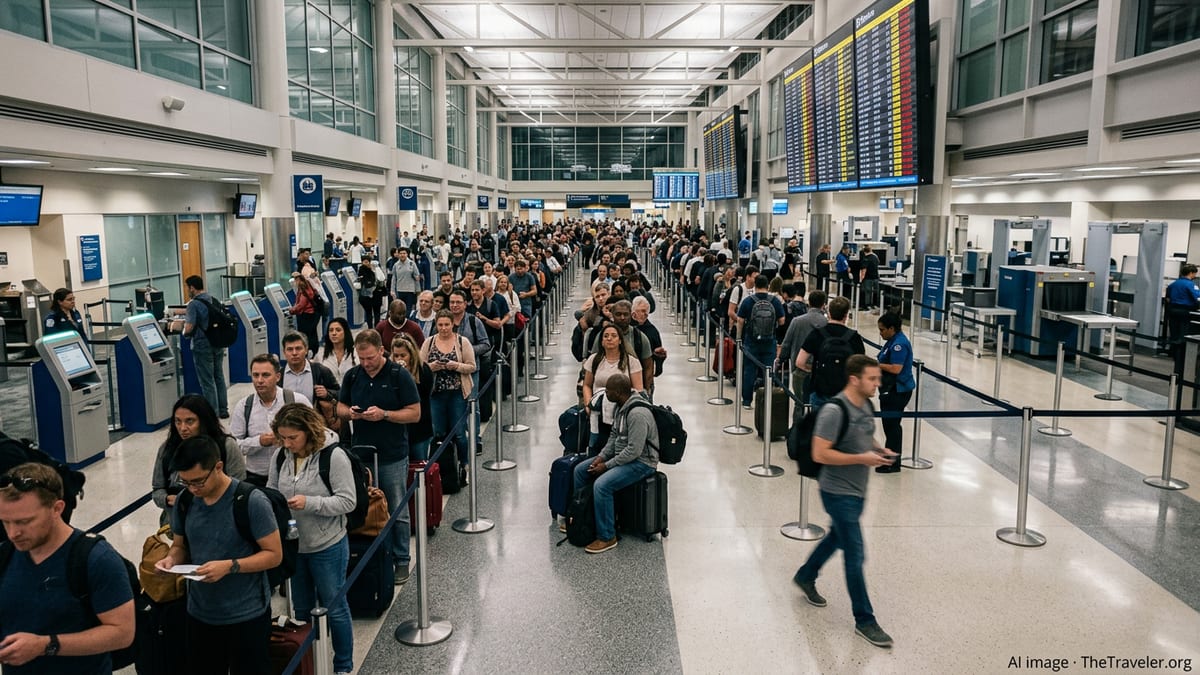
Airports from Boston and New York to Chicago, Dallas, Denver, Los Angeles and Seattle reported packed terminals on Friday night and into Saturday as cancellation boards filled and passengers scrambled for scarce seats on remaining flights. News photographs from major hubs such as Newark Liberty, Ronald Reagan Washington National and Los Angeles International showed travelers camping on the floor, forming long queues at customer service desks and crowding around departure monitors.
Coverage from US and international outlets describes passengers at some airports being handed rebooking cards instructing them to use apps and websites to reschedule journeys, only to find few viable options before late Sunday or Monday. At others, travelers were advised to collect checked bags and leave the airport while they sought hotel rooms or alternative transport by rental car, long distance bus or train.
International connections have also been severely affected. Reports from Australian and European media describe travelers stranded at US gateway airports such as New York John F. Kennedy and Los Angeles after onward flights were canceled, with airlines warning that limited spare aircraft and crews would slow efforts to re protect customers on later departures. The UK Civil Aviation Authority and other regulators have issued advisories noting that knock on delays to and from the United States are likely to persist as airlines rebuild their schedules.
Sports and entertainment travel has been caught up in the chaos as well. Teams in the National Basketball Association, National Hockey League and college football programs have had to rework travel plans, with some returning to campuses or training bases on Friday and arranging charter or commercial departures on Saturday instead, according to sports and wire service reports.
Airlines race to reposition planes and crews
Industry analysts note that the immediate halt to departures on Friday afternoon left aircraft and crew rosters badly out of position for the busy weekend period. When flights are held on the ground simultaneously across the country, later rotations often cannot operate, even after the technical problem is resolved, because pilots and cabin crews quickly run up against duty time limits set for safety reasons.
According to data cited in national newspapers, major US carriers such as Delta Air Lines and American Airlines each canceled more than 2,000 flights between Friday evening and late Saturday, as they opted to cut frequencies and entire routes rather than allow rolling delays to cascade further into the network. Low cost and regional airlines have also reported significant disruption, particularly at connecting hubs where multiple banks of departures depend on tight aircraft turnarounds.
Publicly available information from the Department of Transportation’s consumer reports shows that in a typical month this year, US airlines cancel between about 3 and 7 percent of their scheduled operations. The volume seen since Friday represents an extreme outlier compared with those averages, effectively compressing weeks’ worth of cancellations into a single extended weekend.
Some carriers have introduced temporary travel waivers, allowing passengers booked to travel through the affected period to change dates and in some cases destinations without incurring change fees or fare differences. Travel insurers and assistance providers have also begun issuing notices reminding customers to keep receipts and documentation in case they are eligible to claim for extra accommodation, meals or surface transport triggered by the aviation shutdown.
Uncertain cause renews focus on aging aviation systems
While federal officials have stressed that there is no indication of a deliberate attack, the lack of an immediate public explanation for the communications failure has renewed debate about the resilience of US aviation infrastructure. According to published coverage of recent news conferences, the transportation secretary has argued that incidents of this kind are likely to recur unless Congress approves tens of billions of dollars in additional funding for modernization of air traffic control systems.
Reports note that the United States experienced a previous nationwide ground stop in January 2023 when a separate safety notice system malfunctioned, prompting the temporary grounding of all domestic departures. In both that case and the latest outage, attention quickly turned to the dependence of critical aviation functions on complex networks of telecommunications links, software and legacy hardware.
Industry commentators point out that the Federal Aviation Administration has already begun work on replacing thousands of miles of copper wiring with fiber optic lines and upgrading radio systems, as detailed in agency planning documents and budget materials. However, those programs are expected to take years to complete, leaving the system potentially vulnerable to further isolated outages that could, in rare circumstances, cascade into national disruptions.
Technology and business media have also linked the aviation shutdown to a broader week of digital turmoil, coming on the heels of a major Microsoft 365 outage that temporarily disrupted email and collaboration tools for millions of users worldwide. While the two events are not believed to be technically connected, commentators argue that together they highlight the extent to which everyday work and travel now rely on interconnected digital systems that can fail without warning.
What stranded travelers can do this weekend
Consumer advocates and travel specialists advise that anyone scheduled to fly over the weekend should first confirm their flight status directly with their airline’s app or website before leaving for the airport, given the rapid pace of schedule changes. Many carriers are encouraging customers whose trips are not time sensitive to voluntarily move their journeys to later dates, freeing up seats for those attempting to make essential connections.
Guidance from official consumer resources indicates that when a flight departing from or within the United States is canceled or significantly delayed and a passenger chooses not to travel, they are generally entitled to a refund of the unused portion of their ticket, even if they purchased a nonrefundable fare. This does not automatically extend to compensation for hotels or meals, which typically depend on the individual airline’s policies and whether the cause of the disruption is within the carrier’s control.
Travel insurance providers are urging customers who purchased policies before the outage was widely reported to review their coverage for trip interruption, additional accommodation and missed connection benefits. They recommend retaining boarding passes, delay notifications from airlines and receipts for out of pocket expenses, as claims assessors often require detailed evidence of both the disruption and any assistance already provided by carriers.
With aircraft and crews still scattered and some storms forecast in parts of the country, forecasts published by meteorological and aviation outlets suggest that delays and cancellations will remain elevated at least through Sunday. For many travelers, that means allowing extra time, considering backup routes or surface transport, and preparing for the possibility that US flight chaos will linger beyond the weekend.