


Seven Mile Beach in Grand Cayman is famous for its soft sand and luxury resorts, but you do not need to be a resort guest to enjoy it. Every beach in the Cayman Islands is public, and there are several well-marked access points with free parking where day visitors, cruise passengers, and budget travelers can spread a towel and swim. This guide explains exactly where non-resort guests can go along Seven Mile Beach, with a practical focus on Governor’s Beach, Public Beach, and Cemetery Beach, plus how to handle parking, facilities, and beach access law in real life.
Get the latest updates straight to your inbox!
How Public Beach Access Works on Seven Mile Beach
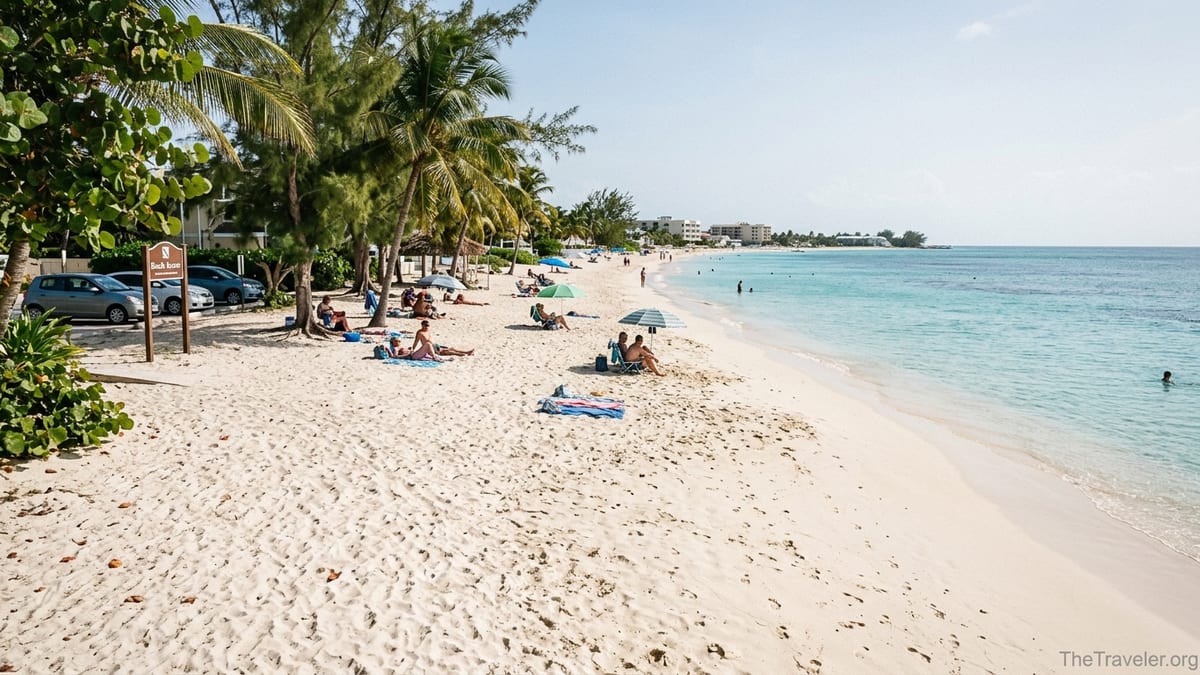
By law, all beaches in the Cayman Islands are public, including the entire length of Seven Mile Beach. In practice that means you can walk the shoreline and swim anywhere, even in front of the most exclusive hotels, without needing to be a guest. The limitation is not where you can be on the sand, but how you get there and what facilities you can use. Loungers, cabanas, and hotel pools remain for paying guests, but the sand and sea are open to everyone.
Public beach areas such as Seven Mile Public Beach, Governor’s Beach, and Cemetery Beach are owned and managed by the Cayman Islands Government and its Public Lands Commission. These zones typically have a dedicated access road or path, a small parking area, and sometimes showers, restrooms, or cabanas. Between the major public beaches you will see narrow “Beach Access” paths from West Bay Road down to the sand, often marked with brown or blue signs. Many of these are simple pedestrian rights of way with little or no parking, but they let you step through the line of condos and hotels and out onto the beach.
The key point for visitors is that you never need to sneak through private property or pretend to be a hotel guest to reach the waterline. If you approach from a signed public access path or one of the main public beaches, you can then walk in either direction along the shore. For example, you might park at Public Beach, walk south until you find a quiet stretch in front of a condo block, and set up on the sand with your own towel and cooler. As long as you are not occupying reserved hotel loungers or using private facilities, you are within your rights.
Because Seven Mile Beach sits on the island’s western shore, it also faces directly into the sunset. This makes every public access point attractive in the late afternoon. Governor’s Beach and Public Beach in particular can get busy around golden hour when residents stop by after work and cruise visitors linger after a day on the water. Arriving at least 30 to 45 minutes before sunset usually gives you time to park, walk down, and claim a patch of sand without stress.
Governor’s Beach: Central, Scenic and Easy to Reach
Governor’s Beach sits roughly in the central section of Seven Mile Beach, directly in front of the Governor’s official residence on West Bay Road. The landmark makes it very easy to find: if you are driving north from George Town, you will pass a low white wall and the Cayman Islands flag; the beach access and small public parking area are just on the seaward side of the road. The sand here is wide and usually less crowded than at Public Beach, especially on weekdays.
There is a small parking area right by the sand, along with room for cars to pull off on the shoulder of West Bay Road when it is busy. Parking is free, as it is everywhere along Seven Mile Beach, and there are no meters or time limits posted. You will not find a large concrete lot or multi-story garage; think more of a simple roadside pull-off that quickly fills around midday and at sunset. Locals often arrive in compact cars or small SUVs, park facing the sea for a quick swim, then leave as evening commuters arrive.
Facilities at Governor’s Beach are limited compared with Public Beach. As of mid‑2026, you should not count on permanent restrooms or showers on-site, and there are no fixed beach bars or restaurants right on the sand. This makes Governor’s Beach a better option for visitors who are comfortable bringing their own drinks, snacks, and shade. Many residents drive over with a soft cooler, a couple of folding chairs, and a beach umbrella they picked up from a local supermarket or brought from home.
In the water, Governor’s Beach offers gently shelving sand suitable for swimmers of most abilities. There is some casual snorkeling a little offshore near scattered coral heads, but this is not a dedicated reef site like Cemetery Beach. What Governor’s Beach excels at is simplicity: park, walk a few steps to the sand, and step into calm, often crystal-clear water. For a central, no-fuss swim or a sunset stop before dinner at one of the restaurants along West Bay Road, it is hard to beat.
Seven Mile Public Beach: Facilities, Food and Families
Seven Mile Public Beach, sometimes just called “Public Beach,” is the largest and most developed public area along the shoreline. Located toward the northern half of Seven Mile Beach, just south of the upscale resort cluster near the northern roundabout, it is designed as an all-purpose beach park. If you want restrooms, changing rooms, shaded cabanas, and nearby food vendors in one place, this is where you come.
The parking arrangement at Public Beach reflects its popularity. There is a sizable surface lot on the inland side of the park with clearly marked spaces, and parking remains free. On sunny weekends and during peak holiday weeks, this lot can still fill by late morning as local families arrive with coolers, tents, and paddleboards. When that happens, drivers often look for spillover options at nearby commercial plazas or along side streets, though you should always avoid blocking driveways or parking in spaces clearly reserved for businesses only.
Facilities here are significantly better than at other access points. As of 2026, Public Beach typically offers maintained restrooms and showers, shaded pavilions or cabanas that residents can reserve via government systems, and open picnic lawns where groups set up for birthday parties and reunions. Vendors change over time, but you can generally expect to find at least a couple of snack or drink stands within walking distance, and restaurants at the adjacent resorts are close enough for a sit-down lunch if you do not mind stepping briefly into a hotel environment.
For visitors without their own gear, Public Beach is also the easiest place to rent items like stand-up paddleboards or non-motorized watercraft from licensed operators who set up along this stretch when conditions and permits allow. Prices fluctuate, but you might expect to pay roughly the equivalent of a casual restaurant meal for an hour-long paddleboard rental. Families with children often choose this area because it has a livelier atmosphere, more people around, and lifeguard presence during some busy periods, although lifeguard coverage should never be assumed and parents should supervise children closely at all times.
Cemetery Beach: Shade, Snorkeling and a Quieter Vibe
Cemetery Beach lies at the northern end of Seven Mile Beach in the West Bay district, adjacent to an actual seaside cemetery shaded by mature trees. This is one of the favorite local spots for snorkeling because a healthy patch of reef sits a short swim offshore. The atmosphere is distinctly quieter than at Public Beach: you are more likely to see independent snorkelers and small groups of residents reading in the shade than busloads of cruise visitors.
Access to Cemetery Beach is via a signed path that runs between the cemetery and the sea. There is a small dedicated parking area near the entrance, along with a few informal roadside spaces where cars can pull off without blocking traffic or driveways. As everywhere along Seven Mile Beach, parking is free, but the number of spaces is very limited. On a typical weekday morning you might find only a handful of vehicles here, while on a calm, sunny Sunday it can feel full as snorkelers and local families arrive.
Facilities at Cemetery Beach are minimal. You should not expect built restrooms, showers, or food outlets right on the sand. Instead, visitors tend to come prepared: reef-safe sunscreen, a rashguard, their own snorkeling gear, and a small cooler with water and snacks. The thick line of trees behind the beach provides abundant natural shade, so many people skip umbrellas and simply hang a towel from a branch or lean against the trunks while drying off between swims.
In the water, the main attraction is the reef that begins just off the beach. Confident swimmers can fin out from the sandy entry until they reach coral heads hosting schools of tropical fish. Conditions vary with wind and swell, so even strong swimmers should evaluate currents on arrival and avoid snorkeling when the sea looks rough or visibility is poor. There are no lifeguards, and boat traffic can occasionally pass offshore, so using a brightly colored snorkel vest or surface marker can improve your visibility to others.
Parking and Getting Around Without a Resort Base
One of the biggest advantages of visiting Seven Mile Beach without resort access is that you are not tied to a single stretch of sand. However, that flexibility only helps if you understand how parking and transport work. The good news is that, as of 2026, street and lot parking around Seven Mile Beach is generally free. You will not find metered bays the way you might in a major city. The trade-off is that spaces are often small, informal, and first come, first served.
At the main public access points, the pattern is fairly consistent. Seven Mile Public Beach has the largest dedicated lot, and when it fills, drivers may look to nearby shopping plazas along West Bay Road. Governor’s Beach has a much smaller pull-off-style lot and roadside shoulder parking. Cemetery Beach offers only a compact cluster of spaces near the cemetery and limited roadside options. At all three, arriving earlier in the day or around mid-afternoon, before the pre-sunset rush, greatly increases your chances of finding a convenient spot without circling.
Non-resort visitors often combine driving with short walks to reach their chosen beaches. For example, some travelers staying inland or in George Town choose to park in larger free car parks at commercial developments such as Camana Bay and then walk across to Seven Mile Beach using pedestrian paths and crossings. This approach can be particularly useful on busy holiday weekends when the small beachfront lots fill quickly. Always check local signage in the garage or lot to ensure that general visitor parking is permitted for the time you plan to be away from your vehicle.
If you prefer not to rent a car, local minibuses and taxis run the length of West Bay Road between George Town and the West Bay area. Many buses will drop passengers near major public access points on request, such as in front of Public Beach or close to the Governor’s residence. This makes it possible to plan a day where you ride the bus from town, swim at Public Beach in the morning, walk the shoreline, and then flag a bus or taxi back from near Cemetery Beach in the afternoon, all without ever needing a resort parking pass.
Facilities, Etiquette and What Non-Guests Can Use
Understanding what you can and cannot use as a non-resort guest is essential for a smooth day on Seven Mile Beach. The simplest rule of thumb is that anything fixed and clearly part of a private development is for guests and paying customers, while the sand and sea are public. That means hotel-branded loungers arranged in neat rows, shaded daybeds under resort-branded cabanas, and beachfront pools are off limits unless you are staying there or have purchased a day pass that explicitly includes those amenities.
At public beaches, facilities such as government-maintained restrooms, outdoor showers, picnic tables, and unbranded cabanas are open to everyone. Some cabanas at Seven Mile Public Beach can be reserved for events through government booking systems, in which case you may see a sign indicating that a particular shelter is reserved for a given time. In the absence of such a notice, visitors commonly use these spaces on a first-come, first-served basis. Groups often bring portable grills or food coolers, though you should always follow posted rules about glass containers, charcoal disposal, and music volume.
Food and drink options vary by location. Public Beach typically has the most convenient access to snacks and beverages, whether from on-site vendors, nearby cafes, or casual restaurants in adjacent developments. Governor’s Beach and Cemetery Beach require more planning: you may want to stock up at a supermarket or grab-takeout cafe inland before heading to the sand. Many visitors pick up sandwiches, fruit, and drinks from grocery chains on the way, then use small soft-sided coolers on the beach rather than large hard coolers that are harder to carry from distant parking.
Beach etiquette is straightforward but important. Keep pathways and access points clear so others can reach the sand, avoid setting up directly in front of someone’s towel when space allows you to spread out, and monitor children so they do not climb on sea grape trees or disturb marked turtle nests when present. Music is common at Public Beach, where families sometimes bring small speakers for gatherings, but volume is usually lower at Governor’s Beach and Cemetery Beach, where many visitors are looking for quieter experiences. When in doubt, follow the tone set by those around you.
Planning Your Ideal Seven Mile Beach Day
Choosing between Governor’s Beach, Public Beach, and Cemetery Beach depends largely on what kind of day you want and who is in your group. A family with young children, for example, might start at Seven Mile Public Beach to take advantage of restrooms, shade structures, and food options. They could arrive around 9:30 a.m., find a parking spot in the main lot, set up under a cabana, and spend the late morning alternating between sandcastle-building and shallow swims before walking to a nearby cafe for lunch.
A couple staying at a small inland guesthouse without direct beach access might prefer Governor’s Beach for a low-key afternoon. They could drive up mid-afternoon, park along the roadside pull-off, and walk just a few steps down to the sand with a single backpack, two towels, and a shared umbrella. After a swim and some reading time, they could stroll the shoreline south or north, enjoying the sight of resort architecture from the public side of the sand, before sitting on the beach to watch the sun dip into the Caribbean.
Snorkel-focused travelers often aim for Cemetery Beach. One common pattern is to arrive mid-morning, when the light is good and wind is often calmer, park in the small lot by the cemetery, and walk the shaded path to the sand with fins, masks, and a mesh bag for gear. After a safety check of current and visibility conditions, they swim out to the reef for a first session, return to rest in the tree shade for water and snacks, then head back out for a second snorkel before leaving around early afternoon to avoid the hottest part of the day.
Whichever access point you choose, a little preparation goes a long way. Reef-safe sunscreen, a hat, polarized sunglasses, and a refillable water bottle make the strong Caribbean sun more manageable. Simple water shoes can be helpful for those with sensitive feet, though most of Seven Mile Beach is soft sand. Bug repellent is worth packing if you plan to stay through sunset, when sandflies sometimes appear near vegetation. Finally, consider bringing cash or a card for spontaneous extras, whether that is a snack from a food stand, a cold drink from a nearby bar, or a last-minute paddleboard rental.
FAQ
Q1. Do I have to be a hotel guest to use Seven Mile Beach?
Not for the beach itself. The sand and sea along all of Seven Mile Beach are public, so anyone can walk, sit, and swim there. However, resort loungers, cabanas, and pools are reserved for guests or paying day-pass visitors.
Q2. Where can I park for free near Seven Mile Beach?
Free parking is available at Seven Mile Public Beach, Governor’s Beach, and Cemetery Beach in small surface lots or roadside pull-offs. Additional free parking can often be found at nearby shopping plazas and commercial developments, provided you respect any posted rules.
Q3. Which public beach has the best facilities for families?
Seven Mile Public Beach is usually the best choice for families because it offers the most facilities, typically including restrooms, showers, shaded cabanas, open lawns, and easy access to food and drink options.
Q4. Is there good snorkeling right off Seven Mile Beach?
Yes. Cemetery Beach at the northern end of Seven Mile Beach is one of the most popular snorkeling spots, with a reef a short swim offshore. Some smaller coral areas also sit offshore from parts of the central beach, but Cemetery Beach is the best-known choice.
Q5. Are there restrooms at Governor’s Beach and Cemetery Beach?
Facilities at these two access points are limited. You should not rely on finding permanent restrooms or showers there and may want to time your visits around stops at Public Beach or nearby cafes for facilities.
Q6. Can I walk the entire length of Seven Mile Beach from one access point?
In normal conditions, you can walk long stretches of the shoreline from any access point, passing in front of resorts and condos without issue. Sections of the beach can be narrower or interrupted after storms, so be prepared to turn around if you encounter obstacles or very high water.
Q7. What should I bring if I am not staying at a beachfront resort?
Bring essentials such as towels, reef-safe sunscreen, a hat, drinking water, and if possible, a small travel umbrella or sunshade. A soft-sided cooler, simple folding chairs, and snorkeling gear can also improve your day, especially at quieter access points like Cemetery Beach.
Q8. Is Seven Mile Beach suitable for children and less confident swimmers?
Generally yes. The shoreline along much of Seven Mile Beach, particularly at Public Beach and Governor’s Beach, tends to be gently sloping with relatively calm water in normal weather. Parents should still watch conditions carefully and supervise children closely, as there are no guaranteed lifeguards.
Q9. Can I visit Seven Mile Beach by bus or taxi instead of renting a car?
Yes. Local minibuses and taxis regularly run along West Bay Road between George Town and West Bay. You can ask to be dropped near Public Beach, Governor’s Beach, or the turnoff for Cemetery Beach, then walk a short distance to the sand.
Q10. Are there rules I should know about when using public beaches?
Public beaches are intended for shared use, so typical rules include keeping glass off the sand, disposing of trash properly, respecting quiet hours, and avoiding damage to vegetation or turtle nests. Following posted signs and being considerate of others will keep you well within local expectations.