


Landing at Seychelles International Airport on Mahé and picking up a hire car is one of the most flexible ways to explore the island’s beaches, mountain viewpoints and small villages. Yet first-time visitors are often surprised by the mix of small local firms, varying insurance rules and the reality of driving on narrow, winding roads. This guide walks you through renting at the airport, what to book in advance, how insurance and deposits really work, and what to expect on the road so you can decide if a rental car is worth it for your trip.
Get the latest updates straight to your inbox!
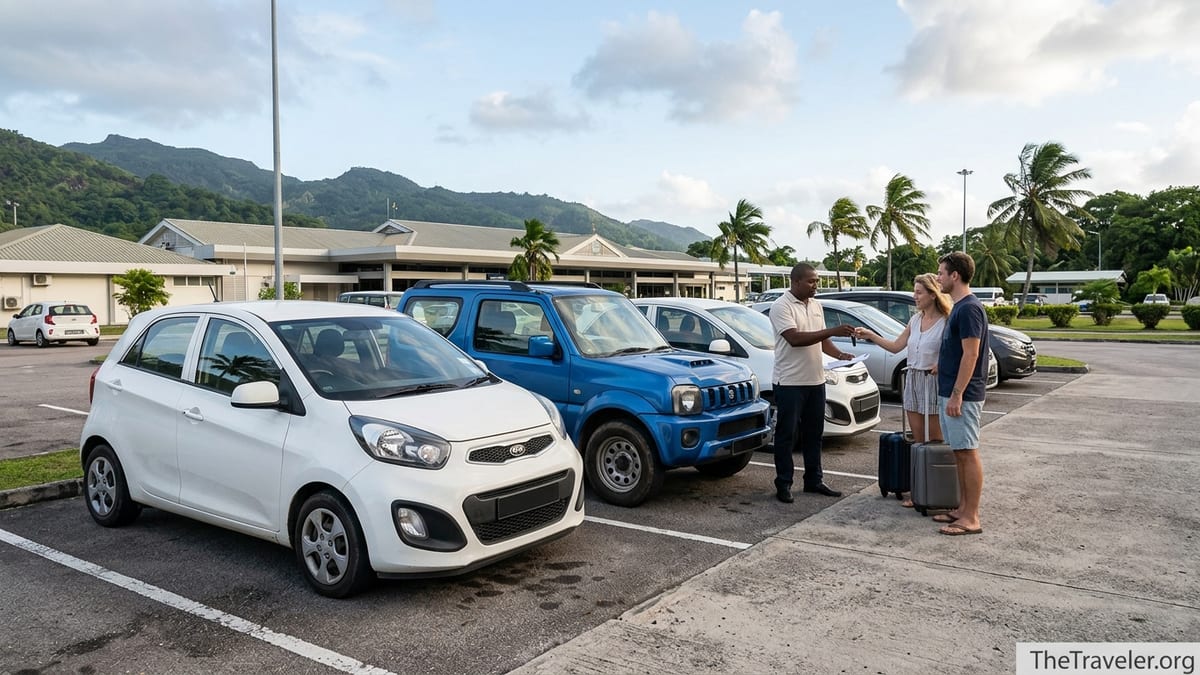
Car rental at Seychelles International Airport: where and what to expect
Seychelles International Airport on Mahé is the main gateway to the country and the easiest place to pick up a rental car. The main car hire offices are clustered just outside the customs exit of the arrivals hall. International brands such as Avis, Hertz, Sixt and Thrifty are typically represented with desks near the exit, alongside desks for brokers and local partners. You will also find smaller Seychellois operators that deliver cars to the terminal on request rather than keeping a large fleet on site.
In practice, the process is straightforward. After you collect your luggage and pass customs, you walk into the arrivals area, look for the row of car rental signs and present your voucher or confirmation. For example, a traveler arriving on an afternoon flight might walk straight to the Sixt or Hertz counter, sign the contract, and then be escorted to a nearby parking lot where the vehicle is waiting. With local outfits, such as Papa Car Rental or RosCar, an employee usually waits in arrivals with a sign, completes paperwork at a small desk or on the hood of the car, then hands over the keys in the short-stay car park.
Opening hours are tied to flight schedules, so the larger brands generally staff their counters during most international arrivals. Smaller companies often agree to meet specific flights even late in the evening, but this must be arranged when booking. If your flight is significantly delayed into the night, it is worth calling or messaging your provider from your layover airport or via the airport’s free Wi-Fi on arrival to confirm they are still on their way.
Car classes at the airport skew towards compact hatchbacks and small SUVs that suit Mahé’s narrow roads. Popular models include Kia Picanto and Hyundai i10 in the budget category, and Suzuki Jimny or similar crossovers for travelers planning to tackle steeper hills or carrying surfboards. Automatic gearboxes are increasingly common and highly recommended if you are not used to driving on the left.
Booking in advance vs walk-up rentals
Mahé’s car rental market is busy year-round, and the island’s limited fleet means that advance booking is strongly recommended, especially between June and September and again from December to March when European holiday traffic peaks. Pre-booking through a major brand or a reputable local company typically locks in a clearer rate and guarantees an automatic transmission if you need one.
As a ballpark guide, a compact automatic booked a few months ahead with a local firm can run to a moderate daily rate with unlimited mileage, while an international brand at the airport might cost a bit more for the same category. Prices vary with season, insurance cover and extras, but the pattern is consistent: booking early usually saves money and avoids last-minute shortages. During busy weeks, travelers who walk up to the desks without a reservation often find only manual cars left or must accept a higher category at a premium price.
Online reviews highlight both strategies in action. One couple flying in from Europe arranged a Kia Picanto with a Mahé-based company before their trip and had the car waiting outside the terminal, contract pre-filled and no queue. Another traveler arriving in high season without a booking reported walking from desk to desk before finally securing a small SUV at a noticeably higher rate than seen online, and on slightly stricter insurance terms with a larger deposit.
Same-day or walk-up rentals can still work in shoulder seasons such as May or October, especially if your dates are flexible and you are comfortable with a manual. However, if you have a tight itinerary, are traveling with children, or need a specific feature such as child seats or extra insurance cover, it is prudent to reserve in advance and keep your confirmation handy in print or on your phone.
Driver requirements, documents and pick-up basics
Renting a car at Seychelles International Airport is relatively simple from a documentation standpoint. Most companies require drivers to be at least 21 years old, with some setting the minimum at 23 for larger vehicles. You typically must have held a valid driving licence for at least one year. For visitors from Europe, North America and many other regions, a standard national licence in Roman script is accepted; an international driving permit is generally not required but can be useful if your licence is not in English or French.
At pick-up, staff will ask to see your passport, driving licence and a credit card in the main driver’s name if a security deposit is required. Some local firms accept debit cards or cash deposits, and a few advertise “no deposit, no credit card” options, though these offers may come with higher daily rates or compulsory damage waivers included in the price. It is wise to confirm in writing before arrival exactly what payment methods are accepted and whether the card needs to be embossed and credit rather than debit.
The handover routine is similar across providers. A representative will walk around the car with you, noting existing scratches or dents on a diagram or tablet. Take your own photos or a short video of all sides, the wheels and the interior, with a timestamp. This is a common travel practice on Mahé and provides peace of mind if minor marks are queried when you return the car. You will also be told about the fuel policy, typically “same-to-same,” meaning you return the car with roughly the same level as at pick-up.
Before driving out of the airport, adjust your mirrors, familiarise yourself with the lights and wipers, and enter your accommodation address into offline maps. The first few minutes will introduce you to driving on the left and navigating the roundabouts that link the airport to Victoria and the southern coast, so it helps not to be fumbling with controls as you join the traffic.
Understanding insurance, excesses and security deposits
Insurance and deposits are the areas that surprise many first-time visitors to Seychelles. Basic coverage usually includes third-party liability and limited collision damage waiver, but this almost always comes with an “excess” or deductible, often around the equivalent of several hundred to a little over a thousand euros depending on the car class and company. In practice, this means that if the car is damaged, you are financially responsible up to that excess amount before the insurer pays the rest.
Different companies handle the excess in different ways. Some airport-based brands and local outfits pre-authorise a sum on your credit card equal to the excess, which is then released after the car is returned in good condition. For example, you might see a 500 or 1000 euro hold pending on your card statement for the first week of your trip. Other firms do not block a deposit but still require an excess, which they would charge if damage occurs. A few operators specialise in low-deposit or no-deposit rentals and instead charge a higher daily rate that includes enhanced insurance or their own risk management policy.
Many Mahé agencies sell optional excess reduction packages. These might reduce your liability from around 1000 euros to 500, 200 or even zero for an added daily fee. A traveler renting a compact for seven days might choose to pay a modest supplement per day for an “extra cover” plan that brings the excess down to a more comfortable level, particularly if they expect to drive mountain roads daily. However, it is important to read the fine print: damage to tyres, windscreens, underbody, keys or the interior is often excluded from both basic insurance and the cheaper reduction plans.
Credit card travel insurance can sometimes cover rental car excesses, but you need to check your policy details and ensure it applies in Seychelles. If you are relying on this, you may still have to accept the rental company’s excess and deposit, then claim reimbursement later if something happens. To avoid disputes, ask the agent at pick-up to explain which types of damage are excluded, whether roadside assistance is included 24/7, and what to do in case of minor and major accidents. On Mahé, renters are usually instructed to contact the hire company before arranging any towing or opening the car’s bonnet, and to report any incident immediately.
Driving on Mahé: roads, rules and real-world conditions
Driving on Mahé is on the left-hand side of the road, with right-hand-drive vehicles. The main coastal road that loops around much of the island is generally in decent condition, though often narrow, with occasional potholes, speed bumps and drainage channels. Speed limits are modest, and local drivers tend to move briskly in familiar areas but slow considerably on blind bends and in villages.
Some of the most memorable drives involve mountain roads that cross the interior. Sans Souci Road, linking Victoria to Port Glaud via the Morne Seychellois National Park, is famous for its viewpoints but also for its steep gradients and tight hairpins. La Misère Road, connecting the east coast near the airport to the western beaches around Grand Anse and Anse Boileau, is another route where you will encounter narrow lanes, drops at the side of the tarmac and occasional buses that seem to fill the entire roadway. Visitors who are uncomfortable with heights or unfamiliar with mountain driving may find these roads challenging, especially after dark or in heavy rain.
Locals advise taking it slowly, using your horn briefly before very tight blind corners to alert oncoming traffic, and giving way where the road narrows. Automatic cars make these climbs far easier, allowing you to focus on steering and positioning rather than constant gear changes. For instance, a couple staying at a hillside guesthouse above Beau Vallon might find the return drive after dinner less stressful in a small automatic hatchback than in a manual, particularly on steep ramps to private parking bays.
Fuel stations are concentrated around Victoria, the airport area and key villages like Anse Royale. There are not many late-night options, so it is smart to top up when your tank is half full rather than waiting for the warning light. Driving at night is possible but requires extra caution due to limited street lighting in rural stretches, pedestrians and dogs near the roadway, and the potential for sudden tropical showers.
Beach parking, security and day-trip logistics
One of the biggest advantages of having a rental car on Mahé is the ease of beach-hopping. Many of the island’s best-known beaches, such as Beau Vallon, Anse Royale, Anse Intendance and Anse Takamaka, lie just off the coastal road. Parking is usually informal but fairly straightforward: you pull into small unpaved bays, roadside lay-bys or hotel-adjacent lots and then walk a short distance to the sand.
For example, at Anse Royale on the southeast coast, visitors describe a small but convenient parking area just off the main road, meters from the water, which can fill up by late morning on weekends. At Beau Vallon, parking is spread along the beachfront road, with cars lining both sides and spilling into side streets behind snack bars and guesthouses. In the quieter south, around Anse Intendance or Anse Takamaka, you may park on compacted sand under casuarina trees before following a path through vegetation to the beach.
There are no large multistory car parks or elaborate security systems. Instead, the standard advice from both locals and hire companies is to avoid leaving valuables in the car, keep anything you must leave out of sight in the boot, and always lock the doors. While Mahé is generally relaxed, opportunistic theft from vehicles can occur. Some guesthouses and small hotels provide gated parking or at least off-street spaces, which are worth using, particularly overnight.
If you plan a full-day road trip, such as a loop from the airport area around the south coast to Baie Lazare, Anse Takamaka, Anse Intendance and back via Anse Royale, factor in time to find parking at popular stops, especially on Sundays when local families head to the beach. Arriving early in the morning not only makes parking easier but also gives you calmer seas and softer light for photos before midday sun becomes intense.
Is renting a car on Mahé worth it?
Whether a rental car is worth the cost on Mahé depends largely on your itinerary, budget and driving confidence. For travelers staying in a large resort with its own beachfront and a handful of nearby restaurants, airport transfers plus occasional taxis or organized excursions may suffice. However, for anyone keen to explore multiple beaches, visit hilltop viewpoints and sample local takeaways and fruit stalls scattered around the island, a car can transform the experience.
Consider a pair of scenarios. In the first, a couple staying five nights near Beau Vallon wants to visit Anse Intendance in the south, have dinner in Victoria, hike in Morne Seychellois National Park and take a day to explore the east coast around Anse Royale. Using taxis for each leg can quickly add up, and the schedules may limit spontaneity. With a rental car, the same couple can leave when the weather looks best, detour to viewpoints like Mission Lodge on Sans Souci Road, and stop at roadside fruit stands without watching the meter.
On the other hand, solo travelers anxious about left-side driving and mountain roads sometimes find that relying on drivers reduces stress and lets them focus on the scenery. Public buses cover much of Mahé and are extremely inexpensive, though they are slower, do not allow luggage on board at busy times, and can be challenging with surfboards or large bags. A hybrid strategy also works: some visitors rent a car only for two or three days in the middle of a longer stay, using it for the key road trips and then returning to a slower rhythm on either side.
As a rough guideline, if you plan to visit more than two or three distinct regions of Mahé during your stay, value flexible timing and are reasonably comfortable driving in unfamiliar conditions, the convenience of a rental car usually outweighs the costs and learning curve. If you prefer to stay mostly in one area, dislike driving or are on a very tight budget, you may be happier piecing together buses, taxis and occasional tours.
Practical tips to avoid common rental pitfalls
A few practical habits can significantly reduce the chances of disputes or added costs. First, communicate with your rental company before arrival. Confirm your flight number, arrival time, car category, transmission type, fuel policy, insurance coverage and whether any balance is due in local rupees, euros or another currency. Ask explicitly about the excess amount and whether a card hold will be placed.
Second, document the vehicle thoroughly at pick-up and drop-off. Take wide shots of each side plus close-ups of existing marks, and repeat this when you return the car in the same lighting if possible. If you are returning outside normal office hours, agree in advance how keys will be handed back and how the final inspection will be handled. Some companies offer hotel collection and return services, meeting you at your accommodation to pick up the car and complete formalities on the spot.
Third, drive defensively, especially on wet mountain roads and around buses. Give yourself more time than navigation apps suggest, avoid tight overtaking manoeuvres, and do not be pressured by impatient local drivers behind you. Pull into a lay-by where safe and let them pass rather than rushing. This is particularly important on popular routes like the stretch between Victoria and Beau Vallon at sunset, when locals and tourists share the road heading for the beach.
Finally, plan for your last day. If you have an evening departure, coordinate a drop-off time that allows for traffic and any last-minute fuel top-up. It is common to meet a rental representative at the departures forecourt or in a nearby car park a couple of hours before your flight, hand over the keys, sign the final paperwork, and walk into the terminal unhurried.
The Takeaway
Renting a car at Seychelles International Airport is one of the most practical ways to discover Mahé beyond your hotel walls. Airport desks and meet-and-greet services offer quick access to compact cars and small SUVs well suited to the island’s winding roads. While insurance excesses and deposits can seem high, understanding how they work and choosing appropriate cover removes much of the financial uncertainty.
On the road, Mahé rewards confident but cautious drivers with quiet coves, ridge-top viewpoints and the freedom to follow the weather or a local tip instead of a fixed timetable. With realistic expectations about mountain driving, sensible parking habits at beaches and clear communication with your rental provider, a hire car can be an asset rather than a stress point.
If your plans involve exploring multiple coasts, chasing sunsets and stopping at fruit stalls and viewpoints whenever the mood strikes, then renting is likely worth it. If you are happier staying put and letting others do the driving, you may still enjoy Mahé by combining transfers, taxis and buses. Either way, knowing how car rental works at Seychelles International Airport helps you make the choice that best fits your style of island escape.
FAQ
Q1. Do I need an international driving permit to rent a car at Seychelles International Airport?
In most cases you do not. A valid national driving licence in English or another widely understood language is generally accepted for visitors staying up to several months. An international driving permit can be useful if your licence is not in Roman script, but it is usually not mandatory.
Q2. How much is a typical security deposit for a rental car on Mahé?
Deposits vary by company and car class. Some local firms block around a few hundred euros on your credit card, in line with the insurance excess, while others may require up to roughly a thousand euros or accept cash instead. A handful of operators advertise no-deposit rentals but usually charge higher daily rates or include extra insurance.
Q3. Is it safe to drive on Mahé’s mountain roads like Sans Souci and La Misère?
These roads are safe if you drive cautiously, stay within speed limits and are comfortable with narrow, winding lanes. Visitors often describe Sans Souci and La Misère as steep with tight bends, so it is best to tackle them in daylight, avoid heavy rain where possible and consider renting an automatic to reduce strain.
Q4. Can I park easily at popular beaches such as Beau Vallon and Anse Royale?
Parking is usually possible but can be tight at peak times. At Beau Vallon, spaces line the beachfront road and side streets, while Anse Royale has a small roadside parking area that fills by late morning on weekends. Arriving earlier in the day and avoiding Sunday midday crowds makes finding a spot much easier.
Q5. What kind of insurance should I choose for a Mahé road trip?
Basic cover typically includes third-party liability and collision damage with a high excess. Many travelers opt for an excess reduction package that lowers their liability to a more manageable amount, especially if they plan to drive mountain roads daily. Always check whether tyres, glass, underbody and keys are covered or excluded.
Q6. Are automatic cars readily available at Seychelles International Airport?
Yes, automatic cars are widely available, especially in compact and small SUV categories, but they are popular and can sell out in high season. If you strongly prefer an automatic, it is important to book in advance and have your reservation explicitly confirm the transmission type.
Q7. Is renting a car cheaper than using taxis on Mahé?
For travelers planning multiple day trips and cross-island journeys, a rental car is often more cost-effective than relying on taxis for every leg. While daily rental rates may seem significant, they can compare favourably to several long taxi rides, particularly for couples or small groups sharing one vehicle.
Q8. Do I need a 4x4 to explore Mahé?
A 4x4 is generally not necessary. Most main and secondary roads are paved, and compact cars handle them fine if driven carefully. A small SUV or higher-clearance vehicle can be more comfortable on steep driveways or rougher side lanes, but off-road driving is not common or encouraged.
Q9. What should I do if I have a minor accident with my rental car?
Stay calm, ensure everyone is safe and do not move the vehicles unless they are causing immediate danger. Contact your rental company right away and follow their instructions. They may advise calling the police for a report, especially if another vehicle is involved, and will explain how to document the incident for insurance.
Q10. Is it easy to refuel near Seychelles International Airport before returning the car?
Yes. There are fuel stations on the east coast road that links the south and Victoria with the airport area. Many renters top up at a station within a short drive of the terminal before meeting the agent for handover. It is wise not to leave refuelling to the last minute in case of queues or unexpected closures.