


More news on this day
Passengers on a United Express-branded SkyWest flight from Chicago to South Bend faced an unexpected detour when their late-night Mitsubishi CRJ-200LR service, operating as Flight SKW5499, abandoned its short hop across Lake Michigan and returned to Chicago O’Hare instead of continuing to South Bend International Airport.
Get the latest news straight to your inbox!
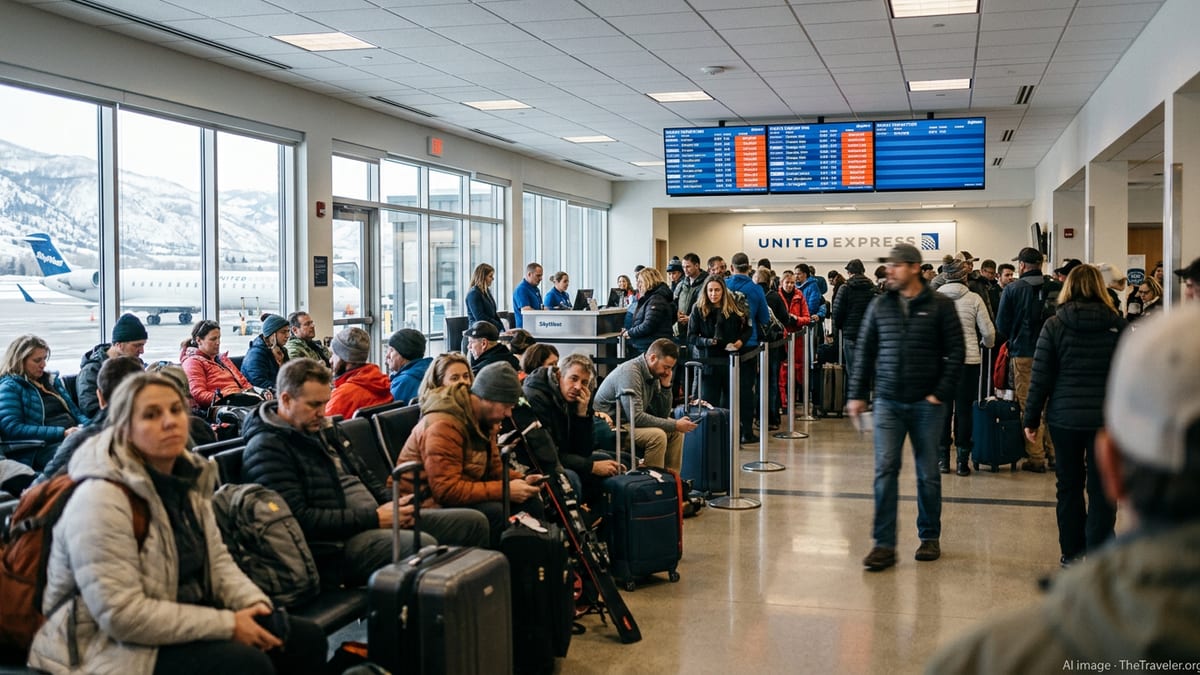
Late-night regional hop turns into an unplanned turnaround
According to publicly available flight-tracking records, SkyWest Flight SKW5499, marketed by United Airlines as UA5499, was scheduled to operate a late-night run from Chicago O’Hare International Airport to South Bend International Airport. The route is a brief regional sector typically completed in under 30 minutes in the air, often served by smaller regional jets such as the Mitsubishi CRJ-200LR.
Data posted for South Bend’s arrivals board showed UA5499 listed as a late evening arrival from Chicago, reflecting the routine nature of this commuter-style connection between northern Indiana and United’s Chicago hub. Instead of following the familiar pattern of a short climb, direct routing, and quick descent into South Bend, tracking information indicates the jet departed O’Hare, entered the corridor toward northern Indiana, then reversed course and headed back to Chicago.
Flight-history snapshots for the CRJ-200LR registered to SkyWest show multiple recent uses on the Chicago to South Bend route, reinforcing that this is a standard pairing in the airline’s United Express network. On this occasion, however, the radar traces point to a brief cruise segment followed by a turn back toward O’Hare, consistent with a diversion decision made in flight.
There is no indication in publicly accessible records that the aircraft made any unscheduled intermediate stop between the two cities. Instead, the path suggests a direct return to O’Hare, where ground operations and maintenance access are significantly more robust than at a smaller regional field such as South Bend.
Possible factors behind the decision to abandon the approach
As of the latest information available, no single official cause has been published for SKW5499’s diversion and return to Chicago. However, recent operational patterns at major Midwestern hubs provide some context. In early June 2026, multiple hubs including Chicago, Denver, and Dallas experienced widespread delays and cancellations linked to convective weather systems, congested airspace, and crew scheduling constraints. These disruptions affected many regional carriers, including SkyWest flying under various mainline brands.
O’Hare’s position as a large, tightly scheduled hub means that even modest thunderstorms or shifting wind conditions can quickly ripple through the system. When weather or runway configurations limit arrival and departure rates, controllers may be forced to meter or reroute traffic, occasionally prompting flights on short segments to return to origin if holding is no longer practical.
For South Bend specifically, publicly available irregular-operations planning documents highlight that regional jets such as the CRJ-100 and CRJ-200 are part of its typical mix, and that low ceilings, visibility, or runway contamination can require diversions or missed approaches. On very short flights, pilots have limited fuel margins for extended holding patterns; if conditions deteriorate rapidly near the destination or air traffic control extends anticipated delays, a return to the better-equipped hub can be the most predictable option for both the crew and the schedule.
Recent coverage of other SkyWest-operated flights out of Chicago has described diversions linked to what airlines describe as cautionary responses to “mechanical indications,” often resulting in aircraft landing at alternate airports where maintenance is available. In the case of SKW5499, the direct return to O’Hare rather than a landing at a closer regional field would also align with the logic of routing the aircraft back to its primary base for inspection if onboard systems prompted additional checks.
What flight-tracking data reveals about SKW5499’s journey
Archived tracking entries for SkyWest’s Mitsubishi CRJ-200LR fleet show that the aircraft type has been cycling regularly through O’Hare on short-haul segments, including to and from South Bend. One recent record for the specific airframe associated with UA5499 shows the route completed normally on earlier dates, reinforcing that the Chicago to South Bend hop has been operating as a stable part of the network.
On the night of the diversion, the plotted path of SKW5499 shows the jet departing O’Hare, climbing to cruise on the eastbound track toward Indiana, then discontinuing its progress as it neared the general vicinity of South Bend. Rather than continuing all the way to the airport and executing multiple holding patterns, the trace shows a decisive turn back west, followed by a return leg toward Chicago.
The absence of an extended racetrack holding pattern near South Bend suggests that the decision to divert and return may have been driven by either time-sensitive operational limits, such as crew duty constraints or fuel considerations, or by a non-escalating but attention-worthy technical indication where company policies favor bringing the aircraft back to the maintenance base.
Observers on flight-tracking platforms noted a cluster of data messages associated with SKW5499 during the period around the diversion. While these messages are not decoded in public feeds, the elevated volume relative to a routine turn can be a sign of additional coordination between the flight crew and airline dispatchers as they evaluate alternate plans and updated weather or traffic information.
Impact on passengers and the broader Chicago–South Bend corridor
For the passengers on board, the diversion and return to Chicago meant an unplanned late-night delay and the loss of a direct flight to South Bend. Based on typical handling of such irregular operations in the Chicago region, travelers were likely rebooked onto later United Express services to South Bend, placed on flights to nearby airports, or offered ground transportation to northern Indiana once the aircraft was back at the gate.
South Bend’s arrivals board for the evening showed multiple United and Delta-branded regional flights scheduled in a tight window, underscoring how important these links are for connecting the region to larger hubs. When one of these short sectors cancels or diverts, the disruption can cascade for travelers connecting to or from long-haul services, particularly late in the day when recovery options are more limited.
For SkyWest and United, the event is part of a broader pattern in which regional operations must balance tight turn times, hub congestion, and increasingly complex weather patterns in the Midwest. Recent reporting on operational challenges in early June has highlighted how a combination of severe thunderstorms, airspace flow programs, and staffing constraints can push short-haul flights to the margin of practicality when conditions change quickly.
Although diversions are disruptive for those on board, aviation safety specialists routinely point out that turning back or landing early is an expected part of conservative decision-making. In this case, the choice to return SKW5499 to Chicago, rather than pushing on to South Bend in marginal circumstances, fits within that risk-averse framework that prioritizes predictable outcomes over schedule fidelity.
Regional jets, aging fleets and heightened operational scrutiny
The Mitsubishi CRJ-200LR, originally part of the Canadair Regional Jet family, has long been a workhorse of short-haul flying in North America. Many of these 50-seat aircraft are now among the older jets in regional fleets, and industry observers note that operators are gradually shifting to newer models such as the CRJ-550 or Embraer E-Jet series where airport infrastructure and economics permit.
Despite their age, CRJ-200s remain common on thin routes where passenger volumes or runway lengths do not justify larger aircraft. This profile describes the Chicago to South Bend market, which relies on frequency and connectivity more than on seat capacity. In that environment, any anomaly, from a minor sensor indication to evolving weather, tends to attract heightened scrutiny from dispatchers and flight crews, especially during night operations.
Public documents from airports like South Bend describe detailed procedures for handling irregular operations involving small regional jets, from gate allocation to passenger care and ground transport options. These frameworks are designed precisely for situations like SKW5499’s aborted trip, where a single short flight can have outsized effects on travelers when it fails to operate as planned.
While additional details about the precise trigger for SKW5499’s return to Chicago may emerge through ongoing data updates and coverage, the event fits a familiar pattern in today’s regional aviation landscape. Smaller jets operating into secondary airports remain highly sensitive to the combined pressures of weather, maintenance vigilance, and tight scheduling, and even routine-seeming hops like Chicago to South Bend can quickly turn into complex logistical puzzles when circumstances shift midflight.