


ETIAS is finally moving from future concept to real-world requirement, and many British travellers are asking how it will interact with EU family connections. If you are a UK passport holder who regularly visits Europe with an EU, EEA or Swiss spouse, partner, parent or child, or you already hold EU residence rights yourself, the rules can look confusing. This guide explains how ETIAS is expected to apply, when family or residence status can make you exempt, and what to watch for as the system continues to roll out.
Get the latest updates straight to your inbox!
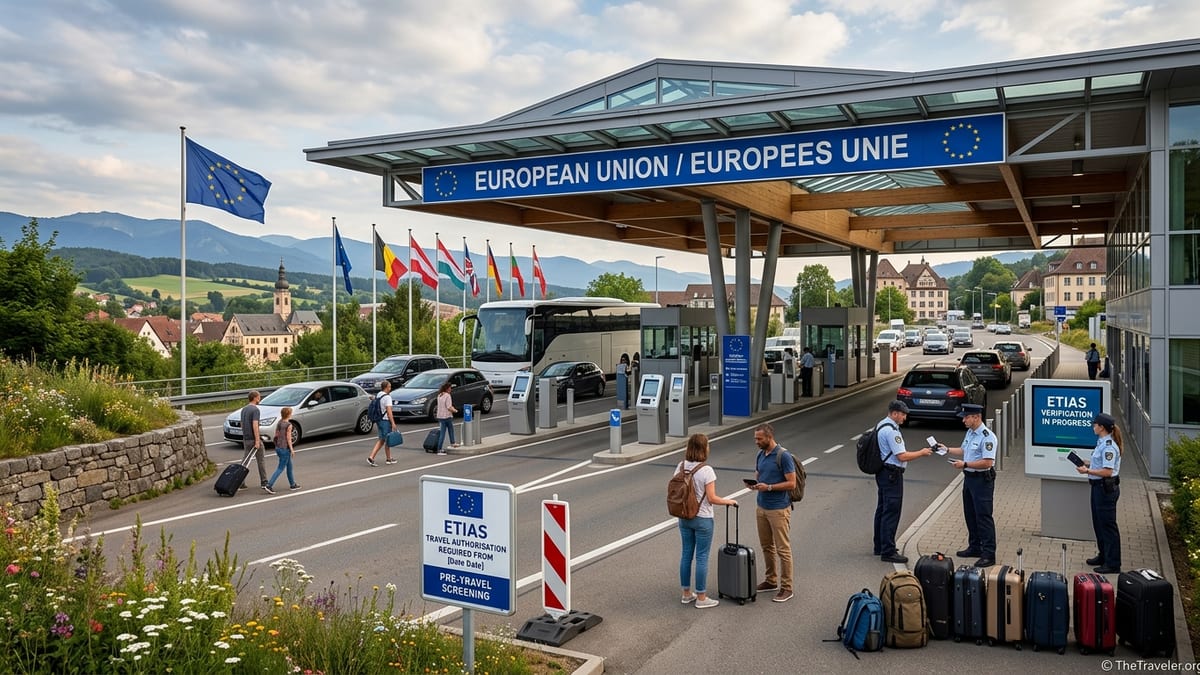
What ETIAS Is and Its Current Status
ETIAS, the European Travel Information and Authorisation System, is the European Union’s new pre-travel screening for visa-exempt third-country nationals. Once fully in force, it will apply to short stays of up to 90 days in any 180-day period in 30 participating European countries. These are the 26 Schengen and closely associated EU states, plus non-EU Schengen members Iceland, Liechtenstein, Norway and Switzerland, and Cyprus. The United Kingdom is on the list of visa-exempt third countries whose nationals will normally need ETIAS for short visits.
ETIAS is not yet in full operation. The official ETIAS communication states that the Entry/Exit System became operational first, and that ETIAS will follow afterwards, with the specific launch date to be announced by the European Commission and published on the official ETIAS website. As of late November 2026, that precise start date has not been confirmed, and applications are not yet open. Travellers should treat any website currently offering to “submit” an ETIAS application as unofficial and avoid paying fees until the EU itself confirms that ETIAS is live.
When it does start, ETIAS will function in a similar way to the UK’s Electronic Travel Authorisation or systems used by the United States and Canada. Most applicants will complete an online form through an official EU website or app, pay a fee that recent official and technical guidance indicates will be around 20 euros, and receive an electronic travel authorisation linked to their passport. Border guards will verify ETIAS electronically at external Schengen borders, and carriers are expected to check that passengers who need ETIAS hold a valid approval before boarding flights, ferries or coaches into participating states.
The core regulation provides that a valid travel authorisation will generally be required before boarding and again when crossing the external border, but it does not change the underlying conditions of entry, the 90/180-day rule or the need for a visa when one is required. ETIAS is a pre-screening layer for nationals who are already visa-exempt.
The Basic Rule for British Visitors
For most British citizens planning short trips as visitors to ETIAS countries, the default assumption is straightforward. Once ETIAS is operational, UK passport holders heading to any of the 30 participating states for up to 90 days in any 180-day period, for tourism, family visits or business trips that do not involve working in the local labour market, will normally need a valid ETIAS in addition to a passport. This applies whether you fly directly from the UK or arrive overland from another country such as Ireland.
Under the ETIAS regulation, the system applies to third-country nationals who are exempt from the requirement to hold a visa for short stays. The United Kingdom appears on the EU list of visa-exempt third countries, which is why British nationals fall within the scope of ETIAS when travelling as visitors. The authorisation will be checked electronically by border guards and by carriers, so a traveller who needs ETIAS but has not obtained it is likely to be denied boarding or refused entry.
Current guidance from EU agencies and national governments indicates that, once live, an ETIAS travel authorisation will normally be valid for multiple trips over several years, provided the passport used to apply remains valid. The permission is linked to that passport, so a new passport will usually require a new ETIAS, even if the previous one is still within its theoretical validity. Precise validity periods and technical rules are set out in the legal text and may be adjusted, so travellers should always verify them on the official ETIAS pages at the time they apply and note the date of consultation.
Importantly, ETIAS does not give any right to work, study long term or reside. It is a screening requirement layered on top of existing visa exemptions, not a residence document or work permit. If your real plan goes beyond a short visit, you will still need to follow the national visa and residence procedures of the country you intend to live or work in, regardless of ETIAS.
Withdrawal Agreement Beneficiaries and Their Family Members
A key group of British travellers sit in a different legal category from ordinary visitors. These are beneficiaries of the EU–UK Withdrawal Agreement who hold residence documents issued by an EU or EEA state where they lived before the end of the Brexit transition period, and their eligible family members. Official Commission guidance on external borders explains that holders of a valid residence document issued under the Withdrawal Agreement format are exempt from both the Entry/Exit System and from the requirement to obtain an electronic travel authorisation such as ETIAS when they travel.
The exemption is tied to the residence document itself. Guidance aimed at border guards stresses that it is not enough simply to be a Withdrawal Agreement beneficiary in principle; the traveller must present the physical residence card or permit issued in the uniform EU format that proves this status. If you are a British national living in, for example, Spain or France under the Withdrawal Agreement and you hold the specific residence card issued for that purpose, you are treated as resident, not as a visiting third-country national, when returning to or travelling within that state.
For cross-border trips within Europe, Commission instructions note that these residence documents also play a central role in showing that the traveller is not subject to EES registration and that the usual 90/180-day counting for visitors does not apply in the same way to their movements related to residence. However, the detailed interaction between Withdrawal Agreement residence rights, ETIAS and short visits to other Schengen countries continues to be clarified in technical guidance. Travellers in this group should always check the latest Commission notes and national border police information, and record the date they consulted the guidance.
Family members covered by the Withdrawal Agreement, such as non-EU spouses or children who have been issued their own Withdrawal Agreement residence cards, are treated in the same way as the British beneficiary regarding exemptions from ETIAS and EES. By contrast, relatives who do not yet hold these cards, or who join later under different national schemes, may fall back into the normal ETIAS-visitor category. Because the scope of the exemption can vary in practice, anyone relying on it should confirm the current rules with official EU sources or local immigration authorities before travel.
EU Residence Cards for Family Members under Free Movement Law
Another important group consists of British citizens who are family members of EU, EEA or Swiss nationals exercising free movement rights and who hold residence cards issued on that basis. Before and after Brexit, many British citizens living with EU partners in countries such as France, Germany, Italy or the Netherlands obtained residence permits as non-EU family members under Directive 2004/38/EC, in the standard EU residence card format described in Regulation 1030/2002.
EU rules draw a distinction between ordinary visa-exempt visitors and non-EU family members who hold these specific residence cards. The ETIAS legal framework and related border guidance state that third-country nationals who already hold certain residence permits or residence cards issued by an EU or Schengen state are exempt from needing ETIAS when travelling, because they are not treated as short-stay visitors in the same sense. Where the residence card confirms rights as the family member of an EU citizen, the law supports an exemption from ETIAS for that card holder.
However, there are two critical limits that British travellers should understand. First, the exemption attaches to the person who holds the qualifying residence document, not to everyone who happens to travel with an EU citizen. A British tourist accompanying their French spouse on a city break, but living in the UK and holding no EU residence card, is still an ordinary visitor who will need ETIAS once it applies. Second, some member states follow particular procedures for residence cards or have country-specific nuances, and Ireland is outside the ETIAS framework entirely. Official ETIAS FAQs and national guidance should therefore be checked carefully for references to residence permits and to any exceptions.
Because residence titles and the way they are labelled vary from country to country, travellers should compare the exact wording and format of their card with the categories listed as ETIAS-exempt in current Commission documentation. If in doubt, seek clarification from the issuing authority or border police well in advance of travel, and keep a copy of any written confirmation during your trip.
Dual Nationals with British and EU, EEA or Swiss Citizenship
Many readers will have both British nationality and the nationality of an EU, EEA or Swiss country, for example dual UK and Irish, French, German, Italian or Spanish citizens. Under EU law these people are EU citizens, and ETIAS is designed only for third-country nationals who are visa-exempt visitors. The official ETIAS regulation and FAQs therefore explain that EU citizens are not eligible to apply for ETIAS and do not need it when they travel using their EU passport within the area.
In practice, this means that a dual British and EU national should generally travel into ETIAS-participating countries on their EU passport and present that passport both to the airline or ferry operator and at border control. Airlines, rail operators and border officers usually expect to see the same document at check-in and at the external border, and mixing passports on the same journey can create confusion in automated systems. Where a traveller uses their British passport to depart the UK, they may nonetheless need to present the EU passport to the carrier and at arrival to demonstrate that ETIAS is not required.
Dual nationals should also remember that any ETIAS-style screening rules of other countries, such as the UK’s own ETA system or planned schemes in other regions, may still apply to them when they travel as the national of a different state. The fact that you are considered an EU citizen for ETIAS purposes does not remove obligations you may have when entering non-EU countries using your British passport.
Parents of dual-national children should carry evidence of the child’s EU nationality, such as the EU passport, and ideally proof of the relationship, especially if surnames differ. This helps ensure that airline staff and border officials understand that the child is an EU citizen who is outside the scope of ETIAS and subject instead to EU rules on free movement of citizens.
Ireland’s Special Position and Cross-Border Trips
Ireland occupies a unique place in this picture. It is a member of the European Union but is not part of the Schengen Area and will not participate in ETIAS. Instead, it remains inside the Common Travel Area with the United Kingdom and the Crown Dependencies. For British citizens, that means travel directly between the UK and Ireland continues to operate under separate arrangements, and ETIAS plays no role in visits that stay entirely within the UK–Ireland Common Travel Area.
If you are a British traveller visiting only Ireland and returning home without entering Schengen or Cyprus, you will not need ETIAS for that journey. Ireland sets its own entry rules, and British and Irish citizens benefit from free movement in the Common Travel Area. Other nationalities should consult Irish government guidance for their own visa and entry requirements, but again, ETIAS is not among them.
However, the picture changes if your itinerary combines Ireland with Schengen or Cyprus on the same trip. Once ETIAS is in force, a British citizen flying from Dublin into France, Spain, Germany, the Netherlands or any other participating state as a visitor would normally need a valid ETIAS for that portion of the journey, unless exempt due to residence rights or dual EU nationality. Carriers operating routes from Ireland into Schengen will be expected to check ETIAS in the same way as carriers departing directly from the UK.
Travellers who move between Ireland, Northern Ireland and Great Britain as part of a wider European tour should therefore separate in their planning the Common Travel Area segment, which is not affected by ETIAS, from the Schengen or Cyprus segment, where ETIAS and the Entry/Exit System apply alongside local immigration rules.
Real-World Scenarios for British Travellers with EU Connections
Consider a UK citizen married to a Spanish citizen, living in Spain with a Withdrawal Agreement residence card, making short trips to France or Germany. If the British spouse holds the specific Withdrawal Agreement residence document issued by Spain, current Commission guidance treats them as exempt from ETIAS and from EES registration when they travel, provided they carry and present that card. Their Spanish spouse, as an EU citizen, is also outside the scope of ETIAS. However, both should still check the latest rules before travel and confirm whether any additional documentation is recommended when crossing into other Schengen states.
In a second scenario, imagine a UK citizen who is the non-EU family member of a French citizen and holds an EU residence card in France issued under free movement law, not under the Withdrawal Agreement. Here, the British family member’s residence card can place them among those third-country nationals who are exempt from ETIAS when travelling within participating states, because they are resident and have their status recorded in an EU residence permit. They should always carry their French residence card along with their passport on trips elsewhere in Schengen, and verify through current ETIAS FAQs that their specific card type is listed among the exempt documents.
A third scenario involves a UK citizen living in the UK, visiting an EU-citizen partner who lives in an EU country. If the British partner does not hold a local residence card or permit, they are treated as a standard British visitor for ETIAS purposes. Even if they are travelling to see an EU partner and will stay in the partner’s home, they will normally need ETIAS once it is live. If they later obtain a residence card as the family member of that EU citizen, they may move into the exempt category as described earlier, but until then they should assume ETIAS will be required.
Fourth, consider UK-citizen parents visiting an adult EU-citizen child in Europe. Unless the parents themselves have residence rights or residence documents in the relevant country, they are ordinary British visitors for ETIAS. The fact that their child is an EU citizen does not in itself create an ETIAS exemption. Only where the parents have been recognised and documented as family members under EU or Withdrawal Agreement rules, with residence cards issued accordingly, would they potentially be exempt. Finally, in families with minor dual-national children, the children who hold EU passports travel as EU citizens without ETIAS, while their British-only parents may still need ETIAS as visitors. In all these examples, travellers should test their real situation against current official rules and pay close attention to whether their trip counts as accompanying or joining an EU family member and whether they have the right kind of residence document.
ETIAS, the 90/180 Rule, the Entry/Exit System and National Visas
ETIAS sits alongside, but does not replace, existing rules about short stays and long-term residence. The familiar 90-days-in-any-180-days limit for non-EU visitors to Schengen continues to apply. ETIAS does not extend or reset this allowance. Instead, the Entry/Exit System records when you enter and leave, and border authorities use those records to track how many days you have spent in the area. A valid ETIAS is a prerequisite for boarding and entry for many nationalities, but it does not affect how days are counted.
For British citizens with residence rights in an EU or EEA country, it is important to distinguish time spent in the country of residence from time spent visiting other states. Residence documents issued under the Withdrawal Agreement or under free movement rules show that you are resident in a particular member state. Time you spend living there under those rights is not counted against the 90/180-day visitor limit, but side trips to other Schengen countries may be, unless other exemptions apply. The interaction between EES records, residence documents and ETIAS is still the subject of detailed technical guidance, so residents should rely on up-to-date information from the Commission and from their host state’s interior ministry.
For longer stays, work, study or family reunification, national visas and residence permits remain essential. ETIAS is not a visa and does not grant permission to take up employment or to live in a country. A British citizen who obtains a national work or study visa will usually be issued a residence permit as well, placing them in a different category from short-stay visitors and potentially exempting them from ETIAS for trips linked to that residence. However, specific arrangements differ by country, and some travellers may still need ETIAS for separate visits, so checking the national rules is crucial.
Because ETIAS, EES and post-Brexit residence regimes are relatively new and still evolving, British travellers should treat each trip as an opportunity to reconfirm requirements. Before booking, consult the official ETIAS website, the European Commission’s border guidance, and the website of the embassy or interior ministry of the country you plan to visit or reside in, and make a note of the date you checked. This approach reduces surprises at boarding or at the border when systems become fully operational.
Working Out Which Type of Traveller You Are
For practical planning, most British readers can sort themselves into one of three broad groups. The first group comprises standard British visitors with no EU residence rights or qualifying residence cards. If you live in the UK, hold only a British passport, and visit ETIAS-participating countries for short stays, you should expect to need ETIAS once it is live. This remains true even if you are visiting EU family members, staying in their home, or travelling together, unless you hold a specific residence document that creates an exemption.
The second group consists of British travellers who have EU-based residence rights evidenced by residence documents that EU and national guidance recognise as exempt from ETIAS. This includes Withdrawal Agreement beneficiaries with the correct format residence cards issued by their host state, and non-EU family members of EU, EEA or Swiss citizens who hold residence cards or permits issued under EU free movement rules. Travellers in this group can usually rely on their residence documents instead of ETIAS for travel connected with their residence, but they must carry those documents, understand any country-specific nuances and re-check the rules before each trip.
The third group is dual nationals with both British and EU, EEA or Swiss citizenship. These travellers are EU citizens for ETIAS purposes and should normally travel on their EU passport within the participating countries. They neither need nor can obtain ETIAS as EU citizens, but should be consistent about which passport they show to carriers and border officers on a given journey. Their British citizenship remains relevant mainly for travel to countries such as the UK, which may have their own electronic authorisation systems.
Across all three groups, the most important single step is to align your plans with official, current information. Before you book, identify which category you fall into, then consult the official ETIAS website, European Commission guidance and your destination country’s government sources, and note the date you checked. As ETIAS moves from planning to practice, this habit will help ensure that your family visits, city breaks and multi-country European trips continue to run smoothly.