


Few Caribbean excursions are as talked about as Grand Cayman’s Stingray City and nearby Starfish Point. Many visitors now book them together on a single tour, promising close encounters with southern stingrays, bright sea stars and glassy turquoise water in one compact outing. The combo can be unforgettable, but it is not one-size-fits-all. Understanding how each stop works in real life – from the wildlife rules to the boat routes and family practicality – will help you decide whether to choose the combo or focus on Stingray City alone.
Get the latest updates straight to your inbox!
Stingray City vs Starfish Point: How the Experiences Really Differ
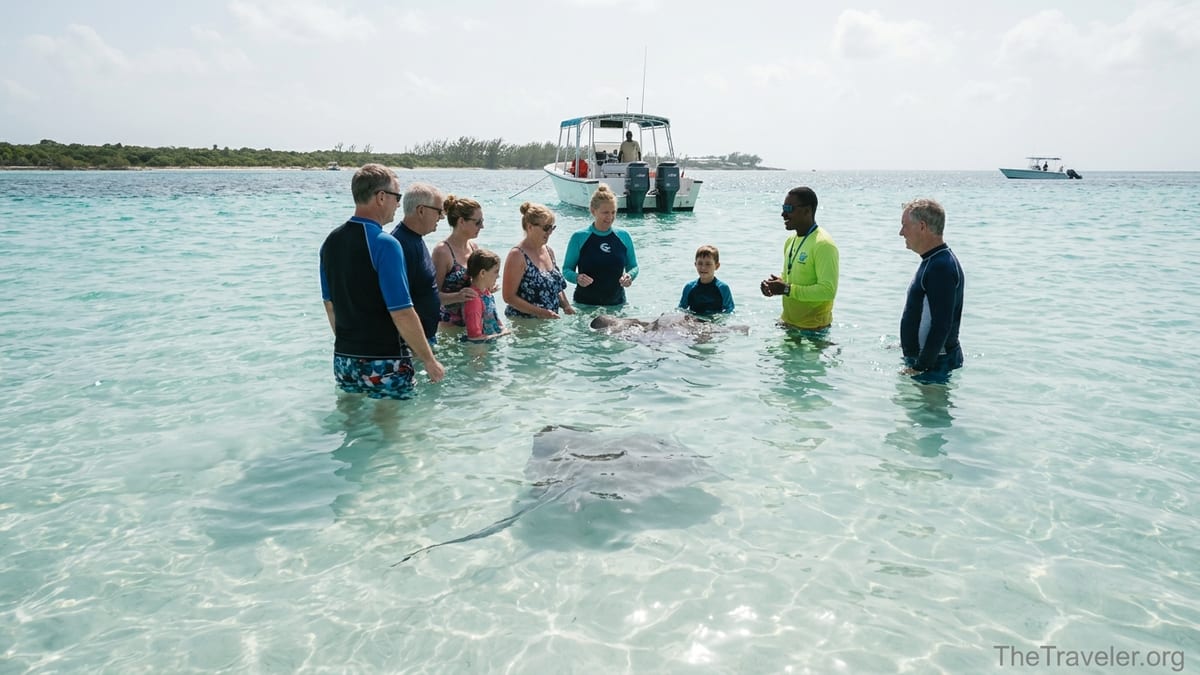
Stingray City is a shallow sandbar out in Grand Cayman’s North Sound where wild southern stingrays glide through waist-deep water. Tour boats anchor directly on the sandbar and guests climb down ladders into clear sea that is usually around 3 to 4 feet deep for adults. The headline moment is standing on soft sand while several rays brush past your legs and, if you choose, taking a turn gently feeding one under the guidance of the crew. It feels like a true wildlife encounter, with constant motion and plenty of adrenaline for first-timers.
Starfish Point is a quiet beach on the tip of the Cayman Kai peninsula. Instead of a sandbar in the middle of the sound, you step onto a narrow curve of natural shoreline where the water stays shallow and calm. West Indian sea stars often rest on the sandy bottom just offshore. Rather than being surrounded by dozens of animals, you might see only a handful of starfish scattered across the shallows. The pace is slow: people wade, take photos, let kids splash near the edge and watch for the orange and rust-colored shapes on the seabed.
In practice, Stingray City feels like an immersive animal encounter that happens to be in postcard-blue water, while Starfish Point feels more like a relaxed beach and photo stop with some marine life sprinkled in. On many combo tours you will spend 40 to 60 minutes at Stingray City and around 30 to 45 minutes at Starfish Point, so the stingrays generally remain the star of the show.
The two are also very different socially. Stingray City sandbar can be busy when several tour boats arrive at once, particularly on days when multiple cruise ships are in port. You may share the sandbar with dozens of other guests spread across several boats. Starfish Point, by contrast, tends to have a handful of small groups spread along the shore, especially outside weekend afternoons, so the atmosphere is more low-key.
Typical Combo Tour Routes, Timing and Logistics
Most combo tours start from either George Town (for cruise passengers) or marinas on the North Sound such as Safehaven, Cayman Islands Yacht Club or marinas near the Seven Mile Beach corridor. From George Town, you usually take a short shuttle ride to the marina, then a 20 to 30 minute boat ride out through the North Sound to the sandbar. Operators such as Island Vibez Watersports and Rowan Watersports commonly run half-day trips that include Stingray City, a snorkeling stop at a reef like Coral Gardens, and a final stop at Starfish Point in a loop before returning to the dock.
On a typical three-stop combo, expect around 3 to 4 hours dock to dock. For example, a morning tour might run from 9:00 a.m. to about 12:30 p.m. with 40 to 60 minutes at Stingray City, 30 to 40 minutes snorkeling over a coral reef and 30 to 45 minutes at Starfish Point. Shorter two-stop tours that skip the reef and focus only on Stingray City and Starfish Point often run closer to 2.5 to 3 hours, which can suit families with younger children or cruise passengers with tight tender schedules.
Combination routes from the North Side or Rum Point/Kai area are a bit different. Some small-boat operators there will first visit Stingray City when crowds are lighter, then cross to a reef snorkel on the outer edge of the sound, and finally hug the coastline back toward Starfish Point, dropping guests by the beach before the short ride home. Because the distances are shorter from the North Side, these trips can leave later in the morning and still dodge some of the biggest crowds.
In real-world terms, cruise passengers should pay close attention to timing. If your ship departs at, say, 4:00 p.m., a morning 3-hour combo that leaves by 9:00 a.m. and returns around noon offers a comfortable buffer for tender queues and any delays. Independent tours advertised as 4 hours that depart mid-day can cut it close. Travelers on land vacations have more flexibility and might deliberately book a mid-afternoon combo in the quieter shoulder between cruise excursions, especially in summer when daylight lasts well into the evening.
Family Friendliness: Ages, Swim Levels and Comfort Zones
Parents often ask whether the combo is suitable for small children or less confident swimmers. Stingray City, despite the dramatic concept, is usually one of the easiest spots in Grand Cayman for families. The sandbar is shallow enough that school-age children and many preschoolers can stand with adult support, and most reputable operators supply life jackets or snorkel vests. Because the boat stays anchored in only a few feet of water, kids can climb back up the ladder to rest at any time while still watching the rays swirl around the group from above.
The biggest consideration at Stingray City is comfort level with animals. The rays are wild but accustomed to humans and often brush gently against legs or float up to take food from a guide’s hands. A confident 8-year-old might be thrilled to hold one briefly with the crew’s help, while a more cautious child, or an adult who is nervous about marine life, may prefer to stay slightly further from the feeding circle and simply observe. For elderly travelers or those with mobility issues, catamaran-style boats with wide, stable ladders and crew assistance tend to be more comfortable than speedboats with narrow transom ladders.
Starfish Point is even easier physically. The sandy shoreline shelves gradually into water that is often only knee- to thigh-deep for adults, and there is no need to climb in and out of the boat more than once. Young children can paddle in the shallows near the beach under parental supervision, and nervous swimmers can simply sit at the water’s edge. For multi-generational groups, Starfish Point provides a chance for grandparents to relax under a palm with a drink while the rest of the family wades out to look for sea stars.
Families should also think about sun and shade. Stingray City is fully exposed; on a calm, clear day there is virtually no natural shade out on the sandbar, and reflections off the water can be intense. Starfish Point, by contrast, usually offers some patchy shade from trees along the beach and the chance to cool off onshore between wading sessions. Rash guards for kids, broad-brimmed hats and plenty of reef-safe sunscreen make a noticeable difference in comfort, especially on longer three-stop combos.
Wildlife Rules: How to Interact Responsibly with Rays and Starfish
Both Stingray City and Starfish Point sit inside designated Wildlife Interaction Zones, which are the only places in Cayman where it is legally permitted to feed and closely interact with certain marine life. Within those zones, however, there are strict rules intended to protect the animals. On reputable tours, crew members will walk guests through the basics before anyone enters the water. At Stingray City, this typically includes keeping the stingray underwater at all times, supporting its body flat with both hands if you choose to hold one, and never lifting a ray’s head or tail out of the sea for a photo.
Guests are generally discouraged from attempting to grab rays themselves or chase them around the sandbar. The more gently people behave, the more the animals will approach on their own to investigate. Many small-group operators emphasize a “no mauling” approach, in contrast with some high-volume boats that have historically held rays out of the water or pressed them onto guests’ shoulders for posed shots. When comparing tour companies, look for language about following Department of Environment guidelines to get a sense of how seriously they take low-impact interaction.
At Starfish Point, the rules are even more critical because sea stars are more fragile. You should never remove starfish fully from the water for photos. Lifting them into the air can cause injury by depriving them of water in their tiny tube feet and internal canals. The recommended approach is to leave starfish mostly on the sandy bottom, or if a guide permits, gently slide a hand underneath and raise them just enough that they remain fully submerged, then lower them carefully back to the same spot. Stacking starfish, passing them around in groups, or carrying them to shallower areas for pictures is strongly discouraged.
Responsible operators now brief guests that starfish numbers at the point have declined compared with earlier years, which makes careful handling particularly important. Many will also remind visitors not to use regular sunscreen directly in the water and instead opt for reef-friendly formulas, or apply on the boat and allow it to absorb before entering. Following these guidelines not only protects the animals but usually creates a calmer, less chaotic experience for everyone on the tour.
Photo Opportunities, Gear and What to Expect from Beach Time
Stingray City delivers some of the most distinctive vacation photos in the Caribbean. Common shots include waist-up images of guests standing in milky-turquoise water with a stingray gliding past in the foreground or close-ups of a ray’s smooth wings as it approaches from below. Many tour crews bring waterproof cameras or GoPros and offer to take photos of couples or families, sometimes selling a digital package after the trip. Whether you buy the professional package or not, bringing your own waterproof camera or a phone in a quality marine housing dramatically increases the chance of getting sharp, well-lit images while keeping your device safe.
Lighting at the sandbar is usually intense, with bright midday sun overhead and light reflecting off the sandy bottom, so polarized sunglasses and a cap help you see the rays clearly between photo moments. For your own camera, shooting slightly downward into the water while kneeling or crouching often produces better composition than trying to point straight down from a standing position. Many visitors find that some of their favorite photos are candid: a child’s surprised reaction as a ray brushes past, or a slightly off-balance adult laughing while holding onto a crew member’s arm.
At Starfish Point, the imagery is softer and more static. Typical photos show a single bright orange sea star resting on pale sand a foot or two below the surface, or a child kneeling in ankle-deep water pointing at a starfish a little further out. Because you should not lift sea stars into the air, compositions usually combine their natural underwater setting with human figures nearby, rather than close-ups of people “holding” them for the camera. The beach backdrop, with low trees and the open North Sound beyond, also makes classic shoreline portraits for those who want one family shot on land.
Beach time at Starfish Point varies by operator. Some small boats simply anchor just offshore and let guests wade straight from the ladder to the beach, while others drop visitors at a small dock or directly on the sand. In either case, you can treat it as a short beach break: kick off fins, walk barefoot along the shoreline and, on some days, purchase drinks or simple snacks from roving vendors or small mobile operations. Facilities are limited, so do not count on full-service restrooms or changing rooms at the point itself. Plan to arrive already in swimwear and use the boat’s onboard restroom if needed.
Is the Combo Better than Stingray City Alone?
Whether the combo is “better” than a dedicated Stingray City trip comes down to your priorities. If your main goal is maximum time with the rays, a focused Stingray City-only tour can be the stronger choice. On some small-group outings, operators will spend more than an hour at the sandbar, shifting the boat slightly if crowds build and giving guests multiple chances to feed or simply float among the rays. Without the need to transit to other stops, the schedule can be more flexible to adapt to changing conditions and guest comfort.
The combo, however, offers variety and a sense of having “seen more” of the North Sound in a single outing. For many first-time visitors or cruise passengers with only one day on Grand Cayman, combining Stingray City with either a reef snorkel and Starfish Point or a sandbar-plus-beach pairing feels like the best value. You get one high-energy wildlife encounter, one classic reef snorkeling stop, and one easy beach pause, each short enough that even children rarely have time to get bored. Travelers who like to collect a range of experiences without committing an entire day to the water usually gravitate to these three-stop itineraries.
Compare it to choosing between a single-museum visit and a city highlights tour. Devoting all your time to Stingray City lets you linger, experiment with snorkeling over the sandbar edge, and perhaps enjoy periods when your boat is one of the few on site. Opting for the combo gives you a highlight reel: a little of the rays, a taste of coral gardens, and a sample of the quiet shallows at Starfish Point. Guests who are especially keen photographers or serious snorkelers might feel rushed on the combo, while casual swimmers and families often describe it as the perfect balance.
There is also the question of crowd patterns and expectations. On busy cruise days, even a Stingray City-only tour may share the sandbar with several other vessels, so the advantage of spending longer there can be marginal during peak windows. In those conditions, adding Starfish Point to the itinerary offers a welcome change of scene and a chance to step onto a relatively uncrowded beach before heading back to port.
Practical Booking Tips and What to Look for in a Combo Tour
When comparing combo tours, pay close attention to group size and boat style. Smaller boats and catamarans that cap guests at a few dozen people usually translate into less time waiting for your turn to feed a stingray or listen to the briefing. They also tend to provide more tailored help to nervous swimmers and young families. Large double-deck vessels, including some sold through major cruise lines, can feel busier on board and in the water but may offer more shade, onboard restrooms and a bar service, which some travelers appreciate.
Another key factor is the time of day. Early morning departures often encounter calmer seas and fewer boats at both Stingray City and Starfish Point. Midday trips can be brighter for underwater visibility but also hotter and more crowded. Late afternoon tours, when available, may enjoy softer light and a more relaxed atmosphere as cruise excursions wind down, but sea breezes can pick up and there is less margin for weather changes. If you are prone to seasickness, shorter rides and earlier departures usually feel more comfortable.
Ask potential operators how strictly they follow wildlife handling rules. Specific phrases such as “we do not lift starfish out of the water” or “we follow Department of Environment guidance and never hold rays above the surface” are encouraging signs. Many guest reviews now mention whether crews seemed respectful of the animals or more focused on posed photos. For travelers who care about conservation, choosing operators with a gentler approach sends a clear signal to the local industry.
Finally, consider the broader shape of your day. If you plan to spend the rest of the afternoon at Seven Mile Beach or exploring George Town, a 3-hour morning combo leaves breathing room for lunch and wandering. Guests staying in the Rum Point or North Side areas might instead fold a combo into a bigger circuit that includes a casual meal at a beach bar and a stop at a lookout point on the coastal road before heading home. Thinking about how the tour fits into your overall schedule will help you decide whether variety or depth of experience matters more.
The Takeaway
Stingray City and Starfish Point together create one of Grand Cayman’s signature half-day adventures. The sandbar offers the heart-pounding thrill of close contact with southern stingrays in clear, shallow water, while Starfish Point balances the day with calm beach time and quieter encounters with sea stars. For many travelers, especially first-timers and cruise guests, a well-run combo tour delivers the right mix of excitement, scenery and relaxation.
If your dream is to immerse yourself in the world of the rays, with extra time to adjust, snorkel and capture that perfect underwater shot, a dedicated Stingray City outing may be the better match. If you prefer to sample several of the island’s marine highlights in a single, efficient loop, the combo will likely feel more satisfying. Either way, choosing operators that prioritize animal welfare, safety and small-group attention will do more to shape your experience than the exact number of stops on the itinerary.
FAQ
Q1. Is the Stingray City and Starfish Point combo suitable for young children?
Yes, most families find the combo very manageable. Stingray City’s sandbar is generally waist-deep for adults, and Starfish Point’s beach has gentle shallows. Life jackets are typically provided, but parents should supervise closely and choose an operator that is comfortable assisting nervous swimmers.
Q2. How long does a typical combo tour last?
Most two- or three-stop combos run about 3 to 4 hours dock to dock. This usually includes boat transfer time from the marina, 40 to 60 minutes at Stingray City, a reef snorkel on some itineraries, and 30 to 45 minutes at Starfish Point before returning.
Q3. Do I need to be a strong swimmer to enjoy the combo tour?
No. Many guests are casual swimmers or even non-swimmers. At Stingray City you can stand on the sandbar while wearing a life jacket, and at Starfish Point the water is very shallow near shore. However, those planning to snorkel on a reef stop should be comfortable in deeper water with fins and mask.
Q4. What should I wear and bring on a Stingray City and Starfish Point combo?
Wear a secure swimsuit, rash guard for sun protection, and water-friendly sandals or bare feet. Bring a towel, reef-safe sunscreen, sunglasses, a hat, and a waterproof camera or phone case if you want photos in the water. Operators usually supply snorkel gear and flotation, but you can bring your own if you prefer.
Q5. Is it safe to touch the stingrays?
Tour operators work within designated Wildlife Interaction Zones and follow safety guidelines. The rays are accustomed to people, and crew members guide any feeding or brief holding so guests support the animals correctly and keep them underwater. As with any wildlife, there is some inherent risk, so listening carefully to the safety briefing is important.
Q6. Are there facilities at Starfish Point?
Facilities at Starfish Point are limited. Do not expect full restrooms or changing rooms on the beach itself. Most visitors change at their hotel or on the boat before the tour and use the onboard restroom if one is available. Plan accordingly and bring only what you are comfortable carrying.
Q7. Will I see many starfish at Starfish Point?
The number of visible starfish can vary by day and tide, and there are generally fewer than in the past. You will often see several sea stars spread across the shallow sandy bottom. Guides will point them out, and guests are asked to leave them underwater and handle them gently, if at all, to help protect the population.
Q8. Is the combo tour a good choice for cruise passengers with limited time?
Yes, as long as you choose departure and return times that leave a buffer before your last tender back to the ship. Many cruise-focused operators schedule 3-hour combos in the morning or early afternoon specifically for port visitors, allowing time to get back to George Town and, if you wish, visit a nearby beach afterward.
Q9. How do I choose between a combo tour and Stingray City only?
If you want as much time as possible interacting with the rays and perhaps a less structured experience, a Stingray City-only trip is ideal. If you prefer variety and want to add a beach stop and often a reef snorkel without booking multiple excursions, the combo gives you more diverse experiences in one outing.
Q10. Can I participate if I am nervous about marine animals?
Yes, many nervous guests still enjoy the tour by staying near the boat ladder at Stingray City, watching the rays from a bit of distance, or remaining on board while others feed them. At Starfish Point you can simply enjoy the shallow water and beach without approaching starfish closely. Communicate your concerns to the crew so they can offer extra reassurance and support.