


More news on this day
America’s post‑Thanksgiving travel rush is heading into its busiest stretch with U.S. Transportation Secretary Sean Duffy warning that more than 50,000 daily flights from Sunday through Tuesday will again push the aviation system to its limits after days of weather‑related disruption, a historic postponement of Macy’s 100th Thanksgiving Day Parade in New York City and a magnitude‑5.0 earthquake near Los Angeles International Airport.
Get the latest news straight to your inbox!
Duffy outlines strain on aviation network after stormy holiday week
In an update over the Thanksgiving weekend, Transportation Secretary Sean Duffy said the United States recorded about 52,000 flights on Tuesday, November 24, the highest daily total in roughly 16 years, as millions of travelers began their holiday journeys. He cautioned that comparable volumes are expected as people return home, projecting more than 50,000 flights a day from Sunday, November 29, through Tuesday, December 1.
Duffy described the Thanksgiving period as the "Super Bowl" of U.S. air travel and credited airline, airport and air traffic control staff with keeping traffic moving despite severe storms and earlier disruptions linked to a nationwide Federal Aviation Administration ground stop earlier in November. He urged passengers to leave extra time for reaching airports and to remain in close contact with their airlines for schedule changes rather than assuming flights would operate as originally planned.
Preliminary delay data shared by the secretary showed that weather remained the most significant cause of disruption during the early part of the Thanksgiving travel window. In a breakdown of recent delay drivers, he said that just over half of delays were attributed to inclement weather, followed by flight volume, staffing and equipment constraints in the air traffic system and runway construction projects. Those proportions are broadly in line with historic holiday‑period patterns, according to federal statistics.
Storm brings outages, flight delays and first‑ever Macy’s parade postponement
The warning comes on the heels of a powerful coastal storm that swept across large parts of the eastern United States on Thanksgiving Day, November 26, bringing flooding, heavy rain and high winds. By Thursday evening, more than 900,000 homes and businesses, mostly in East Coast states, were without power, according to national outage trackers summarizing utility data.
Aviation operations were hit as the storm moved through major population centers. By late Thursday, more than 2,200 flights to or from U.S. destinations had been delayed and over 400 had been canceled, based on figures from flight‑tracking services. Airlines generally cited weather and associated traffic management programs, such as ground delays and flow restrictions, among the main causes.
One of the most visible impacts of the storm was in New York City, where Macy’s 100th Thanksgiving Day Parade was postponed to Saturday, November 28, 2026. Macy’s and city officials announced the decision on Wednesday evening, November 25, citing forecasts for damaging winds, heavy rain and coastal flooding that raised safety concerns for giant balloons, parade participants and spectators. Organizers said it was the first time in the event’s century‑long history that the parade had been pushed off Thanksgiving Day because of weather.
The rescheduled parade stepped off on Saturday morning under overcast skies but far calmer conditions. Marching bands and performance groups that had planned their itineraries around a Thursday appearance faced additional hotel and transport costs after the two‑day delay. Some school groups reported adjusting charter bookings or seeking assistance from sponsors and partners to rebook return travel for hundreds of students and staff once the new parade date was confirmed.
Magnitude‑5.0 quake shakes Los Angeles and damages part of LAX
As East Coast airports dealt with storm‑related disruption, travelers in Southern California experienced a different kind of shock on Saturday, November 28. A magnitude‑5.0 earthquake struck off the coast near Manhattan Beach at 9:30 a.m. local time, according to the U.S. Geological Survey, rattling the greater Los Angeles area and triggering more than 40 recorded aftershocks over the following hours.
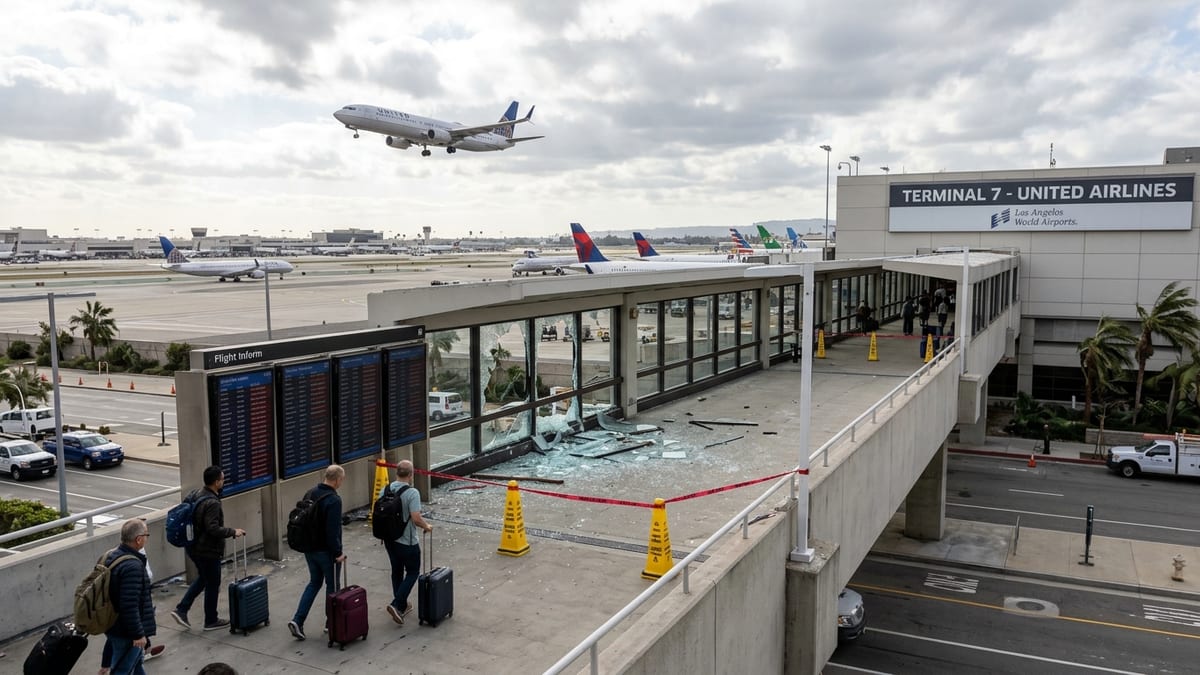
Los Angeles International Airport reported cosmetic damage in parts of its terminal complex but no serious injuries. Local news footage and social media images showed shattered overhead windows and scattered glass along a pedestrian walkway connected to Terminal 7, which is primarily used by United Airlines. Airport staff cordoned off the affected areas while engineers inspected the structure, and local fire officials conducted broader infrastructure checks as part of standard earthquake protocols.
Passengers at LAX described feeling a sharp jolt and seeing some arriving flights perform go‑arounds during the initial shaking. Airlines implemented brief holding patterns while operators confirmed that runways, taxiways and terminal facilities were safe to use. By Saturday afternoon, most flight operations had resumed with relatively limited knock‑on disruption compared with the storm‑related delays seen elsewhere in the country, although some carriers issued flexible rebooking policies for customers traveling through Los Angeles in case of continued aftershocks.
How the disruptions affect travelers heading home after Thanksgiving
With Sunday expected to be the single busiest day of the Thanksgiving travel period, federal officials project that Transportation Security Administration officers will screen more than 3 million passengers at U.S. airports. That would place additional pressure on hubs that have already experienced weather‑related congestion this week, including those in the Northeast corridor and Mid‑Atlantic, along with Chicago, Atlanta and major Florida gateways.
Duffy and aviation agencies are not forecasting systemic gridlock, but they have emphasized that localized problems could flare up quickly if new storms intersect with peak return‑travel windows or if the Los Angeles area experiences further seismic activity. Weather outlooks for Sunday and Monday indicate the potential for rain, gusty winds, snow or thunderstorms across parts of the Midwest and Northeast, which could prompt more air traffic control initiatives such as ground delays or rerouted flight paths. Travelers connecting through affected regions may be more vulnerable to missed connections and rolling delays even if their departure and destination airports remain in the clear.
Unlike the nationwide ground stop earlier in November, which was linked to an FAA technology upgrade and temporarily halted departures around the country, the current challenges are more dispersed and driven mainly by weather systems and high seasonal demand. Airlines have generally been operating full schedules but have less spare capacity to recover quickly when storms or other incidents disrupt a particular hub, so delays in one region can still cascade across the network.
On the ground, the Thanksgiving storm also affected rail and road travel across several states. Flooded streets and downed trees slowed traffic on major highways along portions of the East Coast, while some commuter and intercity rail services were delayed by debris and power issues. Utility crews in New England and the Mid‑Atlantic have been racing to restore power, but scattered outages could continue to affect traffic signals, station facilities and charging infrastructure in certain areas as the post‑holiday exodus begins.
What travelers should verify over the next three days
As the return leg of the holiday weekend ramps up, officials are urging travelers to closely monitor conditions rather than relying on original itineraries. Airlines are updating schedules and issuing waivers for some affected regions, particularly where storms or the Los Angeles earthquake may create lingering operational challenges. Passengers are advised to use carrier apps and text alerts to track gate changes, aircraft swaps and rolling delays in near real time and to check whether they are eligible to rebook without change fees if conditions deteriorate.
At airports, security agencies recommend that travelers allow extra time for check‑in and screening, especially on Sunday and Monday mornings when traffic is expected to peak. Road conditions around some major hubs could be complicated by residual flooding or ongoing utility work, so leaving earlier than usual for the airport may help mitigate the risk of missed flights. Travelers who are connecting through multiple hubs are being encouraged to consider longer layovers where possible to account for potential weather or congestion‑related delays.
Looking beyond the immediate weekend, federal transportation officials say they will be reviewing how the system handled the combination of record flight volumes, a significant coastal storm and an earthquake near one of the country’s busiest airports. Any formal changes to procedures or infrastructure will be announced later, after agencies and operators complete their post‑event assessments. For now, the focus remains on safely moving millions of people home in the final days of the Thanksgiving travel period and on keeping flyers informed as conditions evolve.