


More news on this day
Beijing Capital International Airport has been hit by a fresh wave of disruption as Super Typhoon Bavi sweeps across East Asia, with reports indicating at least 25 flights scrapped and around 370 more delayed, snarling connections between China and destinations in Europe, Northeast and Southeast Asia, and the Middle East.
Get the latest news straight to your inbox!
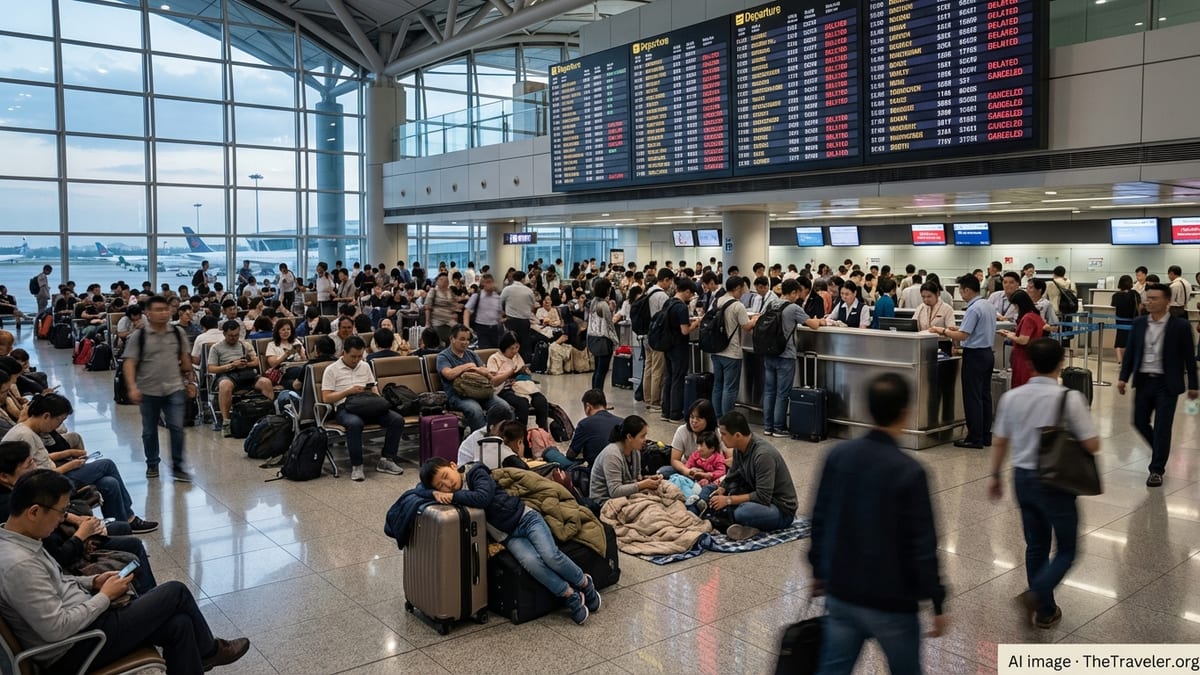
Storm-Driven Chaos at One of the World’s Busiest Hubs
Publicly available flight-tracking data and airport-status dashboards show that Beijing Capital International Airport has become one of Asia’s most disrupted hubs as Bavi’s outer bands bring heavy rain, strong crosswinds and low visibility to northern China. Statistics compiled in real time point to roughly two dozen outright cancellations and hundreds of delayed departures and arrivals, with some flights held on the ground for well over an hour.
The disturbance comes at a peak summer travel period, magnifying the impact on passenger flows. Beijing Capital typically handles well over a thousand flights a day and tens of thousands of connecting travelers. Even a relatively small number of cancellations can trigger knock-on effects throughout the network, especially when a large share of remaining flights depart late, as is occurring during Bavi’s passage.
Aviation-operations updates indicate that disruption at Beijing is part of a broader pattern affecting multiple airports along Bavi’s projected path. However, Beijing’s role as a key international gateway means that its delays are particularly significant for long-haul travelers attempting to traverse Asia or connect between Europe, the Middle East and the wider region.
Historical delay statistics for Beijing Capital show that the airport is vulnerable to weather-related disruption, particularly during the summer typhoon and monsoon season. The current episode linked to Bavi fits into that pattern, although the scale of the storm and its wide geographic footprint are amplifying the effects across several international markets at once.
International Links to Europe, Asia and the Gulf Severely Strained
Flight schedules and tracking platforms for Beijing Capital indicate that services connecting China with France, South Korea, Thailand, Hong Kong, Macau, Kazakhstan and the United Arab Emirates are among the hardest hit. While not all routes have seen outright cancellations, many are experiencing extended delays, rolling schedule changes and aircraft swaps as airlines attempt to reposition fleets around the storm.
Long-haul connections between Beijing and France, including services to major European hubs, have been disrupted as delayed inbound aircraft and crew-rotation issues ripple through timetables. Even when flights remain scheduled, their departure times have in many cases been pushed back significantly, complicating onward connections for passengers heading deeper into Europe or back toward Asia.
Shorter regional sectors are also under pressure. Routes between Beijing and Seoul, Bangkok, Hong Kong and Macau, which normally function as high-frequency links, are showing a mix of cancellations and long ground holds. The tightly coordinated schedules that underpin these routes leave little slack, so even modest delays in departure slots can quickly cascade into missed curfews at destination airports or aircraft arriving after connecting banks have closed.
In Central Asia and the Gulf, services linking Beijing with Kazakhstan and the United Arab Emirates are experiencing irregular operations as carriers reroute around adverse weather systems and adjust flight paths and cruising altitudes. This has contributed to extended block times and increased congestion in nearby airspace as multiple airlines attempt to skirt the worst of Bavi’s influence while still maintaining viable schedules.
Super Typhoon Bavi’s Track Complicates Recovery
Meteorological bulletins and storm-tracking analyses describe Bavi as a powerful system moving west to west-northwest across the northwest Pacific, with periods in recent days where it has reached or approached Super Typhoon intensity. The system’s large wind field and evolving eyewall structure have produced highly variable conditions across East Asia, complicating planning for airlines, air traffic managers and airport operators.
Forecast discussions suggest that Bavi is likely to weaken as it nears landfall in China, but the storm’s broad circulation continues to push bands of heavy rain and gusty winds far from its center. For aviation, that means turbulence and crosswinds can remain a hazard even in locations that are not directly in the projected landfall zone, including major inland hubs that rely on stable approach conditions and clear visibility.
Because the storm has gone through several cycles of weakening and restrengthening, recovery planning at airports has been challenging. Some carriers have preemptively consolidated flights or advanced departures ahead of deteriorating weather, while others have opted to hold services until more precise forecast windows emerge. In Beijing’s case, this has translated into a patchwork of operations in which some flights run close to schedule while others face lengthy, sometimes last-minute delays.
Sector-wide research on flight delays indicates that hubs exposed to intense tropical systems often see prolonged disruption even after skies begin to clear. Aircraft and crew become misaligned with planned rotations, maintenance windows may be missed, and air traffic control continues to manage backlog and rerouting. Beijing Capital now appears to be entering that phase, where the underlying meteorological threat may start to ease but operational complexity and congestion remain elevated.
Knock-On Effects for Passengers Across Continents
For travelers, the most immediate consequence of Bavi’s impact on Beijing Capital is uncertainty. Airline and airport information channels show repeated changes to estimated departure and arrival times, and in some cases aircraft are being reassigned or swapped, altering seat maps and upgrading or downgrading cabin configurations at short notice.
Passengers connecting via Beijing to or from Europe, Southeast Asia, the Korean Peninsula or the Gulf are particularly exposed. Missed connections can lead to overnight stays and rebookings through alternative hubs in Shanghai, Guangzhou, Chengdu or overseas gateways such as Seoul and Bangkok, placing additional pressure on already busy airports elsewhere in the region.
Travel forums and recent case studies from prior storms in the region suggest that even when a traveler’s own flight operates, their baggage may not always follow on schedule if ramp operations are paused repeatedly due to lightning or high winds. This risk is especially pronounced for tight connections where bags must be transferred across terminals under strict time constraints.
Insurance and consumer-rights guidance generally notes that weather-related disruption is treated differently from airline-controlled delays such as mechanical faults. As Bavi is a natural hazard event, many passengers may find that compensation rules are limited, although rebooking and basic assistance are typically offered under carrier policies. This legal and commercial backdrop further underscores the importance of proactive planning for those with critical onward commitments.
What Travelers Should Expect in the Coming Days
With Bavi still influencing conditions across a wide swath of East Asia, operational data suggest that Beijing Capital is unlikely to return to fully normal operations immediately. Even once direct weather impacts lessen, the airport will need time to process accumulated delays, reposition aircraft and restore crew schedules. Airlines are likely to continue implementing ad hoc timetable changes, including selective cancellations of lower-demand frequencies to free capacity for stranded passengers.
Travelers booked on routes linking Beijing with France, South Korea, Thailand, Hong Kong, Macau, Kazakhstan and the United Arab Emirates should be prepared for further adjustments. Public information from carriers shows that many are offering flexible rebooking options, including waivers of change fees or fare differences within specified travel windows, to help distribute passenger loads more evenly over several days.
Industry experience with previous major typhoons in the region suggests that the most severe disruption typically occurs within a one to two day window around a storm’s closest approach, but residual effects can last considerably longer on long-haul and complex multi-leg itineraries. For Beijing Capital, that means some ripple effects are likely to persist even after radar images show Bavi moving inland and weakening.
Analysts tracking aviation performance in Asia note that events such as Bavi are likely to become more operationally challenging as air traffic in the region continues to grow. With runways, terminals and airspace already operating near capacity during peak periods, large-scale weather disturbances can quickly transform into global connectivity issues, and the current turmoil at Beijing Capital International Airport is a clear demonstration of how a single storm can reverberate across continents.