


More news on this day
Air travel across Asia faced fresh disruption on July 9, 2026, as publicly available tracking data showed 5,597 delayed flights and 159 cancellations in and around Thailand, Japan, Hong Kong, India and other regional markets, affecting major hubs in Bangkok, Tokyo and Delhi and impacting carriers such as Cathay Pacific, Thai Airways and Akasa Air.
Get the latest news straight to your inbox!
Widespread Disruption Across Key Asian Hubs
The latest figures compiled from regional flight status boards and aviation analytics platforms indicate that Asia’s major travel gateways endured another difficult day, with disruption concentrated in and around Thailand, Japan, Hong Kong, India, China, Indonesia and the Philippines. The pattern reflects a region still operating under strain, with tight capacity and limited slack to absorb operational shocks.
In Bangkok, delays and cancellations affected both Suvarnabhumi and Don Mueang airports, where a combination of high seasonal demand and ongoing schedule adjustments has left some carriers trimming frequencies while others struggle to maintain on-time performance. Publicly available information on Thai-based airlines shows that a number of routes have already been reduced or temporarily suspended in recent weeks, leaving fewer options when flights are disrupted.
Tokyo’s Haneda and Narita airports also featured prominently in the disruption data. Flights linking Japan to Southeast Asia and Greater China, including services operated or marketed by Cathay Pacific, Japan Airlines, Thai Airways and various low cost carriers, recorded a wave of late departures and arrivals, further complicating connections for passengers traveling between North America, Asia and the Pacific.
In India, congestion in Delhi and other metro airports added to the regional picture, with domestic and international services operated by airlines such as Akasa Air, IndiGo and full service competitors facing rolling delays. According to published coverage, knock-on effects from earlier disturbances, tight aircraft rotations and weather-related restrictions in parts of the subcontinent contributed to the latest schedule pressures.
Major Airlines Feel The Strain
Flag carriers and regional airlines alike were caught up in the disruption numbers. Cathay Pacific, which operates a dense network across Asia from its Hong Kong base, reported continued schedule challenges in recent advisories, urging passengers to monitor flight status and allow additional time at the airport. While core services are continuing, individual flights into and out of Hong Kong have seen revised departure and arrival times, affecting onward connections to Tokyo, Bangkok and Indian cities.
Thai Airways, already in the midst of capacity adjustments due to high fuel prices and seasonal demand shifts, has been part of a broader pattern of reduced and occasionally cancelled services from Thailand. Recent public statements and local business coverage describe carriers in the Thai market cutting or consolidating routes and frequencies as they try to manage higher operating costs, leaving less room to re-accommodate passengers when delays ripple through the system.
India’s Akasa Air, which has expanded rapidly in the domestic market and is building out regional links, has also appeared in disruption reports covering services to and from major Indian hubs. With many carriers running tight schedules to maximize aircraft utilization, even short operational interruptions can cascade into longer delays later in the day, particularly on busy trunk routes connecting India with Southeast Asia and East Asia.
Other regional airlines, including low cost operators based in Thailand, Indonesia and the Philippines, have been experiencing a mix of planned capacity cuts and unplanned operational issues. Aviation industry analyses over recent weeks have highlighted how rising fuel costs, aircraft availability constraints and air traffic control bottlenecks across parts of Asia are collectively eroding the buffer that once helped airlines recover more quickly from irregular operations.
Passengers Face Missed Connections And Longer Journey Times
The disruption totals translate into missed connections, extended layovers and abrupt itinerary changes for thousands of travelers. With key hubs such as Hong Kong, Bangkok and Tokyo serving as major transfer points between long haul and regional services, even modest schedule shifts can leave passengers stranded or forced to reroute through alternative cities at short notice.
Travel forums and social media posts over recent days have reflected growing frustration from passengers dealing with late-notice cancellations, overnight delays and rebookings that extend journey times by many hours. Some travelers have reported being moved onto later flights or entirely different routings via alternative hubs when original connections through places like Hong Kong or Bangkok became unworkable.
Industry guidance generally encourages passengers to build longer connection windows when connecting across Asia during periods of heightened disruption. Publicly available advice from travel agencies and consumer organizations also recommends monitoring flight status repeatedly in the 24 hours before departure, as airlines are increasingly adjusting schedules closer to flight time in response to crew, aircraft and airspace constraints.
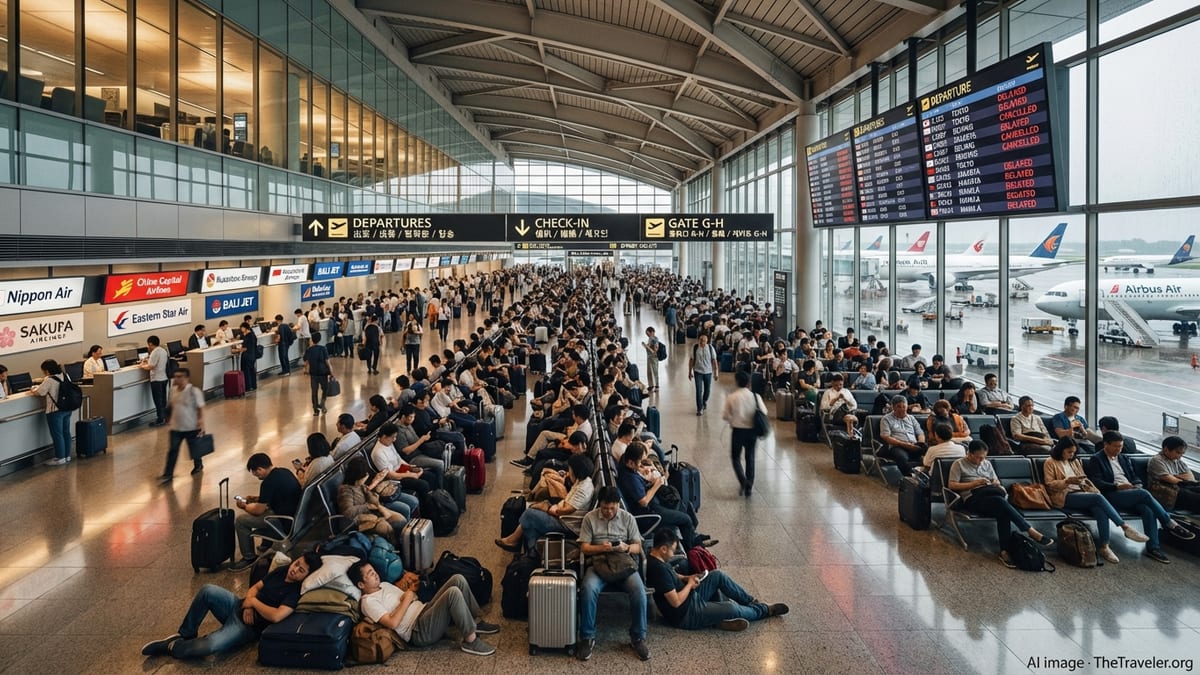
For those already at the airport, the impact of delays has been visible in crowded departure halls and longer lines at transfer and customer service desks in several major hubs. While many airlines provide meal vouchers, hotel accommodation or rebooking assistance when delays are substantial, the uneven patchwork of policies across carriers and jurisdictions means that passenger experiences can vary widely.
Operational And Economic Pressures Behind The Numbers
Behind the headline figures of 5,597 delays and 159 cancellations lie broader operational and economic pressures that have been building across the Asian aviation market. Analysts tracking the region point to a combination of volatile fuel prices, lingering supply chain issues affecting aircraft maintenance and deliveries, and increasingly congested airspace on popular routes.
Recent business reporting from Thailand and other parts of Southeast Asia has underscored how sharply higher fuel costs have convinced some airlines to pare back frequencies, particularly on marginal or highly competitive routes. In several cases, carriers have opted to suspend specific flights for parts of the summer travel period, which can leave remaining services heavily booked and more vulnerable when a disruption occurs.
At the same time, air traffic management capacity in parts of Asia has struggled to keep pace with the rapid rebound in demand. Reports from regional aviation bodies describe airports and control sectors operating at or near capacity during peak hours, increasing the likelihood of flow control measures that slow departures and arrivals. When combined with convective weather common to the summer months in tropical and subtropical regions, the result is a higher baseline of delay.
For airlines, these conditions present a delicate balancing act. Carriers are under pressure to restore and expand networks to capture recovering demand, yet face cost and reliability challenges that limit how aggressively they can add capacity. The disruption seen on July 9 is, according to industry observers, one manifestation of this tension, where tightly optimized schedules can quickly unravel when multiple risk factors converge.
What Travelers Can Expect In The Coming Days
With regional disruptions still unfolding, travel industry commentary suggests that passengers planning to fly through affected hubs in the near term should prepare for potential knock-on effects. Even if scheduled operations normalize, aircraft and crew positioning may remain out of sequence for some time, which can continue to generate irregular timings on certain routes.
Publicly available guidance from airlines and airport operators consistently emphasizes the importance of checking flight status frequently, arriving early at the airport, and ensuring that contact details in bookings are up to date so that schedule changes and rebooking information can be communicated swiftly. Travelers using separate tickets for connecting journeys have been repeatedly warned in consumer coverage that they face higher risk when disruptions strike, as protection and rebooking options are more limited.
For those yet to finalize travel plans, some agents and comparison platforms have begun advising flexible dates, longer connection buffers and travel insurance that explicitly covers delays and cancellations where available. While these measures cannot eliminate the risk of disruption, they may help reduce the financial and logistical impact when large-scale schedule problems emerge.
Industry analysts note that Asia remains one of the world’s most dynamic air travel regions, and that airlines and airports are continuing to invest in capacity and resilience. However, the events reflected in today’s delay and cancellation totals underline how finely balanced the system remains, and how quickly conditions can deteriorate for travelers when multiple stress factors align.