


More news on this day
Thanksgiving travelers moving through President Donald J. Trump International Airport in Palm Beach County on Wednesday reported weather-related delays and busy security lines but relatively few outright cancellations, as national air traffic during the holiday period climbed toward its highest levels in more than a decade.
Get the latest news straight to your inbox!
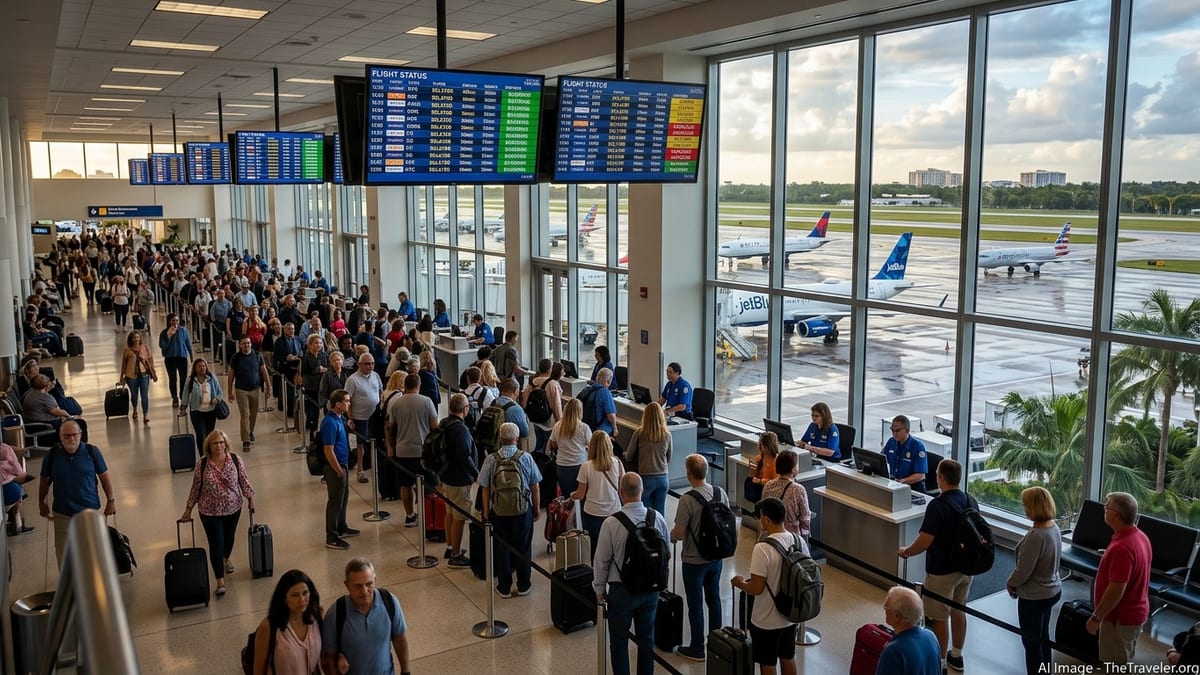
Heavy Thanksgiving traffic with limited disruption at Palm Beach airport
By Wednesday of Thanksgiving week, President Donald J. Trump International Airport was seeing a familiar pattern for the holiday period: crowded departure halls and a growing board of delayed flights, but only a small number of cancellations compared with other peak-travel years. Flight status data for major U.S. carriers showed the airport broadly in line with national trends, where most operations were running but many services were leaving later than scheduled as weather systems moved across the country.
Across South Florida, conditions varied through the day. Passengers at Miami International and Fort Lauderdale–Hollywood International reported long security lines during the morning peak, and national trackers logged more than a thousand delayed flights across the U.S. as wind, low clouds and rain affected operations at several large hubs. At President Donald J. Trump International, inbound travelers described extended time in the air as aircraft slowed or were placed in holding patterns on approach, but most flights ultimately completed their journeys.
That combination of longer ground and air times without widespread cancellations matched federal forecasts going into the holiday. The Federal Aviation Administration projected more than 417,000 flights nationwide over the nine-day Thanksgiving travel window, the busiest holiday skies in roughly 16 years, while cautioning that storms on both coasts could periodically slow traffic into major airports.
National forecasts: record flight volumes and weather risks
The Palm Beach experience unfolded against an exceptionally busy backdrop across the United States. According to the FAA’s Thanksgiving forecast for the current season, airlines are scheduled to operate roughly 417,000 domestic and international flights over the nine-day holiday period, from the Friday before Thanksgiving through the Sunday after. That compares with slightly lower totals in the years immediately before and reflects carriers restoring capacity on key leisure routes.
Screening numbers at Transportation Security Administration checkpoints have been tracking at or above pre-pandemic levels throughout the autumn. For the Thanksgiving travel window, TSA has told passengers and airports to prepare for volumes similar to or higher than last year, when more than 18 million people passed through security between the Tuesday before Thanksgiving and the following Monday and the Sunday after the holiday set a new single-day screening record nationwide. In practice, that means crowds are heaviest not on the Wednesday getaway day but on the Sunday return, when more than 3 million travelers are expected to pass through checkpoints.
Weather remains the main operational wild card. Forecasts issued in the days before Thanksgiving pointed to storm systems capable of bringing strong winds, low ceilings and heavy rain to several regions, including the Northeast corridor and parts of the West Coast, during various phases of the holiday period. Aviation agencies and airlines have warned that such conditions tend to produce arrival and departure metering at the busiest hubs, which can cascade into late-arriving aircraft and schedule knock-on effects at smaller airports such as President Donald J. Trump International.
How the holiday rush is affecting Palm Beach–area passengers
For travelers using President Donald J. Trump International, the main impact by Wednesday was additional time built into their journeys rather than cancellations forcing wholesale changes of plan. Arriving passengers described circling over South Florida as crews waited for a safe landing window on wet runways and in low clouds. On the ground, some outbound flights to congested Northeast airports departed later than timetabled as carriers waited for arrival slots to open up and aircraft to arrive from earlier rotations.
Regional differences were evident for Palm Beach passengers connecting through or arriving from other Florida airports. At Miami International and Fort Lauderdale–Hollywood, which handled larger volumes of domestic and international traffic, lines at check-in and security checkpoints stretched significantly during the morning and early afternoon as peak departure banks coincided with holiday crowds. That congestion filtered into the experience of some travelers using Palm Beach as an origin or destination when their itineraries involved connections or ground transfers via those larger hubs.
Nationally, the pattern of disruption remained uneven rather than system-wide. In the days before Thanksgiving, for example, a technical fault affecting one major airline’s automated weight-and-balance system caused substantial delays at its largest hub, temporarily halting some arrivals and departures before operations were restored later the same day. At the same time, other carriers were able to maintain mostly normal service, illustrating how localized problems can compound holiday stress for some passengers while leaving others largely unaffected.
Official guidance on when to arrive and how to prepare
Federal agencies and airports across the country have been repeating the same core advice for navigating the busiest days of the Thanksgiving travel period. TSA recommends arriving at least two hours before scheduled departure for domestic flights and three hours for international services throughout the holiday week, especially during peak morning and early evening waves. The agency also urges travelers to allow additional time for parking shuttles, airline check-in, baggage drop and unplanned congestion at security.
At President Donald J. Trump International, those baseline guidelines apply in full. Passengers are being advised to confirm their flight status directly with their airline before leaving home, to check whether self-service or mobile bag tags are available to shorten check-in, and to verify which security checkpoints are open at their time of travel. Airlines are also reminding customers that some flights may be placed under ground delay programs if storms or strong winds reduce arrival or departure rates at destination airports, which can extend waiting times even if local weather at origin appears favorable.
Federal and local aviation officials continue to emphasize that real-time information is essential during this period. The FAA publishes current air traffic status and delay programs, while airlines use their apps, text alerts and email to notify travelers of gate changes, revised departure times or opportunities to move to alternative flights when weather or congestion disrupts specific routes. For those using President Donald J. Trump International, where the absolute number of daily departures remains lower than at Florida’s major hubs, reacting quickly to schedule changes can be particularly important because there may be fewer same-day alternatives on some routes.
What travelers should watch for through the end of the holiday period
Conditions for passengers using President Donald J. Trump International are likely to evolve through the end of the Thanksgiving travel window, with the heaviest flows still expected on the Sunday after the holiday. Historically, that day ranks as the single busiest of the year at U.S. airport security checkpoints, and federal forecasts point to a similar pattern this season. Even if Palm Beach avoids the longest lines seen at the state’s larger airports, knock-on effects from weather and delays at destination and hub airports could still lead to schedule changes.
Travelers planning to fly in the coming days are therefore being encouraged to monitor both weather and operational updates that may affect their itineraries. That includes following forecasts for the regions they are departing from and flying to, checking for airline travel waivers that allow fee-free changes when specific cities are expected to see storms, and confirming ground transportation or onward connections at the other end. For passengers heading into or out of Palm Beach, where many trips involve family visits or connections to cruise departures, being flexible on departure time or routing can reduce the risk of missed events.
Looking beyond the Thanksgiving week itself, federal transportation data and current scheduling trends suggest that peak holiday travel conditions at U.S. airports are likely to recur around the Christmas and New Year period, with similar pressures on popular leisure and family routes. For President Donald J. Trump International, that means passengers can expect another stretch of busy terminals and full flights in late December, even as operations generally stabilize again once the current holiday surge subsides. As always, checking airline and airport information before leaving home and allowing generous time at the airport remain the most effective ways to navigate high-demand periods with minimal disruption.