


Airport lounges have become a status symbol as much as a travel convenience, and few brands inspire as much curiosity as the American Express Centurion Lounge. For years, photos of craft cocktails, barista coffee and chef-designed buffets have helped sell premium credit cards with eye-watering annual fees. But in 2026, with stricter guest rules, more locations and ongoing crowding issues, how much real-world value does Centurion Lounge access still deliver to travelers who carry an Amex Platinum or Delta Reserve card?
Get the latest updates straight to your inbox!
What Centurion Lounges Actually Are Today
American Express launched the Centurion Lounge concept to stand out from traditional airline clubs, which for decades were known more for basic snacks and self-serve beer than elevated hospitality. Today, Amex operates around 30 Centurion Lounges worldwide as part of its broader Global Lounge Collection, with locations in major hubs such as Dallas Fort Worth, Miami, Denver, Las Vegas, New York JFK and LaGuardia, and London Heathrow, plus new lounges under development in Newark and Boston. The network has become one of the primary selling points of the Platinum and Centurion cards, a kind of traveling members’ club that signals you are not just another economy passenger.
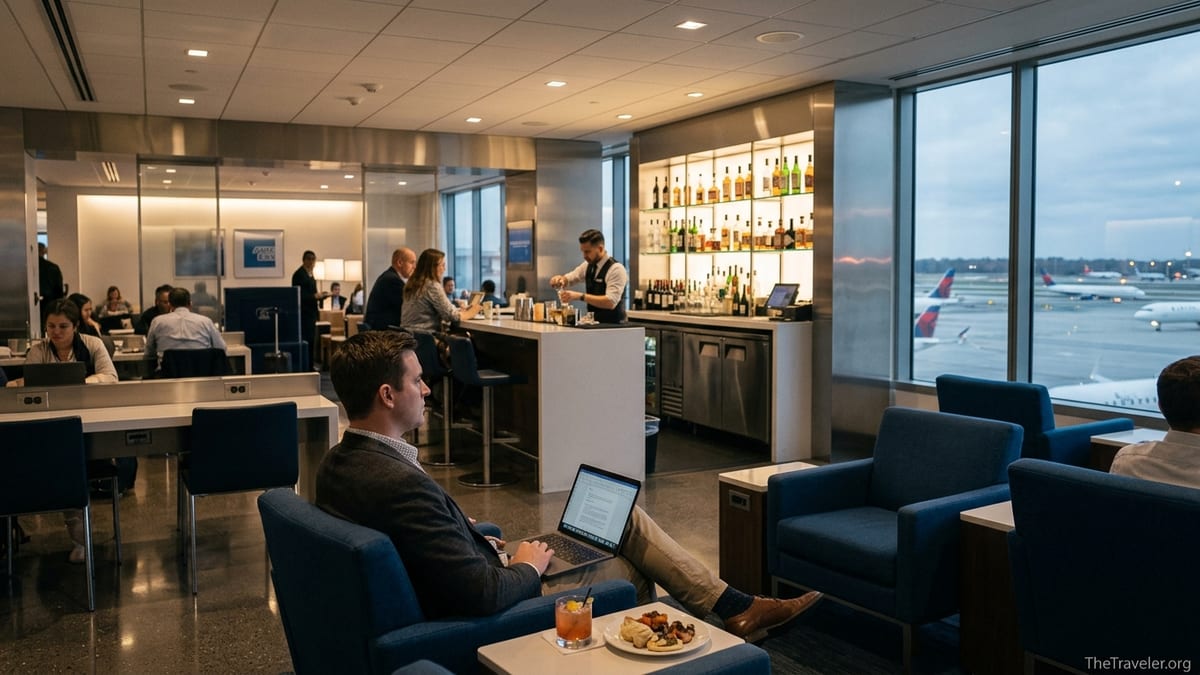
The standard Centurion Lounge formula is fairly consistent. Most lounges offer a staffed bar with complimentary cocktails, wine and beer, a hot buffet menu designed by a local or regional chef, barista-style coffee, work zones with power outlets, quiet spaces and family rooms. In Denver, for example, you will find a large central bar, dedicated work booths and a buffet featuring dishes inspired by Colorado ingredients. In Miami, the menu often leans toward Latin flavors and seafood, while Las Vegas emphasizes hearty comfort food aimed at convention travelers who have been on their feet all day.
Compared with many U.S. airline lounges, the food and beverage quality in Centurion Lounges is generally higher. You are more likely to see braised meats, composed salads and plated desserts instead of packaged cheese cubes and snack mix. Cocktails are crafted to order rather than coming from a soda gun. That upgrade in hard costs is part of why Amex focuses access on high-fee cardholders instead of selling day passes widely to the public.
However, it is important to understand that “premium” does not always mean serene. At peak times, some Centurion Lounges can feel like crowded restaurants at 6 p.m. on a Friday. For travelers who have only seen glossy marketing images, the reality of waiting in line for a shower or circling repeatedly for a seat can be jarring. That tension between aspirational brand and on-the-ground experience is central to evaluating the lounges’ real value.
Who Really Gets In, And Under What Rules
Access to Centurion Lounges is far more restrictive than a typical Priority Pass lounge. In the United States, complimentary entry is limited primarily to holders of The Platinum Card from American Express, The Business Platinum Card from American Express, the invitation-only Centurion Card, and Delta SkyMiles Reserve and Reserve Business cardmembers when they are flying Delta the same day and meet Amex’s Delta lounge-use rules. Day passes are not sold to the general public, and holding a basic Amex such as a Gold or Green card does not get you through the door.
Even among eligible cardholders, there are important constraints. You must have a same-day boarding pass, and in most locations you can only enter within roughly three hours of departure. If you have a long layover on an inbound flight, re-entry on arrival may be refused unless you have a connecting flight the same day. These time rules matter: a traveler connecting through Dallas on a six-hour layover will likely get a very different experience than someone trying to access the lounge six hours before an evening departure.
Guest access has also tightened dramatically. Historically, a Platinum cardholder could bring two guests at no additional charge. Since 2023, in most cases those guests now incur a fee per visit, commonly around 50 dollars per adult and 30 dollars per child aged two to seventeen, with children under two admitted free when accompanied by a parent. Corporate Platinum and Centurion cardholders remain more generous exceptions, often still allowed to bring two guests or immediate family at no extra cost, reflecting the much higher overall value of those relationships to Amex.
For regular U.S. consumer and business Platinum cardholders, there is a path back to complimentary guest access, but it is aimed squarely at high spenders. By putting at least 75,000 dollars of eligible purchases on a Platinum account in a calendar year, a cardholder can unlock the ability to bring up to two guests free of charge for the rest of that year, the entire following year and into January of the year after that. Effective in mid-2026, American Express is also tightening rules so that guests must be traveling on the same flight as the cardmember, closing a loophole where people would escort friends or family into the lounge who were not actually traveling together.
The Experience on the Ground: Comfort vs Crowds
On paper, the Centurion Lounge experience often looks like a terrific value. If you are departing Denver at 6 p.m., you might plan to arrive early, order a craft cocktail that might cost 18 dollars at the airport bar, have a proper hot dinner that would otherwise run 25 to 35 dollars in the terminal, and sit in a quieter space with reliable Wi-Fi, power outlets and reasonably comfortable seating. If you add a glass of wine, espresso and perhaps a shower before a red-eye, it is easy to tell yourself you are getting 60 to 80 dollars of value from a single visit.
In reality, the experience is heavily shaped by crowding. Travelers in recent years have reported arriving at some locations, such as Denver or Las Vegas, only to find a waitlist with estimated delays of thirty minutes or more at peak times. When there is a queue at the door, the lounge may feel more like a busy chain restaurant than a private club, with staff rushing to clear plates and guests hovering for open seats. In that environment, the theoretical value of the complimentary food and drink drops if you only manage to grab a small plate and a quick drink before needing to leave for your gate.
Conditions vary significantly by time of day and airport. A Tuesday morning at the Philadelphia Centurion Lounge may feel calm and spacious, with plenty of seating, short bathroom lines and easy access to the buffet. That same afternoon in Miami before a wave of flights to Latin America, every table might be taken and the bar three deep. International locations can be more forgiving: the London Heathrow lounge has been praised for feeling less crowded after the stricter guest rules came into force, making it easier to find a quiet corner for work or rest.
It is also worth comparing Centurion Lounges not only to the public terminal, but to competitors. In some international hubs, airline-run business-class lounges operated by carriers such as Qatar Airways, Lufthansa or Singapore Airlines offer table service, à la carte dining and dedicated quiet rooms that can outclass what Centurion provides. On the other hand, in many U.S. airports where airline clubs still serve limited snacks and have cash bars, the Centurion option remains a meaningful upgrade in quality for economy travelers.
Putting a Dollar Value on Centurion Lounge Access
To understand the real value of Centurion Lounges, it helps to translate their benefits into something close to dollars and cents. Consider a traveler with an Amex Platinum card who flies six round trips per year, mostly for leisure, and manages to visit a Centurion Lounge eight times over those trips. Each time, they typically have a full meal and two drinks that would otherwise be purchased at airport prices. If we estimate 30 dollars for food and 25 dollars for drinks and coffee per visit, the direct savings might look like roughly 55 dollars per visit, or about 440 dollars per year.
That calculation assumes they actually get to enjoy a full meal and drinks each visit. If crowding on half of those trips means they only grab a quick snack and one drink, the effective value may fall closer to 35 dollars per visit. Now the annual benefit looks more like 280 dollars. Against a Platinum card annual fee that is closing in on 900 dollars for new U.S. applicants, the Centurion Lounge component alone rarely justifies the cost. Instead, it needs to be seen as one piece of a broader package that includes hotel status, travel credits and other perks.
For heavy travelers, the math can shift meaningfully. A consultant who flies twice a month and can visit a Centurion Lounge twenty times a year, often at off-peak hours, might realistically extract 50 to 70 dollars of value per visit. That would imply 1,000 to 1,400 dollars of annual value from lounge access alone, which could more than offset the card fee if they would otherwise buy meals and drinks in the terminal. In this frequent-flyer scenario, Centurion Lounges can be a powerful money-saver and quality-of-life improvement.
Guest fees alter the equation for families. A couple traveling with two school-age children who does not meet the 75,000-dollar spend threshold could be looking at around 50 dollars per adult and 30 dollars per child if they pay guest fees, or roughly 160 dollars for the family to enter a lounge on a single trip. At that price point, some families will correctly conclude that they are better off buying a decent sit-down meal in the terminal or allocating that money to inflight purchases and snacks brought from home.
How Centurion Lounges Compare to Other Lounge Options
American Express positions Centurion Lounges as the crown jewel of its Global Lounge Collection, but they are only one part of the picture. A Platinum cardholder also typically has access to Delta Sky Clubs when flying Delta, Priority Pass lounges at many airports worldwide, and Amex-partnered Escape Lounges in several U.S. and U.K. locations. When evaluating real value, it makes sense to look across all of the lounges you can enter, not just the blue-doored Centurion spaces.
In many U.S. airports, a Priority Pass lounge may be less crowded and nearly as comfortable as a Centurion Lounge, even if the food is less ambitious. For example, in a mid-size hub with a single generic contract lounge, you may find a quieter room with packaged snacks and simple hot dishes that still feels like a meaningful upgrade from the main terminal. If the Centurion Lounge in the same airport regularly has a waitlist, a traveler who values peace and a guaranteed seat may prefer the “second-best” option in practice.
Similarly, airline-branded lounges you can access through a business-class ticket, elite status or a same-day upgrade can rival or surpass Centurion in some markets. In London Heathrow, many travelers with oneworld or Star Alliance status choose their airline’s flagship lounges for better showers, more workspaces and direct boarding access, treating the Amex lounge as a backup. In U.S. hubs like Atlanta or Minneapolis, Delta Sky Clubs have expanded dramatically in size and quality, offering full buffets, staffed bars and large quiet zones that are competitive with Centurion, especially when Sky Clubs are built with more square footage.
The real advantage of Centurion Lounges is consistency for economy travelers who do not otherwise have any airline status. With the right Amex card, a traveler who flies Miami to Las Vegas on American one month and New York to Denver on United the next can still count on similar access and amenities regardless of airline. For occasional travelers who are not loyal to a single carrier, that cross-airline predictability is a key part of the value proposition.
When Centurion Lounge Access Is Truly Worth It
Centurion Lounge access is most compelling for travelers who fly regularly enough to use the benefit but not so often that they already have strong airline lounge access through elite status. A consultant who averages one or two trips a month in economy, often through hubs like Dallas, Denver or Miami, is exactly the kind of traveler who can convert Centurion access into tangible value. Over a year of frequent trips, they may easily save several hundred dollars on airport food and drinks, enjoy quieter workspaces and arrive at meetings more rested, all for a card fee they might already be paying for other reasons such as hotel credits or rideshare benefits.
It is also particularly valuable for travelers who routinely face long layovers or schedule buffers. Someone who arrives three hours early for international departures or builds in extra time before winter flights can realistically sit down for a proper meal, work for an hour, then grab a coffee before boarding. In these situations, the full suite of lounge amenities is used, and the perceived value of access is highest. Centurion Lounges can turn what would have been a tedious wait in a crowded terminal into a productive and relatively pleasant interlude.
By contrast, if your airport habits involve arriving just an hour before boarding, rarely checking bags and heading straight to the gate, you may struggle to use Centurion Lounges often enough. Occasional leisure travelers who take two or three trips a year, often from small airports without a Centurion Lounge, may find that the access sounds impressive but does not materially change their travel day. For those travelers, paying a high annual fee largely for lounge access can feel like a poor fit.
Families with children should look carefully at the combination of access frequency and guest fees. A couple that takes one or two big family trips a year may simply not want to pay 160 dollars in guest charges per visit, especially when children may only want a quick snack before getting restless. In that scenario, options like Priority Pass lounges that admit children freely with a single membership, or even a good sit-down restaurant in the terminal, might be a better experience-to-cost ratio.
Common Misconceptions and Hidden Limitations
One of the biggest misconceptions about Centurion Lounges is that holding any American Express card means automatic access. In reality, only a small subset of premium cards unlock the door, and they come with high annual fees. Another widespread misunderstanding is that once you have a Platinum card, your whole traveling party can join you at no cost. Current rules make that true only for select high-spend or corporate accounts, and even then guest policies can vary by country and change with relatively short notice.
Travelers are also often surprised by timing and capacity limits. It is common to see people arrive at the door in the morning with an evening boarding pass, expecting to “camp out” for the day, only to be turned away because they are outside the allowed entry window. Similarly, some assume their card guarantees entry regardless of how busy the lounge is, when in practice staff must enforce capacity caps for safety and comfort. At very popular locations, it is entirely possible for a Platinum cardholder to be told they will receive a text message when space opens up, and then never be called before their boarding time.
Another subtle limitation is that Centurion Lounges are typically located in one terminal at each airport. If you are flying from a different terminal without easy airside connections, accessing the lounge can require an extra security check or a long walk that eats into your available time. For example, a traveler departing from a remote concourse in Dallas or Miami may realize that the fifteen-minute trek each way makes a quick lounge visit less attractive than grabbing a snack near their gate.
Finally, travelers should remember that not all amenities are equal across locations. Some lounges have showers and quiet rooms, while others in older or space-constrained airports do not. Certain locations are currently temporary or under renovation, such as San Francisco, which has been operating a temporary lounge setup while Amex works on a more permanent solution. Relying on a generic mental image of the “perfect” Centurion Lounge may set expectations higher than what a specific airport can deliver on a given day.
The Takeaway
The truth about American Express Centurion Lounges is more nuanced than the glamorous photos suggest. They remain a clear step up from the public terminal in many U.S. airports and can offer meaningful savings on food and drinks, plus a calmer environment to work or rest. For frequent travelers without airline status, particularly those passing regularly through airports with strong Centurion locations, the lounges can easily justify a significant portion of a premium card’s annual fee.
At the same time, crowding, stricter guest rules and access limitations have eroded some of their once-legendary appeal. Families now face substantial fees to bring children inside. Occasional travelers may rarely encounter a Centurion Lounge at all, or may find it so busy that they do not fully use its amenities. The benefit tends to favor high-spend, high-frequency travelers who are willing to adapt their airport routines, arrive earlier and plan connections that let them make full use of the space.
For anyone considering an Amex Platinum or Delta Reserve card primarily because of Centurion Lounge access, the key question is not “Are the lounges good?” but “How often will I realistically use them, and under what conditions?” If your travel patterns mean eight or more substantial visits a year, and you would otherwise spend heavily on airport food and drinks, the answer may be that they provide excellent real-world value. If not, you may be better served by a lower-fee card and an occasional paid lounge visit or upgraded meal at the airport when you truly need it.
FAQ
Q1. Which credit cards actually get you into Amex Centurion Lounges?
Eligible access is generally limited to The Platinum Card and Business Platinum Card from American Express, the Centurion Card, and Delta SkyMiles Reserve and Reserve Business cards when you meet Delta’s same-day flight requirements. Other Amex cards, including Gold and Green products, do not provide Centurion Lounge entry.
Q2. Are guests still free when I visit a Centurion Lounge with my Platinum Card?
For most U.S. consumer and business Platinum cardholders, guests are no longer free by default. You typically must pay a per-visit fee for each guest unless you unlock complimentary guest access by reaching a high annual spending threshold or hold a Corporate Platinum or Centurion card with more generous guest terms.
Q3. How much do Centurion Lounge guest fees usually cost?
Guest fees can vary slightly by location and local currency, but in many U.S. lounges you can expect to pay in the region of 50 dollars per adult and around 30 dollars per child aged two to seventeen, with infants under two admitted at no charge when accompanied by an eligible cardholder.
Q4. Can I buy a day pass to a Centurion Lounge if I do not have a qualifying Amex card?
No. American Express does not generally sell day passes to Centurion Lounges to the general public. Only eligible cardholders can enter, and while they may be able to pay guest fees for companions, there is no option for a walk-up customer to purchase access without an eligible Amex card.
Q5. How early before my flight can I enter a Centurion Lounge?
Most Centurion Lounges allow entry only within a limited window, typically around three hours before your scheduled departure time. If you arrive at the airport much earlier with a same-day boarding pass, staff may ask you to return closer to your flight time, and access on arrival from a completed trip is often not permitted unless you have a same-day connection.
Q6. Are Centurion Lounges always better than airline or Priority Pass lounges?
Not always. While Centurion Lounges usually offer stronger food and beverage options than many domestic U.S. airline and contract lounges, crowding can reduce their appeal. In some airports, an airline’s flagship lounge or a quieter Priority Pass option may provide a more comfortable experience, especially at peak times.
Q7. Is Centurion Lounge access enough reason on its own to get an Amex Platinum Card?
For most people, lounge access alone does not justify the Platinum card’s high annual fee. Centurion access is best viewed as one part of a broader package that includes hotel benefits, statement credits and other travel perks. It becomes compelling when you travel often enough to visit the lounges regularly and also use several of the card’s other benefits.
Q8. How many times per year should I use Centurion Lounges to feel they are worth it?
There is no single right number, but many travelers find that if they can make eight or more substantial lounge visits a year, where they replace a full airport meal and drinks, the benefit can contribute meaningfully toward offsetting the card’s cost. Fewer visits or rushed stops tend to reduce the perceived value.
Q9. What happens if the Centurion Lounge is full when I arrive?
When a Centurion Lounge reaches its capacity limit, staff may place you on a waitlist and send a text message if space opens up. At busy times you may not be admitted before you need to leave for your flight, so access is not guaranteed even if you hold an eligible card and arrive within the allowed time window.
Q10. Do all Centurion Lounges offer the same amenities?
No. While there is a standard set of expectations around food, drinks, Wi-Fi and seating, specific amenities vary by location. Some lounges have showers, family rooms and quiet zones, while others in older or space-constrained airports may offer a more limited layout. It is worth checking what a particular lounge provides before planning your airport routine around it.