


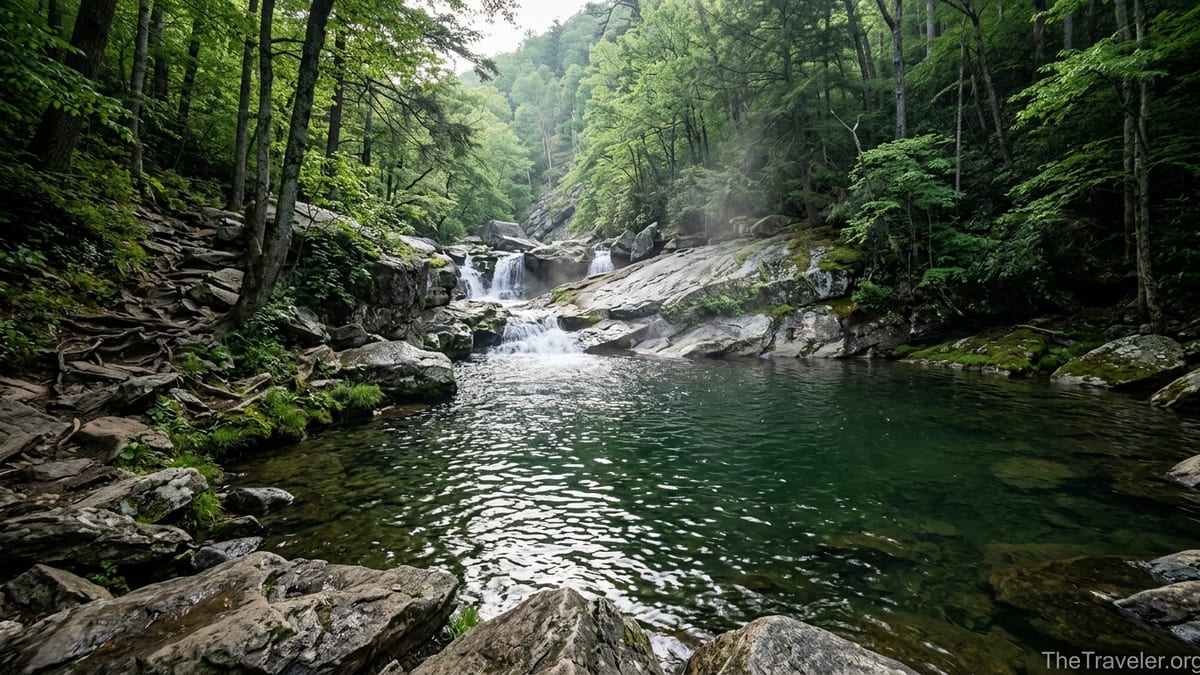
The first time I saw Cedar Run Falls, I was standing on sweat‑slick rock, legs shaking, shirt plastered to my back, wondering whose idea of fun this was. Below me, a clear mountain torrent slid over smooth granite into a deep green plunge pool. It was stunning. It was everything a Shenandoah National Park waterfall should be. Yet getting here on the Cedar Run Trail had already pushed me closer to my limits than any day hike in recent memory.
Get the latest updates straight to your inbox!
Finding Cedar Run: A Different Side of Shenandoah
Cedar Run is not the most famous waterfall hike in Shenandoah National Park. That honor goes to nearby Whiteoak Canyon, a marquee trail with better signage, more parking, and a reputation for being busy on most spring and fall weekends. Cedar Run, by contrast, begins quietly from a small pullout along Skyline Drive near milepost 45 and immediately drops away from the road on a rocky path that feels more like a backcountry route than a national park showpiece.
From the trailhead, there is no gentle warm‑up. Within the first few minutes, the trail pitches sharply downhill through eastern hardwood forest, the tread littered with roots and loose rock. It loses roughly 2,000 feet of elevation between the drive and the lower boundary of the park, one of the steeper continuous descents among Shenandoah’s popular waterfall hikes. Hikers heading toward the Cedar Run swimming holes are essentially walking down a long, natural staircase of boulders and ledges that will all have to be climbed again later.
This is part of what makes Cedar Run so different from Virginia’s more forgiving waterfall walks, such as the paved path to 70‑foot Dark Hollow Falls off Skyline Drive or the rolling, family‑friendly cascade at South River Falls. On Cedar Run, there are no railings, no asphalt, no wide overlooks. The reward is a far more intimate encounter with the stream itself, but it comes at the price of a much harder day.
When I planned my route, I had read that some hikers combine Cedar Run with Whiteoak Canyon to form a strenuous 7.5‑ to 8‑mile circuit, climbing past multiple waterfalls on both creeks. On paper, it looked ambitious but manageable for someone who hikes most weekends. On the ground, I realized quickly that distance is only part of the story here. Elevation gain, terrain, and trail conditions add up to something that feels bigger than the mileage.
First Descent: Beautiful, Slippery and Relentless
The initial hour on Cedar Run felt like a controlled fall downhill. Each switchback brought the sound of water closer: first a distant murmur, then the distinct rush of a steep mountain stream in early summer, swollen by recent storms but no longer dangerous. The forest closed in with tulip poplar and oak, and in June the understory was thick with ferns and blooming rhododendron. The narrow dirt and rock tread left no question that we were in real mountain country.
Unlike Shenandoah’s more manicured waterfall trails, Cedar Run often shares the same channel as runoff. After heavy rain, sections of the path can turn into miniature streams, coating the rocks in a thin film of water and algae. Even in dry spells, you are walking on polished stone and mud in many places. As I picked my way down, I was glad I had committed to real hiking boots with aggressive tread rather than lightweight trail runners. Every third or fourth step required a deliberate placement, and a trekking pole would not have been overkill.
About a mile in, the trail began to track directly alongside the creek. This is where Cedar Run’s character really emerges. The stream drops in a series of chutes and short waterfalls rather than one dramatic plunge. There are ledges where water fans out like white lace over dark rock, and narrow channels where it compresses into frothing slides. None of them are as tall as the 86‑foot upper falls at Whiteoak Canyon, but together they create the feeling of walking down a continuous, living staircase of water.
It was only when we reached the first popular swimming hole that I understood why so many people are willing to wrestle with this trail. Here Cedar Run pours over a sloped slab of rock into a round, turquoise pool ten to twelve feet deep. On summer weekends, hikers use this as a natural waterslide, shooting into the pool and climbing out onto sun‑warmed boulders. Even on a weekday in late May, a few hardy souls were braving the water, which felt only a few degrees above snowmelt.
The Moment the Trail Turned Against Me
Standing there, it would have been easy to declare victory and head back the way we came. We had already descended more than 1,500 feet, scrambled around slick ledges, and reached one of the most photogenic sections of Cedar Run. But the plan was to continue to the junction with the Whiteoak Canyon connector, then climb out that way to complete the loop. The map in my pocket made it look simple: down Cedar Run, up Whiteoak, across the fire road, back to Skyline Drive. A clean figure‑eight of waterfalls.
The turning point came as we left the main swimming hole and pushed deeper down the gorge. The creek narrowed and steepened, and the tread, already rough, turned into a jumble of melon‑sized rocks. Progress slowed to a careful, almost meditative pace. Every decision mattered: do you step on the rounded stone that might roll underfoot or stretch for the flat one partially submerged in water? Do you hug the bank and duck under a fallen tree or hop across on wet rocks midstream?
Fatigue has a way of magnifying the trail’s small challenges into something larger. A two‑foot step down from a rock ledge feels trivial when you are fresh; after an hour of descent, with quadriceps trembling from constant braking, it lands heavily in the knees. The same is true in reverse on the climb out. By the time we reached the junction with the lower Whiteoak Canyon Trail, I could feel a subtle shift from joyful exertion to concern. The realization dawned that the hardest work was still ahead and that there would be no shortcuts back to the car.
What nearly broke me on Cedar Run was not one dramatic obstacle but the cumulative grind: the unrelenting grade, the uneven footing, and the knowledge that every step down into the gorge had to be paid back with interest. It is the difference between a scenic stroll to a viewpoint and a day that demands genuine endurance. For hikers used to boardwalks and groomed paths, the adjustment can be sobering.
Climbing Out: When Beauty Competes With Exhaustion
The return leg up Whiteoak Canyon is objectively beautiful. The trail climbs past a series of falls that have become postcard images for Shenandoah: water veiling over weathered rock, hemlocks clinging to slopes, mist rising in the morning sun. There are stone staircases built by trail crews, handrails in a few exposed spots, and more defined viewpoints. Compared to Cedar Run’s rawness, Whiteoak feels almost civilized.
Yet on tired legs, even the best infrastructure only goes so far. The climb from the lower boundary of the park back to Skyline Drive gains roughly the same 2,000 feet we had given up earlier, but this time concentrated in long, sustained stretches. In several places, the trail tilts into grades that easily top 800 feet per mile. On the steepest sections, my pace slowed to a few dozen steps between rest breaks, lungs gulping the humid summer air.
There is a specific moment on hikes like this when the scenery slips into the background. I remember pausing beside one of Whiteoak Canyon’s signature falls, a 60‑plus‑foot horsetail streaming into a cold plunge pool, and realizing that I had barely looked at it. My attention was narrowed to the next switchback, the feel of salt crusting at my temples, the mental math of remaining distance versus daylight. Even the presence of other hikers, including a trail runner floating uphill at a pace that made me question my life choices, faded into abstraction.
Only later, back at camp and then home sorting photos, could I truly appreciate how spectacular the day had been visually. In the moment, the dominant sensation was effort: quadriceps in open revolt, calves sending sharp reminders with every upward push, shoulders aching under the weight of a daypack loaded with extra water and a rain shell I never needed. Cedar Run and Whiteoak Canyon had delivered on their promise of waterfalls, but they had also revealed the fine line between adventure and overextension.
How Hard Is Cedar Run Really?
Ratings on popular hiking apps often list the combined Cedar Run and Whiteoak Canyon circuit as “hard,” with elevation gain figures in the 3,000‑ to 3,500‑foot range depending on the exact route and device used. That places it in the same general category as some of the more demanding day hikes in the Appalachian region, such as Old Rag in Virginia or the steeper segments of New Hampshire’s Franconia Ridge, even though those are in different mountain ranges and climates.
What those numbers do not fully communicate is the character of the terrain. On Cedar Run in particular, you are almost never just walking on firm, flat dirt. The tread alternates between uneven stone steps, angled rock slabs, loose cobbles, and narrow sidehill paths where a misstep could mean a slide on wet leaves or moss. In places, you may need to use your hands to steady yourself on brief scrambles. None of this reaches technical mountaineering territory, but it demands constant attention and a baseline level of agility.
For a reasonably fit hiker accustomed to rolling trails and moderate climbs, completing the loop can take 5 to 7 hours of steady movement, plus time for breaks at the falls and swimming holes. Add in summer heat, humidity, and the cooling allure of the water, and it is easy to see why people underestimate how draining the day can become. Rescue reports from Shenandoah routinely mention lower‑extremity injuries, heat‑related illness, and simple exhaustion on the park’s steeper waterfall routes, especially when visitors start late in the day or carry too little water.
If you are used to shorter waterfall hikes like the 1.2‑mile round‑trip to Hawk Falls in Pennsylvania’s Hickory Run State Park or the paved walk to Great Falls Park outside Washington, D.C., Cedar Run will feel like a different category entirely. It is less a sightseeing stroll and more a true mountain hike that happens to feature an abundance of water features along the way.
Planning a Safe and Satisfying Day on Cedar Run
Approaching Cedar Run with respect rather than fear is the key to enjoying it. The trail is well within reach of any hiker who is moderately fit, prepared, and willing to move at a sustainable pace. The most practical adjustment is often to scale back your ambition. Instead of committing to the full Cedar Run and Whiteoak Canyon loop on a first visit, many hikers choose an out‑and‑back on Cedar Run to one of the main swimming holes, turning around before the steepest lower sections and long climb out sap their energy.
Starting early pays off. On our hike, we left the Skyline Drive pullout shortly after 8 a.m., which gave us cool shade for most of the descent and plenty of margin to rest without worrying about daylight. In summer, temperatures in the gorge can feel 10 degrees warmer than at the overlooks, especially on still, humid days. Carrying at least two liters of water per person, more in July and August, makes a noticeable difference in how your body handles the work. A small electrolyte drink or salty snacks help ward off muscle cramps on the climb.
Footwear and traction are not the place to cut corners. Sturdy hiking boots or trail shoes with reliable grip are a practical safety measure on Cedar Run’s wet rock. I watched one hiker in smooth‑soled sneakers slide onto a mossy slab near the stream, catching himself just before a soaking; the rest of his day became a cautious tiptoe instead of a confident walk. Trekking poles, while not mandatory, can offload some of the strain from knees and ankles on the descent and provide a third point of contact on tricky steps.
Finally, it is wise to calibrate expectations about timing. If online guides say a loop takes 5 hours, treat that as a minimum, not a target to beat. Build in time to sit beside the water, to watch light shift on the falls, to recover from the inevitable moments when the trail feels like too much. The emotional arc of Cedar Run often includes both exhilaration and doubt. Accepting that from the outset makes the day feel less like a test and more like a conversation with the mountain.
Lessons the Trail Teaches You
Looking back, what stays with me about Cedar Run is not only the scenery but the internal recalibration it prompted. I had gone in assuming that my usual “weekend warrior” fitness and gear would be more than enough for a medium‑length mountain loop. The trail was quick to point out the gaps in that confidence, especially in my downhill conditioning and hydration habits. By the time I limped back to the car, salt streaked across my pack straps, I had a clearer sense of what “hard” really feels like for my body right now.
Cedar Run also underscored the difference between online portrayals of hikes and the lived reality. Social media posts tend to showcase the idyllic moments: someone laughing as they rocket down the natural waterslide, a perfectly framed shot of a cascade, a hammock hung beside a quiet pool. They rarely dwell on the slow, careful rock‑hopping, the shaky legs at mile six, or the silent calculations you make about whether to take one more break before the next switchback.
In that gap between image and effort lies one of the real gifts of a trail like Cedar Run. It strips away the illusion that outdoor adventure is always effortless. It reminds you that awe and discomfort often travel together, that some of the most memorable landscapes must be earned one sweaty, uncertain step at a time. Sitting on a boulder above the final waterfall, shoes off, feet dangling in water so cold it felt electric, I realized how much the struggle had sharpened my appreciation of the place.
There is a humility in admitting that a day hike “nearly broke” you, especially in an era when ultramarathons and thru‑hikes dominate outdoor storytelling. But that honesty can be freeing. It creates space for more people to see themselves on demanding trails, not as flawless athletes but as ordinary hikers doing something hard and coming away changed.
The Takeaway
The waterfalls along Cedar Run are everything a Shenandoah visitor could hope for: clear, cold, and framed by mossy rock and hardwood forest. They rival better‑known cascades in the region and offer a level of intimacy with the stream that more developed viewpoints cannot match. If your idea of a perfect day outside includes plunging into a mountain pool or sitting beside a rushing torrent with your lunch, this trail will feel like a dream.
What makes Cedar Run unforgettable, though, is how starkly it pairs that beauty with physical demand. The steep grades, rough footing, and unrelenting climbs ensure that the scenery is never simply handed to you. For many hikers, myself included, that friction is part of the appeal. It turns a pretty walk into an experience that lingers in the body as much as in the mind.
With realistic planning, appropriate gear, and a willingness to listen to your limits, Cedar Run can be a highlight of any trip to Shenandoah National Park. Treat it as a serious mountain hike rather than a casual stroll to a waterfall, and it will reward you with some of the most compelling water and rock scenery in the park. Underestimate it, and you may find yourself, as I did, counting the final steps back to Skyline Drive and vowing to never again trust a trail described as “hard but worth it” without reading the fine print.
FAQ
Q1. Where exactly is the Cedar Run Trail located?
The Cedar Run Trail is in Shenandoah National Park in Virginia, with a primary access point from Skyline Drive near milepost 45, roughly a 90‑minute drive from Charlottesville and about two hours from Washington, D.C.
Q2. How long does the Cedar Run and Whiteoak Canyon loop take to hike?
Most hikers complete the full Cedar Run and Whiteoak Canyon circuit in 5 to 7 hours, depending on fitness, pace, breaks at the waterfalls, and trail conditions.
Q3. Is Cedar Run suitable for beginners or young children?
Because of its steep grades, rough footing, and potential for slippery rock, Cedar Run is best for experienced or strongly motivated hikers rather than first‑timers or very young children.
Q4. Do I need special gear for this hike?
You do not need technical climbing equipment, but sturdy hiking shoes or boots with good traction, plenty of water, snacks, and optionally trekking poles are strongly recommended.
Q5. Can you swim in the pools along Cedar Run?
Yes, many hikers swim or wade in the deeper pools and use the natural rock slide near one of the main falls, but water is very cold, rocks can be slick, and there are no lifeguards, so caution is essential.
Q6. How does Cedar Run compare in difficulty to other Shenandoah hikes?
Cedar Run combined with Whiteoak Canyon is among the park’s more strenuous day hikes, roughly on par in challenge with popular routes like Old Rag, though the terrain and exposure differ.
Q7. What is the best time of year to hike Cedar Run?
Late spring through early fall offers the best balance of water flow and comfortable temperatures, while winter and early spring can bring ice, snow, and dangerously cold water.
Q8. Is there parking at the Cedar Run trailhead?
There is a small parking area along Skyline Drive near the trailhead that can fill on busy weekends, so arriving early in the morning greatly improves your chances of finding a spot.
Q9. Are pets allowed on the Cedar Run Trail?
Leashed pets are allowed on most trails in Shenandoah, including Cedar Run, but the steep, rocky terrain can be tough on some dogs, so consider your pet’s fitness and paw protection.
Q10. What should I do if the hike feels too hard partway through?
If you feel overwhelmed, it is usually safer to turn back before committing to the full loop, rest frequently, hydrate, and be willing to adjust your plan so you finish with enough energy and daylight.