


More news on this day
A recent freight train derailment on a key rail corridor near Mesa has led to ongoing road restrictions and detours, disrupting travel patterns for commuters, freight haulers, and visitors moving through the fast-growing East Valley of the Phoenix metro area.
Get the latest news straight to your inbox!
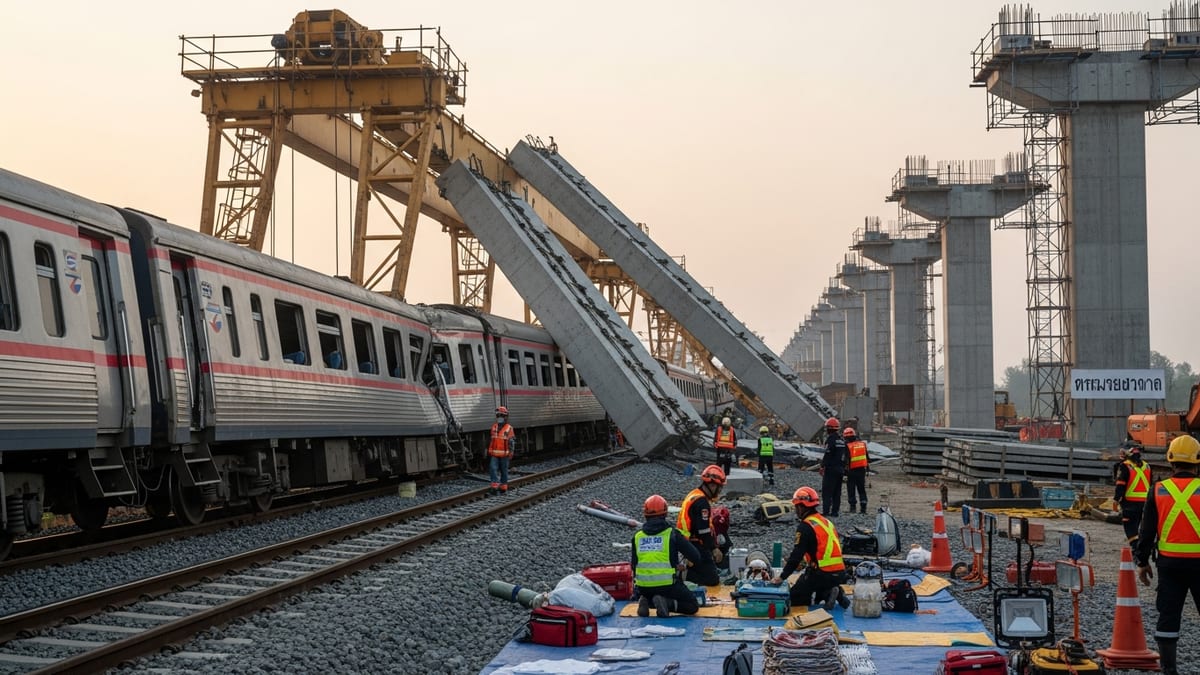
Derailment Near Mesa Disrupts a Critical East Valley Corridor
Regional transportation reports and local coverage describe a freight train leaving the tracks on a corridor that runs through the greater Mesa area, forcing rail and road operators to impose immediate traffic restrictions. The incident occurred on a route that carries both heavy freight and serves as a parallel path to some of the busiest highways in the region, amplifying its impact on mobility across the East Valley.
Initial accounts indicate that several rail cars derailed, blocking adjacent rights-of-way and prompting a shutdown of nearby road approaches while crews assessed damage to track, signaling equipment, and surrounding infrastructure. Publicly available information shows that no major structural damage to bridges or overpasses has been reported so far, but the clean-up operation and technical inspections are expected to take several days.
Because parts of the freight alignment intersect or run close to key arterials that feed into Mesa and neighboring cities, even a partial closure is enough to ripple through the network. Drivers who typically rely on direct cross-town connections are being routed onto longer detours, adding travel time and concentrating congestion at already busy junctions.
For visitors headed to Mesa’s hotels, sports complexes, and retail districts, the derailment has turned what is usually a straightforward freeway-to-arterial hop into a more complicated, stop-and-go journey, particularly during the morning and late-afternoon peaks.
Lane Closures, Detours and What Drivers Are Seeing on the Ground
Transportation advisories for the Phoenix metro region highlight intermittent lane closures, temporary turn restrictions, and reduced speed limits around the affected rail corridor near Mesa as rail crews and road agencies share space in the right-of-way. Electronic message boards and navigation apps are directing motorists onto alternate routes, which may include parallel arterials and segments of the Loop 202 and other freeways, depending on movement and time of day.
On local streets closest to the derailment site, reports indicate that through-traffic has been curtailed to maintain a safe working envelope for heavy equipment removing damaged cars and repairing track. Some intersections are operating with modified signal timing to help flush traffic away from pinch points, while certain side-street connections have been temporarily blocked to discourage cut-through movements in residential areas.
The restrictions are particularly noticeable for drivers accustomed to seamless access between Mesa, Tempe, and the southeast Valley. Commuters describe needing to leave earlier than usual to account for uncertainty in travel times, as a minor incident or stalled vehicle on a detour route can quickly cause backups when normal redundancy is constrained.
For out-of-town travelers arriving via Phoenix Sky Harbor International Airport and heading for Mesa’s resort corridors or spring-training facilities, the best strategy at present is to check real-time traffic tools, follow posted detour signs, and build in extra time between connections, especially if returning to the airport during the afternoon rush.
Impacts on Rail Travel, Tourism and Local Businesses
The derailment has had a dual effect on mobility by affecting both rail freight and nearby roads. While the impacted line is primarily used by freight, its disruption can indirectly influence schedules and routing for other trains across the state, as dispatchers juggle available track capacity. For the traveling public, the more immediate effect is on the roads that share space with or cross the railway.
Local tourism operators and hospitality businesses in and around Mesa rely on predictable drive times from Phoenix and neighboring cities. The added uncertainty created by the derailment-related restrictions may discourage some discretionary trips in the short term, particularly evening outings that require crossing the affected corridor at peak congestion periods.
Businesses that depend on just-in-time deliveries or that ship goods by truck are also feeling the strain. Detours lengthen last-mile routes for freight carriers, adding both time and operating costs. Some carriers are reportedly shifting to earlier or later delivery windows to avoid the most intense congestion near temporary closures.
For leisure visitors, the disruption is more of a nuisance than a trip-ending problem, but it does change how people move between popular attractions. Travelers who might otherwise combine a day in central Phoenix with dinner in downtown Mesa or a game at a nearby stadium may now choose to cluster activities on one side of the affected corridor to minimize time in traffic.
Safety Reviews and Calls for Infrastructure Resilience
In the wake of the derailment near Mesa, transportation planners and rail operators are facing renewed scrutiny over how rail corridors interact with rapidly urbanizing areas. National research into derailment risks has long noted that while rail is comparatively efficient, incidents can have outsized consequences when they occur near densely populated zones or key road junctions.
Publicly available technical discussions suggest that investigators will look at a wide range of potential contributing factors, including track condition, train length and loading, signaling performance, and recent weather patterns. While formal findings typically take months, regional agencies often move more quickly to implement near-term safeguards, such as enhanced inspections, closer coordination with city traffic management centers, and temporary restrictions on train speeds in sensitive segments.
For Mesa and the greater Phoenix area, the incident adds to a growing conversation about how to future-proof infrastructure as population and freight volumes rise. Proposals that have circulated in planning documents, such as grade separations at busy crossings or additional redundancy in east–west road connections, are likely to gain fresh attention as travelers confront the real-world costs of a single corridor disruption.
Community advocates are also using the moment to push for more robust multimodal networks. By improving light rail capacity, bus frequency, and safe cycling corridors, they argue, the region can give residents and visitors more options when a highway or rail link is unexpectedly constrained.
What Travelers to Mesa Should Do in the Coming Days
For travelers with plans to visit Mesa in the next several days, the derailment should be viewed as a manageable complication rather than a reason to cancel. The main advice from transportation updates is to allow more time for surface travel, stay flexible about routing, and pay close attention to current advisories before setting out.
Drivers approaching from Phoenix or other parts of the Valley should check conditions on their preferred route and consider alternate entry points into Mesa if delays appear significant. Choosing travel windows outside of the peak periods can also make a noticeable difference, particularly for trips that cross the impacted rail corridor or rely on nearby interchanges.
Visitors who can make use of the region’s light rail and bus network may find that transit offers a useful hedge against road congestion, especially for trips into central Mesa or adjacent districts where parking is already tight. While the derailment has not directly affected Valley Metro’s main rail spine, connecting bus routes may experience localized delays linked to detours.
With repair crews working to restore full rail service and local agencies continuously adjusting traffic controls, conditions around the derailment zone are likely to evolve quickly. Travelers who stay informed and build flexibility into their itineraries should still be able to enjoy Mesa’s cultural attractions, sporting events, and desert landscapes, even as the city’s transport network absorbs the shock of an unexpected rail incident.