


More news on this day
Several leading Gulf carriers, including Etihad Airways, Air Arabia, flydubai and Qatar Airways, are cancelling or reshaping selected services across the Gulf region as geopolitical tensions and changing security assessments continue to affect airspace and airport operations.
Get the latest news straight to your inbox!
Targeted cancellations hit short Gulf sectors first
Recent schedule changes show that the most immediate impact has been on short regional sectors linking hubs in the United Arab Emirates with nearby Gulf destinations such as Doha, Bahrain and Kuwait. Publicly available timetable data and booking engines indicate that a number of frequencies have been withdrawn or zeroed out on specific days, while other flights continue to operate on modified timings or routings.
Rather than a blanket shutdown, the pattern emerging across Etihad, Air Arabia, flydubai and Qatar Airways is one of selective cancellations. Airlines appear to be pruning departures that operate at off-peak times, overnight or on routes where alternative frequencies are available the same day. This approach allows the carriers to conserve capacity, comply with evolving safety guidance and reassign aircraft to stronger demand markets, while still maintaining a skeleton network for essential travel and connections.
Passenger reports and online tracking platforms suggest that some cancelled services are being notified at relatively short notice, especially where airspace restrictions or airport congestion change within hours. Travellers have described receiving rebooking offers on nearby departures or rerouted itineraries via alternative hubs, underscoring how tightly airlines are managing aircraft and crew resources in the current environment.
These tactical cancellations are also being used to accommodate longer routings around sensitive airspace. Flights that once crossed the Gulf on a direct track are in some instances taking more southerly or westerly paths, adding to block times and increasing the number of aircraft required to preserve full schedules.
Etihad and Air Arabia adjust UAE centric networks
Abu Dhabi based Etihad Airways has focused its changes on services to neighbouring Gulf states and a handful of onward connections that rely on those feeder flights. According to published schedules, selected rotations between Abu Dhabi and cities such as Doha and Bahrain have been pulled from sale on specific days, while core trunk routes are still being maintained with reduced frequency.
Etihad’s strategy appears to prioritise long haul connectivity where possible, with some passengers being reprotected on later departures from Abu Dhabi if their original regional feeder flight is removed. In practice, that can mean longer layovers or a forced overnight in the UAE for affected travellers, particularly those connecting from Europe or North America onto South Asian and Southeast Asian destinations.
Sharjah based Air Arabia, which relies heavily on high density narrowbody services to Gulf and South Asian markets, is also trimming select flights across the region. Observers of the carrier’s booking pattern note that certain late night and early morning Gulf departures are periodically unavailable or flagged as cancelled, even as daytime services continue to run. This selective thinning reflects both operational constraints and the airline’s ability to consolidate demand onto fewer flights during off peak periods.
For price sensitive travellers who depend on Air Arabia’s point to point model, these cuts may limit flexibility and push more passengers onto remaining departures. However, the carrier is still broadly maintaining links between the UAE and major Gulf and subcontinental destinations, signalling an emphasis on continuity of service rather than extensive shutdowns.
flydubai and Qatar Airways balance capacity and safety
Dubai based flydubai, which serves a wide network of short haul routes around the Gulf and wider Middle East, has likewise implemented targeted cancellations. Flight search tools show that some Dubai services to nearby Gulf capitals are temporarily removed from daily schedules, particularly where overlapping frequencies exist or where demand has softened amid ongoing uncertainty.
Because flydubai operates closely alongside its larger partner Emirates at Dubai International and Dubai World Central, its decisions on which routes to adjust are intertwined with overall capacity planning at the emirate’s airports. By cancelling certain short sectors while retaining others, the low cost carrier can free slots and resources to support stronger leisure and VFR (visiting friends and relatives) flows that remain resilient despite regional tensions.
Qatar Airways, based in Doha, is simultaneously dealing with the impact of shifting airspace assessments and the need to preserve its global connecting network. Publicly available booking data indicates that the airline has cancelled a series of near term flights on select Gulf routes while maintaining at least some daily connectivity to key UAE and regional destinations. Travellers on cancelled services are typically being moved to alternative departures or rebooked via different gateways where capacity allows.
Industry watchers note that Qatar Airways, like its UAE peers, is also adjusting routings on certain long haul flights to avoid sensitive areas, which can ripple through the carrier’s tightly banked hub structure. In some cases that prompts further tactical cancellations on shorter Gulf sectors to create slack in the system and keep long range operations running as smoothly as possible.
What travelers are experiencing at Gulf hubs
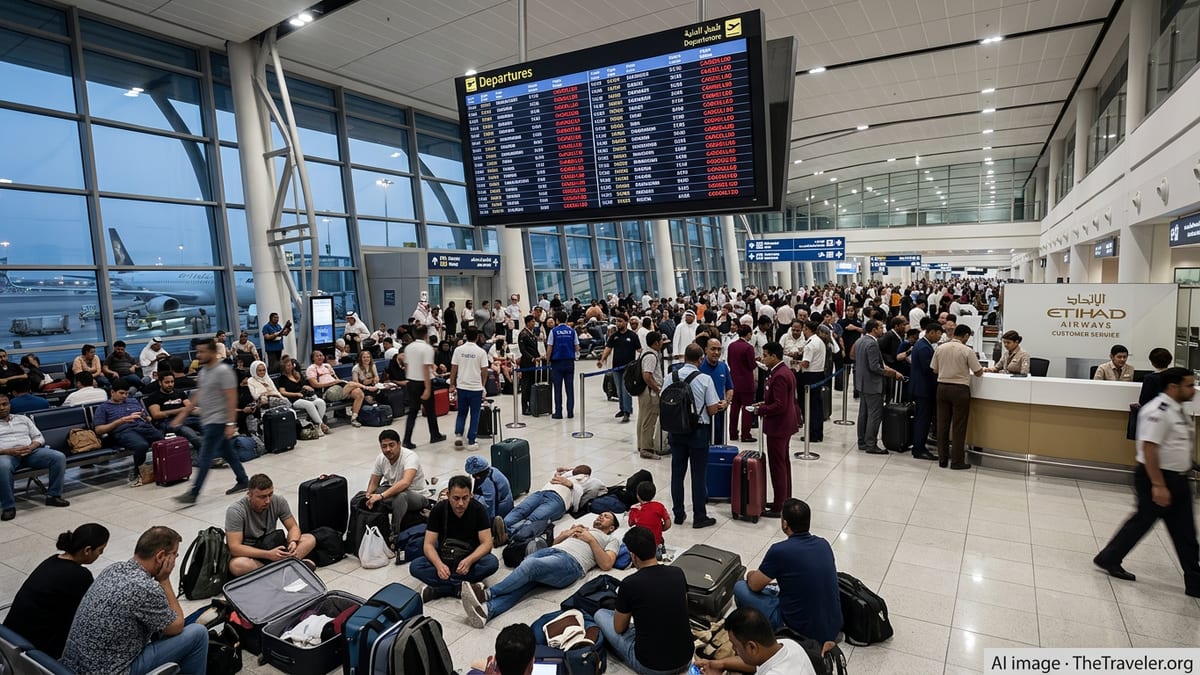
For passengers passing through Abu Dhabi, Dubai, Sharjah and Doha, the most visible impact of the latest wave of cancellations is irregularity rather than complete disruption. Airport departure boards still show a steady stream of Gulf departures, but with more instances of delayed, retimed or cancelled flights than usual on shorter sectors.
Travellers report that ground staff are generally able to offer same day alternatives on the same airline or alliance partners when cancellations occur early, particularly on busy routes with multiple frequencies. However, those with tightly timed connections or travel to secondary destinations sometimes face extended waits, overnight stays or routings via more distant hubs in Europe or Asia.
Experts following the situation advise that passengers build additional flexibility into their travel plans, including longer connection windows and a readiness to accept alternative routings. Keeping contact details updated with airlines and regularly checking booking status in the 24 hours before departure can help reduce the risk of surprises at check in, especially for journeys that rely on short Gulf sectors as feeders.
Behaviour at booking stage is also shifting. Some travellers are choosing itineraries that avoid multiple Gulf connections, while others are maintaining planned travel but purchasing tickets with more flexible change and refund conditions. This is particularly evident among corporate and high yield leisure customers, who are weighing schedule certainty alongside price.
Outlook for Gulf air travel in the coming weeks
Looking ahead, Etihad, Air Arabia, flydubai and Qatar Airways are expected to continue fine tuning their Gulf operations in response to any further changes in airspace access, security guidance and demand. Airlines are updating schedules progressively rather than months in advance, which means that short notice adjustments are likely to remain a feature of regional travel in the near term.
Capacity levels on many core routes remain significantly below the peaks reached before the latest bout of instability, leaving airlines some headroom to consolidate flights or redeploy aircraft as conditions evolve. At the same time, strong underlying demand for travel between the Gulf, South Asia and Europe is encouraging carriers to preserve as much connectivity as practical within the constraints they face.
For travellers, the situation translates into a patchwork of options that can change quickly. Those planning trips that rely on Gulf hubs are being encouraged by industry commentators to monitor their itineraries closely, remain open to rebooking options and consider travel insurance products that specifically address schedule disruption.
While no carrier has signalled a full suspension of operations within the region, the pattern of selective cancellations by Etihad, Air Arabia, flydubai and Qatar Airways underscores how sensitive Gulf aviation remains to geopolitical shifts. The coming weeks will likely test the resilience of airline schedules and the patience of travellers as the industry navigates a challenging operating landscape.