


More news on this day
Passengers departing the United Arab Emirates today are being urged to monitor flight status closely, as Etihad Airways, flydubai and Air Arabia adjust selected services in response to ongoing regional tensions and operational constraints.
Get the latest news straight to your inbox!
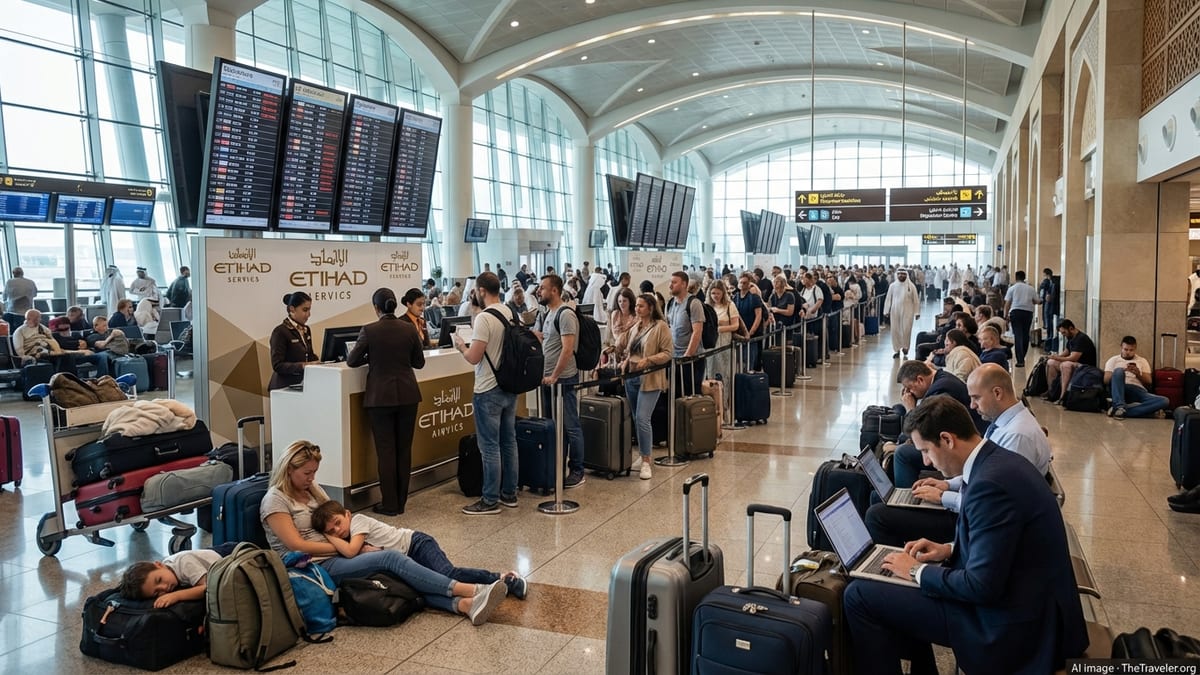
Regional backdrop keeps disruption risks elevated
Travel across the Gulf continues to operate against a volatile security backdrop, with recent reports highlighting fresh missile activity and heightened military alert levels in parts of the region. While the UAE’s main airports remain open and functioning, airlines are keeping schedules under review, particularly on certain regional routes regarded as more sensitive.
Publicly available information indicates that Zayed International Airport in Abu Dhabi, Dubai International and Sharjah International are all maintaining near-normal operations. However, airlines have retained a cautious stance on capacity increases, leaving little slack in the system when weather, airspace congestion or technical issues arise. This means that even isolated disruptions can translate into short-notice delays or cancellations on specific flights.
For travellers departing today, the practical impact is a patchwork picture rather than a blanket shutdown. Many long haul and high demand regional flights are operating as scheduled, while a minority of services, especially on multi segment itineraries, are being retimed, consolidated or, in some cases, withdrawn from sale at short notice.
Passengers are therefore advised to treat their booking as confirmed only once they have checked the live status with the airline on the day of travel, and to allow extra time at the airport in case of secondary screening or check in queues on busier departures.
Etihad: targeted cancellations and rolling schedule checks
Etihad Airways is continuing to run the bulk of its network from Abu Dhabi, with current reporting showing the carrier operating a full long haul schedule and a broad set of regional routes. At the same time, scattered passengers have reported last minute cancellations and extended delays on selected services, particularly where loadings allow two flights to be merged or where rotations are being adjusted for operational reasons.
Public information shared across traveller forums over recent weeks points to a pattern of one off cancellations on some Asia and Europe links, rather than systematic removal of entire city pairs. In several cases, affected customers have reported receiving email notifications within hours of schedule changes, underscoring the importance of monitoring contact details in airline bookings and keeping an eye on spam folders on the day of departure.
Etihad’s guidance to passengers continues to focus on the use of its online flight status tools before leaving for the airport. For those travelling from the UAE today, this means checking both the Abu Dhabi departure board and the specific flight number, as some rotations are operating with revised departure times, aircraft changes or adjusted connection windows.
Travellers with tight onward connections at Abu Dhabi are particularly exposed to short delays, as even modest schedule slippage on inbound sectors can compress transfer times. Where possible, passengers are being encouraged by publicly available advisories to build in a more generous connection buffer or to be prepared for rerouting options if a short connection becomes unviable.
flydubai: largely stable operations with route sensitive tweaks
At Dubai International, flydubai is operating the majority of its short and medium haul network, including key links across the Middle East, South Asia, East Africa and parts of Europe. Travel data and schedule trackers indicate that the airline has broadly stabilised operations after the most acute stages of early year disruption, with most departures running close to their planned times on core routes.
Nonetheless, there have been continuing adjustments on specific sectors where demand has softened or airspace routings have become less predictable. On some days this has taken the form of consolidating services, such as reducing multiple daily frequencies to a smaller number of higher capacity flights, which can leave individual flight numbers cancelled even though the overall city pair remains served.
For travellers flying on flydubai from Dubai today, this environment translates into a need for close attention to itinerary details. A flight that appeared in search results or on an initial booking may have been renumbered or retimed, particularly on routes with several daily departures. Passengers are advised to recheck their booking reference in the airline’s manage booking portal and to confirm check in opening times before they head to the airport.
Given the leaner schedules on some secondary routes, seats on remaining departures can be tight on days when one rotation falls away. Passengers whose flights are cancelled may find that same day rebooking options are limited, particularly at peak travel times, making early contact with the airline or travel agent important as soon as a disruption notification appears.
Air Arabia: selective cancellations from Sharjah and beyond
From its base at Sharjah International Airport, Air Arabia continues to serve an extensive network across the Middle East, North Africa, the Indian subcontinent and Europe. Recent customer accounts, however, show that the airline has not been immune to the broader pattern of isolated cancellations and policy adjustments, particularly on some leisure oriented and connecting itineraries.
Forum posts over recent months have highlighted instances where Air Arabia flights were withdrawn with limited notice, including on routes linking Sharjah with European and South Asian destinations. In some reported cases, passengers have encountered confusion over refund levels, credit notes and rebooking rules, underlining the value of reading current conditions of carriage and any updated cancellation policies before travelling.
Today, most Air Arabia departures from Sharjah are still expected to operate, but travellers should assume there is a non negligible risk of last minute change on selected sectors, especially where there are multiple daily services or where demand has been inconsistent. Passengers are encouraged by publicly available travel guidance to verify not only the flight status but also the operating airport and terminal, as the airline also works with partner carriers and multiple hubs in the wider region.
Those connecting through Sharjah on tight layovers are advised to pay particular attention to minimum connection times, as a short delay on an inbound segment can quickly lead to misconnections on point to point low cost itineraries that are not protected in the same way as traditional through tickets.
Practical steps for UAE travellers flying today
Against this backdrop of generally functioning but occasionally fragile schedules, passengers departing the UAE today can take several practical steps to reduce the risk of serious disruption to their plans. The first is to confirm all flight details on the morning of travel using each airline’s own status tools rather than relying solely on third party booking platforms, which may lag behind real time operational decisions.
Travellers are also advised to arrive at the airport earlier than they might during more stable periods, building in extra time for security checks, potential queues at check in, and possible gate changes. This is particularly important at peak times in Abu Dhabi, Dubai and Sharjah, where high passenger volumes can quickly lead to congestion, especially if a delayed inbound aircraft forces a rapid reshuffle of gate assignments.
For itineraries involving connections, either within the Gulf or beyond, passengers may wish to consider longer layovers where options exist, accepting a slightly longer journey in exchange for greater resilience against knock on delays. Keeping essential items such as medications, chargers and a change of clothes in hand luggage can also provide a measure of comfort if an unexpected overnight stay becomes necessary.
Finally, travellers should keep contact details up to date in their airline profiles and booking records, enabling carriers to push notifications promptly in the event of cancellations or rebooking offers. In a period where Etihad, flydubai and Air Arabia are all running substantial but carefully managed schedules from the UAE, timely information can make the difference between a manageable delay and a significantly disrupted journey.