


Few places in Europe feel as truly wild as the fells of Finnish Lapland. Two national parks stand out for travelers chasing northern lights, silence and long days on the trail: Urho Kekkonen National Park in the east and Pallas–Yllästunturi National Park in the west. Both offer big skies, reindeer tracks and wooden huts glowing in the polar night. Yet the experience on the ground can feel very different. This guide breaks down how the two parks compare so you can decide which wilderness fits you better.
Get the latest updates straight to your inbox!
Getting There: How Remote Do You Want To Be?
Where and how you arrive often sets the tone for the whole trip. Pallas–Yllästunturi is the more accessible of the two, especially for first-time Lapland visitors. The park lies between the municipalities of Kolari, Kittilä, Muonio and Enontekiö in northwestern Lapland. The nearest airport is Kittilä and the nearest railway station is Kolari, with bus connections running from both hubs to trailheads like Ylläs, Pallas and Hetta. For a typical winter trip, many visitors fly into Helsinki, connect to Kittilä, then take a 45 to 60 minute bus or shuttle to resort villages such as Äkäslompolo or Ylläsjärvi right on the park boundary.
Urho Kekkonen National Park, by contrast, is further northeast and feels it. Most hikers base themselves in the Saariselkä or Kiilopää area, reached via Ivalo Airport or a long overnight train to Rovaniemi followed by a several-hour bus ride north. Once in Saariselkä, you can literally walk from the edge of the resort into the park, but continuing deeper toward places like Luirojärvi or the Sokosti fell quickly leaves infrastructure behind. The journey is not difficult to arrange, yet everything takes a little longer and feels more frontier-like.
If you are tacking a short wilderness escape onto a Lapland ski holiday or family trip, the relative ease of Pallas–Yllästunturi may be more appealing. If your goal is to feel far from roads, resorts and everyday life, the extra distance to Urho Kekkonen can be part of the charm.
Landscape & Atmosphere: Soft Fells or Vast Empty Spaces?
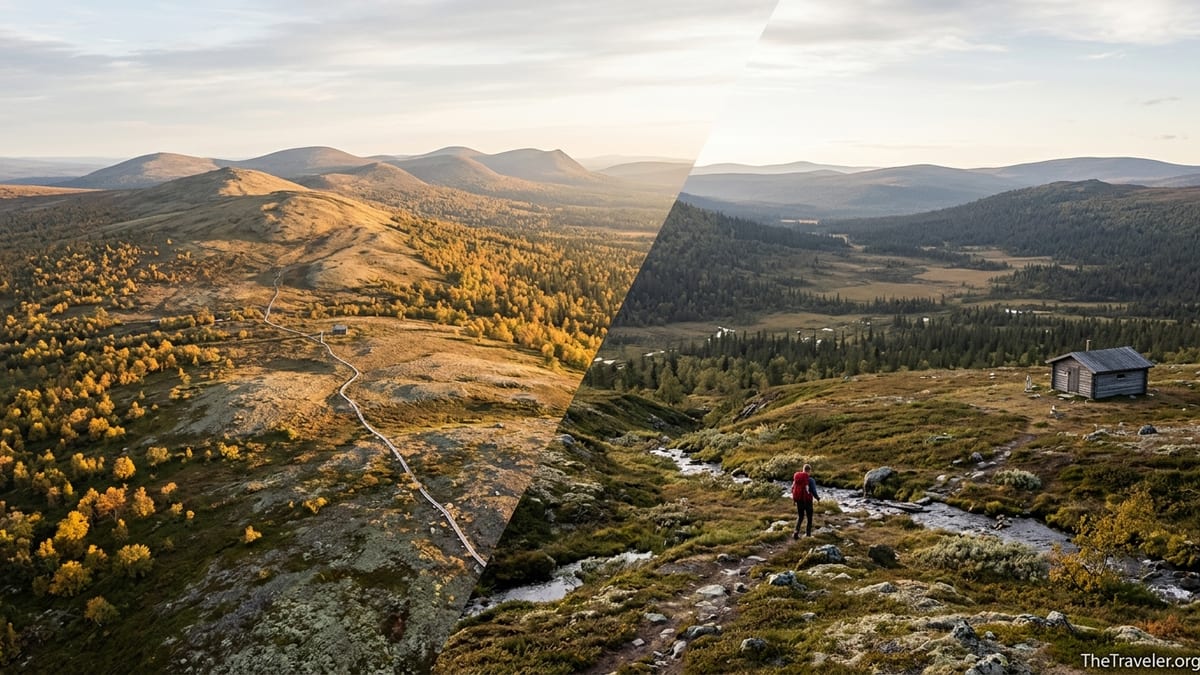
Pallas–Yllästunturi is Lapland at its most classic and gentle. Long, rounded fells roll in a chain, with open summits rising above spruce and pine forest. The famous Hetta–Pallas route spends much of its 50 or so kilometers on these treeless ridges, where on a clear day you can see wave after wave of fells fading into Sweden and Norway. In summer, the hills are covered in dwarf birch and blueberry shrubs; in winter, they become soft white domes that catch the last light of the short arctic day.
Urho Kekkonen, one of Finland’s largest protected areas, feels wilder and more varied. To the west, near Kiilopää and Saariselkä, you find accessible day-hiking terrain: open fells, birch forests and clear streams. Traveling east and south into the interior, the landscape becomes increasingly remote. Valleys like Paratiisikuru, hillsides around Sokosti and the long river systems near Muorravaarakanruoktu or Kemihaara give a strong sense of space and isolation. On multi-day trips you can walk all day and see only a handful of people, especially outside peak holiday weeks.
In practice, Pallas–Yllästunturi often feels like a national park that sits beside established resort villages, while Urho Kekkonen feels like wilderness that happens to have a ski village next to one corner of it. If you like the idea of returning from an airy ridge walk to a village where you can choose between a supermarket picnic or a three-course dinner, Pallas–Yllästunturi fits well. If you want to cross frozen rivers and reach a hut by headlamp with nothing but reindeer and ptarmigan for company, Urho Kekkonen may be closer to your dreams.
Trails, Difficulty & Navigation
Both parks have excellent, clearly signposted trail networks near their main access points, but they cater to different comfort levels once you get beyond the day-hike radius. In Pallas–Yllästunturi, signature routes like Hetta–Pallas or the trails around Ylläs and Äkäslompolo are well marked, with maintained winter tracks for skiing and snowshoeing and waymarked summer paths. Many visitors walk a multi-day itinerary such as Hetta–Pallas with only basic map skills, staying on obvious, popular routes and ending each day at a hut or designated campsite.
Urho Kekkonen has some easy marked trails near Saariselkä and Kiilopää, but a large part of the park is true wilderness without continuous waymarking. Long traverses between huts like Lankojärvi, Tuiskukuru, Muorravaarakanruoktu and Luirojärvi often require solid map and compass skills, especially in bad weather or in winter whiteouts. While GPS devices and phone apps have made navigation easier, you should not rely on a single device in temperatures that routinely drop well below freezing.
For a concrete example, consider a four-day trip in each park. In Pallas–Yllästunturi, a typical summer option might be Hetta to Pallas: day one boat shuttle across Ounasjärvi and a climb to the open fell, days two and three continuing along the ridge with clear markers, and day four descending to the Pallas trailhead where a bus or pre-booked transfer takes you back. In Urho Kekkonen, a four-day loop from Kiilopää to Luirojärvi and back typically requires fording rivers or planning for winter ice, following less obvious routes and carrying more food and safety equipment. Both are rewarding, but the second demands more experience and self-reliance.
Huts, Lodging & Comfort Level
Finland’s hut system is a major part of the appeal in both parks, and it is worth understanding how it works. Metsähallitus, which manages Finnish national parks, maintains several types of huts: open wilderness huts that are free and cannot be reserved, reservable huts with bunks you book in advance, and full rental huts that you rent privately for your group. In both Pallas–Yllästunturi and Urho Kekkonen, you will find a mix of these options, plus lean-to shelters and designated tent sites.
In practice, Pallas–Yllästunturi tends to offer a denser network of huts and services on its popular routes, particularly around Pallas, Hannukuru, Nammalakuru and the Ylläs area. A typical arrangement might be an open wilderness hut next to a reservable one: spontaneous hikers can roll out a sleeping mat in the open side, while those who booked ahead sleep in the reserved bunks. Prices for reservable huts are generally modest by international standards, often roughly in the range of a basic hostel bed per night, though you should always check the latest rates and booking rules when planning.
Urho Kekkonen’s huts are more scattered and many involve longer days between them. Classic destinations like Luirojärvi or Tuiskukuru can be a full day’s ski or hike from the nearest trailhead. Wilderness huts here often fill with long-distance trekkers in peak times, who know the etiquette of sharing space, splitting firewood and fetching water. While you still find some reservable and rental huts, you are more likely to rely on open huts and tent camping, especially if you want to explore beyond the main corridors. For some travelers, this slightly rougher, more communal hut culture is exactly what makes the park special.
If you prefer to sleep in a regular bed every night and mix wilderness days with saunas, hotel breakfasts and perhaps a spa visit, Pallas–Yllästunturi is easier. Villages like Ylläsjärvi, Äkäslompolo and Levi just outside the park offer everything from budget apartments to full-service hotels. Saariselkä near Urho Kekkonen offers similar comforts, but once you go deeper into that park you are committing more fully to hut or tent life between the first and last night.
Seasons, Weather & When To Go
The two parks share broadly similar subarctic conditions, but their character changes sharply with the seasons. From late June to August, both are in their prime summer hiking season. Trails are mostly snow-free, services are open, and mosquitoes can be intense in July especially in low, boggy areas. In Pallas–Yllästunturi, summer is popular with Finnish families and European hikers walking parts of the Hetta–Pallas route or doing day hikes from Ylläs. In Urho Kekkonen, summer visitors include long-distance backpackers who might spend a week or more traversing the park hut to hut.
September brings ruska, the Lapland autumn color season, when birch forests flame yellow and orange under crisp blue skies. Both parks are spectacular at this time, with cooler temperatures and far fewer insects. Practical examples: a weekend visitor to Pallas–Yllästunturi might hike from Pallastunturi Visitor Centre up to Taivaskero and back in a day, then stay in a cabin with a fireplace; in Urho Kekkonen, a popular ruska plan is a three or four-day loop from Kiilopää, staying at huts like Luirojärvi while the northern lights begin to appear over the fells.
Winter is where the parks diverge more noticeably. Pallas–Yllästunturi is interwoven with established cross-country ski tracks, snowshoe routes and nearby ski resorts with lifts and groomed slopes. A family might spend the morning on ski tracks through the national park, then take lifts in Levi or Ylläs in the afternoon and finish with a restaurant dinner. Urho Kekkonen is better suited to backcountry skiing, longer hut-to-hut tours and snowshoeing in quieter settings. Guided multi-day ski tours are popular here, but they require more fitness and cold-weather experience. In March and early April, when days are longer and temperatures a bit milder, both parks offer excellent snow conditions.
Spring and late autumn are shoulder seasons that require care. Rivers may be high during snowmelt and ice unreliable in early spring, making river crossings tricky in Urho Kekkonen in particular. Early winter can bring darkness without stable snow cover, limiting activities. If your time is flexible and you want the widest range of options, aim for mid-July to late August for summer hiking or March to early April for snow trips.
Wildlife, Culture & Local Experiences
Pallas–Yllästunturi and Urho Kekkonen both lie in traditional Sámi regions, and subtle cultural differences can enrich your trip if you pay attention. In the west, reindeer herding cooperatives still use the fells around Pallas and Ylläs, and you may see reindeer grazing near ski tracks or along roads. Visitor centres often include exhibitions explaining herding culture, seasonal migrations and the history of the old Pallas-Ounastunturi National Park that later became part of today’s Pallas–Yllästunturi.
In Urho Kekkonen, Sámi and settler history is interwoven with long-distance routes and old grazing grounds. Place names preserve stories in Sámi languages, and some valleys and lakes are linked to legends and older uses like fishing and hunting. In the more remote reaches, old turf huts and reindeer fences reflect past livelihoods. While modern park regulations protect wildlife, you can still fish in certain rivers and lakes with the correct permits, which many hikers combine with evenings in wilderness huts.
In terms of wildlife watching, both parks are home to similar species: reindeer, willow grouse, golden plover, Siberian jay, wolverine and occasionally brown bear, although large predators prefer to avoid people and are rarely seen. Birdwatchers often choose Urho Kekkonen for more remote routes where human disturbance is minimal, while casual nature lovers might be just as delighted by the tame Siberian jays that visit campfire sites in Pallas–Yllästunturi hoping for crumbs of sausage.
If human culture is important to your trip, Pallas–Yllästunturi’s proximity to resort villages gives access to guided reindeer farm visits, husky safaris and Sámi cultural programs marketed through local tourism companies. Saariselkä near Urho Kekkonen offers similar experiences, but once you step into the park itself the focus shifts quickly from culture to pure wilderness.
Costs, Services & Trip Examples
Overall, the cost of visiting either park depends more on your travel style than which park you choose. Flights or long-distance trains within Finland, plus a bus connection north, will be your major upfront expenses. On the ground, you can keep daily costs relatively low by self-catering, using huts and camping, or spend more for hotel comforts and guided activities. In both parks, a realistic mid-range daily budget for a self-guided hiker staying in a mix of huts and village accommodation might fall somewhere in the range that many travelers would associate with a modest European city break, though prices fluctuate with season and booking choices.
Pallas–Yllästunturi offers more package-style convenience. For example, a long weekend in winter might look like this: fly to Kittilä, take a shuttle to Äkäslompolo, check into a mid-range cabin with its own sauna, and spend three days alternating between cross-country skiing in the park, downhill skiing at Ylläs, and a guided aurora snowshoe tour sold through the village tourist office. Food would come from local supermarkets and one or two restaurant dinners, and you might never need to worry about logistics inside the park beyond reading ski-track maps.
Urho Kekkonen is ideal if you want your money to go primarily into gear and provisions rather than commercial activities. A typical example is a week-long summer trek: train to Rovaniemi, bus to Saariselkä, a night in a simple guesthouse, then five or six days of hut-to-hut or tent-based hiking carrying your own food. Your daily expenses on the trail might be little more than hut fees, gas for your stove and an occasional sauna at a larger hut or back in the village. Many experienced hikers report that once they reach the park, their spending drops dramatically because there are simply fewer opportunities to buy anything.
If you prefer to pay for structure and safety, both parks have guiding companies offering day trips and multi-day tours. Pallas–Yllästunturi’s tours often focus on skiing, snowshoeing and aurora hunting close to the villages, while Urho Kekkonen’s guided offerings lean toward longer expeditions and ski traverses aimed at people who want to experience deep wilderness without handling all the navigation and safety planning themselves.
Which Park Fits Which Traveler?
The choice between Urho Kekkonen and Pallas–Yllästunturi is less about which is “better” and more about what kind of wilderness experience you are ready for. If it is your first time above the Arctic Circle, you are traveling with children, or you simply prefer to know there is a bakery and a bus stop within reach at the end of the day, Pallas–Yllästunturi is usually the safer bet. Its blend of well-marked trails, dense hut network and nearby resorts makes it ideal for people who want big landscapes with relatively small logistical risks.
Urho Kekkonen suits travelers who already feel comfortable backpacking or skiing in remote areas and who want to lean into that remoteness. You do not need to be an expedition expert, but you should be honest about your skills in navigation, winter safety and self-care in changing weather. For many, the reward is profound: multi-day silence, the glow of a hut’s window appearing over a frozen lake at dusk, and a sense that you are sharing the landscape more with reindeer than with other tourists.
One practical way to decide is to look at your backup plan. In Pallas–Yllästunturi, cutting a trip short due to weather or fatigue often means descending to a road and catching a bus back to your base village or arranging a local taxi. In Urho Kekkonen, you may need to retrace your steps to the nearest major trailhead or arrange a pickup with a local transport provider used to serving hikers and skiers. If a simple exit plan feels important, the western park will likely put you more at ease.
Of course, many visitors end up loving both. Some start in Pallas–Yllästunturi, gain confidence on its classic routes, and then plan a longer, wilder journey in Urho Kekkonen the following year. Others fall so hard for the solitude and huge skies of Urho Kekkonen that every future trip to Finland is organized around getting back there.
The Takeaway
If your ideal Lapland trip combines wild scenery with straightforward logistics, Pallas–Yllästunturi is the clear match. It offers high, rolling fells, a long-established hut network and easy access from Kittilä Airport or Kolari railway station. You can hike classic routes like Hetta–Pallas, spend winter days on ski tracks that start almost from your cabin door, and still be back at a restaurant or sauna each evening.
If, instead, you picture long days of silence, bigger distances between huts and the satisfaction of navigating a more demanding landscape, Urho Kekkonen is likely to be the park that stays with you. Reaching its interior huts, watching northern lights over remote lakes and feeling the sheer scale of the park are experiences that reward preparation and a taste for adventure.
The good news is that there is no wrong choice. Both national parks showcase the best of Finnish Lapland: clean air, dark skies, living Sámi cultures and an outdoor infrastructure that lets ordinary visitors experience serious wilderness with a reasonable margin of safety. Start with the park that fits your comfort level and travel style today, and leave room in your plans to come back for the other when you are ready.
FAQ
Q1. Which park is better for a first-time visitor to Lapland?
For most first-time visitors, Pallas–Yllästunturi is better because access is easier, trails are well marked and resort villages nearby offer plenty of services.
Q2. Is Urho Kekkonen National Park suitable for beginners?
The marked trails near Saariselkä and Kiilopää can suit beginners, but multi-day trips into the interior require solid navigation skills and experience in remote areas.
Q3. Can I visit either park without renting a car?
Yes. Pallas–Yllästunturi connects to buses from Kittilä Airport and Kolari station, while Urho Kekkonen can be reached by bus from Ivalo or Rovaniemi to Saariselkä or Kiilopää.
Q4. Which park is better for seeing the northern lights?
Both are excellent, as they lie under the auroral oval. Clear skies and staying several nights matter more than which park you choose.
Q5. Do I need to book huts in advance?
Open wilderness huts cannot be reserved and are first come, first served. Reservable and rental huts in both parks should be booked well in advance in busy seasons.
Q6. Which park has more family-friendly options?
Pallas–Yllästunturi generally has more family-friendly options thanks to shorter marked trails, nearby services and easy day trips from resort villages like Ylläs.
Q7. What time of year is best for hiking?
Late June to late August is best for snow-free hiking in both parks, while September offers beautiful autumn colors with cooler temperatures and fewer insects.
Q8. Are there guided tours available?
Yes. Local companies around both parks offer guided hikes, ski tours and aurora excursions, with more short, accessible tours clustered around Pallas–Yllästunturi’s resort villages.
Q9. How many days should I plan for each park?
A long weekend works for day hikes in either park, but many hikers prefer 4 to 7 days for a satisfying hut-to-hut or tent-based journey.
Q10. If I only have time for one park, which should I choose?
Choose Pallas–Yllästunturi if you value easier logistics and comfort, and Urho Kekkonen if you prioritize solitude, longer routes and a wilder feel.